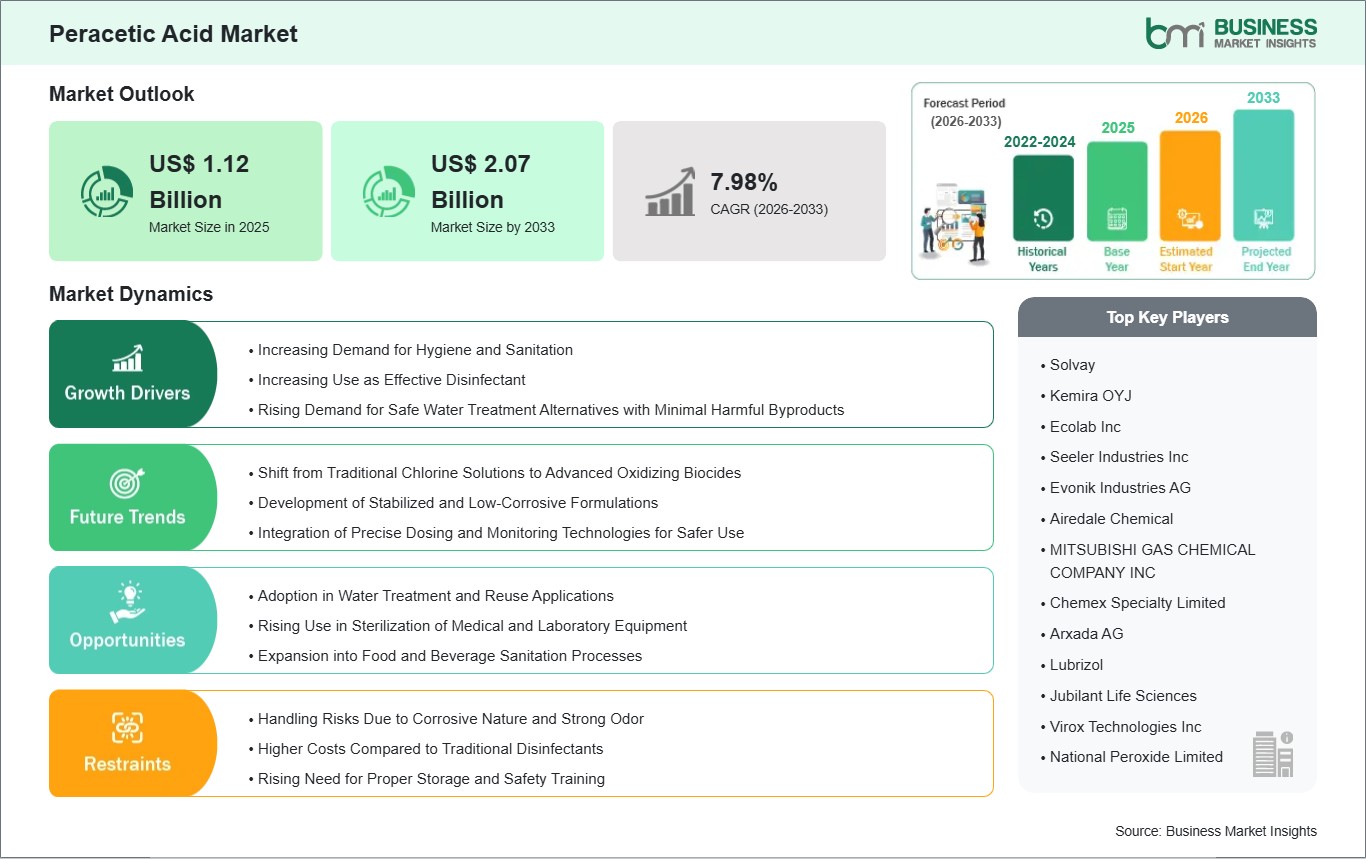
The Peracetic Acid Market size is expected to reach US$ 2.07 billion by 2033 from US$ 1.12 billion in 2025. The market is estimated to record a CAGR of 7.98% from 2026 to 2033.
The global market for peracetic acid (PAA) is influenced by the rising demand for efficient and eco-friendly disinfectants and sanitizers in numerous industries. Peracetic acid is an oxidizing agent that offers quick biocidal action and decomposes into harmless substances like acetic acid, oxygen, and water. It has been used in many industries, including food and beverage processing, pharmaceuticals, healthcare, water treatment, and industrial sanitation, because of its wide antimicrobial potency and low residue. The increasing global focus on food safety and hygiene, especially in processed food and beverage production, continues to support the market for peracetic acid.
In addition, the rising awareness of infection control in healthcare and waterborne pathogens in water treatment and distribution systems also supports the market for PAA. Peracetic acid has been used in many industries because of its antimicrobial potency and low residue. The increasing global focus on food safety and hygiene, especially in processed food and beverage production, continues to support the market for peracetic acid. In addition, the rising awareness of infection control in healthcare and waterborne pathogens in water treatment and distribution systems also supports the market for PAA.
The handling and storage aspect, depending on the inherent reactivity of the compound, also brings up a unique set of protocols that can add further complexity to the end user. Moreover, competition from other disinfecting compounds that have already established a supply chain and user base, particularly in some markets, also brings up a moderate limitation on the growth of PAA. However, the emphasis on green, non-toxic disinfecting compounds in the current regulatory guidelines and company protocols has ensured that PAA has become an essential part of the world's sanitation and water treatment infrastructure. Advances in delivery systems, stabilization technologies, and formulation-specific compounds will also continue to expand PAA's user base within various sectors that value efficacy and environmental responsibility.

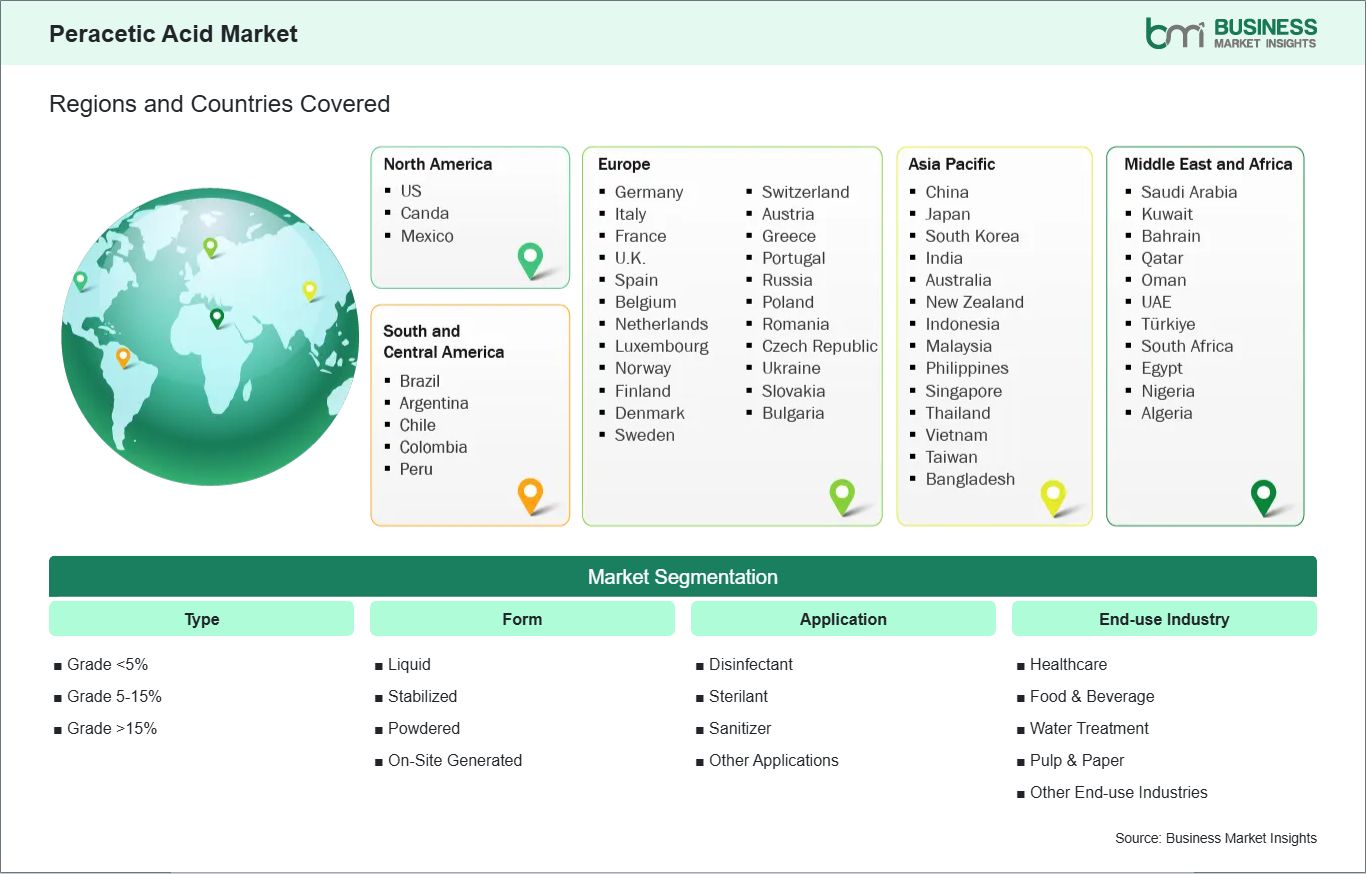
Key segments that contributed to the derivation of the peracetic acid market analysis are grade, form, application, and end‑use industry.
The global peracetic acid market is witnessing significant growth driven by the rising demand for hygiene and sanitation across healthcare, food processing, and public facilities. Peracetic acid is widely used for high‑level surface disinfection due to its broad-spectrum antimicrobial efficacy and rapid biodegradability. Its ability to effectively neutralize pathogens without leaving harmful residues has made it a preferred choice in environments that require stringent sanitation protocols. Increasing awareness about infection control and public health standards has reinforced the adoption of peracetic acid as an essential disinfectant across multiple sectors.
In the food and beverage sector, peracetic acid is heavily integrated into cleaning-in-place (CIP) systems for processing lines, packaging machinery, and storage facilities. The strong decomposition of peracetic acid into non-toxic by-products such as acetic acid, oxygen, and water helps prevent contamination while ensuring the effectiveness of the cleaning process. This helps the food and beverage industry achieve its food safety and green movement strategies by moving away from chlorine-based disinfectants and into peracetic acid-based solutions that have better antimicrobial activity without any harmful by-products.
The rising need for hygiene in public places has also contributed to the growth of peracetic acid use. From hospitals, clinics, mass places, to service areas, specific peracetic acid dosing systems are being used to ensure complete disinfection in accordance with hygiene standards. Its versatility can be utilized in different situations, ranging from surface cleaning to environmental sanitation, all while maintaining its efficacy. The need for effective, sustainable, and safe disinfectants in the world has contributed to the growth of the peracetic acid market.
The global usage of peracetic acid in water treatment and reuse processes is on the rise, as various industries and facilities seek to meet new water quality standards. Peracetic acid is a potent oxidizing agent and disinfectant, which helps in controlling microbial activity in wastewater, water loops, and water reuse systems. The disinfectant properties of peracetic acid are beneficial in water treatment processes, as they do not leave any harmful residues, which are a result of chlorinated compounds. This has led to its wide usage in water treatment processes, as it is a safe and reliable solution in water treatment processes worldwide.
Industrial sectors increasingly utilize peracetic acid in water management systems to prevent microbial growth in cooling towers, process water circuits, and wastewater streams. Its incorporation into water reuse systems ensures compliance with regulatory standards while supporting sustainable water management initiatives. Peracetic acid offers the advantage of reducing operational risks associated with microbial contamination, while its decomposition into environmentally benign substances ensures that treatment processes do not contribute to secondary pollution.
The role of peracetic acid in water treatment has developed over time due to the global focus on sustainable water reuse and resource efficiency. The chemical is being used for water polishing and control of microorganisms in different industrial and municipal water treatment systems. The chemical’s ability to treat both potable and non-potable water is a clear indicator of its significance in water treatment. The increasing use of peracetic acid in water treatment systems is a clear reflection of its strategic role in water hygiene and sustainable water reuse practices around the globe.

The peracetic acid market is experiencing steady growth, with market size and share analysis reflecting evolving treatment preferences and competitive dynamics among key players. The report evaluates important subsegments categorized within grade, form, application, and end‑use industry, highlighting their respective contributions to overall market performance.
By grade, the 5 - 15% Grade subsegment dominated the Peracetic Acid market in 2025. This concentration offers an optimal balance of efficacy and safety for industrial and commercial applications, driving its widespread adoption across multiple sectors.
Based on form, the Liquid subsegment dominated the Peracetic Acid market in 2025. Liquid formulations provide ease of handling, consistent performance, and broad compatibility with existing systems, making them the preferred commercial form.
In terms of application, the Disinfectant subsegment dominated the Peracetic Acid market in 2025. Peracetic acid disinfectants are highly effective against a wide range of microorganisms, supporting strong demand in sanitation and hygiene-critical environments.
On the basis of end-use industry, the Food & Beverage subsegment dominated the Peracetic Acid market in 2025. Food and beverage processing requires reliable microbial control without leaving harmful residues, reinforcing the widespread use of peracetic acid in this sector.
| Report Attribute | Details |
|---|---|
| Market size in 2025 | US$ 1.12 Billion |
| Market Size by 2033 | US$ 2.07 Billion |
| Global CAGR (2026 - 2033) | 7.98% |
| Historical Data | 2022-2024 |
| Forecast period | 2026-2033 |
| Segments Covered | By Type
|
|
Regions and Countries Covered
| |
| North America | US, Canada, Mexico |
| Europe | Belgium, Austria, Finland, Denmark, Greece, Poland, Romania, Russia, Ukraine, Czech Republic, Slovakia, Bulgaria, Italy, Luxembourg, Germany, Switzerland, France, Netherlands, Norway, Portugal, Spain, Sweden, United Kingdom |
| Asia-Pacific | Australia, China, India, Japan, South Korea, Indonesia, Malaysia, Philippines, Singapore, Thailand, Vietnam, Bangladesh, New Zealand, Taiwan |
| South and Central America | Brazil, Argentina, Peru, Chile, Colombia |
| Middle East and Africa | Bahrain, Kuwait, Oman, Qatar, Saudi Arabia, United Arab Emirates, Turkiye, South Africa, Egypt, Algeria, Nigeria |
| Market leaders and key company profiles |
|
The "Peracetic Acid Market Size and Forecast (2022 - 2033)" report provides a detailed analysis of the market covering below areas:
The geographical scope of the Peracetic Acid market report is divided into five regions: North America, Asia Pacific, Europe, Middle East & Africa, and South & Central America. The Peracetic Acid market in North America is expected to grow during the forecast period.
North America is a significant area in the peracetic acid industry due to a mix of high regulatory focus on hygiene, high industrial standards, and a strong focus on developing eco-friendly sanitation solutions. The industrial base in North America is broad and includes food and beverage processing, pharmaceuticals, healthcare, and municipal water treatment plants, which has led to a high adoption rate of peracetic acid due to its performance in critical sanitation and disinfection applications. Food and beverage processing in North America is witnessing a high adoption rate of peracetic acid due to high food safety standards and to support high standards of cleaning-in-place operations.
Similarly, in pharmaceutical and biotechnology production facilities, as contamination control is a major factor in these facilities, PAA has started to make inroads due to its suitability in these environments and low residue levels. The public health agenda in healthcare facilities has led to peracetic acid-based disinfectants being used in various areas, including surgical instruments and facility sanitation, as infection control is a non-negotiable aspect in these environments. Water treatment facilities in various regions are another area that supports regional leadership in peracetic acid usage, as facilities seek a suitable oxidizing and disinfecting agent to combat new contaminants while limiting byproduct formation.
The regulatory framework in North America is conducive to this trend, which is favoring disinfectants that have a balance of efficacy and environmental responsibility. At the same time, there is a strong emphasis from manufacturers and users in the region on overcoming issues related to the safe handling, storage, and delivery of PAA. There is also a strong emphasis on cooperation in the development of best practices, which further cements the importance of the region in the context of the peracetic acid market.

The peracetic acid market is evaluated by gathering qualitative and quantitative data post primary and secondary research, which includes important corporate publications, association data, and databases. A few of the key developments in the peracetic acid market are:
The Peracetic Acid Market is valued at US$ 1.12 Billion in 2025, it is projected to reach US$ 2.07 Billion by 2033.
As per our report Peracetic Acid Market, the market size is valued at US$ 1.12 Billion in 2025, projecting it to reach US$ 2.07 Billion by 2033. This translates to a CAGR of approximately 7.98% during the forecast period.
The Peracetic Acid Market report typically cover these key segments-
The historic period, base year, and forecast period can vary slightly depending on the specific market research report. However, for the Peracetic Acid Market report:
The Peracetic Acid Market is populated by several key players, each contributing to its growth and innovation. Some of the major players include:
The Peracetic Acid Market report is valuable for diverse stakeholders, including:
Essentially, anyone involved in or considering involvement in the Peracetic Acid Market value chain can benefit from the information contained in a comprehensive market report.
Please tell us your area of interest
(Market Segments/ Regions and Countries/ Companies)