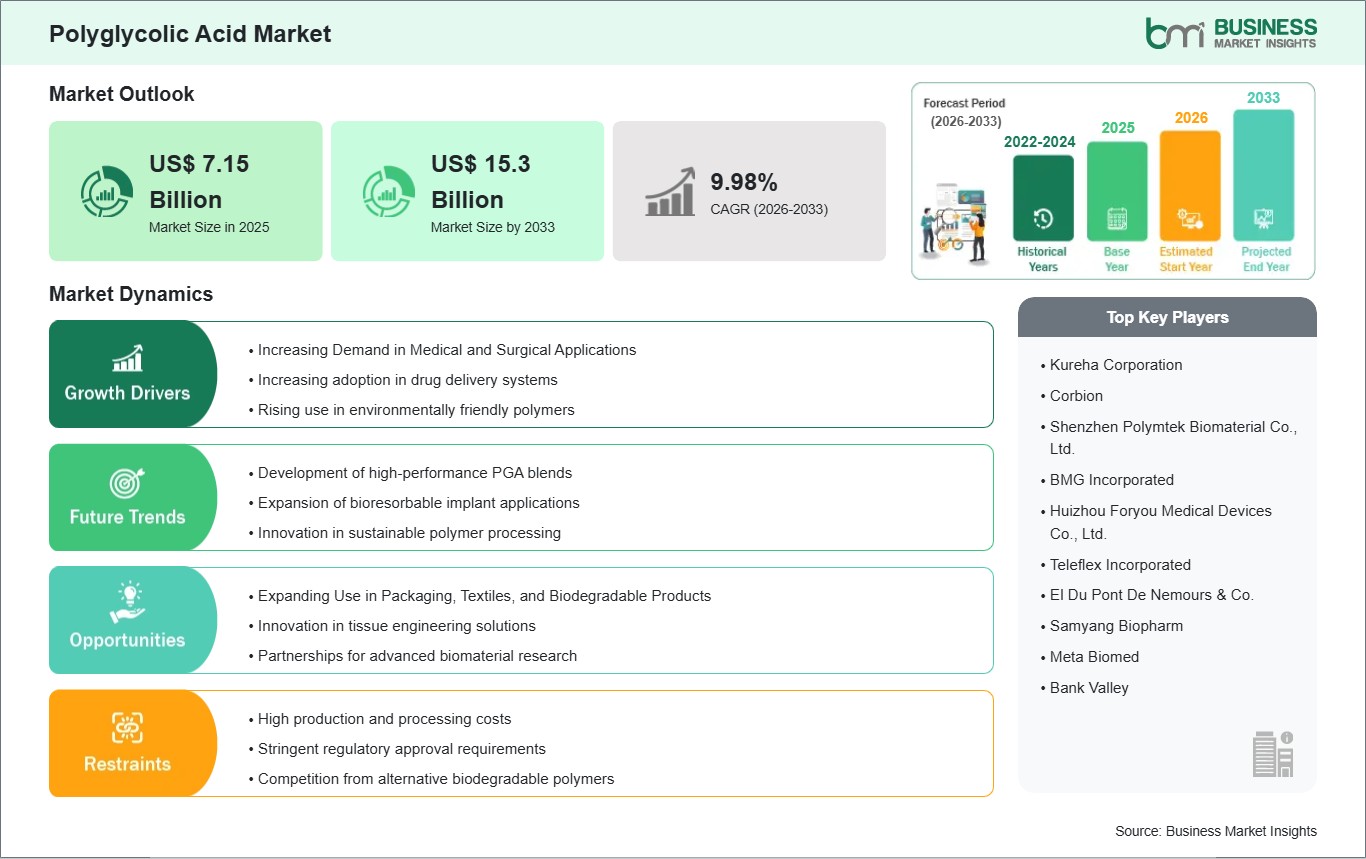
The Polyglycolic Acid Market size is expected to reach US$ 15.3 billion by 2033 from US$ 7.15 billion in 2025. The market is estimated to record a CAGR of 9.98% from 2026 to 2033.
The market for polyglycolic acid (PGA) has seen a steady growth pattern in recent years, owing to the increasing demand for the product in the medical, packaging, and biodegradable sectors. Polyglycolic acid has a number of inherent properties that make it a highly sought-after product in the market, including its tensile strength, biodegradability, and compatibility. Polyglycolic acid has seen a number of applications in the medical field, including sutures, tissue engineering, and drug delivery systems.
Furthermore, the increasing demand for minimally invasive procedures in the healthcare industry has also contributed significantly to the growth of the market in the medical sector, in addition to the increasing emphasis on sustainable products in the environment, which has resulted in the increasing demand for the product in the packaging sector. Polyglycolic acid has seen a number of advancements in the technology used in the synthesis, copolymerization, and extrusion of the product, resulting in the development of high-quality PGA that has the ability to be used in a number of applications in the medical and industrial sectors.
Moreover, the market conditions are also influenced by the strict regulations in the medical polymers segment, where the product has to be of high quality and certified. Some of the challenges that the product may face include the high cost of production, sensitivity to moisture, and the need for special processing equipment, which may be a challenge in the emerging markets.
Overall, the PGA market presents a unique combination of innovation, green technology, and precision manufacturing, making it a vital product in the medical and green fields.

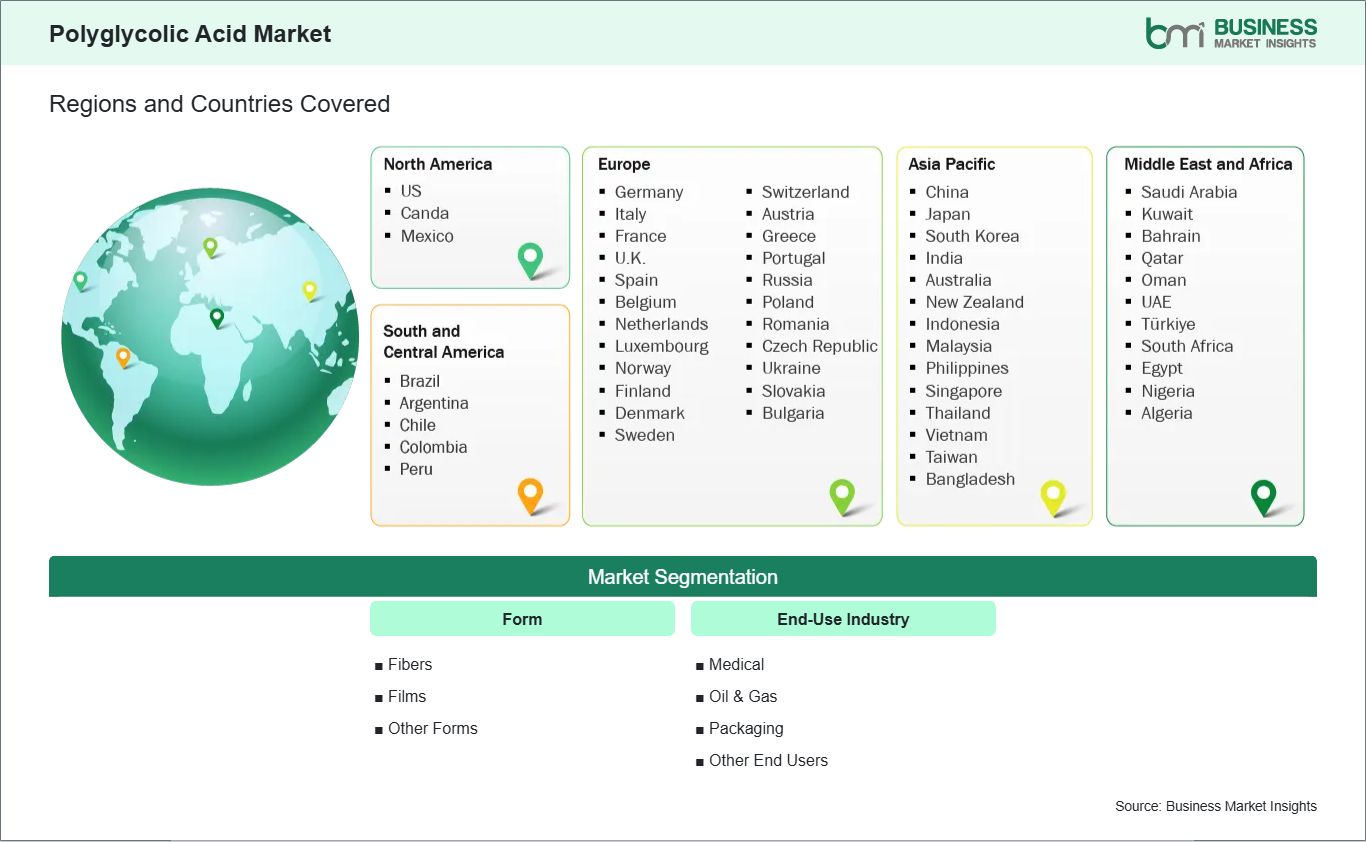
Key segments that contributed to the derivation of the polyglycolic acid market analysis are form and end‑use industry.
The polyglycolic acid market is expanding significantly, mainly due to its extensive utilization in medical and surgical procedures. Polyglycolic acid is a biodegradable polymer that is used in absorbable sutures, meshes, and tissue engineering. Its biodegradable characteristic allows it to dissolve in the body without leaving a permanent scar, thus avoiding sutures that require removal. This has increased its acceptance in healthcare facilities. Increasing knowledge of minimally invasive procedures and advanced wound care solutions is creating a high demand for polyglycolic acid in all segments of healthcare. Its high strength is beneficial for complex surgeries, thus increasing its significance in modern medical procedures.
Apart from its utilization in sutures, polyglycolic acid is used in controlled drug delivery systems. Its biodegradable characteristic allows for the gradual release of medicinal agents, thus enhancing their efficacy and reducing side effects. These characteristics are beneficial in cancer, orthopedic, and tissue engineering therapies. Increasing patient-centered care, along with advancements in surgery, is creating a high demand for polyglycolic acid globally. Manufacturers are producing high-purity polyglycolic acid of consistent quality, thus fulfilling strict regulations.
The dual role of PGA in surgery and drug delivery is creating long-term growth potential. Rising prevalence of chronic diseases, increasing surgical procedures, and expanding healthcare infrastructure contribute to sustained demand. Innovations in combination therapies and tissue engineering are further enhancing the value proposition of PGA-based materials. As the medical industry continues to prioritize efficiency, safety, and patient comfort, polyglycolic acid is emerging as a crucial polymer for advanced healthcare solutions.
Polyglycolic acid is being increasingly explored for various non-medical applications, especially in biodegradable packaging materials, textiles, and disposable products. The biodegradability and suitability for green manufacturing processes make it an excellent alternative to synthetic materials. PGA films and coatings are being explored for green packaging materials. These materials have the potential to be used in making biodegradable materials for sustainable packaging. As awareness regarding sustainable development increases globally, the need for biodegradable materials like PGA is creating new growth momentum in various industries.
Polyglycolic acid is being explored for textile materials. The biodegradable nature of PGA makes it suitable for making biodegradable fibers. These fibers have excellent mechanical properties and moisture-wicking properties. These materials can be used in making sustainable textiles for various applications. The ability to combine mechanical properties with biodegradability makes PGA an excellent material in an industry looking for sustainable materials. In addition, new research and development activities in making sustainable and disposable products are creating new growth opportunities for PGA.
The developments in the processing and blending techniques of polymers are also increasing the versatility of PGA. Developments are helping to enhance its thermal stability, mechanical properties, and compatibility with other biodegradable polymers. This has been helping industries to increasingly use PGA to meet environmental requirements. The biodegradable nature, functional performance, and versatility make PGA an important polymer for both industrial and consumer uses.
The polyglycolic acid market demonstrates steady growth, with size and share analysis highlighting evolving trends and competitive dynamics among key players. The report examines subsegments categorized within form and end‑use industry, offering insights into their contribution to overall market performance.
By Form, the fibers subsegment dominated the market in 2025, driven by its extensive use in absorbable surgical sutures and other biomedical textile applications that leverage PGA’s high tensile strength and biodegradability.
Based on End‑Use Industry, the medical subsegment dominated the market in 2025, supported by growing demand for PGA‑based bioresorbable implants, sutures, and other medical products requiring temporary structural support.
| Report Attribute | Details |
|---|---|
| Market size in 2025 | US$ 7.15 Billion |
| Market Size by 2033 | US$ 15.3 Billion |
| Global CAGR (2026 - 2033) | 9.98% |
| Historical Data | 2022-2024 |
| Forecast period | 2026-2033 |
| Segments Covered | By Form
|
|
Regions and Countries Covered
| |
| North America | US, Canada, Mexico |
| Europe | Belgium, Austria, Finland, Denmark, Greece, Poland, Romania, Russia, Ukraine, Czech Republic, Slovakia, Bulgaria, Italy, Luxembourg, Germany, Switzerland, France, Netherlands, Norway, Portugal, Spain, Sweden, United Kingdom |
| Asia-Pacific | Australia, China, India, Japan, South Korea, Indonesia, Malaysia, Philippines, Singapore, Thailand, Vietnam, Bangladesh, New Zealand, Taiwan |
| South and Central America | Brazil, Argentina, Peru, Chile, Colombia |
| Middle East and Africa | Bahrain, Kuwait, Oman, Qatar, Saudi Arabia, United Arab Emirates, Turkiye, South Africa, Egypt, Algeria, Nigeria |
| Market leaders and key company profiles |
|
The "Polyglycolic Acid Market Size and Forecast (2022 - 2033)" report provides a detailed analysis of the market covering below areas:
The geographical scope of the Polyglycolic Acid Market report is divided into North America, Asia Pacific, Europe, Middle East & Africa, and South & Central America. North America held the largest share in 2025.
The polyglycolic acid market exhibits significant regional variation based on healthcare infrastructure, environmental regulations, and industrial adoption, with North America dominating the market due to its advanced medical device industry, high R&D capabilities, and strict regulatory standards. The United States and Canada lead demand for surgical sutures, tissue engineering, and drug delivery applications, supported by early adoption of biodegradable polymers in healthcare.
In Europe, market growth is driven by stringent environmental regulations, sustainability initiatives, and advanced medical research in countries such as Germany, France, and the UK, which encourage the use of PGA in both healthcare and biodegradable packaging applications.
Asia Pacific is emerging as a high-growth region due to rapid industrialization, expanding healthcare infrastructure, and rising awareness of sustainable materials in China, India, Japan, and South Korea, with local manufacturers increasingly focusing on cost-effective PGA production.
The Middle East & Africa region is gradually expanding, supported by healthcare development projects and infrastructure modernization, with reliance on imports for high-quality PGA formulations.
South & Central America shows steady growth, driven by healthcare improvements and industrial applications in Brazil, Mexico, and Argentina, though adoption is influenced by price sensitivity and limited local production. Across regions, the market is shaped by technological readiness, regulatory frameworks, and sector-specific requirements, creating a diverse and evolving global landscape for PGA applications.

The Polyglycolic Acid Market is evaluated by gathering qualitative and quantitative data post primary and secondary research, which includes important corporate publications, association data, and databases. A few of the key developments in the polyglycolic acid market are:
The Polyglycolic Acid Market is valued at US$ 7.15 Billion in 2025, it is projected to reach US$ 15.3 Billion by 2033.
As per our report Polyglycolic Acid Market, the market size is valued at US$ 7.15 Billion in 2025, projecting it to reach US$ 15.3 Billion by 2033. This translates to a CAGR of approximately 9.98% during the forecast period.
The Polyglycolic Acid Market report typically cover these key segments-
The historic period, base year, and forecast period can vary slightly depending on the specific market research report. However, for the Polyglycolic Acid Market report:
The Polyglycolic Acid Market is populated by several key players, each contributing to its growth and innovation. Some of the major players include:
The Polyglycolic Acid Market report is valuable for diverse stakeholders, including:
Essentially, anyone involved in or considering involvement in the Polyglycolic Acid Market value chain can benefit from the information contained in a comprehensive market report.
Please tell us your area of interest
(Market Segments/ Regions and Countries/ Companies)