Succinic Acid Market Outlook (2022-2033)

Historic Data: 2022-2024   |   Base Year: 2025   |   Forecast Period: 2026-2033
Report Content: Market Scope, Market Segmentation, Market Dynamics, and Competitive Analysis

Report Coverage:
  • Type (Petro-based Succinic Acid, Bio-based Succinic Acid)
  • End-Use Industry (Industrial, Coatings, Food & Beverage, Cosmetics, Pharmaceuticals)

No. of Pages: 419
Report Code: BMIPUB00034455
Category: Chemicals and Materials
Succinic Acid Market

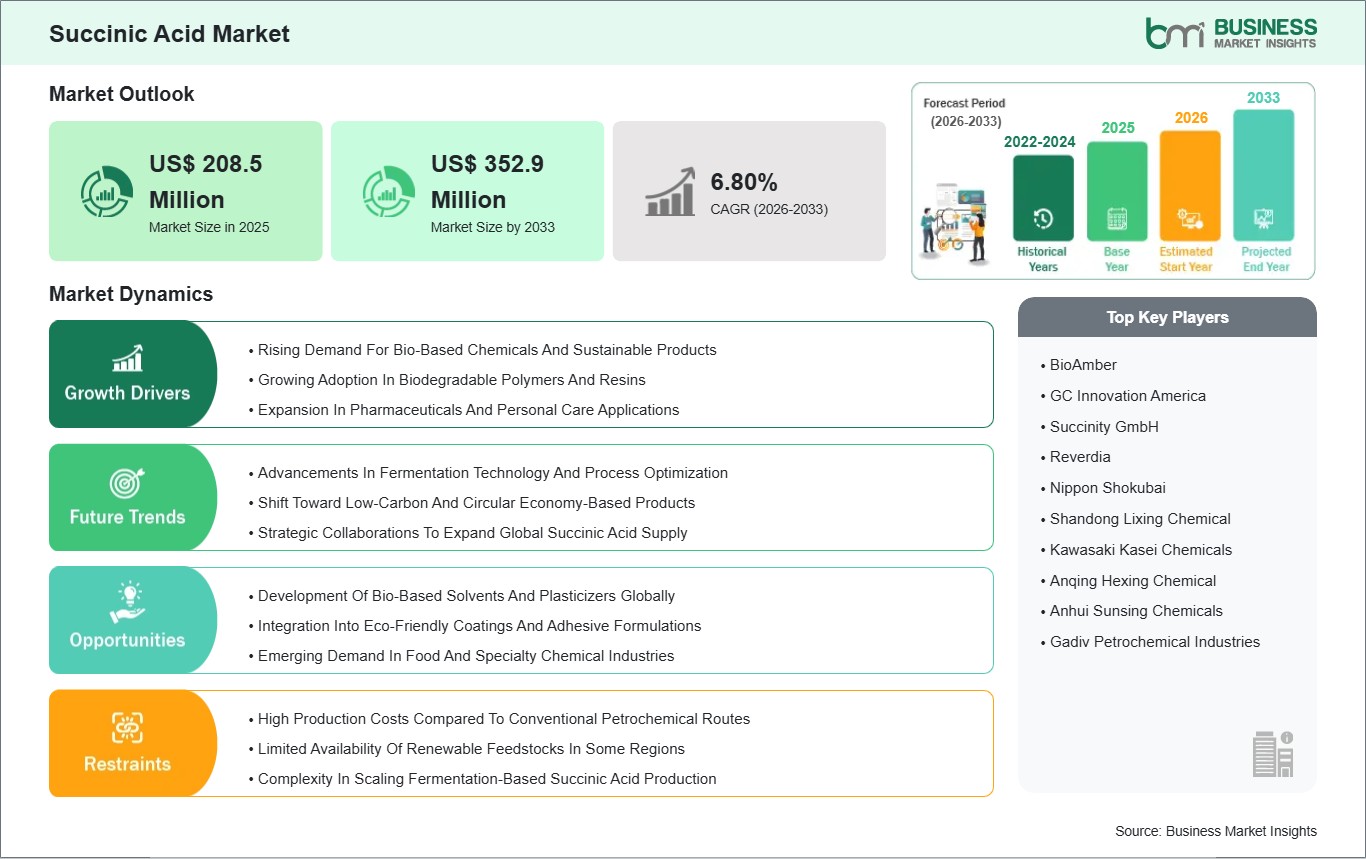
The Succinic Acid Market size is expected to reach US$ 352.9 million by 2033 from US$ 208.5 million in 2025. The market is estimated to record a CAGR of 6.80% from 2026 to 2033.

Executive Summary and Global Market Analysis:

The global succinic acid market is developing as an important sector of bio-based chemicals and specialty intermediates because the market needs sustainable solutions for various applications that include polymers resins solvents personal care products, and pharmaceuticals, and food and beverages. The production of succinic acid, which traditionally comes from petrochemical sources now uses bio-based methods that employ fermentation technologies with renewable feedstocks. The chemical supply chain carbon footprint reductions and circular economy principles become global trends that this movement supports. The markets are likely to expand as corporates have shown growing interest in biodegradable polyesters and plasticizers and solvent applications, which utilize succinic acid's diverse chemical functions and sustainable environmental characteristics.

In polymer synthesis, succinic acid serves as an essential building block for polyester polyols and polybutylene succinate (PBS) because it enhances mechanical properties and biodegradability, making it suitable for developing next-generation materials. North America leads this market because of it`s advanced technology research facilities, major biorefinery investments and early green chemistry adoption in manufacturing industries. The region's chemical production facilities work with universities, startups and chemical manufacturers to speed up the market introduction of new succinic acid production methods. The demand for bio-based succinic acid derivatives increases because strict rules require companies to cut VOC emissions, and customers prefer sustainable personal care and packaging solutions.

The market experiences difficulties because of existing positive market forces. The established petrochemical feedstocks maintain their ability to compete with costs especially in situations where crude oil prices experience fluctuations. The production of bio-based succinic acid needs to reach competitive cost levels through continuous process improvements and the development of additional fermentation facilities. The traditional markets face adoption challenges because of existing supply chain systems and the public's limited knowledge about sustainable benefits that last over time. The combination of ongoing technological progress, the establishment of strategic partnerships and the development of sustainable materials policy incentives will drive regional growth while establishing succinic acid as a vital foundation element of the developing bio-economy.

Succinic Acid Market - Strategic Insights:

global-market-strategic-framework
Get more information on this report

Succinic Acid Market Segmentation Analysis:

Key segments that contributed to the derivation of the succinic acid market analysis are type and end‑use industry.

  • By type, the succinic acid market is segmented into petro‑based succinic acid, bio‑based succinic acid. The petro‑based succinic acid segment dominated the market in 2025.
  • In terms of end‑use industry, the succinic acid market is categorized into industrial, coatings, food & beverage, cosmetics, pharmaceuticals. The industrial segment dominated the market in 2025.

Succinic Acid Market Drivers and Opportunities:

Rising Demand For Bio‑Based Chemicals And Sustainable Products

The global succinic acid market is increasingly shaped by demand for bio‑based chemicals and sustainable products as industries seek alternatives to petrochemical feedstocks. Succinic acid—when produced via fermentation using renewable biomass—aligns with manufacturers’ goals to reduce carbon footprints and meet consumer expectations for greener materials. Sectors such as packaging, coatings, and engineering plastics are integrating bio‑derived succinic acid to replace traditional petroleum‑based intermediates, reinforcing its value proposition as a foundational bio‑chemical building block.

Consumer goods companies are also fueling this trend by incorporating succinic acid in personal care and cosmetic formulations marketed for their natural and eco‑friendly attributes. In regions with strong environmental policy frameworks, such as Europe and North America, producers are prioritizing bio‑based ingredients to comply with low‑VOC and sustainability standards. This shift is affecting value chains as raw material suppliers, chemical producers, and end‑use manufacturers adapt sourcing strategies to emphasize renewable content.

Additionally, collaborations between biotechnology firms and major chemical producers are accelerating the commercialization of high‑purity, bio‑based succinic acid. These partnerships enable scale‑up of fermentation processes that were historically limited to niche applications, making biological routes more competitive with traditional petrochemical methods. As a result, the market is diversifying as product developers across industries pursue both performance and sustainability, driving broader adoption of succinic acid as a bio‑based chemical solution.

Development Of Bio‑Based Solvents And Plasticizers Globally

The global succinic acid market is expanding because manufacturers are developing bio-based solvents and plasticizers, which provide safer renewable options that replace traditional solvent systems and plasticizer chemicals. Manufacturers of succinic acid derivatives produce ester-based solvents and plasticizers that deliver effective solving capabilities while decreasing their use of fossil-based resources. The CASE industry needs to adopt sustainable components with low toxicity because current environmental regulations and consumer preferences demand this solution.

The Asia-Pacific and European chemical industry is working to create succinic acid-based solvents that can meet both environmental standards and operational performance requirements. Bio-based solutions attract formulators because they need to achieve environmental standards while maintaining product effectiveness. In coatings applications bio-derived solvents, which use succinic acid technology can minimize volatile organic compound emissions which leads to better indoor air quality and helps customers meet regional standards for low environmental impact.

Plasticizers from succinic acid are being researched as alternatives to phthalate plasticizers, which are used in flexible PVC and other polymer materials. The movement away from phthalate plasticizers is growing stronger because people now prioritize health and safety matters. Succinic acid-based plasticizers deliver essential flexibility and strength properties while minimizing the toxicity issues that some standard additives present. As innovation continues and regulatory landscapes evolve globally, the development of bio‑based solvents and plasticizers is set to expand, further broadening the applications and value of succinic acid in sustainable chemical portfolios.

Succinic Acid Market Size and Share Analysis:

The succinic acid market demonstrates steady growth, with size and share analysis highlighting evolving trends and competitive dynamics among key players. The report examines subsegments categorized within type and end‑use industry, offering insights into their contribution to overall market performance.

By type, the petro‑based succinic acid subsegment dominated the market in 2025, driven by its established manufacturing processes, lower production cost, and widespread adoption in chemical industries.

On the basis of end‑use industry, the industrial subsegment dominated the market in 2025, driven by high demand for succinic acid as a key raw material in polymers, solvents, and other large-scale industrial applications.

Succinic Acid Market Report Highlights:

Report Attribute Details
Market size in 2025 US$ 208.5 Million
Market Size by 2033 US$ 352.9 Million
Global CAGR (2026 - 2033)6.80%
Historical Data 2022-2024
Forecast period 2026-2033
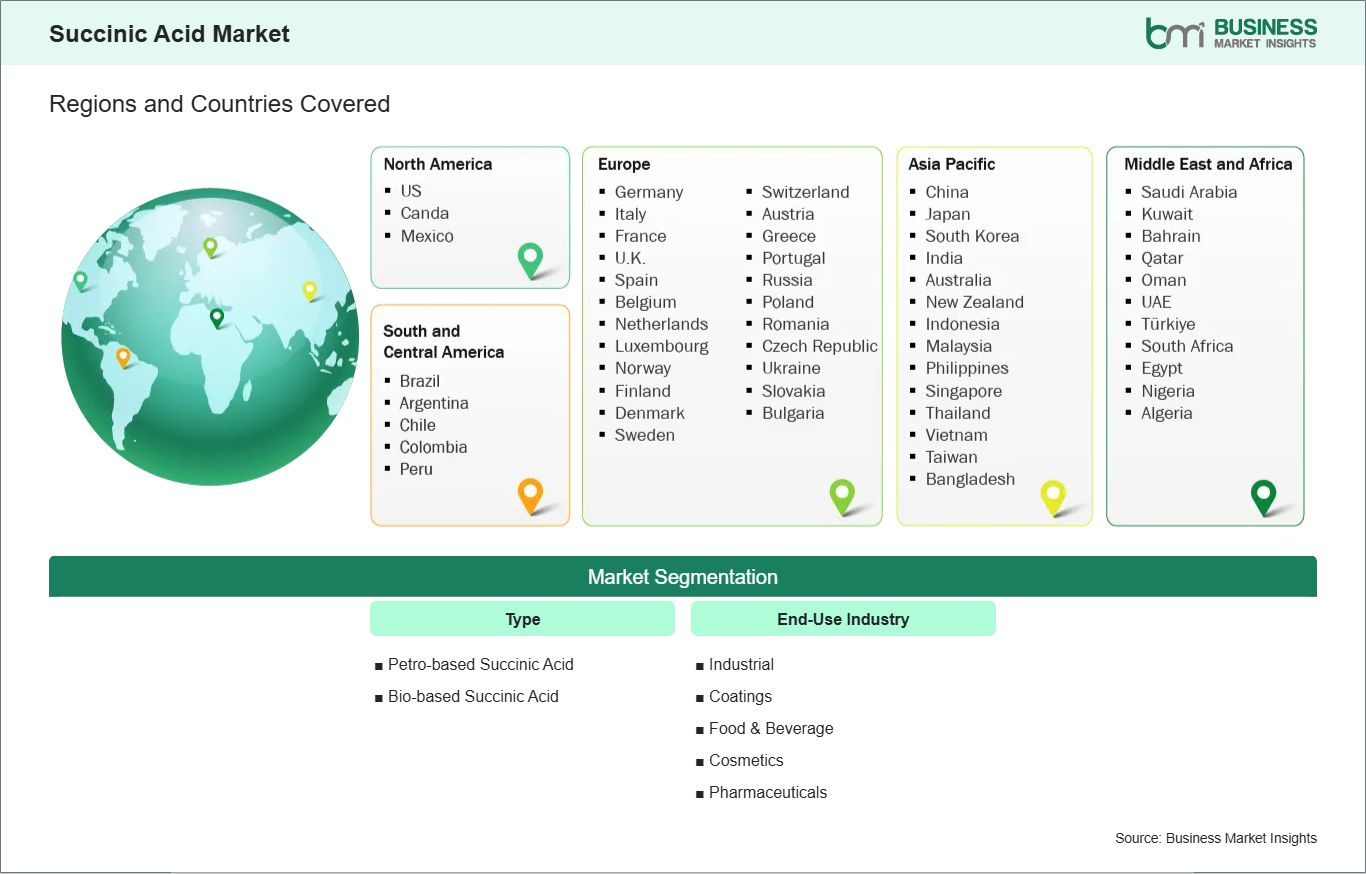
Segments Covered By Type
  • Petro-based Succinic Acid
  • Bio-based Succinic Acid
By End-Use Industry
  • Industrial
  • Coatings
  • Food & Beverage
  • Cosmetics
  • Pharmaceuticals
Regions and Countries Covered
North America US, Canada, Mexico
Europe Belgium, Austria, Finland, Denmark, Greece, Poland, Romania, Russia, Ukraine, Czech Republic, Slovakia, Bulgaria, Italy, Luxembourg, Germany, Switzerland, France, Netherlands, Norway, Portugal, Spain, Sweden, United Kingdom
Asia-Pacific Australia, China, India, Japan, South Korea, Indonesia, Malaysia, Philippines, Singapore, Thailand, Vietnam, Bangladesh, New Zealand, Taiwan
South and Central America Brazil, Argentina, Peru, Chile, Colombia
Middle East and Africa Bahrain, Kuwait, Oman, Qatar, Saudi Arabia, United Arab Emirates, Turkiye, South Africa, Egypt, Algeria, Nigeria
Market leaders and key company profiles
  • BioAmber
  • GC Innovation America
  • Succinity GmbH
  • Reverdia
  • Nippon Shokubai
  • Shandong Lixing Chemical
  • Kawasaki Kasei Chemicals
  • Anqing Hexing Chemical
  • Anhui Sunsing Chemicals
  • Gadiv Petrochemical Industries
Get more information on this report

Succinic Acid Market Report Coverage and Deliverables:

The "Succinic Acid Market Size and Forecast (2022 - 2033)" report provides a detailed analysis of the market covering below areas:

  • Succinic Acid Market size and forecast at global, regional, and country levels for all the key market segments covered under the scope
  • Succinic Acid Market trends, as well as drivers, restraints, and opportunities
  • Succinic Acid Market analysis covering key trends, global and regional framework, major players, regulations, and recent developments
  • Industry landscape and competition analysis covering market concentration, heat map analysis, prominent players, and recent developments for the Succinic Acid Market
  • Detailed company profiles, including SWOT analysis

Succinic Acid Market Geographic Insights:

The geographical scope of the Succinic Acid Market report is divided into North America, Asia Pacific, Europe, Middle East & Africa, and South & Central America. North America held the largest share in 2025.

The global succinic acid market shows different market patterns across various regions because North America has become the leading region through its implementation of bio-based chemical technologies, its development of industrial infrastructures and its dedication to fermentative production methods. In this region, manufacturers use renewable feedstocks such as corn sugar and glucose and lignocellulosic biomass to produce bio-succinic acid, which they apply to biodegradable polyesters, solvents and personal care products and pharmaceuticals. The North American region gains a competitive advantage because its chemical innovation ecosystem, research partnerships and regulatory systems promote sustainable chemistry development between the United States and Canada.

Industrialization, urbanization and manufacturing growth in Asia Pacific have created rising succinic acid demand, which is most prominent in China, Japan, South Korea and India. The automotive, electronics and consumer goods industries use engineering plastics and bio-based polyols and eco-friendly solvents that receive support from government initiatives, which promote renewable chemicals and bio-refinery development.

Europe functions as a major market that businesses use to operate because of strong environmental regulations, circular economy policies and financial incentives for bio-based products. Germany, France and the Nordic region have increased their succinic acid usage for biodegradable polyesters, personal care products and specialty chemicals, which show their commitment to sustainable and low-carbon methods.

The market in the Middle East and Africa shows growth through industrial applications and expanding pharmaceutical and personal care sectors, which operate in the United Arab Emirates and South Africa instead of using traditional manufacturing methods.

The South and Central American market exhibits a trend where Brazil and Argentina start using succinic acid for their bio-based polymer and solvent applications through their local agricultural feedstocks, which they use in fermentation.

The three factors of sustainability requirements and growing consumer demand for renewable chemicals and industrial and specialty markets drive development across all regions.

global-market-geography
Get more information on this report

Succinic Acid Market Research Report Guidance:

  • The report includes qualitative and quantitative data in the Succinic Acid Market across type, end‑use industry, and geography.
  • The report starts with the key takeaways (chapter 2), highlighting key trends and outlook of the Succinic Acid Market.
  • Chapter 3 focuses on the research methodology of the study.
  • Chapter 4 includes ecosystem analysis.
  • Chapter 5 highlights the major industry dynamics in the Succinic Acid Market, including factors that are driving the market, prevailing deterrents, potential opportunities, as well as future trends. Impact analysis of these drivers and restraints is also covered in this section.
  • Chapter 6 discusses the Succinic Acid Market scenario, in terms of historical market revenues, and forecast till the year 2033.
  • Chapters 7 to 9 cover Succinic Acid Market segments by type, end‑use industry, and geography across North America, Asia Pacific, Europe, Middle East & Africa, and South & Central America. They cover the market revenue forecast and factors driving the market.
  • Chapter 10 describes the competitive analysis along with the heat map analysis for the key players operating in the market.
  • Chapter 11 describes the industry landscape analysis. It provides detailed descriptions of business activities such as market initiatives, new developments, mergers, and joint ventures globally, along with a competitive landscape.
  • Chapter 12 provides detailed profiles of the major companies operating in the Succinic Acid Market. Companies have been profiled on the basis of their key facts, business descriptions, products, financial overview, SWOT analysis, and key developments.
  • Chapter 13, i.e., the appendix, is inclusive of a brief overview of the company, a list of abbreviations, and a disclaimer.

Succinic Acid Market News and Key Development:

The Succinic Acid Market is evaluated by gathering qualitative and quantitative data post primary and secondary research, which includes important corporate publications, association data, and databases. A few of the key developments in the succinic acid market are:

  • In May 2024, Corbion announced that it expanded its partnership with global distributor IMCD to include Thailand, enhancing customer support and fortifying its presence in the APAC region, which supports broader distribution of its fermentation‑based biochemical products (including bio‑based platform chemicals and derivatives connected to succinic acid and other sustainable bio‑ingredients). This expansion strengthens Corbion`s ability to service markets with renewable chemical needs across Southeast Asia.
  • In March 2025, Corbion published its first CSRD‑compliant Annual Report and reaffirmed strategic focus on sustainability and fermentation‑derived biochemicals, reinforcing its commitment to bio‑based chemical production technologies that include succinic acid and related intermediates. This update highlights ongoing organizational emphasis on sustainable ingredient solutions, which underpins global expansion of bio‑based chemical portfolios.

Key Sources Referred:

  • World Health Organization (WHO)
  • Organisation for Economic Cooperation and Development (OECD)
  • The World Bank Group
  • Worldometer
  • The Lancet
  • International Bar Association
  • International Trade Administration
The List of Companies - Succinic Acid Market
  • BioAmber
  • GC Innovation America
  • Succinity GmbH
  • Reverdia
  • Nippon Shokubai
  • Shandong Lixing Chemical
  • Kawasaki Kasei Chemicals
  • Anqing Hexing Chemical
  • Anhui Sunsing Chemicals
  • Gadiv Petrochemical Industries
Frequently Asked Questions
How big is the Succinic Acid Market?

The Succinic Acid Market is valued at US$ 208.5 Million in 2025, it is projected to reach US$ 352.9 Million by 2033.

What is the CAGR for Succinic Acid Market by (2026 - 2033)?

As per our report Succinic Acid Market, the market size is valued at US$ 208.5 Million in 2025, projecting it to reach US$ 352.9 Million by 2033. This translates to a CAGR of approximately 6.80% during the forecast period.

What segments are covered in this report?

The Succinic Acid Market report typically cover these key segments-

  • Type (Petro-based Succinic Acid, Bio-based Succinic Acid)
  • End-Use Industry (Industrial, Coatings, Food & Beverage, Cosmetics, Pharmaceuticals)

What is the historic period, base year, and forecast period taken for Succinic Acid Market?

The historic period, base year, and forecast period can vary slightly depending on the specific market research report. However, for the Succinic Acid Market report:

  • Historic Period : 2022-2024
  • Base Year : 2025
  • Forecast Period : 2026-2033
  • Who are the major players in Succinic Acid Market?

    The Succinic Acid Market is populated by several key players, each contributing to its growth and innovation. Some of the major players include:

  • BioAmber
  • GC Innovation America
  • Succinity GmbH
  • Reverdia
  • Nippon Shokubai
  • Shandong Lixing Chemical
  • Kawasaki Kasei Chemicals
  • Anqing Hexing Chemical
  • Anhui Sunsing Chemicals
  • Gadiv Petrochemical Industries
  • Who should buy this report?

    The Succinic Acid Market report is valuable for diverse stakeholders, including:

    • Investors: Provides insights for investment decisions pertaining to market growth, companies, or industry insights. Helps assess market attractiveness and potential returns.
    • Industry Players: Offers competitive intelligence, market sizing, and trend analysis to inform strategic planning, product development, and sales strategies.
    • Suppliers and Manufacturers: Helps understand market demand for components, materials, and services related to concerned industry.
    • Researchers and Consultants: Provides data and analysis for academic research, consulting projects, and market studies.
    • Financial Institutions: Helps assess risks and opportunities associated with financing or investing in the concerned market.

    Essentially, anyone involved in or considering involvement in the Succinic Acid Market value chain can benefit from the information contained in a comprehensive market report.

    Available Report Formats

    pdf-format excel-format pptx-format
    Buy Now
    Sales Assistance
    +1 646 791 7070 (US & UK)
    Customization Form

    Please tell us your area of interest
    (Market Segments/ Regions and Countries/ Companies)