
Agentic AI in Healthcare Market Outlook: Size, Share, Trends, Growth Analysis, Competitive Landscape & Forecast, 2026-2033

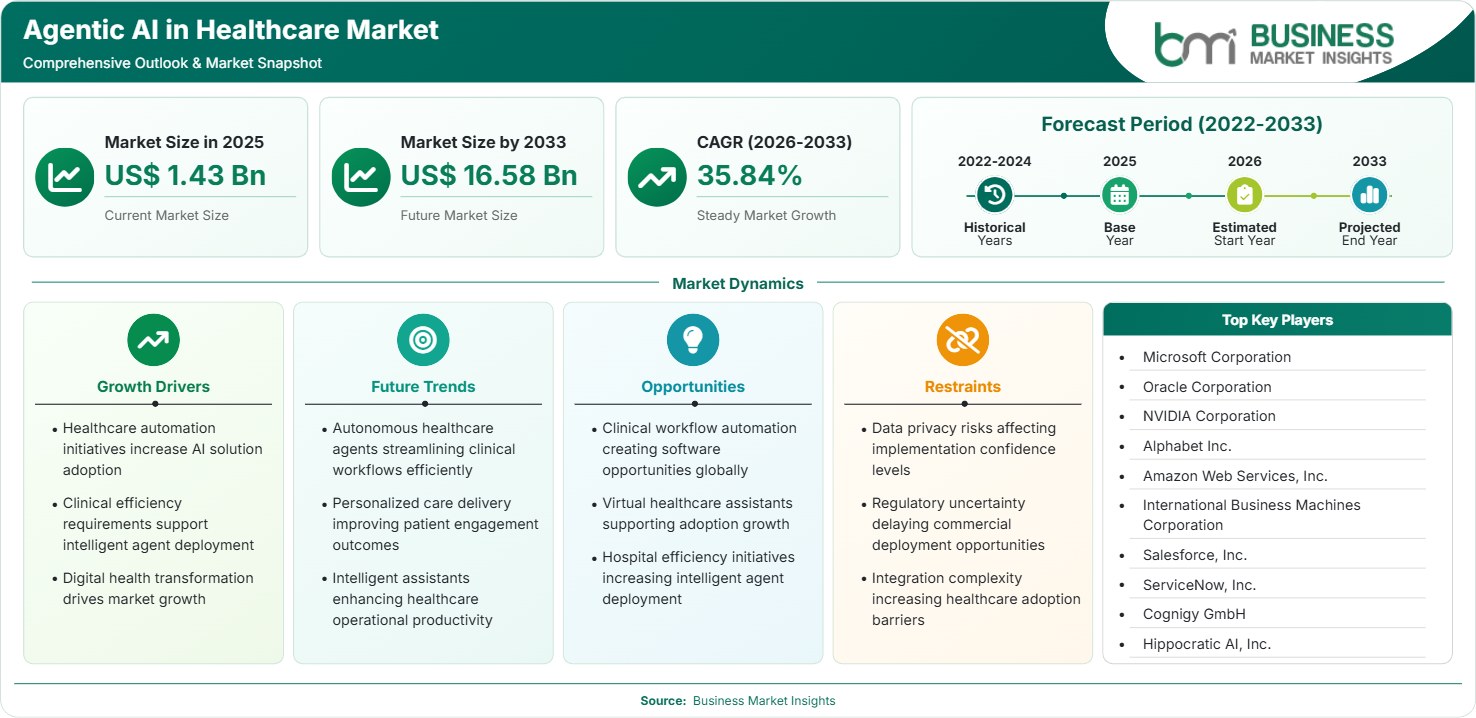
The Agentic AI in Healthcare Market size was valued at US$ 1.43 Billion in 2025 and is projected to reach US$ 16.58 Billion by 2033, growing at a CAGR of 35.84% during 2026–2033. Key growth drivers include autonomous clinical workflows, healthcare workforce shortages, AI-enabled diagnostics, digital health investments, and rising demand for operational automation. Opportunities emerge from multimodal AI agents, payer-provider integration, and personalized patient engagement platforms.

Report Coverage
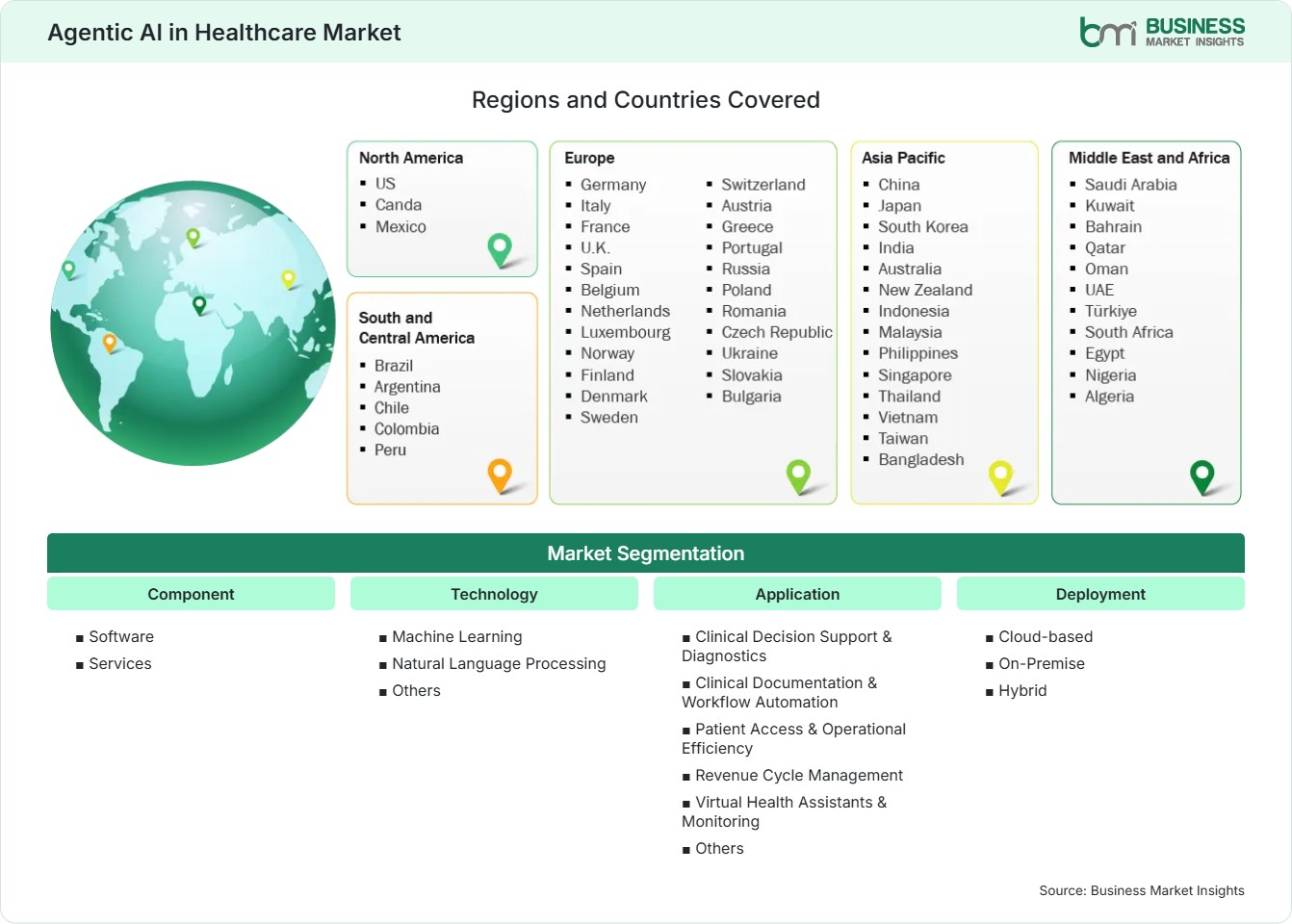
  • Component: Software, Services
  • Technology: Machine Learning, Natural Language Processing, Others
  • Application: Clinical Decision Support & Diagnostics, Clinical Documentation & Workflow Automation, Patient Access & Operational Efficiency, Revenue Cycle Management , Virtual Health Assistants & Monitoring, Others
  • Deployment: Cloud-based, On-Premise, Hybrid
  • End User: Healthcare Providers, Healthcare Payers, Others
US$ 1.43 Bn Market size in 2025
US$ 16.58 Bn Market Size by 2033
35.84% CAGR, 2026 - 2033
2026-2033 Forecast Period

AI Overview

Agentic AI in Healthcare Market Summary

  • North America Region: North America holds a market share of 40%–44% in 2025, growing with a CAGR of 34%–37% during 2026–2033. Growth is supported by large healthcare IT budgets, cloud adoption, AI governance initiatives, provider digitization, clinical automation investments, healthcare staffing pressures, payer efficiency programs, and growing deployment of autonomous care coordination systems. The U.S. dominates regional demand, supported by advanced digital infrastructure and a CAGR of 35%–38% through 2033.
  • Fastest Growing Region: Asia Pacific holds an Agentic AI in Healthcare Market share of 24%–28% in 2025, growing with a CAGR of 38%–42% during 2026–2033. Expansion is driven by healthcare modernization, government AI programs, hospital digitization, rising patient volumes, telehealth adoption, cloud infrastructure development, improved data availability, and increasing investment in intelligent healthcare automation technologies.
  • Leading Segment: Software accounts for a 68%–72% share in 2025 and advances at a 36%–39% CAGR through 2033. Growth stems from enterprise AI platforms, agent orchestration tools, workflow automation adoption, scalable deployment models, healthcare analytics demand, integration capabilities, clinical intelligence applications, and continuous innovation across digital healthcare ecosystems.
  • High Growth Segment: Clinical Documentation & Workflow Automation represents an 18%–22% share in 2025 and records a 39%–43% CAGR through 2033. Expansion is supported by clinician burnout reduction initiatives, automated documentation demand, ambient intelligence integration, productivity enhancement requirements, reimbursement optimization, and increasing deployment across provider organizations.
  • Key Market Opportunity: Expanding autonomous care coordination platforms can enable proactive patient management, reduce administrative burdens, improve clinical outcomes, support value-based care models, enhance interoperability, and accelerate healthcare system productivity globally.
  • Major Market Players: Microsoft Corporation, Oracle Corporation, NVIDIA Corporation, Alphabet Inc., Amazon Web Services, Inc., International Business Machines Corporation, Salesforce, Inc., ServiceNow, Inc., Cognigy GmbH, and Hippocratic AI, Inc.
Strategic Insights

Agentic AI in Healthcare Market: Strategic Insights

Agentic AI in Healthcare Market Strategic Framework
FREE PDF
Request your free sample
Request free sample
Stakeholder View

Key Takeaways

  • The value chain is increasingly integrating cloud providers, healthcare software vendors, EHR platforms, AI model developers, and healthcare organizations, creating collaborative ecosystems for scalable agent deployment.
  • Clinical workflow automation and patient access optimization present the strongest commercial opportunities as providers seek measurable efficiency gains amid persistent labor shortages.
  • Innovation is shifting from predictive analytics toward autonomous decision-support systems capable of executing complex healthcare tasks with minimal human intervention.
  • Asia Pacific offers a compelling investment case due to rapid healthcare digitization, government AI initiatives, expanding data infrastructure, and increasing adoption across large patient populations.
  • Strategic partnerships, venture investments, and healthcare AI acquisitions are accelerating as technology vendors seek differentiated capabilities in intelligent automation and clinical agent deployment.
  • Interoperability-focused solutions capable of integrating across fragmented healthcare environments are expected to gain competitive advantage over standalone applications.
Geographic Outlook

Agentic AI in Healthcare Market Regional Highlights

North America Agentic AI in Healthcare Market

North America represented approximately 40%–44% of the Agentic AI in Healthcare Market share in 2025 and is expected to expand at a CAGR of 34%–37% through 2033. Strong healthcare spending, advanced digital infrastructure, mature cloud ecosystems, and widespread EHR adoption support regional leadership. The region benefits from active AI innovation ecosystems and favorable investment activity. Healthcare providers increasingly implement autonomous systems to improve productivity, reduce documentation burdens, and enhance patient experiences while advancing value-based care delivery.

  • U.S. healthcare providers are expanding autonomous documentation, scheduling, patient engagement, and clinician support applications as healthcare organizations prioritize productivity improvements and operational efficiency outcomes across complex care environments.
  • Major technology companies continue investing in healthcare-focused AI platforms, strengthening model performance, interoperability, security frameworks, and enterprise deployment capabilities for large provider systems.
  • Healthcare payers increasingly adopt intelligent automation solutions to streamline claims processing, member communication, prior authorization workflows, and care management programs.
  • Regulatory discussions around trustworthy AI governance are encouraging organizations to formalize deployment frameworks, accelerating enterprise-level implementation and risk management practices.

US Agentic AI in Healthcare Market

The United States accounts for approximately 76%–80% of North American revenue in 2025 and records a CAGR of 35%–38% through 2033. Adoption is supported by healthcare digitization maturity, significant healthcare IT expenditure, advanced cloud infrastructure, and strong AI innovation activity. Large integrated delivery networks increasingly implement intelligent agents across administrative, financial, and clinical workflows. Continued investment in ambient documentation technologies and AI-powered patient engagement solutions further supports expansion.

  • Academic medical centers are pioneering advanced autonomous agents for clinical research support, decision assistance, patient communication, and operational process automation.
  • Value-based care initiatives continue creating incentives for scalable AI platforms capable of improving efficiency, quality metrics, and patient satisfaction outcomes.
  • Venture capital participation remains strong across healthcare AI startups targeting autonomous workflows, virtual assistants, and intelligent care navigation capabilities.
  • Collaborations between software vendors and health systems are accelerating commercialization and deployment of healthcare-specific AI agent solutions.

Europe Agentic AI in Healthcare Market

Europe accounted for approximately 26%–30% of the Agentic AI in Healthcare Market share in 2025 and is projected to register a CAGR of 33%–36% through 2033. Growth is supported by expanding healthcare digitization programs, AI governance initiatives, electronic health record modernization, and increasing demand for clinical workflow efficiency. Strong regulatory oversight encourages responsible deployment while maintaining patient trust. Germany and the United Kingdom lead regional adoption, while Central and Eastern European healthcare systems are increasingly investing in intelligent automation technologies to improve service delivery and administrative productivity.

  • Germany remains the leading national market due to extensive hospital digitization programs, advanced healthcare infrastructure, strong enterprise software adoption, and growing AI investments across clinical and operational environments.
  • The United Kingdom continues accelerating deployment through National Health Service modernization initiatives, supporting automation projects focused on scheduling, documentation, patient communication, and workflow optimization.
  • France is witnessing increasing adoption across public healthcare networks as organizations seek scalable solutions that reduce administrative burdens and improve care coordination outcomes.
  • Spain is emerging as a high-growth market, supported by healthcare digital transformation projects, cloud adoption, innovation funding, and rising demand for intelligent workforce augmentation tools.
  • Regional stakeholders prioritize explainable AI frameworks, cybersecurity controls, and interoperability standards to facilitate sustainable implementation across diverse healthcare environments.

Asia Pacific Agentic AI in Healthcare Market

Asia Pacific region had a share of about 24% - 28% in 2025 and is expected to grow at a CAGR of 38% - 42% till 2033, thereby becoming the most rapidly growing regional market. Growth is facilitated by healthcare modernization initiatives, greater hospital digitization, government-supported AI strategies, and investments in cloud infrastructure. A large population creates significant demand for scalable healthcare automation systems. In terms of revenue generation, China is the leading country, while India is the fastest-growing.

  • China maintains regional leadership through extensive AI research investments, large-scale healthcare datasets, technology innovation programs, and aggressive hospital digitization strategies.
  • India records the highest growth rates across the region, supported by health-tech investments, telemedicine expansion, cloud adoption, and growing healthcare infrastructure development.
  • Japan is leveraging intelligent healthcare technologies to address workforce shortages, aging demographics, and increasing demand for operational efficiency across healthcare facilities.
  • South Korea continues strengthening AI deployment through advanced digital infrastructure, healthcare innovation programs, and strong collaboration between medical institutions and technology vendors.
  • Southeast Asian healthcare systems increasingly invest in intelligent patient engagement and workflow automation solutions as healthcare access and digitalization improve.

Rest of World Agentic AI in Healthcare Market

The Rest of World region represents approximately 10%–14% of the Agentic AI in Healthcare Market share in 2025 and is projected to advance at a CAGR of 34%–38% through 2033. South and Central America are benefiting from healthcare modernization investments and increasing cloud adoption. Brazil leads regional implementation activity.

Middle East and Africa markets are supported by national digital health transformation programs and smart hospital initiatives. The United Arab Emirates and Saudi Arabia lead adoption, while several African healthcare systems increasingly explore AI-enabled technologies to strengthen healthcare access and service efficiency.

  • Brazil remains the largest market across South and Central America, supported by healthcare IT spending growth, provider digitization initiatives, and increasing AI awareness.
  • Mexico demonstrates strong adoption potential through investments in healthcare modernization, cloud infrastructure expansion, and operational efficiency improvement programs.
  • Saudi Arabia is benefiting from healthcare transformation initiatives aligned with national digitalization objectives, supporting technology investments across providers and healthcare networks.
  • The United Arab Emirates continues accelerating smart hospital development projects and enterprise AI deployments, strengthening regional technology leadership.
  • Several African markets are adopting targeted automation solutions for resource optimization, healthcare access improvement, and administrative efficiency enhancement.
Global Market Geography
FREE PDF
Request your free sample
Request free sample
Segment Analysis

Agentic AI in Healthcare Market Segmentation

Component

The component segment is led by software solutions, which accounted for approximately 68%–72% market share in 2025 and are expected to expand at a CAGR of 36%–39% through 2033. Rising demand for AI platforms for enterprises, orchestration capabilities, workflow automation, and scalability will drive adoption. The Agentic AI in Healthcare Market scope continues to expand as organizations implement intelligent software capabilities, while services remain important for product implementation and customization.

  • Software: Software platforms enable autonomous task orchestration, clinical intelligence, patient engagement automation, and operational optimization, making them central to healthcare organizations pursuing scalable AI implementation strategies.
  • Services: Services support consulting, integration, optimization, governance, training, and maintenance requirements, helping healthcare providers successfully deploy intelligent agent technologies within regulated operating environments.

Technology

Technology adoption largely depends on machine learning platforms, which are expected to capture a market share of about 42%-46% in the Agentic AI in Healthcare Market in 2025 and grow at a CAGR of 35%-38% until 2033. Companies are making greater use of predictive analytics and reasoning. Along with this, NLP is becoming increasingly significant due to increased demand for conversational healthcare, documentation, and productivity tools.

  • Machine Learning: Machine learning enables intelligent decision support, predictive care management, anomaly detection, workflow optimization, and adaptive system performance improvements across healthcare applications.
  • Natural Language Processing: Natural language processing supports conversational interfaces, documentation generation, patient communication, ambient listening technologies, and unstructured clinical data interpretation across healthcare environments.

Application

Applications are becoming more operationally efficient and clinically supportive. Clinical Documentation & Workflow Automation has an 18%–22% share in 2025 and is projected to register a high CAGR of 39%–43% until 2033. The segment is driven by programs that reduce clinician burnout and improve productivity. Overall, the Agentic AI in Healthcare Market trends suggest increasing use of autonomous technology across various healthcare operations.

  • Clinical Decision Support & Diagnostics: Intelligent agents assist care teams with evidence synthesis, clinical recommendations, risk assessment, diagnostic support, and care pathway optimization.
  • Clinical Documentation & Workflow Automation: Automation tools streamline documentation activities, reduce administrative workloads, improve clinician productivity, and support healthcare operational efficiency objectives.
  • Patient Access & Operational Efficiency: Solutions optimize scheduling, resource allocation, referrals, patient navigation, communication, and administrative process management across healthcare systems.
  • Revenue Cycle Management (RCM): Agent-enabled platforms improve billing accuracy, claims processing efficiency, reimbursement workflows, denial management, and payer-provider collaboration capabilities.
  • Virtual Health Assistants & Monitoring: Virtual assistants facilitate patient engagement, symptom guidance, monitoring support, communication management, and personalized healthcare interactions.

Deployment

The cloud deployment segment dominates the market, with a share of 58% - 62% by 2025 and a CAGR of 37% - 40%. This deployment method gives flexibility, scalability, computational power, and a quick time to deploy. Healthcare organizations use hybrid deployment models to ensure their applications meet performance criteria and data governance requirements while still enabling access to AI technologies.

  • Cloud-based: Organizations benefit from scalable infrastructure, advanced processing capabilities, continuous updates, interoperability support, and lower implementation complexity compared with traditional environments.
  • On-Premise: On-premise environments remain relevant for institutions prioritizing data residency, security controls, regulatory compliance, and customized infrastructure management requirements.
  • Hybrid: Hybrid deployment strategies combine cloud scalability with local governance controls, supporting flexible implementation across diverse healthcare operating environments.

End User

Healthcare providers represent the largest end-user segment with approximately 60%–64% Agentic AI in Healthcare Market share in 2025 and expected CAGR of 36%–39% through 2033. Demand is driven by workflow optimization requirements, workforce shortages, and patient experience initiatives. Healthcare payers are also increasing investment in intelligent automation to improve operational efficiency, care coordination, and claims management performance.

  • Healthcare Providers: Hospitals, clinics, integrated delivery networks, and specialty care organizations deploy intelligent agents to improve efficiency, productivity, and patient care outcomes.
  • Healthcare Payers: Insurance organizations adopt automation technologies to streamline claims processing, member services, utilization management, and administrative workflow performance.
Market Forces

Agentic AI in Healthcare Market Dynamics

Key Market Drivers

Healthcare Workforce Shortages Accelerating Automation Demand

Healthcare systems worldwide face ongoing workforce shortages, driving demand for autonomous technologies to handle routine, labor-intensive tasks. Administrative tasks still occupy much of healthcare practitioners' time, motivating them to use intelligent agents to handle routine work such as scheduling, documentation, care coordination, and patient interaction. Agentic tools increase the productivity of healthcare practitioners by reducing manual labor and enabling them to spend more time on higher-value patient interactions. Another reason for implementing autonomous decision-support systems is the increasing complexity of healthcare operations. Sustainability of operations is an important factor in today's organizational environment, and the ability of agentic technologies to increase efficiency and support care teams plays a key role in the market's long-term development.

Expansion of Digital Health Infrastructure and Cloud Ecosystems

Growing investments in digital healthcare transformation provide the foundational infrastructure necessary for large-scale deployment of autonomous AI agents. There is widespread use of cloud platforms, EHRs, interoperability systems, and analytics environments with intelligent decision-making capabilities by hospitals and healthcare provider networks. Improved computing capabilities enable the AI agent to handle varied datasets, manage processes, and deliver insights in real time. Healthcare providers also embed AI capabilities into their existing enterprise systems to enable efficient, scalable implementation. Digital maturity in the healthcare ecosystem helps to facilitate the integration of agentic technology solutions, leading to rapid deployment and in the Agentic AI in Healthcare Market growth over the forecast period.

Rising Demand for Data-Driven Clinical Decision Support

Healthcare organizations increasingly require technologies capable of processing large volumes of structured and unstructured clinical information. Agentic systems support clinicians by synthesizing patient records, identifying care recommendations, highlighting risks, and facilitating evidence-based decision-making. The increasing volume of data from e-health records, diagnostics, wearables, and the connectivity of health technology is creating an enabling environment that can foster the growth of autonomous intelligence. Companies that wish to improve the quality of healthcare services continue to spend large sums of money on developing clinical technology solutions. In an environment where outcome-driven healthcare delivery is key, intelligent technologies that can think contextually, orchestrate tasks, and learn continuously have become highly desired. Such developments have huge potential to foster the growth of the emerging Agentic AI in Healthcare Market globally.

Key Market Opportunities

Autonomous Care Coordination Across Value-Based Care Models

Healthcare organizations are moving toward implementing value-based care models, which demand ongoing patient engagement, early intervention, and coordinated treatment processes. Intelligent agents can perform large-scale appointment scheduling, follow-up communications, medication alerts, referral management, and patient navigation. This helps improve patient care coordination and, at the same time, reduces the administrative workload for healthcare providers. Thus, providers and health insurers are investing in smart care coordination platforms to achieve improved outcomes and cost savings in the delivery of healthcare services. To enhance the patient experience and save organizational resources, care coordination through intelligent agents will be one of the most lucrative business opportunities over the forecast period.

Multimodal AI Agents for Enterprise Clinical Workflows

The increasing complexity of emerging healthcare settings is creating a need for solutions that can simultaneously process text data, images, voice communications, diagnostic results, and patient histories. Multimodal AI tools are meeting this need by combining information from various data sources to support decision-making. They offer an opportunity for more advanced workflow automation, better context understanding, and improved response accuracy. The demand is likely to grow in hospitals, specialty care centers, diagnostics firms, and integrated delivery networks. As investments in AI in healthcare continue to grow at the enterprise level, multimodal solutions have the potential to drive productivity gains and support precision medicine.

Expansion into Emerging Healthcare Ecosystems

The accelerated pace of modernization in healthcare services in Asia Pacific, the Middle East, and selected countries in Latin America is providing a favorable ground for future expansion. More governments and organizations in the healthcare industry are becoming interested in advancing their digitization efforts, cloud-based strategies, and intelligent automation projects in response to capacity and service delivery issues. The increasing volume of data in the healthcare sector and the expansion of digital infrastructure enhance the feasibility of implementing such technologies. Agentic AI in Healthcare Market Forecasts, in the long run, highlight several investment areas where technology platforms can help improve access and efficiency.

Market Restraints and Challenges

Data Privacy Regulations and Governance Complexity

Factor: Healthcare organizations operate in highly regulated settings where patient data must be managed with great caution, and cybersecurity and compliance measures must be in place. The application of AI systems brings more governance issues to the fore regarding transparency, accountability, and decision validation. Impact: More time will be required to conduct risk and cybersecurity assessments and regulatory analyses before deploying AI technologies. It will be even harder for multinational healthcare systems to implement AI due to cross-border data management issues. Effective governance frameworks remain essential for sustaining trust and ensuring responsible deployment of autonomous healthcare technologies.

Integration Barriers Across Fragmented Healthcare Systems

Factor: A majority of health care organizations still maintain heterogeneous technological infrastructures that include old software applications, disparate databases, and different interoperability standards. The process of integrating autonomous agents into such environments may entail many changes and customizations. Impact: Complex integration might increase process costs and make it harder to realize the anticipated benefits. The shortage of resources available to healthcare organizations may create problems in maintaining the technical knowledge required for successful implementation. Differences in technological development among healthcare organizations also explain inconsistencies in adoption.

Company Analysis

Competitive Landscape

The competitive environment remains highly dynamic as technology leaders, healthcare platform providers, cloud companies, and specialized AI firms compete to expand enterprise adoption. Ongoing Agentic AI in Healthcare Market analysis indicates that strategic partnerships, platform integration capabilities, healthcare-specific AI models, and workflow automation expertise are becoming major competitive differentiators.

Company Name

Overview

Products and Services Relevant to this Market

Microsoft Corporation

Global technology leader advancing healthcare AI through enterprise cloud, AI copilots, and healthcare workflow automation solutions.

Dragon Copilot, Azure AI services, healthcare cloud solutions, clinical documentation automation, intelligent workflow tools.

Oracle Corporation

Major healthcare technology provider integrating AI across healthcare records, analytics, and operational systems.

Oracle Health platform, clinical workflow automation, healthcare analytics, AI-enabled operational management solutions.

NVIDIA Corporation

Leading AI computing company supplying infrastructure and frameworks for healthcare AI development and deployment.

AI computing platforms, healthcare AI models, accelerated computing, medical imaging AI infrastructure.

Alphabet Inc.

Technology innovator delivering cloud-based AI capabilities supporting healthcare analytics and intelligent applications.

Google Cloud healthcare AI, generative AI services, healthcare data platforms, analytics tools.

Amazon Web Services, Inc.

Cloud provider supporting scalable healthcare AI deployments through advanced infrastructure and machine learning services.

Healthcare cloud solutions, AI services, machine learning platforms, healthcare data management tools.

International Business Machines Corporation

Enterprise technology company providing healthcare-focused artificial intelligence and automation solutions.

Watson-related healthcare capabilities, analytics, automation software, intelligent workflow support systems.

Salesforce, Inc.

Customer engagement technology provider expanding AI-driven healthcare communication and service capabilities.

Healthcare Cloud, patient engagement solutions, workflow automation, AI-powered service applications.

ServiceNow, Inc.

Enterprise workflow company enabling intelligent automation and operational efficiency across healthcare organizations.

Workflow automation platforms, service management solutions, AI-powered operational tools.

Cognigy GmbH

Conversational AI specialist developing enterprise virtual agents and automated communication platforms.

Conversational AI agents, virtual assistants, healthcare customer interaction automation solutions.

Hippocratic AI, Inc.

Specialized healthcare AI company focused on safety-oriented healthcare agent development and deployment.

Healthcare AI agents, patient communication technologies, clinical support automation solutions.

Trust & Transparency

Research Methodology

The market analysis combines proprietary research with secondary data from government agencies, company disclosures, regulatory filings, industry databases and expert interviews. Market estimates are validated through data triangulation, cross-market benchmarking and analyst review.

View Full Research Methodology

Questions Answered

Frequently Asked Questions

Which region offers the most attractive future investment opportunities?

Asia Pacific presents strong investment potential due to rapid healthcare digitalization, government AI initiatives, expanding cloud infrastructure, growing healthcare expenditures, and increasing deployment of intelligent automation solutions.

What does the Agentic AI in Healthcare Market Report cover?

The Market Report covers market sizing, forecasts, segment analysis, regional insights, competitive landscape, growth drivers, opportunities, challenges, technology trends, and strategic developments influencing industry expansion.

How do healthcare providers benefit from autonomous AI agents?

Healthcare providers gain productivity improvements, reduced documentation workloads, enhanced patient communication, faster information retrieval, better resource allocation, and improved care coordination through intelligent automation capabilities.

Which application area is expected to witness the strongest growth through 2033?

Clinical Documentation & Workflow Automation is anticipated to experience the fastest growth owing to increasing demand for reducing clinician burnout, improving productivity, and streamlining healthcare administrative processes.

What factors are driving demand for agentic AI solutions in healthcare?

Demand is being driven by clinician shortages, administrative inefficiencies, rising healthcare costs, growing digitalization, and increasing adoption of autonomous systems that can support clinical documentation, patient engagement, and operational management activities.

Access the Full Agentic AI in Healthcare Market Report

Get segment-level forecasts, regional estimates, competitive benchmarking, company profiles and downloadable Excel datasets.

Access the full Agentic AI in Healthcare Market Report
350 pages PDF & Excel | 2026-11-03
Similar Research

Related Market Reports