
Generative AI in Product Design Engineering Market Outlook: Size, Share, Trends, Growth Analysis, Competitive Landscape & Forecast, 2026-2033

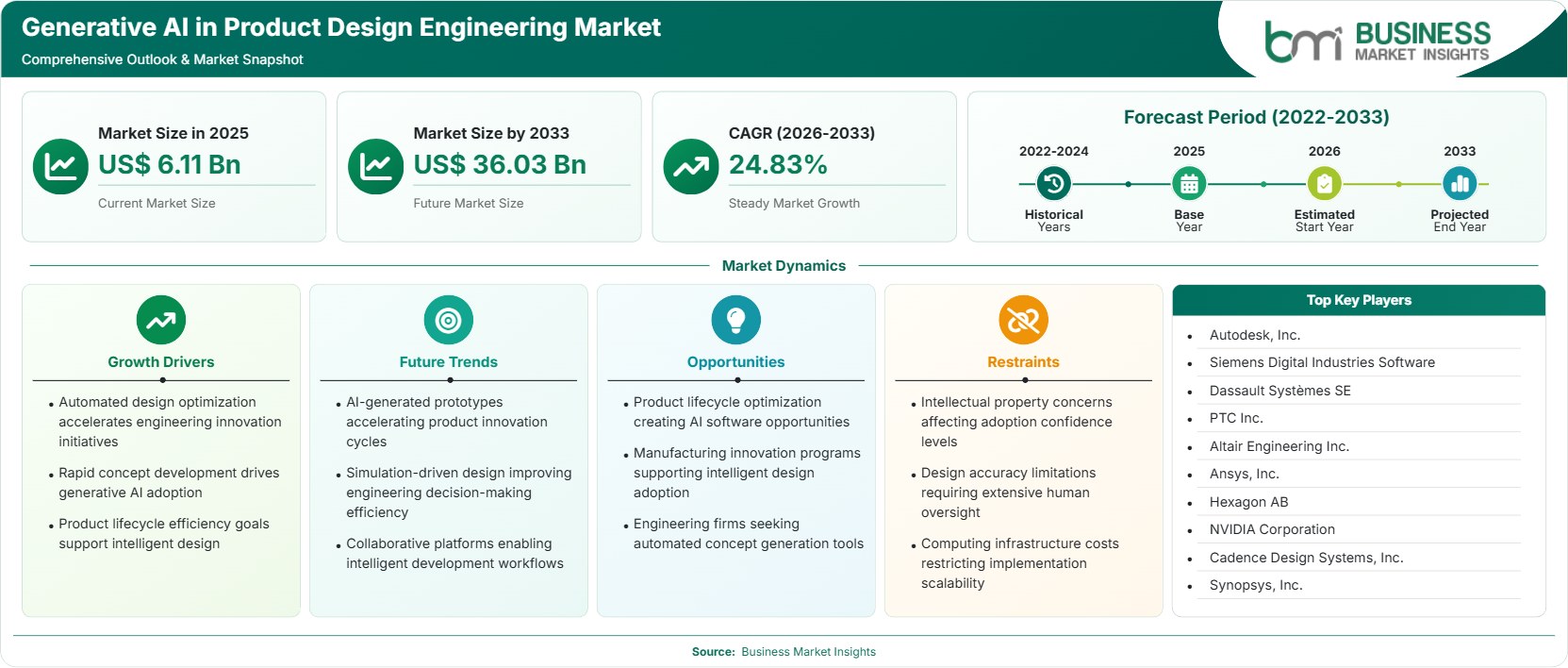
The Generative AI in Product Design Engineering Market size was valued at US$ 6.11 Billion in 2025 and is projected to reach US$ 36.03 Billion by 2033, growing at a CAGR of 24.83% during 2026–2033. Key drivers include accelerating digital engineering adoption, simulation-led design optimization, cloud-based product development, and AI-assisted R&D workflows, while opportunities emerge from autonomous engineering platforms, industrial digital twins, and intelligent product lifecycle management.

Report Coverage
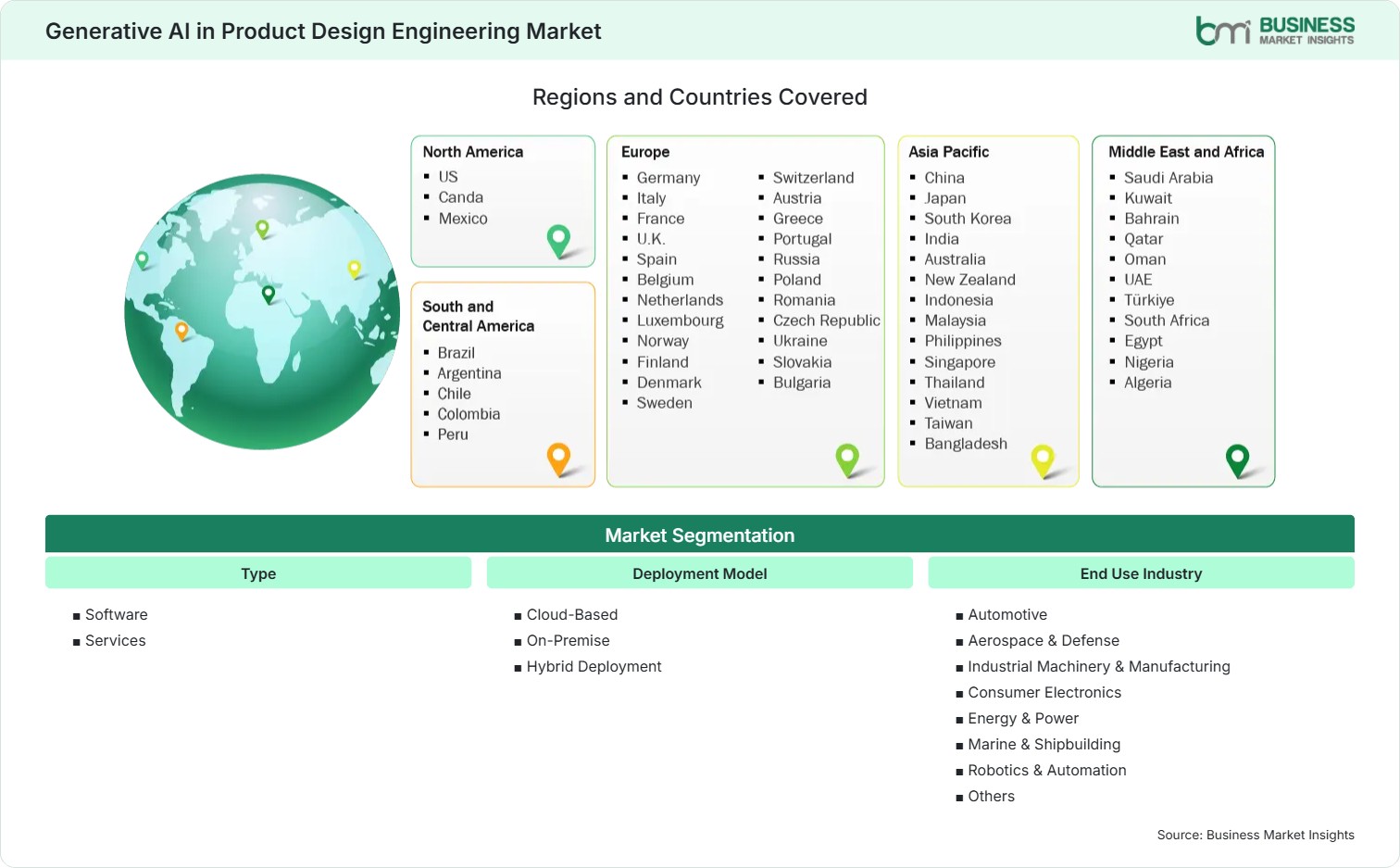
  • Type: Software, Services
  • Deployment Model: Cloud-Based, On-Premise, Hybrid Deployment
  • End Use Industry: Automotive, Aerospace & Defense, Industrial Machinery & Manufacturing, Consumer Electronics, Energy & Power, Marine & Shipbuilding, Robotics & Automation, Others
US$ 6.11 Bn Market size in 2025
US$ 36.03 Bn Market Size by 2033
24.83% CAGR, 2026 - 2033
2026-2033 Forecast Period

AI Overview

Generative AI in Product Design Engineering Market Summary

  • North America Region: North America holds a market share of 38%–41% in 2025, growing at a CAGR of 23%–25% during 2026–2033. Strong investments in engineering software, advanced manufacturing digitization, cloud infrastructure expansion, automotive innovation, and AI-enabled product lifecycle management drive sustained demand and enterprise adoption across industries globally. The U.S. accounts for 78%–82% of regional revenue and is expanding at 24%–26% CAGR through 2033, supported by engineering software leadership and industrial AI investments.
  • Fastest Growing Region: Asia Pacific holds a Generative AI in Product Design Engineering Market share of 26%–29% in 2025, growing at a CAGR of 27%–29% during 2026–2033. Expanding manufacturing bases, industrial automation programs, electronics production growth, engineering talent availability, and government-backed digital transformation initiatives accelerate the deployment of advanced AI-driven design environments.
  • Leading Segment: Software accounts for 68%–72% share in 2025 and advances at 24%–26% CAGR during 2026–2033. Growing demand for generative design engines, simulation tools, digital twins, engineering collaboration platforms, and automated product development workflows sustains segment leadership.
  • High Growth Segment: Cloud-Based deployment represents 48%–52% share in 2025 and grows at 27%–29% CAGR during 2026–2033. Scalable computing resources, faster implementation cycles, cross-functional collaboration, reduced infrastructure costs, and continuous model updates support accelerated enterprise adoption.
  • Key Market Opportunity: AI-driven integration of product design, simulation, material optimization, and lifecycle management enables organizations to reduce development cycles, improve engineering productivity, lower prototyping expenses, and increase innovation throughput.
  • Major Market Players: Autodesk, Inc.; Siemens Digital Industries Software; Dassault Systèmes SE; PTC Inc.; Altair Engineering Inc.; Ansys, Inc.; Hexagon AB; NVIDIA Corporation; Cadence Design Systems, Inc.; Synopsys, Inc.
Strategic Insights

Generative AI in Product Design Engineering Market: Strategic Insights

Generative AI in Product Design Engineering Market Strategic Framework
FREE PDF
Request your free sample
Request free sample
Stakeholder View

Key Takeaways

  • The various stages of the value chain are now coming together through software vendors, cloud providers, semiconductor companies, suppliers of digital twin technology, and engineering services firms, thus forming integrated product development ecosystems that are enabled by AI.
  • The greatest opportunities for growth are appearing in the fields of cloud-native engineering platforms, electronics product design, industrial automation systems, and AI-assisted simulation environments, since the speed of development has a direct effect on competitiveness.
  • Innovation is moving from standalone design automation to multifunctional engineering copilots, which are able to produce geometry, check manufacturability, suggest materials, and at the same time optimize product performance.
  • The investment case for Asia Pacific is highly attractive because of the region's digitalization of manufacturing, its leadership in electronics production, the expansion of industrial automation, and the increasing amount of spending by companies on engineering infrastructure that is enabled by AI.
  • Strategic partnerships, acquisitions, and platform integrations are increasingly aiming at combining generative AI, digital twins, simulation capabilities, and product lifecycle management solutions into unified offerings.
  • Organizations that adopt engineering workflows enabled by AI will be able to achieve substantial reductions in the number of design iterations, in their engineering workloads, and in the costs of developing prototypes, all while still supporting their product innovation goals.
Geographic Outlook

Generative AI in Product Design Engineering Market Regional Highlights

North America Generative AI in Product Design Engineering Market

North America accounted for approximately 38%–41% Generative AI in Product Design Engineering Market share in 2025 and is projected to expand at 23%–25% CAGR through 2033. The region benefits from strong engineering software ecosystems, advanced industrial digitization, extensive cloud infrastructure, and early adoption of AI-powered design platforms. Aerospace, defense, automotive, and industrial manufacturing companies increasingly embed AI into engineering workflows.

  • Increasingly, the major manufacturers are incorporating generative design and simulation technologies to cut down on engineering lead times and, at the same time, improve manufacturability and material utilization.
  • Strong cloud infrastructure allows large-scale engineering computation and thus promotes collaborative product development by teams that are geographically dispersed.
  • Digital engineering frameworks are increasingly being used by organizations in the aerospace and defense sectors, combining simulation, AI optimization, and lifecycle management platforms.
  • The innovation in semiconductor technology enables the development of computing resources with higher performance that are needed for advanced design generation and for the training of engineering models.

US Generative AI in Product Design Engineering Market

The United States represents 78%–82% of North American Generative AI in Product Design Engineering Market revenue and advances at 24%–26% CAGR through 2033. The market benefits from strong software innovation, extensive cloud adoption, and leadership in aerospace, automotive, industrial equipment, and electronics engineering. Enterprises increasingly use AI for automated concept generation, simulation acceleration, and engineering workflow optimization.

  • Engineering software companies are still bringing out AI copilots that automate repetitive modeling and simulation workflows.
  • Automakers use generative technologies to achieve lightweighting, improve efficiency, and enable rapid design iteration.
  • The modernization of the defense programs promotes the use of digital engineering and model-based system development techniques.
  • Engineering environments that are based on the cloud enable secure collaboration between designers, suppliers, and manufacturing partners.

Europe Generative AI in Product Design Engineering Market

Europe held 25%–28% Generative AI in Product Design Engineering Market share in 2025 and is forecast to grow at 22%–24% CAGR through 2033. The region benefits from strong industrial engineering capabilities, advanced automotive manufacturing, and widespread adoption of Industry 4.0 initiatives.

  • Germany is leading the way in generating regional revenue, due to its advanced ecosystems in the automotive and industrial engineering sectors.
  • France is showing increasing demand as a result of its investments in aerospace engineering and its modernization of digital design.
  • Sustainability goals promote the use of optimization tools, which can reduce the amount of materials used and the waste generated during production.
  • Increasingly, industrial manufacturers are combining digital twins with AI-driven design exploration to improve their operational efficiency.

Asia Pacific Generative AI in Product Design Engineering Market

Asia Pacific captured 26%–29% Generative AI in Product Design Engineering Market share in 2025 and is anticipated to record the fastest expansion at 27%–29% CAGR through 2033. China remains the largest regional market, while India presents the highest-growth investment opportunity. Expanding manufacturing capacity, leadership in electronics production, automation deployment, and government-led industrial digitalization strengthen adoption.

  • China gains the advantages of large-scale manufacturing ecosystems and the rapid adoption of industrial AI technologies.
  • India is showing strong momentum, this being due to the expansion of its engineering services and its investments in digital manufacturing.
  • Increasingly, makers of electronic equipment are using AI tools to reduce the time taken to develop products and to enhance design efficiency.
  • In the robotics and automation industries, generative engineering models are used for optimizing components and improving performance.

Rest of World Generative AI in Product Design Engineering Market

The rest of the world accounted for approximately 7%–9% Generative AI in Product Design Engineering Market share in 2025 and is projected to expand at 21%–23% CAGR through 2033. In South and Central America, there is a growing adoption of digital engineering solutions in industrial manufacturing, in mining equipment, and in energy infrastructure projects.

  • Brazil is leading regional adoption as a result of its industrial modernization programs and its investments in manufacturing technology.
  • The Gulf states place a high priority on developing their capabilities in advanced manufacturing and on implementing technology localization programs.
  • There is an increasing need for energy and infrastructure development projects to make use of digital design and optimization platforms.
  • As more companies adopt the use of clouds, engineering software becomes more accessible in emerging industrial markets.
Global Market Geography
FREE PDF
Request your free sample
Request free sample
Segment Analysis

Generative AI in Product Design Engineering Market Segmentation

Type

Software represents the leading category with 68%–72% market share in 2025 and a 24%–26% CAGR through the forecast period. The Generative AI in Product Design Engineering Market scope continues expanding as organizations prioritize engineering automation, simulation integration, and design intelligence. Increasing demand for scalable AI platforms and workflow optimization solutions supports sustained adoption across manufacturing-intensive industries.

  • Software: Enables automated design generation, optimization, simulation integration, and collaborative engineering workflows, strengthening productivity while reducing development timelines and prototyping costs.
  • Services: Growing implementation complexity increases demand for consulting, integration, customization, training, deployment support, and ongoing optimization services across enterprise engineering environments.

Deployment Model

Cloud-Based deployment accounts for 48%–52% share in 2025 and delivers the strongest expansion at 27%–29% CAGR. Organizations increasingly prefer scalable computing environments that support collaborative engineering, AI model deployment, and simulation-intensive workloads. The Generative AI in Product Design Engineering Market trends indicate an accelerating migration toward digital engineering ecosystems.

  • Cloud-Based: Supports scalable AI workloads, global collaboration, faster implementation, subscription-based access, and continuous software updates for engineering organizations.
  • On-Premise: Preferred in highly regulated environments requiring maximum control over proprietary design data, intellectual property, and security-sensitive engineering processes.
  • Hybrid Deployment: Combines cloud scalability with local infrastructure control, enabling flexible compliance, performance optimization, and secure engineering collaboration.

End Use Industry

End-user expansion remains broad-based as enterprises seek faster innovation cycles and improved engineering productivity. Automotive and industrial manufacturing generate substantial adoption, while robotics, aerospace, and electronics sectors demonstrate rapid deployment. AI-enabled engineering platforms increasingly support product optimization, simulation automation, and lifecycle management activities across complex industrial environments.

  • Automotive: Supports lightweight component design, electric vehicle development, manufacturing optimization, and rapid engineering iteration requirements.
  • Aerospace & Defense: Enables performance optimization, structural efficiency improvements, systems engineering, and reduced certification-cycle complexity.
  • Industrial Machinery & Manufacturing: Facilitates equipment redesign, cost optimization, predictive engineering insights, and accelerated product development processes.
  • Consumer Electronics: Assists miniaturization, thermal management, component optimization, and rapid introduction of innovative product designs.
  • Energy & Power: Supports equipment optimization, grid infrastructure design improvements, and engineering efficiency enhancements.
  • Marine & Shipbuilding: Enhances vessel design efficiency, fuel optimization strategies, and structural performance evaluation activities.
  • Robotics & Automation: Accelerates component development, motion optimization, and high-performance system engineering workflows.
Market Forces

Generative AI in Product Design Engineering Market Dynamics

Key Market Drivers

Industrial Digital Engineering Transformation

Manufacturers are now turning to digital engineering environments equipped with AI to boost design productivity and shorten the development cycle. Industrial companies make use of generative algorithms to examine thousands of different design options, which in turn leads to more efficient use of resources and quicker decision-making. The International Energy Agency notes a broader trend towards digitalization in industry, which is encouraging investment in intelligent manufacturing. Engineering software platforms are increasingly including simulation, optimization, and digital twin features as part of comprehensive ecosystems. The rising demand for fast product innovation is driving the uptake in the automotive, aerospace, electronics, and machinery sectors. All of these factors together are accelerating the adoption of AI-driven engineering processes that can reduce the number of prototypes needed and enhance operational efficiency.

Demand for Faster Product Development Cycles

The greater the complexity of products and the shorter the time available for commercialization, the more organizations are forced to automate their engineering processes. By using AI-assisted design systems, repetitive modeling tasks can be reduced, validation procedures can be automated, and optimal configurations can be identified earlier in the development process. Those companies that are seeking to achieve competitive distinction are placing increasing emphasis on speeding up innovation without sacrificing performance or manufacturability. With the help of advanced engineering tools, teams can examine a wider range of design options and identify more valuable alternatives more efficiently. The capacity to shorten the time taken to get from concept to production encourages wider acceptance within enterprises. As industrial markets become more dynamic, organizations continue to invest in technologies that enhance engineering throughput and accelerate innovation outcomes.

Expansion of Cloud Engineering Infrastructure

The availability of cloud computing greatly enhances access to advanced design and simulation environments. Today, organizations can obtain scalable computing resources for model training, optimization, and high-performance simulation without making large infrastructure investments. Engineering collaboration is becoming more common among distributed teams and with supplier networks, which makes cloud-native work processes strategically important. Improved computing availability also allows digital twins, lifecycle management systems, and AI copilots to be incorporated into single, unified environments.

Key Market Opportunities

Autonomous Engineering Assistants

The next wave of industrial innovation involves engineering copilots that can independently generate concepts, recommend design changes, validate manufacturability, and interpret simulation outcomes. Organizations increasingly seek automation that supports engineers without replacing domain expertise. These solutions can improve productivity while reducing engineering bottlenecks across product development workflows. Software providers continue to invest heavily in multimodal AI capabilities that connect text, geometry, simulation, and lifecycle data. As engineering knowledge becomes digitized, autonomous assistants may unlock substantial efficiency benefits. This opportunity aligns strongly with long-term Generative AI in Product Design Engineering Market Forecasts, emphasizing integrated engineering intelligence platforms.

Integration with Industrial Digital Twins

The use of digital twins presents great possibilities for applications in generative engineering. Using operational performance data, companies can produce product configurations optimized for actual usage conditions. The constant feedback loops enhance engineering decision-making, enable predictive improvements, and decrease design uncertainty. There is a growing trend among manufacturers to establish connected environments that link design, simulation, production, and operational performance. Combining AI-powered optimization with digital twins can lead to tangible improvements in reliability, efficiency, and the outcomes relating to lifecycle cost.

Sustainable Product Development

Organizations face increasing pressure to reduce material waste, energy consumption, and environmental impact throughout product lifecycles. Generative engineering platforms enable designers to evaluate lightweight configurations, alternative materials, and manufacturing-efficient geometries. Sustainability priorities increasingly influence procurement, product strategy, and investment decisions across industrial sectors. AI-powered optimization tools help manufacturers achieve performance objectives while minimizing resource requirements. These Generative AI in Product Design Engineering Market dynamics create attractive commercialization opportunities for software providers focused on sustainable engineering and advanced optimization capabilities.

Market Restraints and Challenges

Data Quality Constraints and Reduced Model Reliability

To develop AI systems, it is necessary to use large amounts of high-quality design, simulation, and operational data to achieve reliable results. A great many organizations have fragmented data environments that include inconsistent formats, incomplete records, and separate engineering repositories. This situation directly impacts model accuracy, optimization effectiveness, and user confidence. If the training data is of poor quality, it may lead to misleading recommendations and thus reduce the enthusiasm for adopting the system among engineering decision-makers. Enterprises often incur additional costs for data preparation, governance, and validation before implementation.

Intellectual Property Risks and Slower Adoption

The product design environment includes a great deal of sensitive intellectual property, engineering specifications, and proprietary manufacturing knowledge. Because of the risks of exposing external data and the regulatory compliance requirements associated with the use of AI, organizations remain wary. This caution affects the way they make purchasing decisions, choose where to deploy the systems, and develop their implementation strategies. Concerns about model transparency, who owns the design, and the management of confidential information could hinder acceptance in regulated sectors. Companies often need to implement comprehensive governance policies, strengthen their cybersecurity measures, and establish compliance frameworks before they can expand the technology's deployment.

Company Analysis

Competitive Landscape

The competitive environment is characterized by expanding platform integration, AI-enabled simulation capabilities, and increasing convergence between design, engineering, and lifecycle management solutions. Ongoing Generative AI in Product Design Engineering Market analysis indicates competition is increasingly centered on comprehensive digital engineering ecosystems.

Company Name

Overview

Products and Services relevant to this market

Autodesk, Inc.

Global provider of design and engineering software with significant investment in AI-enhanced design generation and digital engineering capabilities.

Fusion, generative design tools, cloud collaboration solutions, product development software, and engineering workflow automation platforms.

Siemens Digital Industries Software

Industrial software leader integrating AI, simulation, and digital twin technologies into engineering environments.

NX, Teamcenter, digital twins, simulation software, product lifecycle management platforms.

Dassault Systèmes SE

Developer of integrated engineering and virtual twin solutions supporting intelligent product innovation.

CATIA, SOLIDWORKS, 3DEXPERIENCE platform, simulation solutions, collaborative design environments.

PTC Inc.

Provides engineering software focused on digital transformation and lifecycle-based product development.

Creo, Windchill, generative design capabilities, and product lifecycle management solutions.

Altair Engineering Inc.

Specializes in computational intelligence, simulation technologies, and AI-enabled engineering tools.

Optimization software, simulation platforms, AI engineering solutions, and HPC technologies.

Ansys, Inc.

Leading engineering simulation provider supporting AI-assisted product development and validation.

Simulation software, digital engineering tools, multiphysics analysis solutions.

Hexagon AB

Industrial technology company advancing data-driven engineering and manufacturing workflows.

CAD solutions, simulation software, manufacturing intelligence, and digital engineering platforms.

NVIDIA Corporation

Supplies computing infrastructure enabling advanced AI model development and engineering computation.

GPUs, AI platforms, digital twin technologies, and accelerated computing solutions.

Cadence Design Systems, Inc.

Develops computational software supporting electronic and system-level engineering optimization.

AI-driven design software, simulation tools, computational engineering platforms.

Synopsys, Inc.

Technology provider integrating AI with advanced engineering and electronics design workflows.

Design automation software, simulation solutions, AI-enhanced development tools.

Trust & Transparency

Research Methodology

The market analysis combines proprietary research with secondary data from government agencies, company disclosures, regulatory filings, industry databases and expert interviews. Market estimates are validated through data triangulation, cross-market benchmarking and analyst review.

View Full Research Methodology

Questions Answered

Frequently Asked Questions

What does the Generative AI in Product Design Engineering Market Report indicate about future competition?

Competition is expected to center on integrated platforms combining generative AI, simulation, digital twins, and lifecycle management capabilities, creating end-to-end engineering intelligence ecosystems.

How does AI influence product development efficiency?

AI reduces manual engineering effort, accelerates concept generation, automates design validation, improves simulation workflows, and identifies optimized product alternatives more efficiently than conventional approaches.

Why are cloud deployments gaining preference?

Cloud deployments provide scalable computing resources, global collaboration capabilities, lower infrastructure requirements, continuous software updates, and easier integration with digital engineering ecosystems.

Which industries are generating the strongest demand?

Automotive, aerospace and defense, industrial machinery, consumer electronics, robotics, and energy sectors account for most demand due to their requirement for rapid innovation, simulation-intensive workflows, and performance optimization.

What factors are accelerating adoption across engineering organizations?

Organizations increasingly seek faster product development, reduced prototyping costs, stronger design optimization, and improved collaboration. AI-enabled engineering platforms address these needs by automating repetitive tasks and expanding design exploration capabilities.

Access the Full Generative AI in Product Design Engineering Market Report

Get segment-level forecasts, regional estimates, competitive benchmarking, company profiles and downloadable Excel datasets.

Access the full Generative AI in Product Design Engineering Market Report
350 pages PDF & Excel | 2026-10-12
Similar Research

Related Market Reports