
Computer Aided Engineering Market Outlook: Size, Share, Trends, Growth Analysis, Competitive Landscape & Forecast, 2026-2033

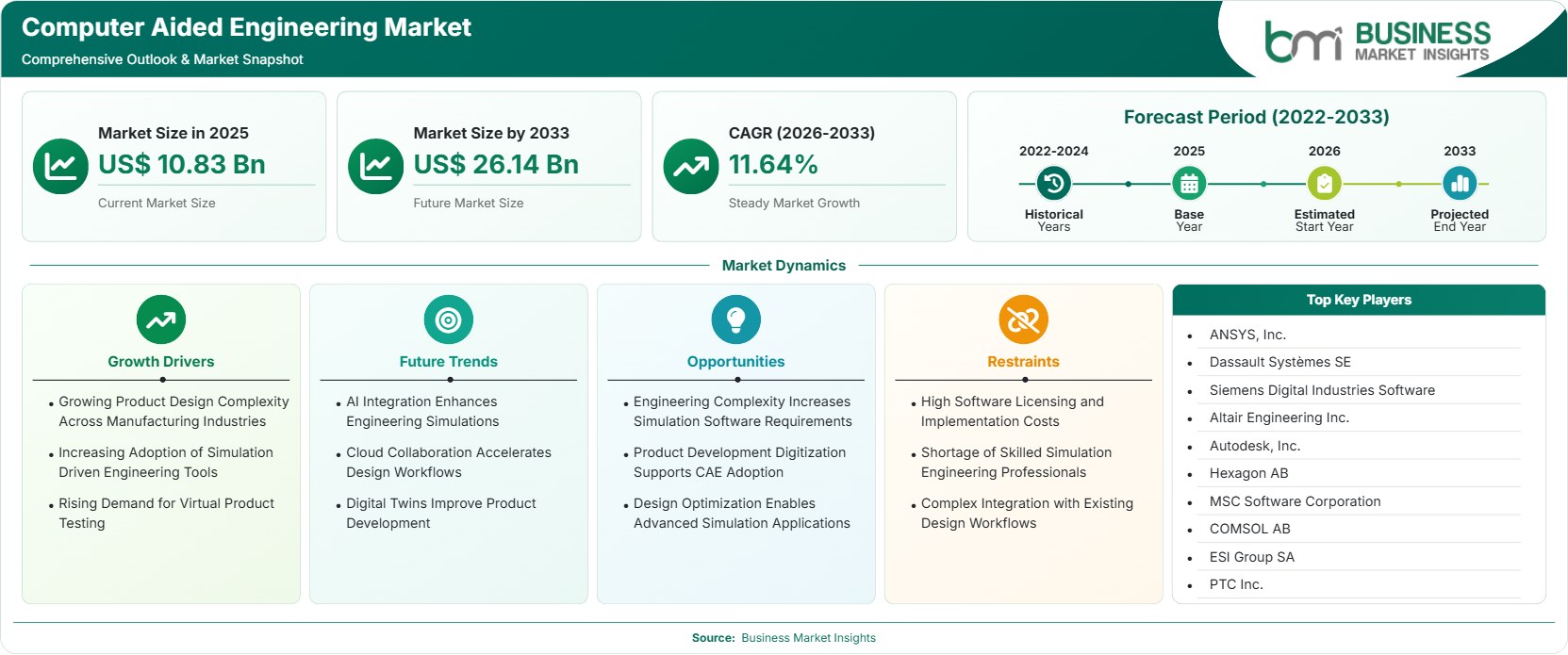
The Computer Aided Engineering Market size was valued at US$ 10.83 Billion in 2025 and is projected to reach US$ 26.14 Billion by 2033, growing at a CAGR of 11.64% during 2026–2033. Key drivers include digital twin adoption, simulation-led product development, EV engineering requirements, and cloud deployment. Opportunities emerge from AI-enabled multiphysics simulation, smart manufacturing, and virtual certification workflows.

Report Coverage
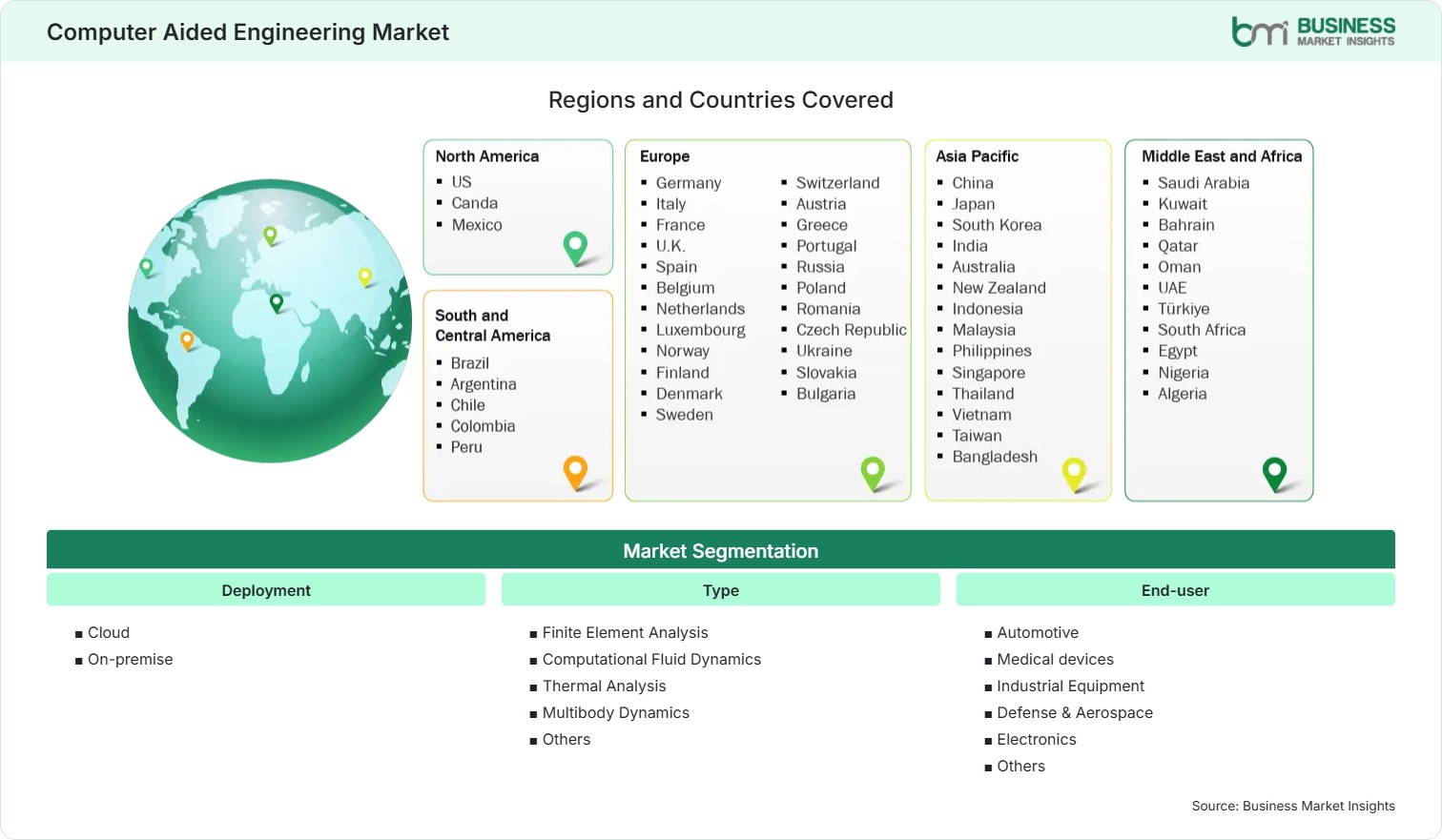
  • Deployment: Cloud, On-premise
  • Type: Finite Element Analysis , Computational Fluid Dynamics , Thermal Analysis, Multibody Dynamics, Others
  • End-user: Automotive, Medical devices, Industrial Equipment, Defense & Aerospace, Electronics, Others
US$ 10.83 Bn Market size in 2025
US$ 26.14 Bn Market Size by 2033
11.64% CAGR, 2026 - 2033
2026-2033 Forecast Period

AI Overview

Computer Aided Engineering Market Summary

  • North America Region: North America holds 36%–39% share in 2025, growing at 10.5%–11.5% CAGR. Drivers include aerospace simulation spending, EV engineering programs, and digital twin deployment. Opportunities stem from cloud-native simulation and AI-integrated design validation. US market benefits from strong industrial software ecosystems and advanced manufacturing investments, expanding at 10.8%–11.8% CAGR.
  • Fastest Growing Region: Asia Pacific holds 27%–30% share in 2025 and advances at 13.0%–14.0% CAGR. Growth is supported by automotive electrification, semiconductor investments, manufacturing modernization, digital engineering adoption, government innovation initiatives, and expanding engineering talent pools.
  • Leading Segment: Finite Element Analysis (FEA) accounts for 34%–37% share in 2025 and grows at 10.8%–11.8% CAGR. Demand is driven by structural simulation requirements, lightweight engineering projects, safety compliance testing, accelerated validation cycles, and reduced prototyping expenditure.
  • High Growth Segment: Cloud deployment represents 38%–42% share in 2025 and advances at 13.5%–14.5% CAGR. Growth reflects scalable computing access, collaboration capabilities, remote engineering workflows, subscription adoption, faster deployment cycles, and reduced infrastructure complexity.
  • Key Market Opportunity: AI-powered engineering simulation creates opportunities through automated model generation, predictive optimization, accelerated design exploration, reduced engineering workloads, enhanced product performance, broader simulation accessibility, and improved innovation efficiency.
  • Major Market Players: ANSYS, Inc.; Dassault Systèmes SE; Siemens Digital Industries Software; Altair Engineering Inc.; Autodesk, Inc.; Hexagon AB; MSC Software Corporation; COMSOL AB; ESI Group SA; PTC Inc.
Strategic Insights

Computer Aided Engineering Market: Strategic Insights

Computer Aided Engineering Market Strategic Framework
FREE PDF
Request your free sample
Request free sample
Stakeholder View

Key Takeaways

  • The value chain is evolving from standalone simulation software toward integrated digital engineering ecosystems connecting design, manufacturing, testing, and lifecycle management platforms.
  • Automotive electrification and medical-device engineering offer some of the strongest commercial opportunities because they require extensive validation, safety testing, thermal modeling, and regulatory documentation.
  • AI-assisted simulation, generative engineering, and real-time digital twins are becoming central R&D priorities, reducing iteration cycles while improving engineering productivity.
  • Asia Pacific presents the strongest regional investment case due to manufacturing expansion, engineering workforce growth, and significant public support for digital industrialization initiatives.
  • Industry consolidation is increasing as major industrial software providers acquire specialized simulation vendors to strengthen multiphysics, HPC, and AI capabilities.
  • Demand from semiconductor and electronics manufacturers is broadening simulation applications beyond mechanical domains into thermal, electromagnetic, and systems-level engineering.
Geographic Outlook

Computer Aided Engineering Market Regional Highlights

North America Computer Aided Engineering Market

Market share held by North America was around 36%–39% during 2025 and is anticipated to grow at a CAGR of 10.5%–11.5% till 2033. The region has a well-developed sector of aerospace, automotive, defense, and industrial automation, which helps invest in software. High-performance computing and digital engineering lead the region. The Computer Aided Engineering Market share remains concentrated among large enterprises, though cloud deployment increasingly attracts small and medium businesses seeking scalable engineering capabilities and faster product validation.

  • Aerospace manufacturers increasingly adopt digital twins and advanced simulation to reduce development timelines and improve certification outcomes.
  • Automotive companies continue integrating simulation into EV platform engineering, battery thermal management, and lightweight vehicle development.
  • Industrial manufacturers invest in virtual commissioning and predictive design validation to enhance operational efficiency and reduce prototyping costs.
  • AI-enabled engineering platforms improve design optimization and simulation accessibility across enterprise engineering environments.

US Computer Aided Engineering Market

The United States represents approximately 72%–76% of North American Computer Aided Engineering Market revenue and records a CAGR of 10.8%–11.8% through 2033. The federal government encourages spending on advanced manufacturing, aerospace technology innovations, and semiconductor manufacturing growth. Engineering companies continue to digitize their processes, which increases the need for cloud-based solutions and digital threads.

  • Aerospace and defense spending encourages development of sophisticated simulation environments supporting complex program requirements.
  • Semiconductor expansion initiatives increase demand for thermal, structural, and multiphysics engineering analysis solutions.
  • Cloud adoption supports collaboration among geographically distributed engineering teams and supply-chain partners.
  • Universities and research institutes continue strengthening engineering software adoption through simulation-driven innovation programs.

Europe Computer Aided Engineering Market

Europe holds approximately 25%–28% of the Computer-Aided Engineering Market share in 2025 and is growing at a 10.8%–11.8% CAGR. Germany is still the leader among them, while Eastern Europe offers better growth prospects as its CAGRs surpass those of other regions. The reasons for their adoption include sustainability legislation, electric cars, and Industry 4.0. More engineering-focused sectors increasingly employ virtual validation and simulation-based design practices.

  • Germany leads regional revenues through strong automotive, machinery, and industrial software ecosystems.
  • France benefits from aerospace engineering investments and advanced manufacturing modernization initiatives.
  • Nordic countries support adoption through digitalization and industrial sustainability programs.
  • Poland and Czech Republic demonstrate higher growth due to manufacturing expansion and engineering outsourcing activities.

Asia Pacific Computer Aided Engineering Market

Asia Pacific represents 27%–30% Computer Aided Engineering Market share in 2025 and is forecast to expand at 13.0%–14.0% CAGR, making it the fastest-growing region. Demand in the region is being driven by China, while India is growing fastest. Manufacturing capacity expansion, electronics production, and automotive innovation enable wide-scale adoption. Engineering software companies are investing in the region due to increased simulation and design workloads.

  • China drives adoption through automotive, aerospace, electronics, and smart manufacturing investments.
  • India benefits from engineering service growth, digital transformation initiatives, and expanding industrial capabilities.
  • Japan maintains strong demand from automotive and precision manufacturing industries.
  • South Korea accelerates deployment through semiconductor and electronics engineering requirements.
  • Regional talent availability supports broader enterprise adoption of simulation technologies.

Rest of World Computer Aided Engineering Market

Rest of World accounts for approximately 8%–10% Computer Aided Engineering Market share and advances at 11.5%–12.5% CAGR. South and Central America have advantages in terms of modernization activities and investment in the automotive industry. Markets in the Middle East and Africa exhibit more adoption through investments in infrastructure, energy, aerospace, and manufacturing diversification. The region is continually developing its engineering skills in order to be more competitive.

  • Brazil remains the leading South American market, supported by industrial and transportation manufacturing activity.
  • Mexico benefits from supply-chain shifts and growth in advanced manufacturing operations.
  • UAE drives Middle Eastern adoption through aerospace, smart industry, and digital transformation initiatives.
  • Saudi Arabia supports engineering software investment through industrial diversification programs.
  • South Africa remains a significant African market for engineering and industrial simulation applications.
Global Market Geography
FREE PDF
Request your free sample
Request free sample
Segment Analysis

Computer Aided Engineering Market Segmentation

Deployment

Deployment generated a major portion of industry revenue. On-premise solutions retained strong adoption among highly regulated industries, while cloud platforms recorded faster expansion. This segment accounted for roughly 38%–42% share for cloud environments in 2025 and is expected to expand at 13.5%–14.5% CAGR. The Computer Aided Engineering Market scope continues widening as scalable infrastructure removes computational barriers.

  • Cloud: Supports scalable computing, distributed engineering collaboration, subscription-based access, and faster deployment for enterprises requiring simulation resources without extensive infrastructure investment.
  • On-premise: Preferred by organizations handling sensitive engineering data, supporting customized workflows, regulatory requirements, and integration with established enterprise systems.

Type

Type segmentation remains heavily influenced by simulation complexity and industry requirements. FEA maintained leadership with 34%–37% share in 2025 and a projected 10.8%–11.8% CAGR due to extensive use in structural validation and optimization across engineering-intensive sectors.

  • Finite Element Analysis (FEA): Widely used for stress, durability, vibration, and structural performance evaluation across automotive, aerospace, industrial equipment, and medical applications.
  • Computational Fluid Dynamics (CFD): Gains momentum from thermal management, aerodynamic optimization, fluid-flow analysis, and energy-efficiency improvement projects.
  • Thermal Analysis: Essential for electronics, EV batteries, industrial systems, and semiconductor applications requiring temperature management and reliability testing.
  • Multibody Dynamics: Supports motion simulation, system behavior assessment, and mechanical performance optimization in transportation and machinery applications.

End-user

End-user demand is led by automotive manufacturers, supported by vehicle electrification and autonomous technology development. The segment contributes about 26%–29% share in 2025 and maintains strong growth through simulation-driven product development and regulatory compliance requirements.

  • Automotive: Extensive use in crash simulation, battery validation, durability assessment, aerodynamics, and vehicle performance optimization.
  • Medical devices: Rising deployment for virtual testing, compliance documentation, implant design, and accelerated product development.
  • Industrial Equipment: Enables performance optimization, predictive engineering, lifecycle efficiency improvements, and reduced prototype requirements.
  • Defense & Aerospace: Requires advanced simulation for structural integrity, mission-critical reliability, certification, and operational performance.
  • Electronics: Driven by thermal management, miniaturization challenges, electromagnetic considerations, and semiconductor design validation.
Market Forces

Computer Aided Engineering Market Dynamics

Key Market Drivers

Expansion of Digital Twin and Simulation-Driven Engineering

Digital twin adoption is transforming engineering operations by enabling continuous product performance monitoring, virtual testing, and lifecycle optimization. Simulation is becoming an integral part of IoT and operational data that manufacturers are using for better decision-making and the reduction of risk involved in design. The aerospace, automotive, and industrial industries are focusing on digital engineering approaches to make the development process more efficient. The importance of efficiency, sustainability, and customization keeps boosting demand. The use of simulation systems plays a key role in this area.

Growth of Electric Vehicle and Advanced Mobility Programs

EV development requires extensive structural, thermal, battery, and aerodynamic simulation. Automobile manufacturers use engineering software to test their products with respect to their safety, reliability, and energy efficiency in a virtual environment before actual manufacturing. Investment made worldwide in the area of EVs is consistently growing, and therefore, there is a great demand for virtual testing and validation software. Software-defined cars, connected mobility, and lightweight materials are adding more simulation needs.

Cloud Computing and High-Performance Computing Accessibility

Cloud infrastructure enables engineering organizations to access powerful simulation resources without substantial capital expenditure. Simulation in an HPC environment allows modeling, optimizations, and multiphysics simulations that have been possible up to now only for big companies. Advances in the field of GPU computation, parallel processing, and distributed computing enable faster simulations. They allow a wider distribution of simulations in medium-sized companies, engineering service providers, and scientific organizations. Improved computational power enables AI-based simulations as well.

Key Market Opportunities

AI-Powered Simulation and Engineering Automation

Simulation engineering using Artificial Intelligence is changing product development via meshing automation, prediction modeling, design space exploration, and engineering optimization. The application of artificial intelligence within simulation processes will help reduce the manual effort required in these processes, making it faster and more accurate. These AI-based systems allow engineers to evaluate complex situations and select the best design. With the adoption of intelligent engineering systems by industries, development practices are likely to change substantially. Long-term Computer Aided Engineering Market forecasts highlight strong growth opportunities for vendors offering scalable, AI-enabled engineering ecosystems and innovative digital solutions.

Virtual Certification Across Regulated Industries

There is an increasing trend among regulatory agencies to accept simulation technology as a reliable way of assessing, verifying, and ensuring compliance. Sectors like the medical devices industry, aerospace, and the automotive industry have taken advantage of the benefits provided by virtual testing to reduce the expenses, efforts, and time involved in conducting physical tests. Current Computer Aided Engineering Market Trends indicate that Vendors that provide robust traceability, compliance documentation, audit readiness, and certification workflows are well-positioned to capture growing demand as regulated industries accelerate digital transformation initiatives.

Industrial Digitalization in Emerging Economies

Emerging economies are rapidly investing in industrial digitalization through smart manufacturing, automation, robotics, and advanced engineering technologies. This is creating a high demand for software applications that can help with efficient design optimization, process simulation, digital twin, and virtual testing software to increase efficiency while lowering costs associated with development. The growth of skilled engineering labor force, robust industrial infrastructure, and favorable government policies is promoting the use of software. Software providers that can offer cloud-based, scalable solutions and local expertise have bright prospects in the future.

Market Restraints and Challenges

High Implementation Complexity and Skills Gap

Advanced engineering environments often require specialized expertise in modeling, simulation techniques, and data interpretation to achieve optimal results. As a result, organizations frequently encounter long deployment timelines, significant training investments, and challenges in recruiting skilled professionals. These talent shortages can limit the effective utilization of simulation tools and reduce overall productivity. Small and medium-sized enterprises are particularly affected, as limited budgets and technical resources make it difficult to maximize returns on sophisticated simulation investments. Furthermore, implementation complexity increases project risks and creates ongoing dependence on highly specialized engineering teams for system operation, maintenance, and continuous improvement.

Data Security and Intellectual Property Concerns

Cloud-based engineering platforms require organizations to transfer, process, and store highly sensitive product, design, and operational data in digital environments. This creates concerns regarding data security, unauthorized access, cyberattacks, and intellectual property protection. Industries such as defense, aerospace, automotive, and other regulated sectors often face strict compliance standards that can delay adoption. Additionally, regional data residency requirements, governance frameworks, and cybersecurity regulations may increase implementation costs and complexity. For multinational engineering organizations, ensuring consistent security controls across global operations remains a significant challenge, slowing modernization efforts.

Company Analysis

Competitive Landscape

The Computer Aided Engineering Market analysis reflects a competitive environment shaped by simulation platform integration, cloud transformation, AI capabilities, and digital twin innovation.

Company Name

Overview

Products and Services relevant to this market

ANSYS, Inc.

Global leader in engineering simulation with strong presence across aerospace, automotive, and electronics industries.

Structural simulation, CFD, digital twins, embedded software validation, multiphysics engineering platforms.

Dassault Systèmes SE

Major industrial software provider integrating simulation with product lifecycle management environments.

SIMULIA, 3DEXPERIENCE, structural analysis, fluid simulation, design optimization solutions.

Siemens Digital Industries Software

Provides integrated engineering and digital twin capabilities for manufacturing enterprises.

Simcenter portfolio, multiphysics simulation, systems engineering, digital twin technologies.

Altair Engineering Inc.

Known for simulation, HPC, and AI-driven engineering innovation.

HyperWorks, optimization tools, data analytics, engineering simulation software.

Autodesk, Inc.

Expands simulation functionality through cloud-connected design and engineering solutions.

Fusion ecosystem, generative design, simulation, engineering collaboration platforms.

Hexagon AB

Strong engineering technology portfolio serving industrial and manufacturing customers globally.

Engineering analysis software, digital engineering solutions, simulation technologies.

MSC Software Corporation

Established specialist with extensive heritage in structural and motion simulation.

MSC Nastran, Adams, structural analysis, multibody dynamics solutions.

COMSOL AB

Specialist provider focused on multiphysics simulation applications.

COMSOL Multiphysics, modeling environments, engineering research solutions.

ESI Group SA

Focused on virtual prototyping and predictive engineering technologies.

Virtual testing, manufacturing simulation, digital engineering platforms.

PTC Inc.

Integrates engineering software with product lifecycle and digital thread strategies.

Digital engineering tools, lifecycle management, simulation-enabled development solutions.

Trust & Transparency

Research Methodology

The market analysis combines proprietary research with secondary data from government agencies, company disclosures, regulatory filings, industry databases and expert interviews. Market estimates are validated through data triangulation, cross-market benchmarking and analyst review.

View Full Research Methodology

Questions Answered

Frequently Asked Questions

What does the Computer Aided Engineering Market Report indicate about competition?

The market is increasingly shaped by consolidation, AI integration, cloud migration, and digital twin investments as leading software vendors broaden engineering simulation capabilities through acquisitions and platform expansion.

How is artificial intelligence influencing engineering software?

AI supports automated model preparation, optimization, predictive simulation, and design exploration, helping engineering teams reduce development time while improving product performance.

Why is cloud deployment gaining popularity?

Cloud environments provide scalable computing resources, remote collaboration, subscription pricing, and faster access to advanced simulation capabilities without extensive infrastructure investment.

Which industry generates the strongest demand for CAE solutions?

Automotive remains a leading adopter due to heavy use in crash testing, battery development, structural validation, aerodynamics, and electric vehicle engineering programs.

What factors are accelerating adoption of engineering simulation platforms?

Growing product complexity, EV development, digital twins, cloud computing, and pressure to reduce prototyping costs are accelerating adoption of simulation-based engineering approaches across industries.

Access the Full Computer Aided Engineering Market Report

Get segment-level forecasts, regional estimates, competitive benchmarking, company profiles and downloadable Excel datasets.

Access the full Computer Aided Engineering Market Report
350 pages PDF & Excel | 2026-09-21
Similar Research

Related Market Reports