
Computer Vision Market Outlook: Size, Share, Trends, Growth Analysis, Competitive Landscape & Forecast, 2026-2033

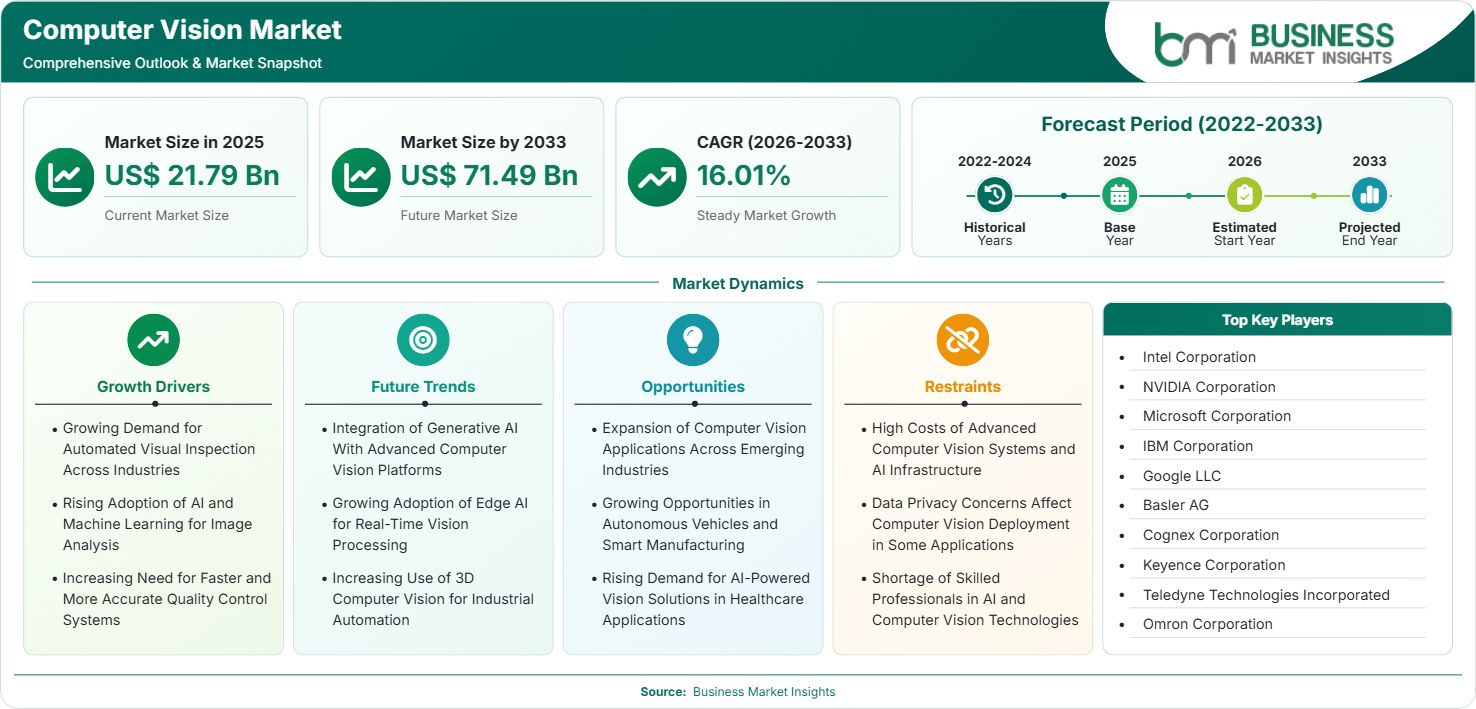
The Computer Vision Market size was valued at US$ 21.79 Billion in 2025 and is projected to reach US$ 71.49 Billion by 2033, growing at a CAGR of 16.01% during 2026–2033, driven by automated inspection, AI-enabled image analysis, intelligent manufacturing, autonomous mobility, healthcare imaging, and expanding industrial automation.

Report Coverage
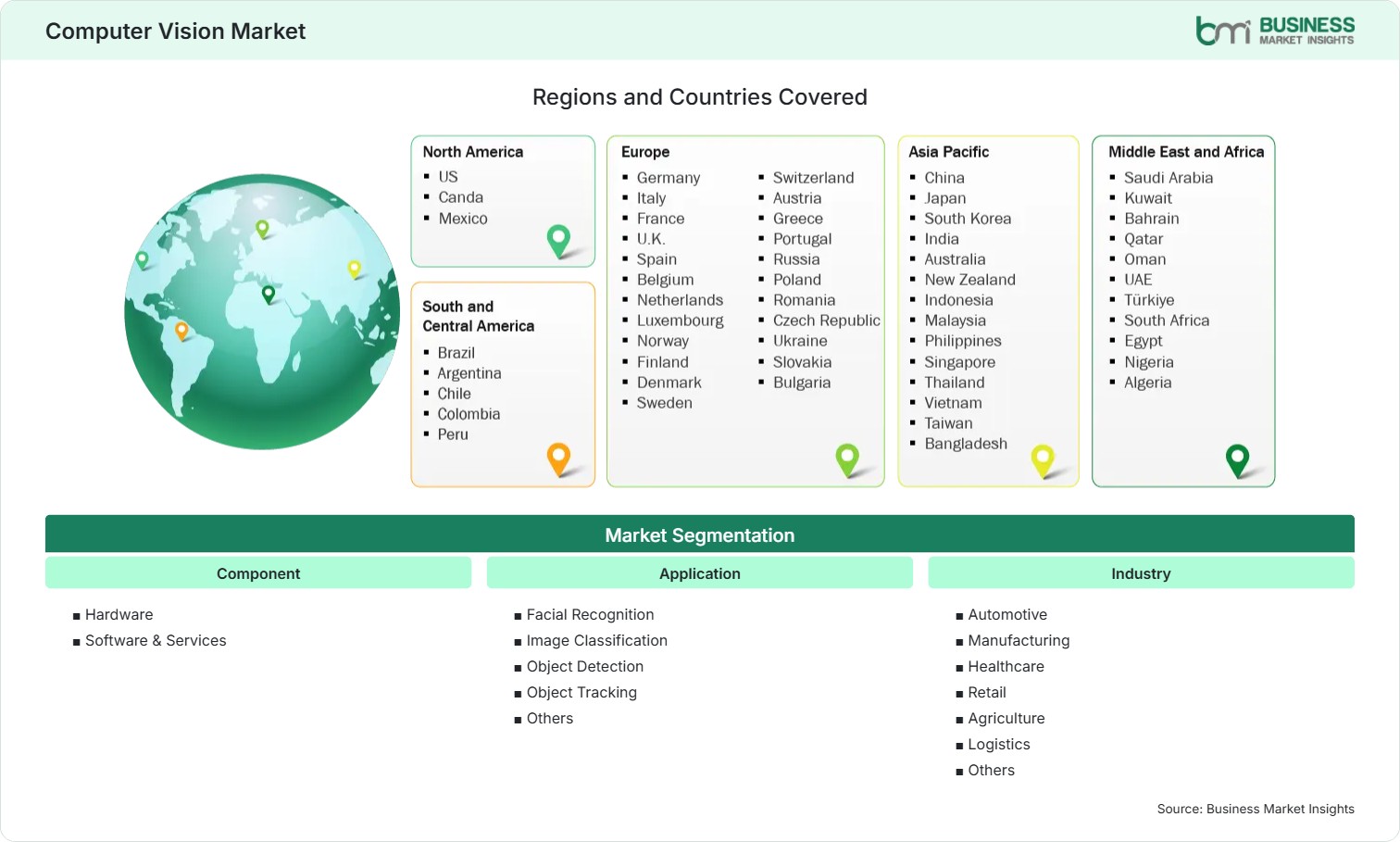
  • Component: Hardware, Software & Services
  • Application: Facial Recognition, Image Classification, Object Detection, Object Tracking, Others
  • Industry: Automotive, Manufacturing, Healthcare, Retail, Agriculture, Logistics, Others
US$ 21.79 Bn Market size in 2025
US$ 71.49 Bn Market Size by 2033
16.01% CAGR, 2026 - 2033
2026-2033 Forecast Period

AI Overview

Computer Vision Market Summary

  • North America Region: North America holds a 34%–38% share in 2025 and is projected to grow at a 15.0%–17.0% CAGR during 2026–2033, supported by advanced AI infrastructure, technology investment, autonomous systems, industrial automation, and strong software ecosystems. The US market is projected to grow at a 15.5%–17.5% CAGR through 2033, supported by AI investment, cloud computing, semiconductor capabilities, autonomous vehicles, and enterprise adoption.
  • Fastest Growing Region: Asia Pacific accounts for a 28%–32% share in 2025 and is projected to expand at a 18.0%–21.0% CAGR through 2033, driven by manufacturing automation, smart factories, electronics production, robotics adoption, expanding AI investment, and government-supported digital transformation across China, Japan, South Korea, and India.
  • Leading Segment: Component, Software & Services represents a 58%–63% share in 2025 and is projected to grow at a 17.0%–19.0% CAGR through 2033, supported by cloud-based vision analytics, AI models, computer vision algorithms, software integration, recurring services, and demand for scalable enterprise solutions.
  • High Growth Segment: Industry, Healthcare represents a 9%–13% share in 2025 and is projected to grow at a 19.0%–22.0% CAGR through 2033, driven by medical imaging, clinical decision support, automated diagnostics, surgical assistance, workflow optimization, and AI-enabled healthcare analytics.
  • Key Market Opportunity: Expansion into emerging industries, autonomous vehicles, smart manufacturing, precision agriculture, logistics automation, and AI-powered healthcare creates opportunities for scalable vision platforms, edge computing, and specialized applications.
  • Major Market Players: Intel Corporation, NVIDIA Corporation, Microsoft Corporation, IBM Corporation, Google LLC, Basler AG, Cognex Corporation, Keyence Corporation, Teledyne Technologies Incorporated, and Omron Corporation.
Strategic Insights

Computer Vision Market: Strategic Insights

Computer Vision Market Strategic Framework
FREE PDF
Request your free sample
Request free sample
Stakeholder View

Key Takeaways

  • The ecosystem is interconnecting semiconductor makers, camera producers, artificial intelligence platform makers, software creators, system integration companies, cloud companies, and industrial automation companies. The competitive edge is moving towards systems which integrate sensing, computing, algorithms, and analytics.
  • Manufacturing provides high-value opportunity since automated visual inspection could increase consistency and decrease manual inspection. Automotive, electronics, pharmaceutical, and food processing industry provide strong use cases.
  • AI development is moving computer vision beyond conventional classification toward multimodal perception, generative AI, 3D vision, and real-time edge inference. These capabilities are expanding the addressable opportunity across autonomous systems and intelligent automation.
  • Asia Pacific provides a compelling investment case because of its manufacturing concentration, robotics adoption, electronics production, and rapid development of smart factories. China, Japan, South Korea, and India offer distinct growth opportunities.
  • Strategic investments increasingly target AI infrastructure, specialized chips, edge computing, industrial software, and vertical applications. Partnerships between technology providers and industrial users can accelerate commercialization and strengthen ecosystem positioning.
  • Data governance is becoming a strategic consideration as facial recognition, healthcare imaging, and workplace monitoring applications raise requirements related to consent, privacy, cybersecurity, and responsible AI deployment.
Geographic Outlook

Computer Vision Market Regional Highlights

North America Computer Vision Market

North America held a 34%–38% of global computer vision market share in 2025 and is projected to grow at a 15.0%–17.0% CAGR through 2033. The area has access to advanced AI technologies, robust technology investments, developed cloud infrastructure, and early adopters of enterprises. North America’s demand is dominated by the United States in terms of its technology landscape and high concentration of AI technology developers, semiconductor companies, and autonomous vehicles projects. Artificial intelligence research and industrial automation are areas in which Canada plays an important role. AI investment in the technology and industrial sectors is boosting the use of computer vision.

  • Autonomous vehicle development is creating demand for advanced perception systems combining cameras, sensors, edge processors, and AI algorithms to interpret complex environments with low latency.
  • Healthcare providers are evaluating computer vision for medical imaging, clinical workflows, surgical assistance, and diagnostic support, creating opportunities for specialized solutions with strong regulatory compliance.

US Computer Vision Market

The US represented approximately 29%–33% of global demand in 2025 and US computer vision market forecast to grow at a 15.5%–17.5% CAGR through 2033. Strong AI infrastructure, semiconductor capabilities, cloud computing, and technology investment support adoption across industries. Technology companies and industrial automation providers are developing increasingly integrated solutions that combine advanced processors, cameras, AI models, and analytics.

  • Technology investment supports rapid development of AI models, specialized processors, and cloud-based vision platforms, enabling enterprises to deploy sophisticated image analysis across increasingly diverse workflows.
  • Manufacturing companies are adopting automated inspection to improve production consistency, identify defects earlier, and reduce dependence on manual quality-control processes.
  • Healthcare applications are expanding as AI-assisted imaging and clinical analysis gain attention, although regulatory requirements and validation standards influence commercialization timelines.

Europe Computer Vision Market

Europe computer vision market accounted for a 24%–28% share in 2025 and is projected to grow at a 13.5%–16.0% CAGR through 2033. Germany, the United Kingdom, France, and Italy represent leading markets supported by industrial automation and advanced manufacturing. Germany is projected to grow at a 14.0%–16.0% CAGR, while the United Kingdom represents a high-growth market at 15.0%–17.0%. Automotive production, smart manufacturing, robotics, healthcare innovation, and logistics automation support adoption.

  • Germany remains a major industrial opportunity because automotive manufacturing, robotics, and advanced machinery production create strong demand for automated visual inspection and intelligent factory systems.
  • The United Kingdom provides opportunities through AI research, healthcare innovation, financial technology, logistics, and increasing enterprise investment in intelligent automation.
  • France is expanding applications across aerospace, automotive, manufacturing, and healthcare, supported by industrial digitalization and investment in artificial intelligence capabilities.
  • Italy offers opportunities in industrial machinery, automotive components, food processing, and manufacturing automation, where vision systems can improve inspection accuracy and production efficiency.

Asia Pacific Computer Vision Market

Asia Pacific computer vision market held a 28%–32% share in 2025 and is projected to achieve an 18.0%–21.0% CAGR through 2033, making it the fastest-growing region. China, Japan, South Korea, and India are leading markets, with India projected to grow at 20.0%–23.0% CAGR. Electronics manufacturing, automotive production, robotics, smart factories, and government-backed digitalization are accelerating demand. Expanding AI capabilities and local technology development are strengthening regional ecosystems.

  • China represents a major opportunity due to its extensive manufacturing base, electronics production, robotics deployment, and large-scale investment in industrial automation and artificial intelligence.
  • Japan benefits from advanced robotics and automotive industries, supporting demand for high-precision machine vision, inspection systems, and intelligent factory applications.
  • South Korea is expanding computer vision adoption across electronics, semiconductor manufacturing, automotive production, and smart factories requiring high-speed automated inspection.
  • India represents a high-growth opportunity as industrial digitalization, logistics modernization, healthcare technology, and AI investment expand demand for scalable vision solutions.

Rest of World Computer Vision Market

South and Central America computer vision market accounted for approximately 6%–9% of global demand in 2025 and are projected to grow at a 14.0%–17.0% CAGR through 2033. Brazil and Mexico lead regional opportunities, supported by manufacturing, agriculture, logistics, and retail automation.

  • Brazil offers opportunities in agriculture, manufacturing, logistics, and retail as enterprises increasingly evaluate computer vision for productivity improvement, automated inspection, and operational monitoring.
  • Mexico benefits from automotive manufacturing and industrial investment, creating demand for machine vision systems supporting quality control, assembly inspection, and production automation.
  • The UAE and Saudi Arabia are investing in smart infrastructure, security, logistics, and digital transformation, creating opportunities for AI-enabled visual analytics and intelligent monitoring.
  • South Africa provides potential applications across mining, manufacturing, agriculture, and security, where computer vision can support operational efficiency and automated monitoring.
Global Market Geography
FREE PDF
Request your free sample
Request free sample
Segment Analysis

Computer Vision Market Segmentation

Component

Software & Services represented a 58%–63% of global computer vision market share in 2025 and is projected to grow at a 17.0%–19.0% CAGR during 2026–2033. Software enables algorithm development, AI model deployment, image analytics, and integration with enterprise systems, while services support implementation and maintenance.

  • Hardware: Cameras, sensors, processors, and specialized accelerators provide the physical foundation for vision applications. Higher resolution, edge processing, and improved sensing capabilities are supporting advanced industrial and autonomous deployments.
  • Software & Services: AI algorithms, analytics platforms, development tools, integration, consulting, and maintenance enable scalable deployment. Demand is increasing as enterprises seek customized solutions and recurring software-based capabilities.

Application

Object Detection represented a 25%–30% share in 2025 and is projected to grow at a 18.0%–21.0% CAGR during 2026–2033. Detection technologies identify and localize objects within images or video streams, supporting industrial inspection, autonomous systems, logistics, security, and retail.

  • Facial Recognition: Facial recognition supports identity verification, access control, security, and customer authentication. Adoption is influenced by accuracy improvements, regulatory requirements, privacy concerns, and responsible AI governance.
  • Image Classification: Classification systems categorize images according to predefined characteristics, supporting medical imaging, quality inspection, agriculture, retail, and automated content analysis applications.
  • Object Detection: Object detection identifies and localizes specific objects within visual data, enabling automated inspection, autonomous navigation, security monitoring, inventory management, and logistics optimization.
  • Object Tracking: Tracking technologies follow objects across video frames, supporting traffic monitoring, robotics, autonomous mobility, warehouse operations, sports analytics, and security applications requiring continuous movement analysis.

Industry

Manufacturing represented a 24%–29% share in 2025 and is projected to grow at a 16.0%–19.0% CAGR during 2026–2033. Industrial facilities increasingly deploy computer vision for inspection, assembly verification, process monitoring, and worker safety.

  • Automotive: Automotive manufacturers use computer vision for automated inspection, assembly verification, driver assistance, autonomous perception, and production monitoring, supporting higher accuracy and increasingly automated manufacturing processes.
  • Manufacturing: Manufacturing applications focus on defect detection, quality control, dimensional inspection, and process monitoring. Vision systems help improve consistency and enable high-speed inspection across production lines.
  • Healthcare: Healthcare applications include medical imaging, diagnostic support, surgical assistance, and workflow automation. AI-enabled image analysis is expanding opportunities while regulatory validation and clinical accuracy remain essential.
  • Retail: Retailers deploy computer vision for inventory monitoring, checkout automation, customer analytics, shelf management, and security, supporting operational efficiency and improved visibility across physical stores.
  • Agriculture: Agricultural applications include crop monitoring, disease detection, yield assessment, weed identification, and precision farming, enabling data-driven decisions and reducing reliance on manual field inspection.
  • Logistics: Logistics operators use computer vision for parcel identification, warehouse automation, inventory tracking, robotic navigation, and shipment verification, improving throughput and operational accuracy.
Market Forces

Computer Vision Market Dynamics

Key Market Drivers

Growing Demand for Automated Visual Inspection Across Industries

Manufacturing companies are turning to automated visual inspection technology to improve quality consistency, reduce manual inspection needs, and detect product defects earlier in production processes. Computer vision technology enables rapid product inspection, making it applicable to manufacturing industries, including automotive, electronics, pharmaceuticals, food, and industrial machinery. In contrast to manual inspection conducted by humans, computer vision systems can operate around the clock with uniform standards across all product batches. This technology will help meet the growing need for advanced inspection techniques driven by increased product complexity in manufacturing operations. These developments are strengthening the role of automated inspection in industrial quality management.

Rising Adoption of AI and Machine Learning for Image Analysis

AI and machine learning technologies are enhancing the abilities of computer vision technology by allowing computer vision systems to recognize complicated patterns, classify the information, and adapt to more varied data sets. Deep learning algorithms can boost detection performance in difficult environments where rule-based approaches might struggle. Businesses are implementing AI-based image analysis technology in order to monitor quality, secure their operations, provide medical imaging services, analyse shopper behaviours in stores, perform agricultural tasks, and implement autonomous systems.

Increasing Need for Faster and More Accurate Quality Control Systems

Manufacturers worldwide are facing the challenge of increasing manufacturing efficiency while adhering to quality control measures and reducing waste. Computer vision enables automated inspection of products on a production-line basis, applying consistent standards to their assessment. In the manufacture of automobiles and electronics, even the smallest production flaws can lead to costly recalls and malfunctions, underscoring the need for effective detection. Additionally, computer vision enables monitoring of processes on the production line, allowing the operator to detect discrepancies before they affect entire batches of products.

Key Market Opportunities

Expansion of Computer Vision Applications Across Emerging Industries

Computer vision is evolving from traditional industrial inspection systems to new areas such as agriculture, logistics, construction, energy, insurance, and smart infrastructure. Visual analysis in agriculture will help with crop monitoring and disease identification; visual technology in logistics can be used for parcel sorting, inventory management, and the automation of warehouse operations. Construction organizations will be able to assess on-site progress and safety by analyzing visual data. Energy firms will be able to inspect infrastructure and identify the need for maintenance. This will open new avenues for vendors specializing in developing algorithms for specific industries.

Growing Opportunities in Autonomous Vehicles and Smart Manufacturing

Autonomous driving and smart manufacturing are key fields where computer vision will continue to expand. Autonomous vehicles need advanced visual capabilities to detect road conditions, objects, pedestrians, and other cars in real time. Similarly, smart manufacturing needs vision systems to conduct inspections, control robots, monitor manufacturing processes, and make decisions. Some of the latest developments in edge AI, 3D sensing, high-resolution cameras, and specialized processors are contributing to improved system performance and are considered a major computer vision market trend.

Rising Demand for AI-Powered Vision Solutions in Healthcare Applications

Opportunities for computer vision in healthcare are rapidly growing as healthcare professionals are looking for solutions that analyse big data amounts and streamline the workflow. AI-driven vision solutions can be used for radiology, pathology, ophthalmology, dermatology, surgical planning, and patient monitoring. Computer vision technology will help doctors to detect patterns and select cases to prioritize, thus making their work easier. Moreover, the use of computer vision goes beyond diagnosis, as it can be applied for administrative and operational tasks, such as tracking the movement of patients within the facilities.

Market Restraints and Challenges

High Costs of Advanced Computer Vision Systems and AI Infrastructure

Factor: Implementing computer vision solutions requires high-definition cameras, dedicated processors, artificial intelligence chips, edge computers, software, data storage, integration capabilities, and professional personnel. The overall costs may be relatively high for enterprises implementing such solutions across multiple sites or assembly lines. Impact: The high initial investment might slow implementation within small and medium-sized companies and limit the adoption of computer vision systems in sensitive sectors where cost is critical. Companies might focus on narrower implementations that demonstrate ROI first, rather than transforming the entire company.

Data Privacy Concerns Affect Computer Vision Deployment in Some Applications

Factor: Computer vision technology can analyse visually sensitive data, including faces, personnel, clients, patients, vehicles, and private spaces. Technologies like facial recognition and office surveillance may require consent, data management, cybersecurity measures, and compliance with privacy legislation. Impact: Uncertainty around regulations and concerns about surveillance and information misuse could slow implementation and broaden the compliance burden.

Company Analysis

Competitive Landscape

The Computer Vision Market analysis is increasingly defined by competition across AI computing, machine vision hardware, image processing software, industrial automation, and cloud platforms. Large technology companies are expanding AI capabilities, while specialized machine vision providers focus on high-precision industrial applications.

Company Name

Overview

Products and Services relevant to this market

Intel Corporation

Global semiconductor company providing computing and edge technologies that support AI-enabled vision processing across enterprise and industrial environments.

CPUs, AI accelerators, edge computing platforms, OpenVINO toolkit, computer vision development capabilities, and industrial AI solutions.

NVIDIA Corporation

Leading AI computing company providing accelerated hardware and software platforms for advanced image processing and machine learning applications.

GPUs, Jetson platforms, CUDA, TensorRT, Metropolis, AI development tools, and edge computer vision solutions.

Microsoft Corporation

Global technology company offering cloud, AI, and software capabilities that enable scalable computer vision application development.

Azure AI Vision, Azure cloud infrastructure, AI services, machine learning tools, and enterprise computer vision platforms.

IBM Corporation

Technology company providing AI, cloud, analytics, and enterprise solutions supporting computer vision deployment across multiple industries.

IBM watsonx, AI software, computer vision capabilities, cloud services, analytics, and enterprise AI integration solutions.

Google LLC

Technology company with extensive AI and cloud capabilities supporting image recognition, machine learning, and scalable vision application development.

Google Cloud Vision AI, Vertex AI, machine learning tools, image analysis services, and cloud-based AI infrastructure.

Basler AG

Specialized machine vision company providing cameras and imaging components for industrial and non-industrial vision applications.

Industrial cameras, 3D vision, lenses, image processing software, embedded vision, and machine vision accessories.

Cognex Corporation

Machine vision specialist serving manufacturing and logistics applications through intelligent inspection and identification technologies.

Vision sensors, industrial cameras, barcode readers, vision software, deep learning tools, and automated inspection systems.

Keyence Corporation

Industrial automation company offering high-performance machine vision systems designed for inspection, measurement, and manufacturing applications.

Machine vision cameras, vision systems, image processing, measurement systems, sensors, and automated inspection solutions.

Teledyne Technologies Incorporated

Technology company providing advanced imaging and sensing products for industrial, scientific, aerospace, and machine vision applications.

Industrial cameras, imaging sensors, machine vision systems, image processing technologies, and advanced sensing solutions.

Omron Corporation

Industrial automation company integrating machine vision with robotics, inspection, sensing, and manufacturing control technologies.

Vision sensors, smart cameras, inspection systems, industrial robots, automation controllers, and integrated machine vision solutions.

Trust & Transparency

Research Methodology

The market analysis combines proprietary research with secondary data from government agencies, company disclosures, regulatory filings, industry databases and expert interviews. Market estimates are validated through data triangulation, cross-market benchmarking and analyst review.

View Full Research Methodology

Questions Answered

Frequently Asked Questions

What factors should companies evaluate before deploying computer vision?

Organizations should assess accuracy requirements, data availability, hardware infrastructure, processing location, integration complexity, privacy obligations, cybersecurity, scalability, and total cost of ownership.

How does 3D computer vision differ from conventional 2D vision?

2D vision primarily analyzes image characteristics such as color, texture, and shape, while 3D systems capture depth and spatial relationships.

Which industries can benefit from computer vision beyond manufacturing?

Healthcare, agriculture, logistics, retail, automotive, construction, energy, and security are expanding their use of computer vision.

Why is edge computing important in computer vision market report?

Edge computing processes visual data near cameras or devices rather than sending all information to centralized cloud infrastructure.

What is driving the shift from traditional machine vision to AI-based computer vision?

AI-based systems can identify complex patterns and adapt to variable visual conditions more effectively than many rule-based approaches.

Access the Full Computer Vision Market Report

Get segment-level forecasts, regional estimates, competitive benchmarking, company profiles and downloadable Excel datasets.

Access the full Computer Vision Market Report
350 pages PDF & Excel | 2026-08-06