
Aerospace and Defense PCB Market Outlook: Size, Share, Trends, Growth Analysis, Competitive Landscape & Forecast, 2026-2033

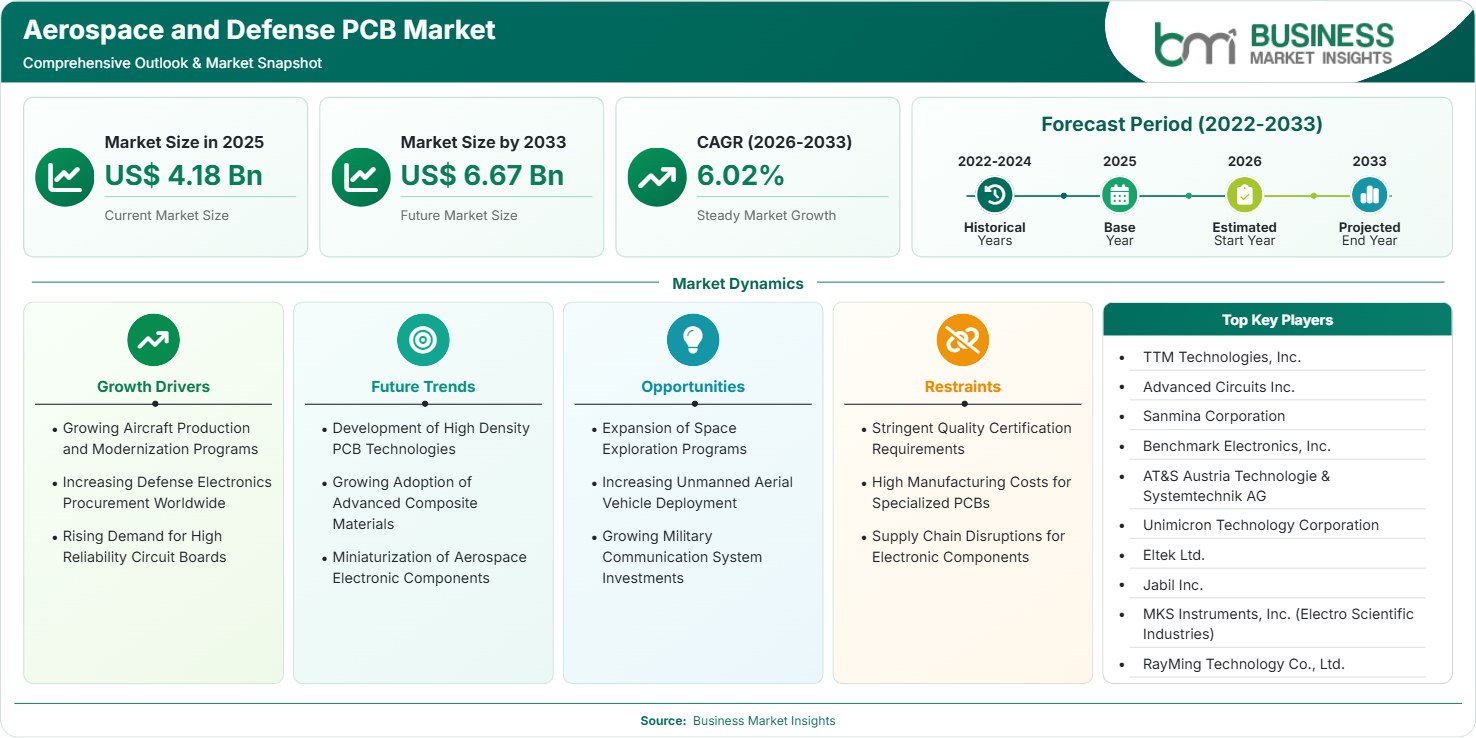
The Aerospace and Defense PCB Market size was valued at US$ 4.18 Billion in 2025 and is projected to reach US$ 6.67 Billion by 2033, growing at a CAGR of 6.02% during 2026–2033. Rising aircraft production, increasing defense electronics procurement, expanding satellite deployment, and growing investments in mission-critical electronic systems continue creating attractive opportunities for certified printed circuit board manufacturers worldwide.

Report Coverage
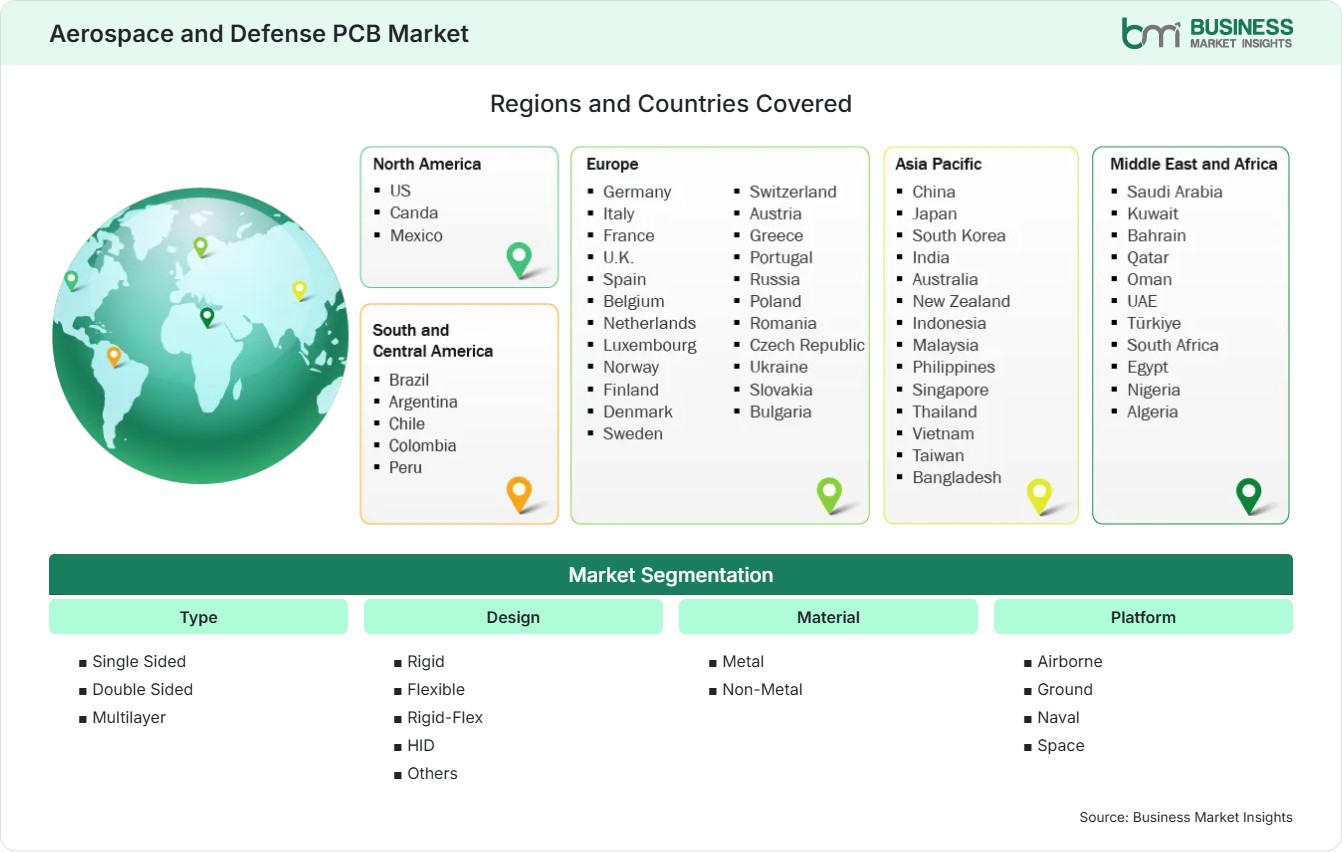
  • Type: Single Sided, Double Sided, Multilayer
  • Design: Rigid, Flexible, Rigid-Flex, HID, Others
  • Material: Metal, Non-Metal
  • Platform: Airborne, Ground, Naval, Space
  • Application: Navigation Systems, Communication Systems, Lighting Systems, Weapon Systems, Power Supply, Command & Control Systems, Others
US$ 4.18 Bn Market size in 2025
US$ 6.67 Bn Market Size by 2033
6.02% CAGR, 2026 - 2033
2026-2033 Forecast Period

AI Overview

Aerospace and Defense PCB Market Summary

  • North America Region: North America accounts for 36%–39% of global revenue in 2025 and is expected to register a 5.7%–6.0% CAGR during 2026–2033. Strong defense budgets, aircraft manufacturing, and advanced avionics production continue driving demand. The United States remains the regional leader through extensive aerospace manufacturing capabilities, continuous military modernization, and increasing investments in domestic electronics production, expanding at 5.8%–6.1% CAGR.
  • Fastest Growing Region: Asia Pacific holds 24%–27% market share in 2025 and is forecast to expand at a 7.0%–7.4% CAGR during 2026–2033. Growth is supported by indigenous defense manufacturing, commercial aviation expansion, semiconductor investments, satellite programs, and government initiatives promoting localized aerospace electronics production.
  • Leading Segment: Multilayer PCBs represent 49%–53% of market revenue in 2025 and are projected to grow at a 6.3%–6.6% CAGR through 2033. Increasing integration of avionics, radar systems, communication equipment, and electronic warfare platforms continues driving demand for compact, high-density circuit board solutions.
  • High Growth Segment: Space platforms account for 12%–15% market share in 2025 while recording the highest 7.5%–8.0% CAGR during the forecast period. Rising satellite constellations, national security programs, and commercial launch activities continue strengthening demand for radiation-resistant and highly reliable PCB technologies.
  • Key Market Opportunity: Expansion of satellite manufacturing, unmanned defense platforms, and localized aerospace electronics production creates significant opportunities for suppliers offering advanced multilayer, rigid-flex, and high-density interconnect PCB solutions.
  • Major Market Players: TTM Technologies, Inc., Advanced Circuits Inc., Sanmina Corporation, Benchmark Electronics, Inc., AT&S Austria Technologie & Systemtechnik AG, Unimicron Technology Corporation, Eltek Ltd., Jabil Inc., MKS Instruments, Inc. (Electro Scientific Industries), and RayMing Technology Co., Ltd.
Strategic Insights

Aerospace and Defense PCB Market: Strategic Insights

Aerospace and Defense PCB Market Strategic Framework
FREE PDF
Request your free sample
Request free sample
Stakeholder View

Key Takeaways

  • The aerospace electronics value chain is becoming increasingly integrated as PCB manufacturers, material suppliers, semiconductor companies, aerospace OEMs, and defense contractors collaborate to strengthen certified manufacturing capacity, improve supply resilience, and accelerate development of mission-critical electronic systems.
  • Multilayer, rigid-flex, and high-density interconnect technologies continue offering the strongest commercial opportunities because next-generation aircraft, satellites, and defense platforms require lightweight, compact, and highly reliable electronic assemblies with greater functionality.
  • Automation, AI-driven optical inspection systems, laser microvia drilling, and cutting-edge testing systems have been adopted by manufacturers in their efforts to increase production quality and minimize manufacturing defects in accordance with strict aerospace certification requirements.
  • The Asia-Pacific region is still a lucrative investment territory owing to the growth of commercial aviation industry, indigenous production of defense electronics, semiconductor fabrication, and government policies that encourage local manufacture of aerospace electronics and PCBs.
  • Collaborations, capacity expansions and acquisitions of technology companies have enhanced competitiveness as companies try to secure long term contracts with aerospace OEMs and defense agencies amid growing demand for certified printed circuit boards.
Geographic Outlook

Aerospace and Defense PCB Market Regional Highlights

North America Aerospace and Defense PCB Market

North America accounted for 36%–39% of global revenue in 2025 and is projected to expand at a 5.7%–6.0% CAGR during 2026–2033. The region benefits from a mature aerospace ecosystem, strong defense expenditure, advanced avionics manufacturing, and well-established PCB fabrication capabilities. Continuous investments in next-generation combat aircraft, military communication systems, commercial aviation, and satellite programs sustain long-term demand for certified, high-reliability printed circuit boards. The Aerospace and Defense PCB Market share remains the largest globally because of strong OEM presence, vertically integrated supply chains, and continuous research in advanced aerospace electronics.

  • Defense modernization programs continue increasing procurement of multilayer and rigid-flex PCBs for radar systems, electronic warfare equipment, missile guidance, and secure military communications requiring exceptional reliability.
  • Commercial aircraft production recovery supports demand for lightweight avionics, flight control electronics, cabin systems, and power management modules manufactured using aerospace-certified PCB technologies.
  • Expanding government and commercial satellite programs encourage adoption of radiation-resistant, thermally stable PCB materials for long-duration space missions and advanced communication satellites.
  • Growing investment in domestic semiconductor manufacturing and electronics localization strengthens supply chain resilience while reducing dependence on imported aerospace electronic components.

US Aerospace and Defense PCB Market

The United States Aerospace and Defense PCB Market represented 82%–85% of North American revenue in 2025 and is expected to grow at a 5.8%–6.1% CAGR through 2033. Large defense budgets, extensive aerospace manufacturing infrastructure, and continuous investment in military modernization maintain strong PCB demand. Aircraft production, space exploration initiatives, and advanced defense electronics manufacturing continue supporting stable procurement across commercial and military aerospace applications.

  • Major defense contractors continue integrating advanced PCB technologies into fighter aircraft, missile systems, surveillance platforms, and electronic warfare equipment.
  • NASA missions and commercial launch providers create sustained demand for lightweight, radiation-resistant PCB assemblies used in satellites and launch vehicles.
  • Automation, digital quality inspection, and advanced manufacturing technologies improve production efficiency while maintaining strict aerospace certification compliance.

Europe Aerospace and Defense PCB Market

Europe contributed 26%–29% of global revenue during 2025 and is projected to register a 5.8%–6.2% CAGR through 2033. Commercial aircraft manufacturing, collaborative defense procurement, and increasing space investments continue supporting market expansion. France remains the leading regional Aerospace and Defense PCB Market, while Poland demonstrates the highest growth at 6.6%–7.0% CAGR due to increasing defense manufacturing and electronics investments.

  • Airbus production expansion increases procurement of advanced multilayer circuit boards for commercial aviation platforms.
  • Defense modernization initiatives strengthen demand for radar, surveillance, navigation, and secure communication electronics.
  • European Space Agency missions encourage development of lightweight, high-reliability PCB technologies for satellite applications.
  • Environmental regulations encourage manufacturers to adopt advanced fabrication materials and sustainable production processes.

Asia Pacific Aerospace and Defense PCB Market

Asia Pacific Aerospace and Defense PCB Market accounted for 24%–27% of worldwide revenue in 2025 and is forecast to record the fastest 7.0%–7.4% CAGR during the forecast period. Rapid industrialization, commercial aviation growth, indigenous aircraft production, semiconductor expansion, and rising defense expenditure continue driving demand. China leads regional revenue generation, while India records the fastest expansion at 7.8%–8.2% CAGR owing to government-backed aerospace manufacturing initiatives.

  • Indigenous fighter aircraft and naval modernization programs significantly increase procurement of aerospace-grade PCB technologies.
  • Expanding commercial aviation maintenance and aircraft manufacturing strengthen regional electronics production capacity.
  • Government incentives promoting semiconductor and electronics manufacturing improve long-term supply chain competitiveness.
  • Rising satellite launches and unmanned aerial vehicle deployment accelerate adoption of compact, high-density circuit boards.

Rest of World Aerospace and Defense PCB Market

The Rest of World region accounted for 10%–12% of global revenue in 2025 and is anticipated to expand at a 6.1%–6.5% CAGR through 2033. Growing military aviation procurement, aerospace maintenance activities, and industrial localization initiatives continue supporting demand. Brazil leads South & Central America, whereas Saudi Arabia records the fastest regional growth at 6.8%–7.2% CAGR, supported by increasing investments in domestic defense manufacturing.

  • Gulf countries continue expanding military communication and surveillance infrastructure, supporting demand for aerospace-certified PCB manufacturing.
  • Brazil's aerospace sector strengthens procurement of avionics and electronic assemblies for commercial and defense aircraft.
  • Localization initiatives encourage technology transfer partnerships and improve regional electronic manufacturing capabilities.
  • Growing maintenance, repair, and overhaul activities generate steady aftermarket demand for certified printed circuit boards.
Global Market Geography
FREE PDF
Request your free sample
Request free sample
Segment Analysis

Aerospace and Defense PCB Market Segmentation

Type

The Type segment accounted for 49%–52% of industry revenue in 2025 and is projected to expand at a 6.2%–6.5% CAGR through 2033. Increasing electronic complexity in aircraft, satellites, and defense systems is driving demand for advanced circuit board configurations. The Aerospace and Defense PCB Market scope continues expanding as manufacturers develop compact, lightweight, and highly reliable PCB solutions capable of supporting next-generation aerospace electronics.

  • Single Sided: Used in lighting modules, monitoring equipment, auxiliary control systems, and other low-complexity aerospace electronics where dependable performance and economical manufacturing remain important.
  • Double Sided: Supports communication equipment, navigation modules, and power management systems by offering improved circuit density and electrical performance in demanding aerospace environments.
  • Multilayer: Dominates demand because advanced avionics, radar systems, satellites, and electronic warfare platforms require compact, high-density circuit board architectures with superior signal integrity.

Design

Design innovations continue improving installation flexibility, weight reduction, and long-term reliability. The segment represented 41%–44% of market revenue in 2025 while advancing at a 6.4%–6.8% CAGR through 2033 as aerospace manufacturers increasingly adopt compact electronic architectures.

  • Rigid: Extensively used in avionics, radar equipment, cockpit electronics, and flight control systems because of structural stability and long operational life.
  • Flexible: Enables lightweight electronic integration within aircraft cabins, sensors, and compact aerospace systems exposed to continuous vibration and movement.
  • Rigid-Flex: Increasingly adopted in satellites, missile guidance systems, and advanced defense electronics requiring durability and reduced assembly complexity.
  • HID: Supports miniaturized, high-performance electronic systems by enabling higher component density and shorter signal transmission paths.

Material

Material selection remains essential for ensuring thermal stability, electrical performance, and mechanical durability under harsh operating conditions. This segment held 58%–61% of market demand in 2025 and is expected to grow at a 6.0%–6.3% CAGR through 2033.

  • Metal: Preferred for power electronics and radar applications requiring superior heat dissipation, mechanical strength, and durability.
  • Non-Metal: Widely adopted in lightweight aerospace electronic assemblies because of excellent insulation, dimensional stability, and compatibility with advanced multilayer designs.

Platform

Platform-based demand accounted for 34%–37% of revenue in 2025 and is projected to register a 6.5%–6.9% CAGR through 2033. Modernization across air, land, sea, and space platforms continues increasing procurement of aerospace-qualified circuit boards.

  • Airborne: Largest platform due to widespread use across commercial aircraft, military fighters, helicopters, and unmanned aerial vehicles.
  • Ground: Supports radar installations, armored vehicles, mobile communication systems, and tactical command centers.
  • Naval: Increasing deployment in submarines, naval combat vessels, sonar equipment, and maritime surveillance systems supports stable PCB demand.
  • Space: Fastest-growing platform owing to increasing satellite launches, launch vehicles, and orbital communication infrastructure investments.

Application

Application diversity continues expanding as aircraft and defense platforms incorporate increasingly sophisticated electronic systems. This segment represented 45%–48% of industry demand in 2025 while growing at a 6.3%–6.7% CAGR during the forecast period. The Aerospace and Defense PCB Market trends reflect increasing integration of intelligent electronics across mission-critical aerospace applications.

  • Navigation Systems: Advanced GPS, inertial navigation, and flight management systems require reliable multilayer PCB technologies.
  • Communication Systems: Secure military communication and satellite connectivity rely on high-frequency, high-performance circuit board solutions.
  • Lighting Systems: Modern aircraft lighting increasingly utilizes compact PCB assemblies that improve energy efficiency and operational reliability.
  • Weapon Systems: Missile guidance, targeting equipment, and fire-control systems require ruggedized PCB architectures capable of operating under severe environmental conditions.
  • Power Supply: Energy distribution, power conversion, and battery management systems require thermally stable PCB technologies with high electrical reliability.
  • Command & Control Systems: Mission computing, battlefield management, and surveillance platforms utilize advanced PCB assemblies supporting secure, real-time information processing.
Market Forces

Aerospace and Defense PCB Market Dynamics

Key Market Drivers

Growing Aircraft Production and Modernization Programs

Aircraft manufacturers continue increasing production to meet rising commercial aviation demand while defense agencies modernize aging fleets with advanced avionics, radar, and electronic warfare capabilities. As per industry outlooks such as IATA, the continuous increase in the Aerospace and Defense PCB Market demand for air travel will ensure that the aircraft deliveries will continue, resulting in an ongoing requirement for electronic components for aerospace applications. Aircraft have more electronics compared to the previous generation, which needs high-quality multilayered printed circuit boards that are small in size and can withstand harsh environment conditions.

Increasing Defense Electronics Procurement Worldwide

Global defense budgets continue supporting procurement of next-generation communication systems, missile guidance electronics, intelligence platforms, radar equipment, and electronic warfare systems. Governments have been focusing on indigenous manufacture and defense chain security by supporting PCBs that are certified. Network-centric warfare technologies that are increasingly being used call for circuit boards that can provide excellent signal integrity and durability. Manufacturers are doing this by automating their process and conducting testing to ensure quality PCBs that meet military standards and deliver reliable operation throughout their operational life cycles.

Rising Demand for High Reliability Circuit Boards

Mission-critical aerospace electronics must withstand vibration, thermal cycling, humidity, radiation, and mechanical stress without compromising operational performance. High-reliability printed circuit board technologies are thus important in flight control systems, satellites, communication systems, and military electronic equipment. High-end laminates, advanced copper technology, automated optical inspection, and advanced drilling are now being used in the manufacturing process in order to enhance the durability of the boards. The use of artificial intelligence, advanced sensors, and autonomous systems in aerospace technology makes the need for such durable circuit boards even more important.

Key Market Opportunities

Expansion of Space Exploration Programs

Increasing investments in commercial satellite constellations, security satellites, earth observation missions, and deep-space missions are continuously opening up new avenues for aerospace PCB manufacturers. Such systems need assemblies that are light in weight, radiation-resistant, and very reliable. They need to operate in tough orbital conditions for prolonged periods of time. The Aerospace and Defense PCB Market Forecasts indicate growing public and private investments in launch vehicles, communication satellites, and space infrastructure will ensure continuous demand for multilayer, rigid-flex, and high density interconnect PCBs during the forecast period.

Increasing Unmanned Aerial Vehicle Deployment

UAV usage by military organizations is still growing in terms of applications such as surveillance, reconnaissance, border control, intelligence, and combat support missions. Current unmanned systems include complex navigation and communications equipment, intelligent computer boards, and imaging devices that necessitate lightweight and small-sized PCB solutions. Higher endurance needs and autonomy in their operations stimulate the use of flexible circuit boards and multilayers. Companies able to produce qualified and lightweight electronic assemblies will be on the rise due to growing demand from defense and commercial UAV projects.

Growing Military Communication System Investments

Investments in highly secure communication infrastructures to aid in enhancing battlefield awareness and encrypted data transfer are being made on an ongoing basis. Such investments necessitate PCBs that can effectively support high frequency and low electromagnetic interference applications. The increasing adoption of integrated command networks, air-borne communication systems, and naval communication systems is expected to provide lucrative opportunities for PCB suppliers catering to the aerospace industry.

Market Restraints and Challenges

Stringent Quality Certification Requirements

Factor: Aerospace and defense manufacturers must comply with rigorous certification standards, including extensive qualification testing, complete traceability, and strict manufacturing documentation before products enter service. Impact: Compliance significantly increases development costs, extends product qualification timelines, and limits participation by smaller suppliers lacking specialized manufacturing infrastructure and certification expertise.

High Manufacturing Costs for Specialized PCBs

Factor: Aerospace-grade printed circuit boards require premium materials, precision fabrication equipment, advanced inspection technologies, and highly skilled engineering personnel to achieve required reliability levels. Impact: Elevated production costs reduce pricing flexibility, increase procurement expenses, and require continuous investment in manufacturing technologies to remain competitive while maintaining compliance with stringent aerospace quality standards.

Company Analysis

Competitive Landscape

The competitive environment is characterized by continuous investment in advanced manufacturing technologies, aerospace certifications, and long-term partnerships with aircraft manufacturers and defense contractors. The Aerospace and Defense PCB Market analysis indicates that leading participants are expanding multilayer and rigid-flex PCB production, strengthening engineering capabilities, and improving automated inspection systems to address increasing demand for mission-critical electronic assemblies.

Company Name

Overview

Products and Services Relevant to this Market

TTM Technologies, Inc.

Global manufacturer specializing in high-reliability printed circuit boards for aerospace, defense, industrial, and commercial electronics.

Multilayer PCBs, HDI boards, rigid-flex PCBs, RF/microwave boards, engineering support, and aerospace-qualified manufacturing.

Advanced Circuits Inc.

U.S.-based PCB manufacturer providing rapid prototyping and production services for high-performance electronic applications.

Prototype PCBs, multilayer circuit boards, PCB fabrication, assembly, and quick-turn manufacturing services.

Sanmina Corporation

Electronics manufacturing services provider delivering integrated manufacturing and engineering solutions for regulated industries.

PCB manufacturing, avionics assemblies, system integration, testing, and lifecycle management solutions.

Benchmark Electronics, Inc.

Global engineering and manufacturing company supporting complex aerospace and defense electronic programs.

PCB assembly, precision manufacturing, engineering services, testing, and electronic system integration.

AT&S Austria Technologie & Systemtechnik AG

International supplier of advanced interconnect technologies and high-performance PCB solutions.

HDI PCBs, IC substrates, multilayer boards, rigid-flex technologies, and advanced packaging solutions.

Unimicron Technology Corporation

Leading manufacturer of advanced PCB technologies serving high-reliability electronic industries.

Multilayer PCBs, HDI boards, IC substrates, rigid-flex PCBs, and aerospace electronics manufacturing.

Eltek Ltd.

Specialist in high-reliability printed circuit boards for aerospace, defense, industrial, and medical sectors.

High-reliability PCBs, prototype manufacturing, multilayer fabrication, and engineering support services.

Jabil Inc.

Global manufacturing solutions company with strong aerospace and defense engineering capabilities.

Electronics manufacturing, PCB assembly, design engineering, testing, and supply chain management services.

MKS Instruments, Inc. (Electro Scientific Industries)

Provider of precision manufacturing equipment supporting advanced PCB fabrication processes.

Laser drilling equipment, PCB processing systems, precision manufacturing technologies, and microvia solutions.

RayMing Technology Co., Ltd.

PCB fabrication and assembly company supplying prototype and production solutions across multiple industries.

Multilayer PCBs, rigid-flex boards, PCB assembly, turnkey manufacturing, and customized fabrication services.

Trust & Transparency

Research Methodology

The market analysis combines proprietary research with secondary data from government agencies, company disclosures, regulatory filings, industry databases and expert interviews. Market estimates are validated through data triangulation, cross-market benchmarking and analyst review.

View Full Research Methodology

Questions Answered

Frequently Asked Questions

What does this Aerospace and Defense PCB Market Report provide?

The report provides comprehensive insights into market size, segmentation, regional outlook, competitive landscape, technology trends, investment opportunities, supply chain developments, and strategic recommendations to support informed decision-making by manufacturers, investors, and aerospace organizations.

What technologies are shaping future market development?

High-density interconnect PCBs, rigid-flex designs, automated optical inspection, laser microvia drilling, artificial intelligence-based quality control, and advanced thermal management materials are improving manufacturing efficiency and product reliability.

Which region offers the highest growth potential?

Asia Pacific is projected to record the fastest growth owing to expanding aerospace manufacturing, indigenous defense production, semiconductor investments, commercial aviation development, and supportive government policies encouraging domestic electronics manufacturing.

Which PCB type dominates the market?

Multilayer PCBs account for the largest share because they provide higher circuit density, improved signal integrity, compact designs, and superior reliability required for avionics, radar, communication, and electronic warfare systems.

What factors are driving the Aerospace and Defense PCB Market?

Increasing aircraft production, military modernization, satellite deployment, electronic warfare programs, and rising integration of advanced avionics are the primary factors driving demand for high-reliability printed circuit boards across commercial and defense aerospace platforms.

Access the Full Aerospace and Defense PCB Market Report

Get segment-level forecasts, regional estimates, competitive benchmarking, company profiles and downloadable Excel datasets.

Access the full Aerospace and Defense PCB Market Report
350 pages PDF & Excel | 2026-08-25
Similar Research

Related Market Reports