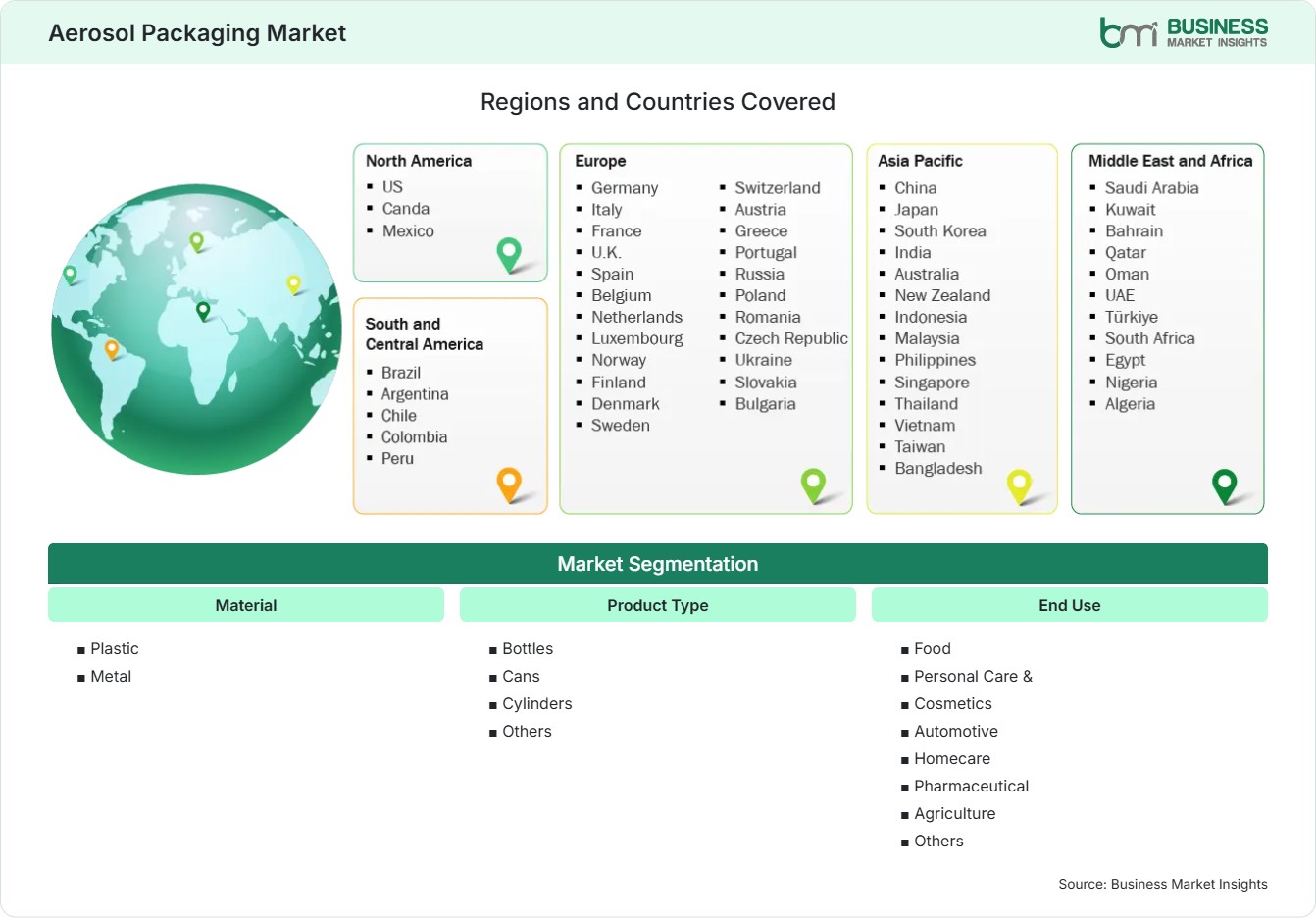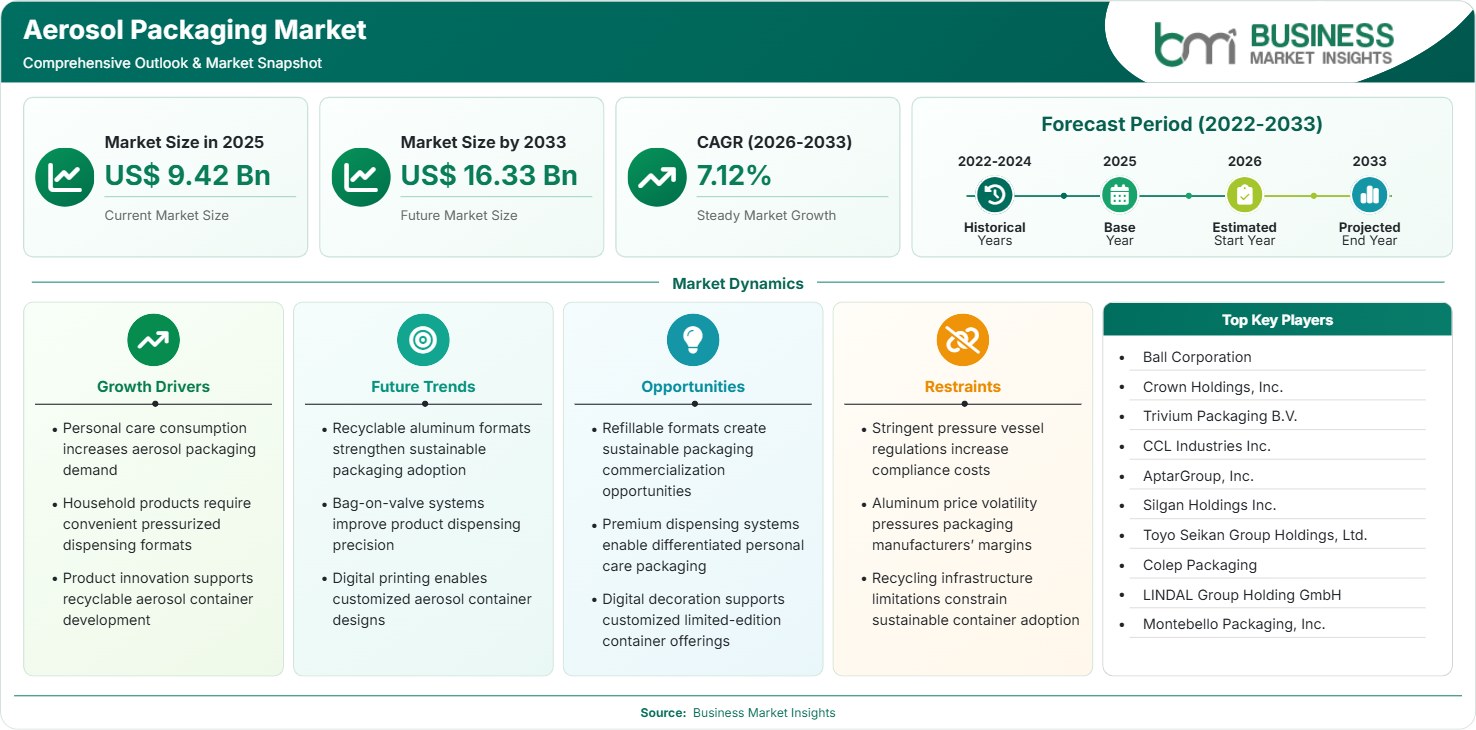
Aerosol Packaging Market Regional Highlights
North America Aerosol Packaging Market
North America represented a 33%–36% share in 2025 and is projected to grow at a 6.2%–6.6% CAGR through 2033. Demand is concentrated in personal care, household, pharmaceutical, and automotive applications, supported by mature filling infrastructure. The United States accounts for most regional consumption, while Mexico provides a manufacturing and nearshoring opportunity. Aluminum lightweighting and recycled-content adoption are increasingly important purchasing criteria. The regional Aerosol Packaging Market share is therefore underpinned by established customers, technical qualification capabilities, and reliable domestic supply.
- Recycled aluminum investment is strengthening sustainable packaging propositions while maintaining barrier performance and premium appearance for personal care and homecare brands.
- Pharmaceutical and healthcare applications support higher-value formats because controlled dispensing, formulation integrity, and regulatory compliance create stronger supplier qualification requirements.
- Mexico offers manufacturing diversification as brands seek shorter supply chains, competitive conversion economics, and proximity to the United States.
- Major suppliers compete through lightweighting, specialized valves, decoration capabilities, and consistent filling-line compatibility across multinational customer portfolios.
US Aerosol Packaging Market
The US Aerosol Packaging Market represented approximately 67%–71% of North American demand in 2025 and is projected to grow at a 5.8%–6.3% CAGR through 2033. Mature personal care and household categories provide volume stability, while pharmaceutical and specialty applications increase value density. Local production of dispensing components is gaining importance as brands prioritize shorter lead times and supply assurance. The country's advanced filling ecosystem also supports commercialization of differentiated aerosol formats and specialized formulations.
- Personal care remains a major demand center, with deodorants, hair products, shaving products, and fragrance formats requiring convenient, consistent spray performance.
- Domestic actuator production is improving responsiveness for specialized formulations, particularly high-powder, shimmer, and other technically demanding aerosol applications.
- Pharmaceutical and healthcare applications provide opportunities for controlled-dose systems, bag-on-valve formats, and packaging requiring strong formulation protection.
Europe Aerosol Packaging Market
Europe Aerosol Packaging Market represented a 27%–30% share in 2025 and is expected to expand at a 5.8%–6.3% CAGR through 2033. Germany remains a leading market, while France, the United Kingdom, and Italy retain strong personal care and industrial demand. Regulatory emphasis on packaging circularity, material efficiency, and waste reduction encourages lightweighting and recycled inputs. Germany is modeled at a 5.7%–6.2% CAGR, with France at 5.9%–6.4%, reflecting mature demand and sustainability-led product redesign.
- European manufacturers are prioritizing recyclable steel and aluminum, supported by established metal recovery systems and brand-owner sustainability targets.
- Germany benefits from industrial and automotive applications, while its mature personal care sector provides additional aerosol demand.
- France benefits from premium beauty and cosmetics production, increasing demand for differentiated graphics, lightweight containers and advanced dispensing systems.
- The United Kingdom and Italy provide opportunities for specialty packaging, household products and pharmaceutical aerosols requiring flexible production capabilities.
Asia Pacific Aerosol Packaging Market
Asia Pacific Aerosol Packaging Market held a 24%–27% share in 2025 and is projected to achieve the fastest 7.0%–7.8% CAGR through 2033. China remains the leading manufacturing and consumption base, while India is positioned as a high-growth market. Japan and South Korea contribute sophisticated personal care demand and advanced packaging capabilities. The region's expanding consumer class, urbanization, and manufacturing investment support both volume growth and technology adoption. Sustainable aerosol packaging also provides an attractive regional growth opportunity.
- China combines large-scale manufacturing with broad household and personal care consumption, supporting integrated packaging supply chains and high-volume production.
- India provides strong upside as cosmetics, household care and modern retail penetration expand alongside domestic packaging investment.
- Japan and South Korea favor high-quality dispensing, premium personal care formats and sophisticated sustainability requirements.
- Southeast Asia offers incremental opportunities through urbanization, consumer-product manufacturing and regional export-oriented packaging capacity.
Rest of World Aerosol Packaging Market
South and Central America Aerosol Packaging Market represented part of the 10%–13% Rest of World share in 2025, with regional growth modeled at 6.0%–6.6% through 2033. Brazil is the leading market, supported by personal care manufacturing and consumer demand. Growing sustainability requirements support recycled and lightweight metal formats, while local production provides supply-chain advantages for multinational consumer brands.
Middle East and Africa comprise the balance of Rest of World demand, with the UAE, Saudi Arabia and South Africa providing leading commercial hubs. Growth is supported by personal care, household products, automotive maintenance and agricultural applications, although recycling infrastructure remains uneven.
- Brazil provides the strongest South American opportunity through personal care scale, local manufacturing and growing sustainability requirements.
- Gulf markets favor premium personal care and household products, supporting higher-value decorated containers and specialized dispensing systems.
- South Africa provides a regional manufacturing and distribution platform for household, personal care, and industrial applications.
- Recycling infrastructure gaps remain a constraint, increasing the value of lightweight designs, localized collection partnerships and material-efficiency initiatives.