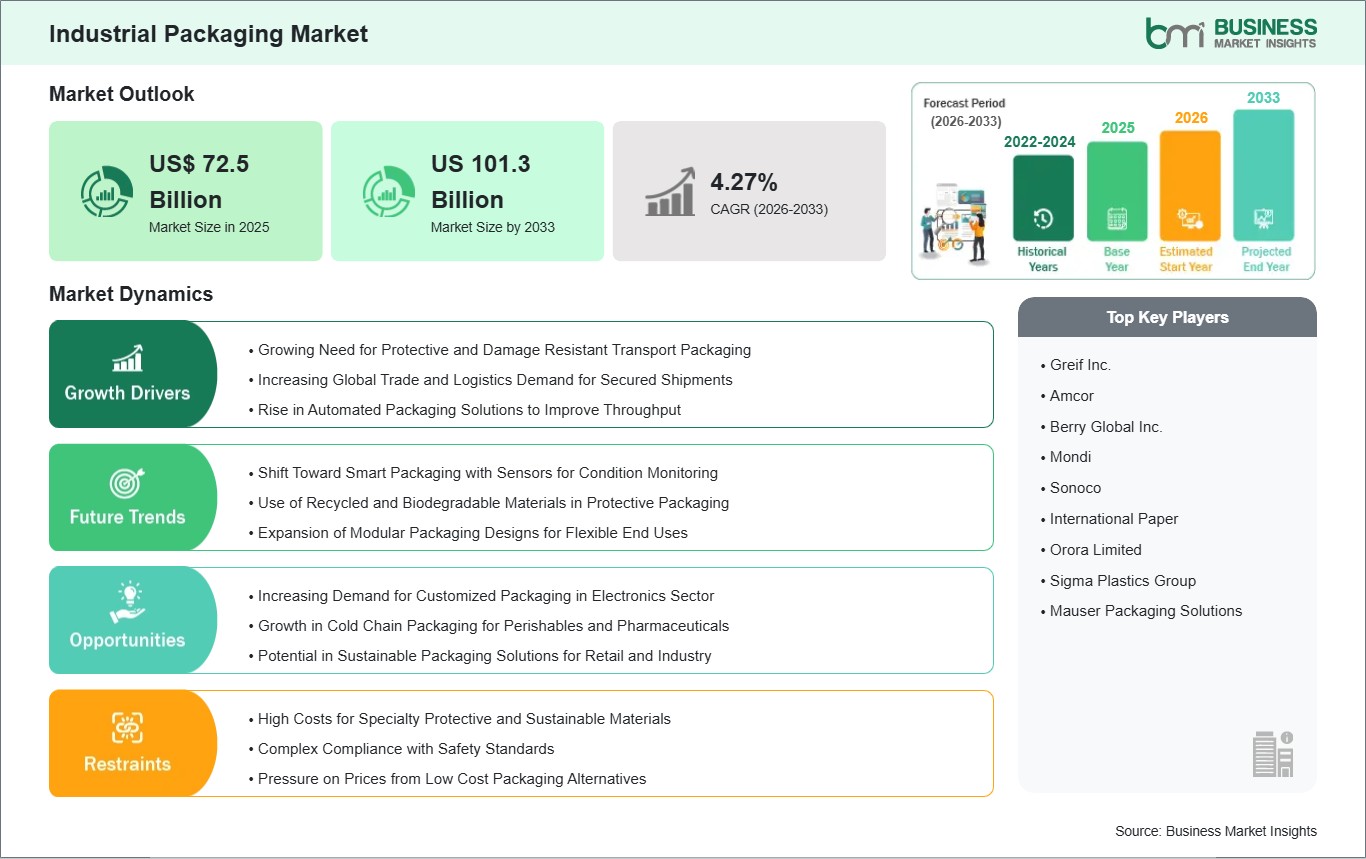
Growing Need for Protective and Damage Resistant Transport Packaging
The global industrial packaging market is being significantly driven by the increasing need for protective and damage-resistant solutions for transporting goods across complex supply chains. Industrial products, including machinery, chemicals, automotive parts, and bulk materials, often require packaging that can withstand mechanical shocks, vibration, and environmental exposure during transit. Materials such as high-strength plastics, corrugated containers, metal drums, and composite packaging solutions are widely used to ensure that goods reach their destinations without damage. As global trade networks expand and transportation distances increase, the demand for reliable protective packaging has become a critical component of logistics and supply chain management.
In addition to this, there are challenges associated with the handling, stacking, and storage of goods. Packaging solutions are being designed to ensure stability of goods, minimize movement of goods, and facilitate easy handling of goods through automation. Palletized packaging, IBCs, and reinforced packaging are used to ensure efficiency in operations and minimize loss of goods. Across the world, industries such as chemicals, construction, and heavy manufacturing require reliable packaging solutions that can withstand harsh conditions, including temperature fluctuations, moisture, and handling of goods.
Additionally, sustainability is changing the way in which protective industrial packages are developed. Companies are increasingly turning to recyclable, reusable, and lightweight materials for their products. Advancements in material sciences have helped in the creation of packages that are strong yet lighter in weight. These packages not only reduce transportation expenses but also lower emissions. As supply chains across the world become increasingly interconnected and sustainable in nature, the need for strong and sustainable industrial packages is increasing further, thus underlining the importance of such packages.
Increasing Demand for Customized Packaging in Electronics Sector
The rapid development of the global electronics industry has given rise to a high demand for customized industrial packaging solutions that cater to the unique needs of sensitive electronic components. For instance, sensitive electronic parts such as semiconductors, circuit boards, and electronic gadgets require special care in terms of packaging. Anti-static materials, foam inserts, trays, and containers are commonly used for packaging sensitive electronic components. As the electronics manufacturing industry continues to advance and miniaturize, the need for highly specialized packaging solutions has assumed a crucial role.
Customization is one of the significant factors that cater to the unique demands of the electronics industry. Packaging solutions are designed to cater to the unique dimensions, shapes, and sensitivities of sensitive electronic components. For instance, packaging solutions are designed to ensure a secure fit for sensitive electronic components, thus preventing them from moving about. This ensures that sensitive electronic components are well protected against damage. At the same time, customization has a significant role to play in maximizing space efficiency in shipping and storage. Globally, electronics manufacturing companies are increasingly investing in packaging solutions that cater to their unique demands.
Moreover, the demand for customized packaging is influenced by the increasing complexity of global electronics supply chains. Components are often transported across multiple regions before final assembly, requiring packaging that maintains integrity throughout extended transit periods. Environmental factors such as humidity, temperature variations, and electrostatic discharge pose significant risks, making specialized packaging essential for preserving product quality. As the global electronics market continues to expand and innovate, customized industrial packaging solutions are becoming indispensable for ensuring reliability, efficiency, and protection across the entire value chain.