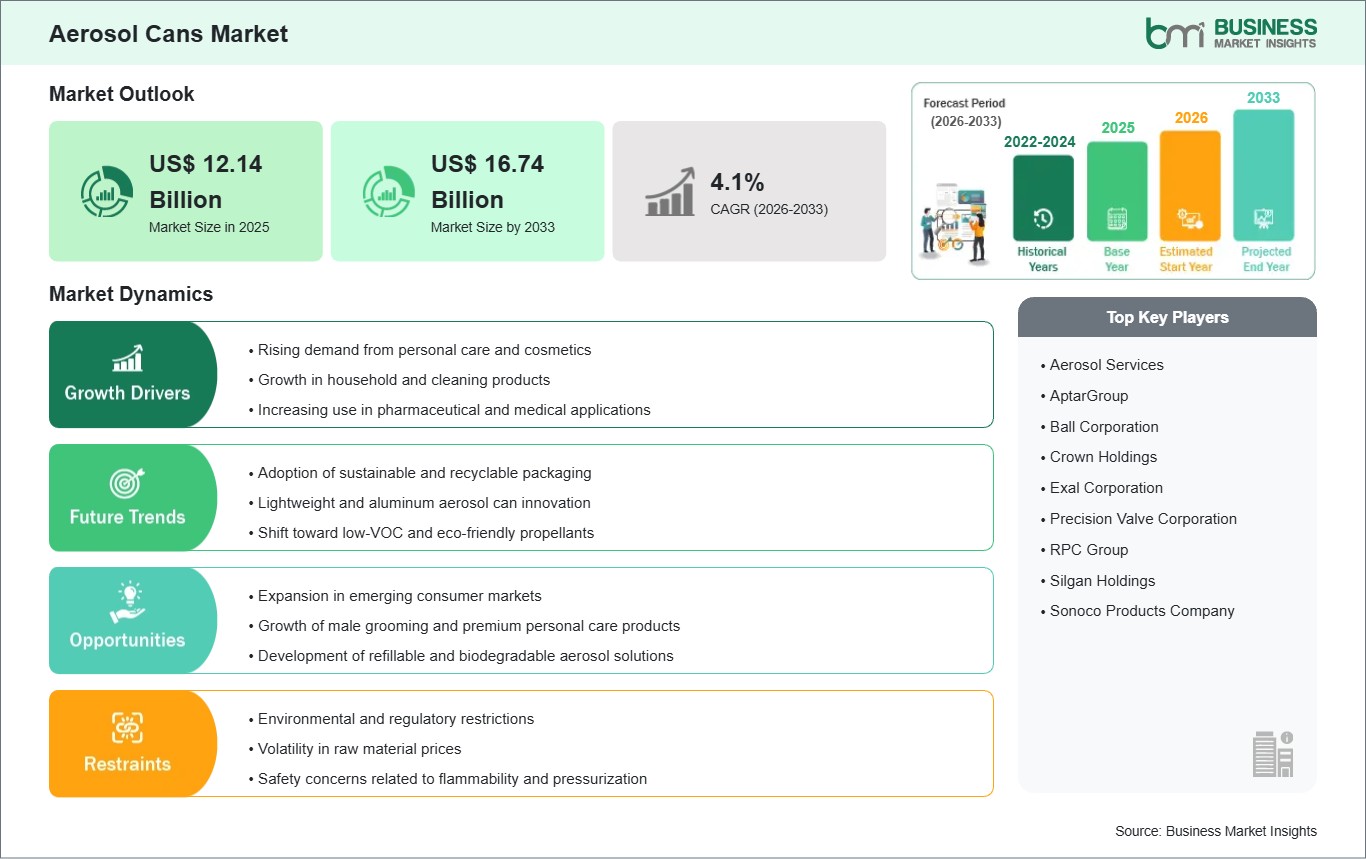
The Aerosol Cans market size is expected to reach US$ 16.74 billion by 2033 from US$ 12.14 billion in 2025. The market is estimated to record a CAGR of 4.1% from 2026 to 2033.
Aerosol cans are designed to deliver liquids, powders, and sprays safely and conveniently. This category includes products like personal care aerosols, household cleaning sprays, industrial lubricants, paints, coatings, and medical aerosols. Aerosol cans are crucial for precise dispensing, product protection, portability, and easy use for both commercial and consumer purposes. The demand is increasing in both emerging and established markets, largely due to urbanization, changes in lifestyles, and a rising preference for convenience and hygiene. The need for safe, portable, and eco-friendly packaging is significantly boosting market growth. Industries are choosing aerosol cans that offer leak-proof containment, longer shelf life, consistent spray performance, and resistance to pressure and temperature changes. As a result, there is a greater use of aerosols in personal care, household maintenance, automotive care, industrial applications, and pharmaceuticals. At the same time, more investment in improving formulas and packaging has led to innovations like eco-friendly propellants, lightweight metals, better coatings, and precise valve mechanisms. These advancements have improved product performance, safety, and versatility.
The growing focus on sustainability, convenience, and hygiene is increasing the use of aerosol cans in eco-friendly cleaning products, personal care items, medical sprays, and new industrial applications. Moreover, there is a global interest in reducing chemical emissions, minimizing waste, and promoting recyclable packaging, which is raising the demand for modern aerosol cans that support green technologies and responsible consumption.
Regulations on volatile organic compounds (VOCs), environmental safety, and product labeling are pushing manufacturers to adopt cleaner formulas and safer packaging methods. Despite these positive trends, the market faces challenges like fluctuating raw material costs, regulatory compliance, and the need for specialized manufacturing technologies. Nevertheless, ongoing improvements in material design, eco-friendly propellants, wider product applications, and increased consumer awareness are likely to drive steady market growth. The global aerosol cans market is expected to grow consistently due to innovation, rising demand for safe and convenient packaging, and a shift toward sustainable, user-friendly, and technologically advanced products.

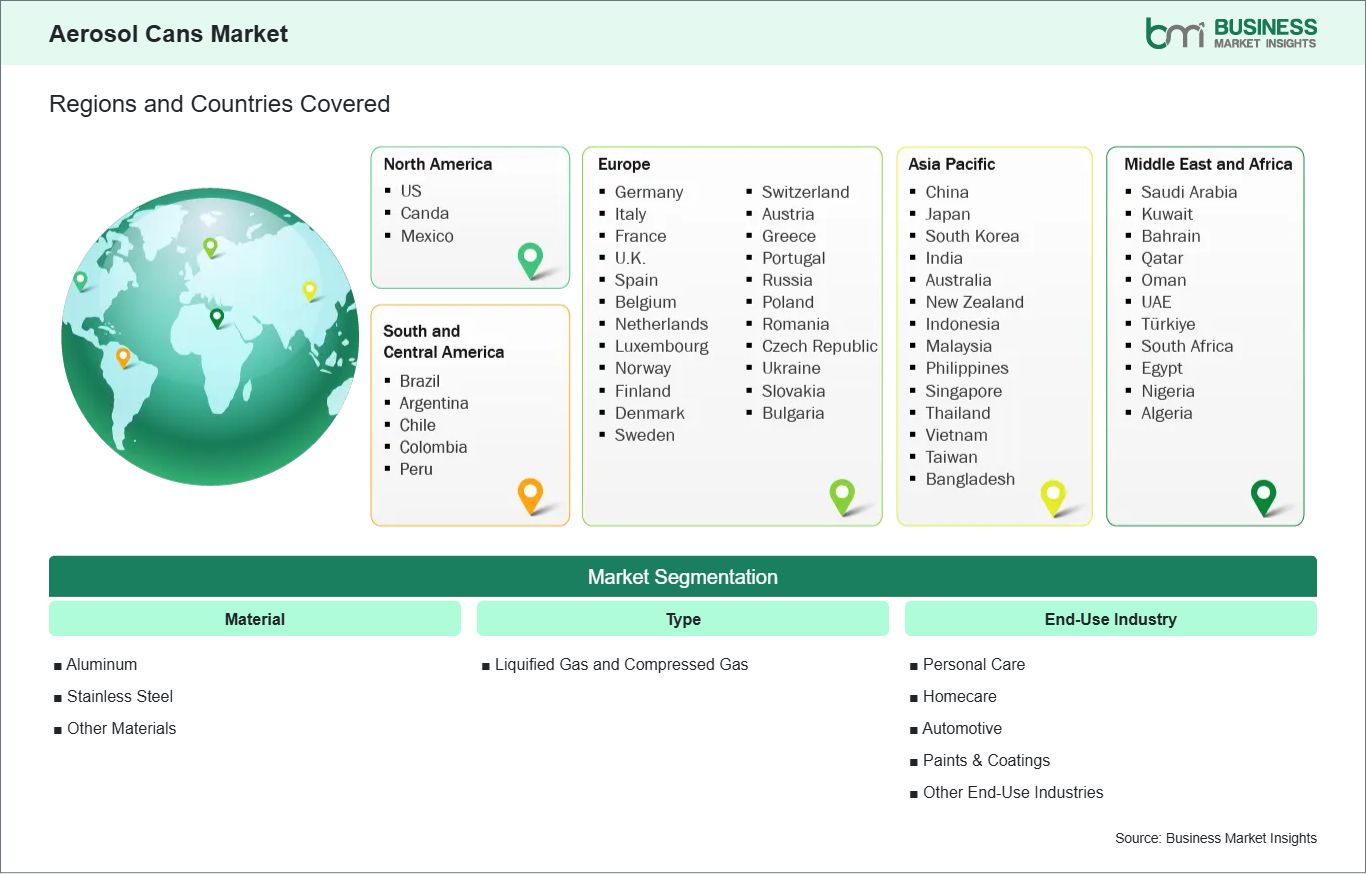
Key segments that contributed to the derivation of the Aerosol Cans market analysis are material, type, and end-use industry.
Industries such as personal care, household cleaning, automotive maintenance, paints and coatings, pharmaceuticals, and industrial chemicals are steadily expanding, owing to which the use of aerosol cans in deodorants, hair sprays, cleaning sprays, lubricants, paints, medical sprays, and industrial coatings is increasing. The rise in consumer and industrial activity, along with the demand for safe, convenient, and efficient product delivery systems, has created a strong need for aerosol cans that provide leak-proof containment, consistent spray performance, corrosion resistance, and long shelf life. Aerosol cans improve user convenience, dosage precision, product protection, and portability while supporting innovative formulations and multifunctional applications in personal care, industrial, and household sectors. In both commercial and consumer markets, demand for lightweight, durable, and application-specific aerosol cans has risen sharply. This trend, along with increased investment in eco-friendly propellants, recyclable packaging, and high-performance dispensing systems, is accelerating the adoption of aerosol cans around the world. Rapid industrial growth in emerging economies, along with steady demand from developed regions, further supports market expansion. The rising use of aerosol packaging in personal care, household maintenance, automotive products, medical sprays, and industrial applications continues to drive steady growth. This growth is fueled by urbanization, infrastructure upgrades, and changing consumer lifestyles around the globe.
Manufacturers are using new materials, better coatings, and precision valve technologies to improve spray consistency, pressure tolerance, corrosion resistance, and shelf life. There is growing emphasis on sustainable propellants, lightweight metals, recyclable packaging, and energy-efficient manufacturing processes that meet environmental regulations and support green initiatives. These innovations aim to reduce chemical emissions, minimize waste, extend product usability, and boost performance in demanding applications. In sectors like personal care, household cleaning, automotive maintenance, pharmaceuticals, and industrial coatings, where safety, efficiency, and environmental compliance are critical, high-performance aerosol cans are increasingly adopted. Additionally, the global shift toward eco-friendly products, energy-efficient formulations, and recyclable packaging has raised the demand for aerosol cans that support sustainability and responsible consumption. As regulations around VOCs, emissions, and packaging standards become stricter, and industries emphasize convenience, safety, and environmental responsibility, the demand for high-quality, durable, and environmentally sustainable aerosol cans is expected to grow steadily in global markets.
The Aerosol Cans market demonstrates steady growth, with size and share analysis highlighting evolving trends and competitive dynamics among key players. The report further examines subsegments categorized within material, type, and end-use industry, offering insights into their contribution to overall market performance. By material, the aluminum subsegment dominates the market because it is lightweight, resistant to corrosion, and durable. These qualities make it suitable for personal care, household, and industrial uses, ensuring product safety and a longer shelf life. Aluminum also simplifies manufacturing, is easy to recycle, and works well with many propellants and coatings.
In terms of end-use industry, the paints and coatings subsegment holds the largest share of the market owing to the high demand for convenient, portable, and precise spray applications in both industrial and consumer painting. Aerosol packaging provides uniform coverage, protects formulations from contamination, and improves stability. The growing activities in construction, automotive, and home improvement are also boosting the use of aerosol-based paints and coatings.
| Report Attribute | Details |
|---|---|
| Market size in 2025 | US$ 12.14 Billion |
| Market Size by 2033 | US$ 16.74 Billion |
| Global CAGR (2026 - 2033) | 4.1% |
| Historical Data | 2022-2024 |
| Forecast period | 2026-2033 |
| Segments Covered | By Material
|
|
Regions and Countries Covered
| |
| North America | US, Canada, Mexico |
| Europe | Belgium, Austria, Finland, Denmark, Greece, Poland, Romania, Russia, Ukraine, Czech Republic, Slovakia, Bulgaria, Italy, Luxembourg, Germany, Switzerland, France, Netherlands, Norway, Portugal, Spain, Sweden, United Kingdom |
| Asia-Pacific | Australia, China, India, Japan, South Korea, Indonesia, Malaysia, Philippines, Singapore, Thailand, Vietnam, Bangladesh, New Zealand, Taiwan |
| South and Central America | Brazil, Argentina, Peru, Chile, Colombia |
| Middle East and Africa | Bahrain, Kuwait, Oman, Qatar, Saudi Arabia, United Arab Emirates, Turkiye, South Africa, Egypt, Algeria, Nigeria |
| Market leaders and key company profiles |
|
The "Aerosol Cans Market Size and Forecast (2022–2033)" report provides a detailed analysis of the market covering below areas:
The geographical scope of the Aerosol Cans market report is divided into five regions: North America, Asia Pacific, Europe, Middle East & Africa, and South & Central America. The Aerosol Cans market in Asia Pacific is expected to grow significantly during the forecast period.
The Asia Pacific Aerosol Cans market is segmented into China, Japan, South Korea, India, Australia, New Zealand, Indonesia, Malaysia, the Philippines, Singapore, Thailand, Vietnam, Taiwan, Bangladesh, and the Rest of Asia Pacific. The aerosol cans market in Asia Pacific is steadily growing due to rapid industrialization, urbanization, rising consumer demand, and ongoing economic development. Key players in this market are China, Japan, South Korea, and India. These countries are heavily investing in personal care products, household cleaning solutions, automotive maintenance sprays, paints and coatings, pharmaceuticals, and industrial chemicals. The increasing demand from sectors like personal care, household, automotive, industrial, and healthcare is boosting the use of aerosol cans in the region. Population growth, urban infrastructure expansion, and a greater focus on convenience, hygiene, and eco-friendly options are driving the adoption of aerosol cans in deodorants, hair sprays, cleaning sprays, lubricants, paints, medical sprays, and industrial coatings. Another important trend is the improvement of aerosol can technologies and the growth of production capabilities.
Manufacturers are focusing on improving packaging materials, applying better coatings, and upgrading valve and propellant systems to enhance spray consistency, shelf life, and safety. Lightweight metals, precision manufacturing, and corrosion-resistant coatings are now being used to improve durability and lessen environmental impact. The establishment of local manufacturing facilities, improved supply chain integration, and stronger logistics networks are cutting down reliance on imports while ensuring a steady supply.
Additionally, more investments in sustainable propellants, recyclable materials, and energy-efficient production processes, along with the rising demand for high-performance and eco-friendly aerosol products, are making Asia Pacific a key hub for production, innovation, and distribution in the global aerosol cans market. Supportive government regulations, favorable industrial and environmental policies, and ongoing growth in consumer goods, healthcare, and industrial sectors are further strengthening the region's long-term market outlook.

The Aerosol Cans market is evaluated by gathering qualitative and quantitative data post primary and secondary research, which includes important corporate publications, association data, and databases. A few of the key developments in the Aerosol Cans market are:
The Aerosol Cans Market is valued at US$ 12.14 Billion in 2025, it is projected to reach US$ 16.74 Billion by 2033.
As per our report Aerosol Cans Market, the market size is valued at US$ 12.14 Billion in 2025, projecting it to reach US$ 16.74 Billion by 2033. This translates to a CAGR of approximately 4.1% during the forecast period.
The Aerosol Cans Market report typically cover these key segments-
The historic period, base year, and forecast period can vary slightly depending on the specific market research report. However, for the Aerosol Cans Market report:
The Aerosol Cans Market is populated by several key players, each contributing to its growth and innovation. Some of the major players include:
The Aerosol Cans Market report is valuable for diverse stakeholders, including:
Essentially, anyone involved in or considering involvement in the Aerosol Cans Market value chain can benefit from the information contained in a comprehensive market report.
Please tell us your area of interest
(Market Segments/ Regions and Countries/ Companies)