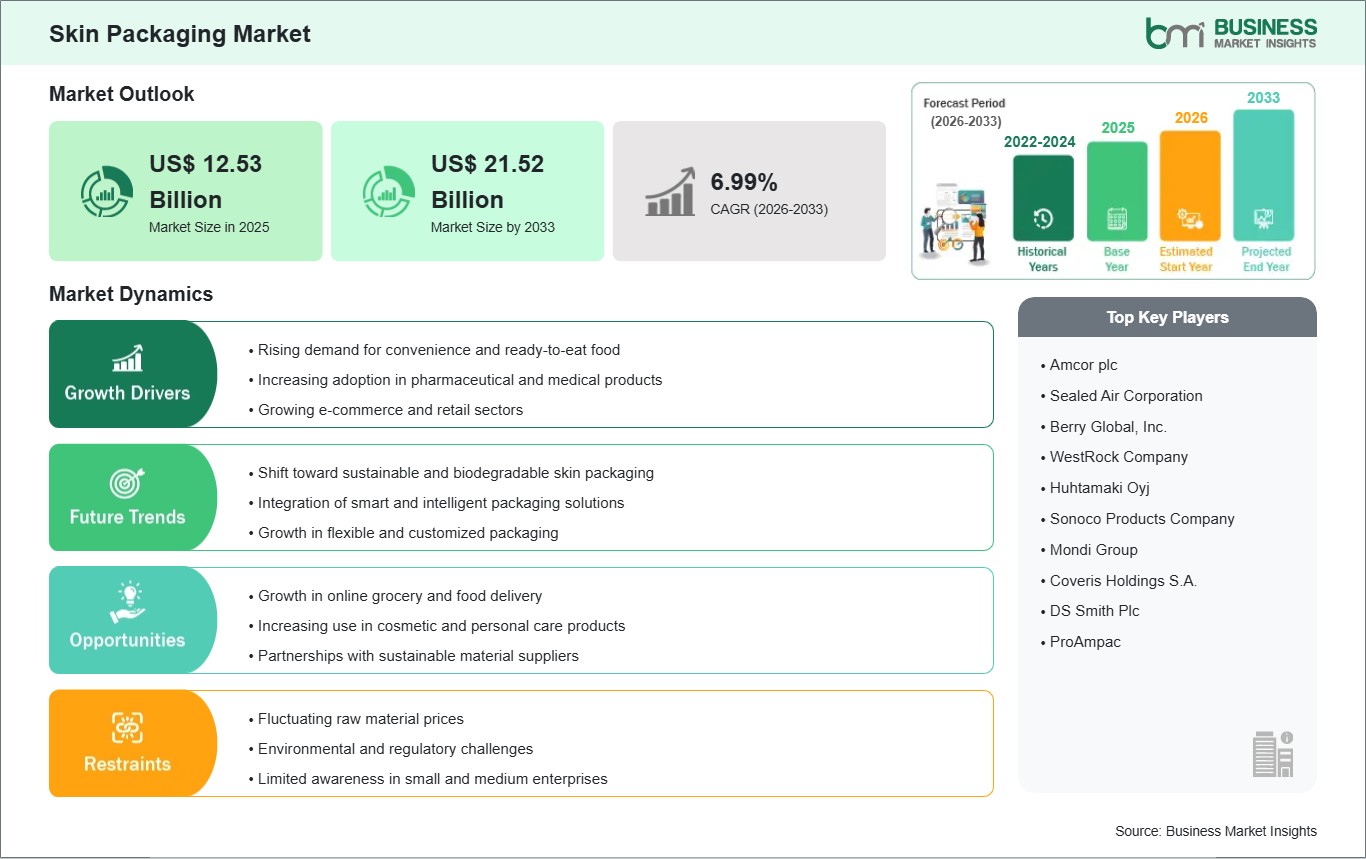
The Skin Packaging Market size is expected to reach US$ 21.52 billion by 2033 from US$ 12.53 billion in 2025. The market is estimated to record a CAGR of 6.99% from 2026 to 2033.
The global skin packaging market is expanding steadily as manufacturers and consumers increasingly prioritize product protection, shelf life, and visual appeal. Skin packaging, a form of thermoforming packaging where a product is sealed directly onto a substrate, is widely used across the food, electronics, cosmetics, and healthcare industries due to its ability to prevent contamination, reduce tampering, and maintain product integrity. The growth is primarily driven by rising demand for convenience, sustainability, and high-quality packaging that enhances the consumer experience. In the food sector, skin packaging preserves freshness while offering visibility of the product, aligning with consumer preferences for clean and transparent packaging. In electronics and cosmetics, it protects high-value items from damage and ensures tamper-evidence. Innovation is a key market driver, with companies developing eco-friendly films, biodegradable substrates, and advanced sealing technologies that reduce material waste and energy consumption.
Additionally, automation and customization trends enable brands to differentiate products and improve operational efficiency. However, the market faces challenges including the high cost of advanced packaging materials, technical complexity in sealing delicate products, and regulatory requirements for food and pharmaceutical packaging compliance. Despite these constraints, the combination of product safety, sustainability initiatives, and rising demand for premium packaging solutions positions the global skin packaging market for continued growth.

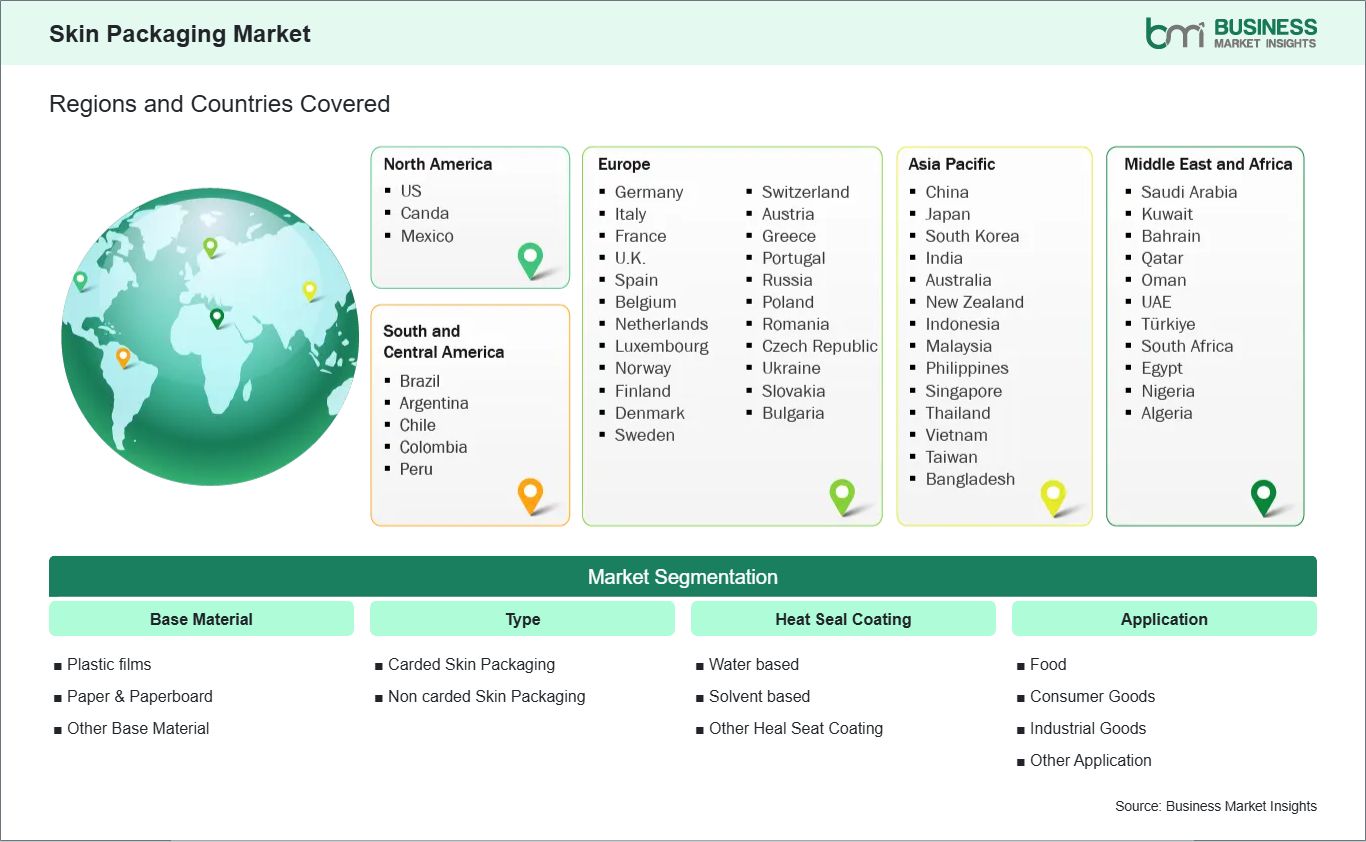
Key segments that contributed to the derivation of the skin packaging market analysis are base material, type, heal seal coating, and application.
Western Europe’s skin packaging market is growing rapidly, especially with the increased demand from consumers for ready-to-eat food products. Countries such as Germany, France, and Spain are witnessing a sharp growth in demand for fresh food, meat, and ready-to-eat food products in retail stores and other outlets. Skin packaging has emerged as a popular choice among food manufacturers, especially for fresh meat, cheese, and seafood, due to its transparency and long shelf life. For instance, in Germany, large retailers are witnessing double-digit annual growth in chilled food convenience, prompting food processors to use skin films with high barrier properties to retain freshness and enhance visual appeal.
In France, for example, the increasing interest in “healthy convenience” foodstuffs such as salads, marinated meats, and portioned vegetarian products has spurred French food manufacturers to abandon traditional clamshell containers in favor of skin packaging solutions that reduce food waste and preserve freshness. The flexibility of skin packaging to fit complex product forms is also interesting to food producers in the French provinces of Provence and Brittany, where they are promoting fresh food products in high-end supermarkets. Food processors in Spain have also found consumers willing to pay a small premium for attractive, transparent packaging that promises freshness and convenience.
Furthermore, the suitability of skin packaging for high-speed automated equipment is consistent with the emphasis placed by Western Europe on efficiency in the production of food products. Given the high labor costs, Western European companies, especially in the Benelux region, are using integrated skin packaging equipment to reduce the cost per unit while maintaining the quality and convenience aspects that consumers require. The market potential for the skin packaging product is expected to continue its growth trajectory, especially given the increased requirement for quick meals among consumers of different age groups, ranging from professionals in London to families in Milan.
The growth in online shopping and food delivery services in Western Europe has a positive impact on the skin packaging market. The pandemic has resulted in a shift to digital shopping, especially in urban areas such as Paris, Amsterdam, and Barcelona, and this has largely continued. Online stores and food delivery services are looking for packaging materials that can withstand transportation, and skin packaging, with its tight film adhesion and minimal headspace, provides a solution to prevent food from moving during transportation, especially during last-mile delivery.
For instance, within the United Kingdom, where online grocery shopping is increasingly becoming a larger percentage of overall food retail, food retailers have been embracing meal kit packs and fresh food bundles within temperature-controlled containers. Feedback from consumers suggests an increased level of satisfaction with this form of packaging, thus encouraging more food retailers within this market to follow suit. In Spain and Italy, online food retail marketplaces have been embracing skin-wrapped food products such as charcuterie and premium cuts within curated food delivery containers. It is evident that this form of food packaging is becoming more accepted within the online food retail market.
Moreover, meal kit delivery platforms within cities such as Stockholm, Munich, and Zurich have been partnering with kitchens within respective cities to offer pre-cooked meals within containers that have been optimized for food safety and appeal. In this case, it is evident that food safety and appeal within containers have been enhanced through the embracing of this form of food packaging. It is evident that this form of food packaging will have an even brighter future within Western Europe, considering the innovations within last-mile logistics within this market.

The skin packaging market is experiencing steady growth, with market size and share analysis reflecting evolving treatment preferences and competitive dynamics among key players. The report evaluates important subsegments categorized within base material, type, heat seal coating, and application, highlighting their respective contributions to overall market performance.
By base material, the plastic films subsegment dominated the Skin packaging market in 2025 hey offer high clarity, flexibility, and strength that are critical for protective and display packaging. They can be engineered to specific barrier and heat‑seal properties, which paper often cannot match.
Based on type, the carded skin packaging subsegment dominated the skin packaging market in 2025 because it combines a stiff backing card with a vacuum‑formed film, providing excellent product presentation and security. This format is favored in retail environments where product visibility and tamper resistance matter.
On the basis of heat seal coating, the water‑based subsegment dominated manufacturers shift toward lower VOC, safer, and more environmentally friendly processes. They provide reliable adhesion and are easier to handle in modern coating lines compared to solvent‑based systems.
In terms of application, the consumer goods subsegment dominated the skin packaging market in 2025 skin packaging is widely used for electronics accessories, toys, hardware, and personal items where product visibility and protection are priorities. These sectors often require high volumes of retail‑ready packaging, unlike food or industrial goods.
| Report Attribute | Details |
|---|---|
| Market size in 2025 | US$ 12.53 Billion |
| Market Size by 2033 | US$ 21.52 Billion |
| Global CAGR (2026 - 2033) | 6.99% |
| Historical Data | 2022-2024 |
| Forecast period | 2026-2033 |
| Segments Covered | By Base Material
|
|
Regions and Countries Covered
| |
| North America | US, Canada, Mexico |
| Europe | Belgium, Austria, Finland, Denmark, Greece, Poland, Romania, Russia, Ukraine, Czech Republic, Slovakia, Bulgaria, Italy, Luxembourg, Germany, Switzerland, France, Netherlands, Norway, Portugal, Spain, Sweden, United Kingdom |
| Asia-Pacific | Australia, China, India, Japan, South Korea, Indonesia, Malaysia, Philippines, Singapore, Thailand, Vietnam, Bangladesh, New Zealand, Taiwan |
| South and Central America | Brazil, Argentina, Peru, Chile, Colombia |
| Middle East and Africa | Bahrain, Kuwait, Oman, Qatar, Saudi Arabia, United Arab Emirates, Turkiye, South Africa, Egypt, Algeria, Nigeria |
| Market leaders and key company profiles |
|
The "Skin Packaging Market Size and Forecast (2022 - 2033)" report provides a detailed analysis of the market covering below areas:
The geographical scope of the Skin packaging market report is divided into five regions: North America, Asia Pacific, Europe, Middle East & Africa, and South & Central America. The Skin packaging market in North America is expected to grow during the forecast period.
North America is the leading contributor to the skin packaging market at the global level, followed by Asia Pacific, Europe, and the Rest of the world. The dominance of the North American market is due to the well-developed industrial sector, high technology adoption rate, and high consumer awareness about product quality and safety. The United States is the leading contributor to the regional market due to high usage in the food industry, where skin packaging is used to preserve food items. This type of packaging is used to preserve food items such as meats, cheese, and read-to-eat food products. The use of skin packaging in the food industry is increasing due to the long shelf life of the products and the high visibility of the products.
Moreover, the increasing consumer demand for convenient and eco-friendly packaging is also driving the market for skin packaging. Cosmetics and electronics are also driving the skin packaging market in the United States. These industries are using skin packaging due to the high level of security and tamper resistance. Canada is another leading contributor to the skin packaging market in the North American region. The region’s focus on innovation, consumer safety, and environmental compliance makes it a pivotal hub for both the development and application of skin packaging solutions globally.

The skin packaging market is evaluated by gathering qualitative and quantitative data post primary and secondary research, which includes important corporate publications, association data, and databases. A few of the key developments in the skin packaging market are:
The Skin Packaging Market is valued at US$ 12.53 Billion in 2025, it is projected to reach US$ 21.52 Billion by 2033.
As per our report Skin Packaging Market, the market size is valued at US$ 12.53 Billion in 2025, projecting it to reach US$ 21.52 Billion by 2033. This translates to a CAGR of approximately 6.99% during the forecast period.
The Skin Packaging Market report typically cover these key segments-
The historic period, base year, and forecast period can vary slightly depending on the specific market research report. However, for the Skin Packaging Market report:
The Skin Packaging Market is populated by several key players, each contributing to its growth and innovation. Some of the major players include:
The Skin Packaging Market report is valuable for diverse stakeholders, including:
Essentially, anyone involved in or considering involvement in the Skin Packaging Market value chain can benefit from the information contained in a comprehensive market report.
Please tell us your area of interest
(Market Segments/ Regions and Countries/ Companies)