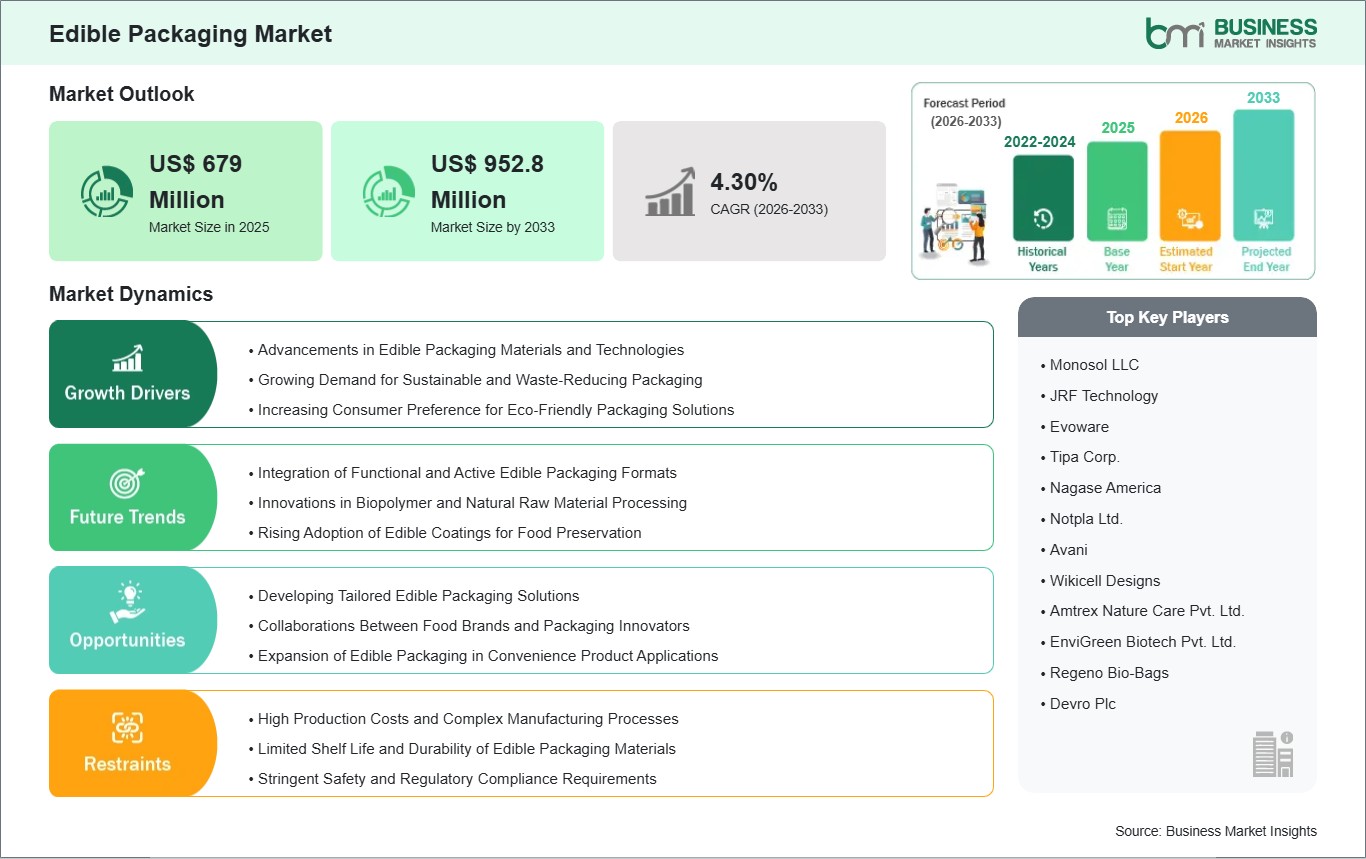
The Edible Packaging Market size is expected to reach US$ 952.8 Million by 2033 from US$ 679 Million in 2025 .The market is estimated to record a CAGR of 4.30% from 2026 to 2033.
The edible packaging market, as a segment of the global sustainable packaging market, has gained momentum as a promising opportunity due to the rising awareness of the adverse environmental impacts of pollution, plastic waste, and the need for the development of eco-friendly packaging alternatives. Edible packaging, made from biopolymers such as protein-based, polysaccharide-based, and lipid-based packaging, has the potential advantage of being safe for consumption or biodegradation, thus offering the dual advantage of packaging and consumability, thereby meeting the criteria of the circular economy. The rising clean label trend, coupled with the increasing regulatory environment on plastic packaging, has encouraged the interest of the food and beverage industry to incorporate edible packaging in various product categories, including snacks, confectionery, beverages, and others. The major drivers for this market are sustainability mandates from governments and retailers, awareness of food waste reduction, and innovation in packaging to improve product shelf life while being environmentally friendly. In addition, advancements in material science and food technology have helped to improve the performance capabilities of food packaging, making it more suitable for consumers. However, there are certain restraints to market growth, such as limitations in material strength and sensitivity to moisture, which can be drawbacks for this market. In addition, in certain parts of the world, there is no clear guideline for safety standards for food packaging, which can be a hindrance to this market`s growth. Despite all these limitations, R&D activities, sustainability mandates for various industries, and strategic partnerships between food companies and packaging companies are driving this market in a positive direction.

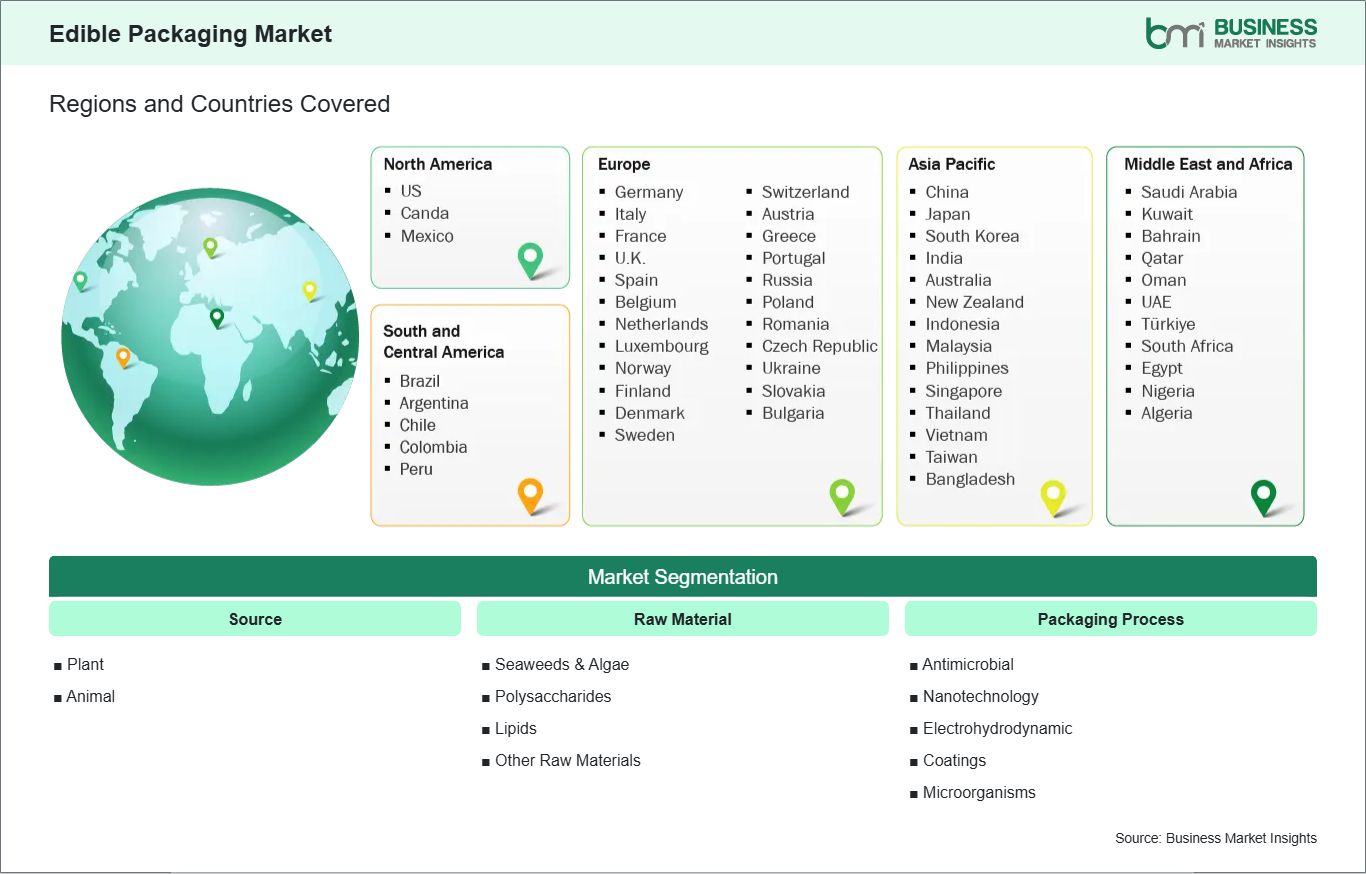
Key segments that contributed to the derivation of the edible packaging market analysis are source, raw material, end user, and packaging process.
The growth of the edible packaging market is being fueled by innovations in materials and technology. Scientists and manufacturers are developing films, coatings, and wraps made from natural polymers, proteins, and starches that are fully biodegradable and safe for consumption. These advancements allow edible packaging to meet modern requirements for durability, moisture resistance, and food safety, making them viable alternatives to traditional plastic packaging.
Technology improvements are also driving adoption in the food and beverage sector. Companies can now produce edible films with extended shelf life, precise portioning, and the ability to carry flavor or nutritional supplements. These innovations make edible packaging not just a novelty, but a practical solution for reducing waste while enhancing the consumer experience. Restaurants, confectionery brands, and ready-to-eat food producers are beginning to explore these materials as a sustainable way to package their products.
Beyond functional improvements, these technological advancements are enabling greater customization. Edible packaging can be designed with specific textures, colors, and flavors that align with product identity and branding. This combination of sustainability, usability, and sensory appeal positions edible packaging as an innovative material that resonates with environmentally conscious consumers worldwide.
There is growing opportunity in creating edible packaging tailored to the needs of different industries and consumer preferences. Companies are moving beyond one-size-fits-all approaches and designing films, wraps, and containers that suit specific food products, from beverages to snacks and confectioneries. Tailored solutions improve compatibility with the packaged item, maintain freshness, and enhance the overall eating experience.
Edible packaging also opens the door for creative marketing and brand differentiation. By incorporating flavors, vitamins, or interactive designs, brands can engage consumers in a unique way that traditional packaging cannot. This trend creates a dual benefit: reducing environmental impact while also offering a memorable product experience that encourages repeat purchases.
The opportunity extends to industrial and commercial applications as well. Businesses in catering, fast food, and retail are exploring edible packaging to reduce their environmental footprint and meet sustainability goals. With consumer demand for eco-friendly options continuing to rise, companies that develop flexible, tailored edible packaging solutions can capture market share while contributing to the global push against plastic waste.

The edible packaging market is experiencing steady growth, with market size and share analysis reflecting evolving treatment preferences and competitive dynamics among key players. The report evaluates important subsegments categorized within source, raw material, end user, and packaging process, highlighting their respective contributions to overall market performance.
By source, the Plant subsegment dominated the Edible Packaging market in 2025. Plant-based materials offer sustainability, biodegradability, and safety for direct food contact, making them highly suitable for eco-friendly packaging solutions, which drives their widespread adoption.
Based on raw material, the Seaweeds & Algae subsegment dominated the Edible Packaging market in 2025. Seaweeds and algae provide excellent film-forming properties, flexibility, and barrier performance, making them ideal for innovative edible packaging applications and supporting strong market demand.
In terms of end user, the Food subsegment dominated the Edible Packaging market in 2025. Food applications benefit from edible packaging`s ability to reduce waste and maintain product freshness, reinforcing the dominance of this segment.
On the basis of packaging process, the Antimicrobial subsegment dominated the Edible Packaging market in 2025. Antimicrobial processes enhance food safety, extend shelf life, and improve overall packaging performance, driving widespread adoption of this technology.
| Report Attribute | Details |
|---|---|
| Market size in 2025 | US$ 679 Million |
| Market Size by 2033 | US$ 952.8 Million |
| Global CAGR (2026 - 2033) | 4.30% |
| Historical Data | 2022-2024 |
| Forecast period | 2026-2033 |
| Segments Covered | By Source
|
|
Regions and Countries Covered
| |
| North America | US, Canada, Mexico |
| Europe | Belgium, Austria, Finland, Denmark, Greece, Poland, Romania, Russia, Ukraine, Czech Republic, Slovakia, Bulgaria, Italy, Luxembourg, Germany, Switzerland, France, Netherlands, Norway, Portugal, Spain, Sweden, United Kingdom |
| Asia-Pacific | Australia, China, India, Japan, South Korea, Indonesia, Malaysia, Philippines, Singapore, Thailand, Vietnam, Bangladesh, New Zealand, Taiwan |
| South and Central America | Brazil, Argentina, Peru, Chile, Colombia |
| Middle East and Africa | Bahrain, Kuwait, Oman, Qatar, Saudi Arabia, United Arab Emirates, Turkiye, South Africa, Egypt, Algeria, Nigeria |
| Market leaders and key company profiles |
|
The "Edible Packaging Market Size and Forecast (2022 - 2033)" report provides a detailed analysis of the market covering below areas:
The geographical scope of the Edible Packaging market report is divided into five regions: North America, Asia Pacific, Europe, Middle East & Africa, and South & Central America. The Edible Packaging market in North America is expected to grow during the forecast period.
North America is the leading region in the global edible packaging market, driven by the high sustainability initiatives and strong demand for environmentally friendly products. The region is home to strong innovation hubs in the food and food packaging industries. The region has been proactive in its regulatory policies to tackle plastic pollution and promote the use of biodegradable materials. The policies have encouraged food companies and food packaging companies to adopt edible films and coatings as alternatives to traditional plastic materials. Retailers and fast-moving consumer goods companies in the region have been adopting edible food packaging to increase their brand image and respond to the demands of environmentally conscious consumers. Besides the environmental factors, the North American region has the added advantage of research and startup hubs in next-generation materials. The interaction between food companies and material developers has hastened the development of edible packaging materials that are both effective and appealing. The strong food service and convenience foods industries in the North American region have given edible packaging a head start in the market, as these packaging materials have the potential to set products apart in a competitive market. Besides this, consumer education and sustainability have helped the edible packaging market gain traction among end-users as a move toward a reduced dependence on plastics. However, despite its leadership in innovativeness and market readiness, North America also has challenges in terms of cost implications and supply chain integration. Edible packaging materials are also more expensive to produce and require modifications in existing production processes. Furthermore, quality and performance, such as moisture and mechanical strength, are also key areas of focus for this region. However, owing to its strong commitment to sustainability, coupled with private sector investments and consumer willingness to adopt new and unique packaging concepts, North America is likely to play a key role in dictating global edible packaging market trends.

The edible packaging market is evaluated by gathering qualitative and quantitative data post primary and secondary research, which includes important corporate publications, association data, and databases. A few of the key developments in the edible packaging market are:
The Edible Packaging Market is valued at US$ 679 Million in 2025, it is projected to reach US$ 952.8 Million by 2033.
As per our report Edible Packaging Market, the market size is valued at US$ 679 Million in 2025, projecting it to reach US$ 952.8 Million by 2033. This translates to a CAGR of approximately 4.30% during the forecast period.
The Edible Packaging Market report typically cover these key segments-
The historic period, base year, and forecast period can vary slightly depending on the specific market research report. However, for the Edible Packaging Market report:
The Edible Packaging Market is populated by several key players, each contributing to its growth and innovation. Some of the major players include:
The Edible Packaging Market report is valuable for diverse stakeholders, including:
Essentially, anyone involved in or considering involvement in the Edible Packaging Market value chain can benefit from the information contained in a comprehensive market report.
Please tell us your area of interest
(Market Segments/ Regions and Countries/ Companies)