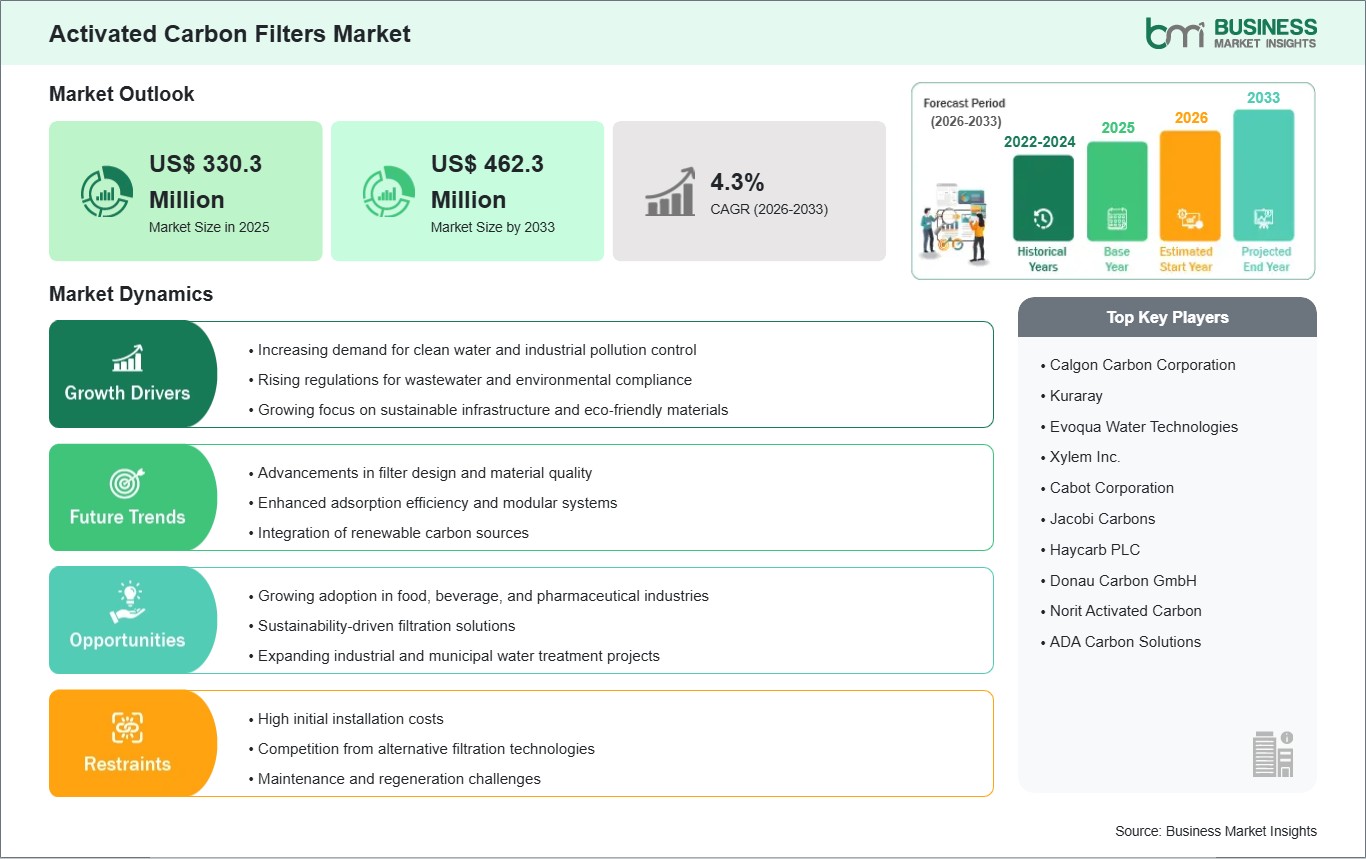
The Activated Carbon Filters Market size is expected to reach US$ 462.3 Million by 2033 from US$ 330.3 Million in 2025 .The market is estimated to record a CAGR of 4.3% from 2026 to 2033.
The global activated carbon filters market is defined by increasing demand for effective water and air purification solutions across industrial, municipal, and residential sectors. Activated carbon filters—known for their high adsorption capacity and efficiency in removing contaminants—are widely used to eliminate organic compounds, chlorine, and impurities from water and air streams. This shift reflects broader environmental and regulatory priorities: improving water quality, reducing pollution, and ensuring public health safety.
Competitive dynamics increasingly center on filtration efficiency, durability, and system integration, with emphasis on advanced carbon materials and optimized filter designs. Manufacturers are investing in high-performance activated carbon media and corrosion-resistant filter housings to enhance operational lifespan and performance. Commercial strategies now include customized filtration systems and turnkey solutions tailored to specific end-use industries.
Meanwhile, regulatory frameworks and sustainability initiatives are driving adoption, particularly in water treatment and industrial emission control. Governments and industries are integrating activated carbon filtration technologies to comply with environmental standards and reduce ecological impact. This evolving landscape positions activated carbon filters as essential components in modern purification and environmental management systems.

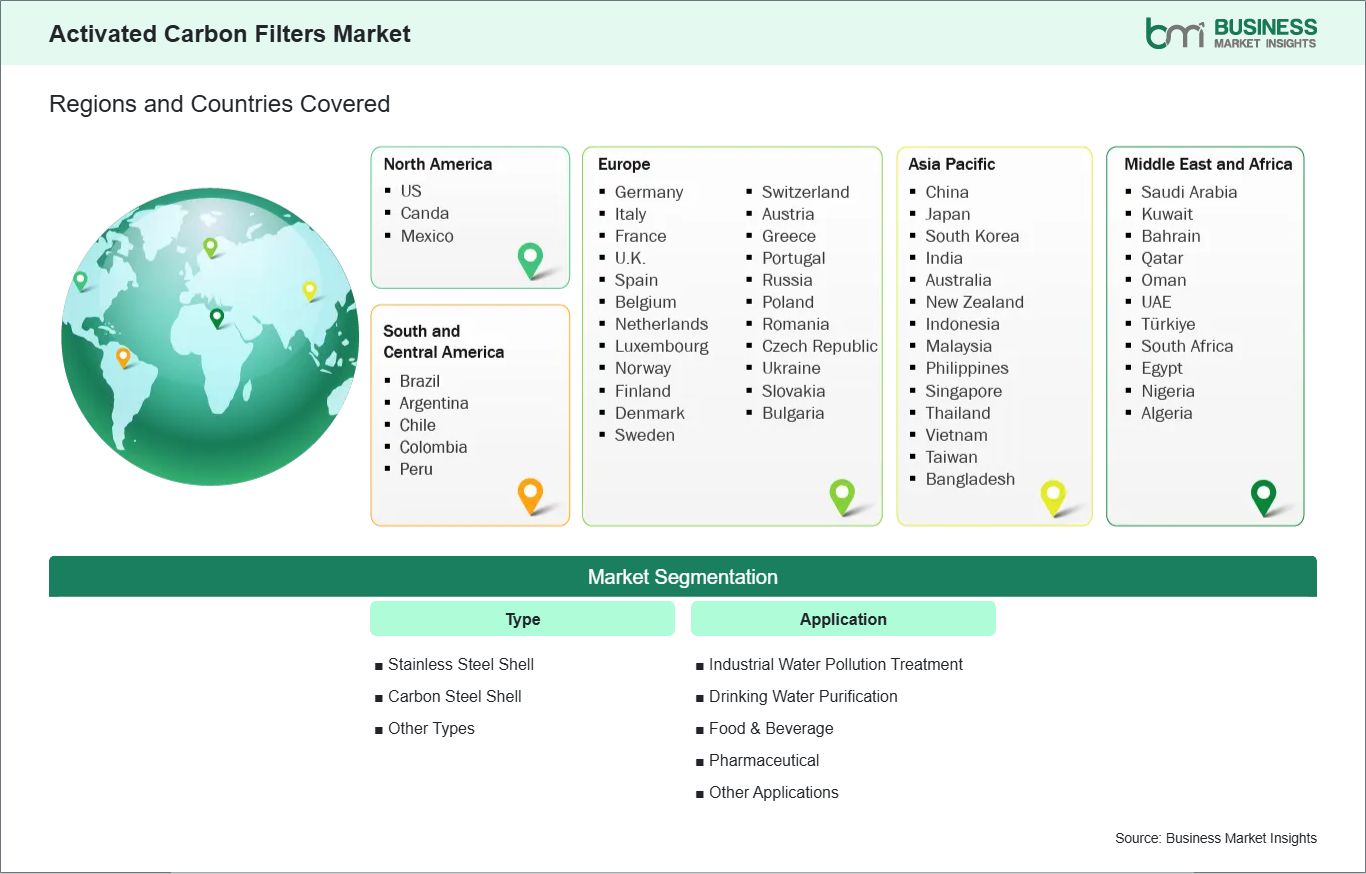
Key segments that contributed to the derivation of the activated carbon filters market analysis are type and application.
Water scarcity and pollution have become pressing global challenges, driving the adoption of advanced filtration technologies such as activated carbon filters. Municipalities and industries are under growing pressure to ensure safe water supply and meet increasingly stringent environmental regulations. Activated carbon filters are highly effective in adsorbing harmful substances, including organic compounds, chlorine, pesticides, and industrial toxins, thereby improving water quality and safeguarding public health. Their versatility makes them suitable for both drinking water purification and wastewater treatment, positioning them as a cornerstone of modern pollution control strategies.
Industrial expansion has led to a surge in wastewater generation, with sectors such as chemicals, textiles, and pharmaceuticals contributing significant pollutant loads. Activated carbon filters play a critical role in treating these effluents before discharge, reducing environmental impact and helping companies comply with regulatory standards. Their ability to remove volatile organic compounds and persistent pollutants makes them indispensable in sustainable water management.
Technological advancements are further enhancing the efficiency of activated carbon filters. Innovations in pore structure design, regeneration techniques, and hybrid filtration systems are improving adsorption capacity and extending filter life. These improvements reduce operational costs and broaden adoption across diverse applications. As global awareness of water scarcity and pollution intensifies, the demand for activated carbon filters will continue to grow, supported by regulatory mandates, industrial responsibility, and consumer expectations for clean, safe water.
The food, beverage, and pharmaceutical industries are highly dependent on high‑purity water, making activated carbon filters essential to their operations. In food and beverage processing, these filters are used to remove impurities, odors, and chlorine, ensuring that products maintain consistent taste, clarity, and quality. For example, in beverage production, activated carbon enhances flavor stability and prevents undesirable chemical interactions. In the pharmaceutical sector, where purity standards are even more stringent, activated carbon filters are critical for eliminating trace contaminants that could compromise drug safety and efficacy.
The increasing focus on quality control and regulatory compliance is a major driver of adoption. Global standards such as FDA, WHO, and ISO require manufacturers to maintain strict water purity levels, and activated carbon filters provide a reliable solution to meet these benchmarks. Their ability to deliver consistent performance across diverse applications makes them indispensable in safeguarding consumer health and product integrity.
Advancements in filter design and material quality are also improving operational efficiency. Modern activated carbon filters offer higher adsorption capacity, longer service life, and easier regeneration, reducing downtime and operational costs. Additionally, the growing emphasis on sustainable manufacturing is encouraging the use of eco‑friendly activated carbon derived from renewable sources such as coconut shells.
As the food, beverage, and pharmaceutical industries continue to expand globally, driven by rising consumer demand and healthcare needs, the reliance on activated carbon filtration systems will increase significantly. This trend underscores their role not only in ensuring product quality but also in supporting sustainability and regulatory compliance across critical industries.

The Activated Carbon Filters Market demonstrates steady growth, with size and share analysis highlighting evolving trends and competitive dynamics among key players. The report examines subsegments categorized within type and application, offering insights into their contribution to overall market performance.
By type, the stainless steel shell subsegment dominated the market in 2025, driven by its high durability and resistance to corrosion.
Based on application, the industrial water pollution treatment subsegment dominated the market in 2025, driven by increasing regulatory requirements for wastewater management.
| Report Attribute | Details |
|---|---|
| Market size in 2025 | US$ 330.3 Million |
| Market Size by 2033 | US$ 462.3 Million |
| Global CAGR (2026 - 2033) | 4.3% |
| Historical Data | 2022-2024 |
| Forecast period | 2026-2033 |
| Segments Covered | By Type
|
|
Regions and Countries Covered
| |
| North America | US, Canada, Mexico |
| Europe | Belgium, Austria, Finland, Denmark, Greece, Poland, Romania, Russia, Ukraine, Czech Republic, Slovakia, Bulgaria, Italy, Luxembourg, Germany, Switzerland, France, Netherlands, Norway, Portugal, Spain, Sweden, United Kingdom |
| Asia-Pacific | Australia, China, India, Japan, South Korea, Indonesia, Malaysia, Philippines, Singapore, Thailand, Vietnam, Bangladesh, New Zealand, Taiwan |
| South and Central America | Brazil, Argentina, Peru, Chile, Colombia |
| Middle East and Africa | Bahrain, Kuwait, Oman, Qatar, Saudi Arabia, United Arab Emirates, Turkiye, South Africa, Egypt, Algeria, Nigeria |
| Market leaders and key company profiles |
|
The "Activated Carbon Filters Market Size and Forecast (2022 - 2033)" report provides a detailed analysis of the market covering below areas:
The geographical scope of the Activated Carbon Filters Market report is divided into North America, Asia Pacific, Europe, Middle East & Africa, and South & Central America. North America held the largest share in 2025.
The adoption and maturity of activated carbon filters vary across regions, driven by environmental regulations, industrial growth, and water treatment needs. In North America, stringent environmental regulations and advanced water treatment infrastructure drive market growth. The US and Canada emphasize sustainable water management and pollution control technologies.
In Europe, strict environmental policies and high standards for water quality promote the adoption of advanced filtration systems. Countries such as Germany, the UK, and France lead in implementing sustainable water treatment solutions.
Asia Pacific market is growing due to rapid industrialization, urbanization, and increasing concerns over water pollution in countries such as China, India, and Southeast Asia. Government initiatives to improve water infrastructure and environmental protection further boost demand. The Middle East & Africa and South & Central America regions show steady growth, driven by increasing investments in water treatment and industrial development. Across all regions, regulatory frameworks and environmental concerns play a key role in shaping market dynamics.

The Activated Carbon Filters Market is evaluated by gathering qualitative and quantitative data post primary and secondary research, which includes important corporate publications, association data, and databases. A few of the key developments in the activated carbon filters market are:
The Activated Carbon Filters Market is valued at US$ 330.3 Million in 2025, it is projected to reach US$ 462.3 Million by 2033.
As per our report Activated Carbon Filters Market, the market size is valued at US$ 330.3 Million in 2025, projecting it to reach US$ 462.3 Million by 2033. This translates to a CAGR of approximately 4.3% during the forecast period.
The Activated Carbon Filters Market report typically cover these key segments-
The historic period, base year, and forecast period can vary slightly depending on the specific market research report. However, for the Activated Carbon Filters Market report:
The Activated Carbon Filters Market is populated by several key players, each contributing to its growth and innovation. Some of the major players include:
The Activated Carbon Filters Market report is valuable for diverse stakeholders, including:
Essentially, anyone involved in or considering involvement in the Activated Carbon Filters Market value chain can benefit from the information contained in a comprehensive market report.
Please tell us your area of interest
(Market Segments/ Regions and Countries/ Companies)