Market Summary
Executive Summary and Global Market Analysis
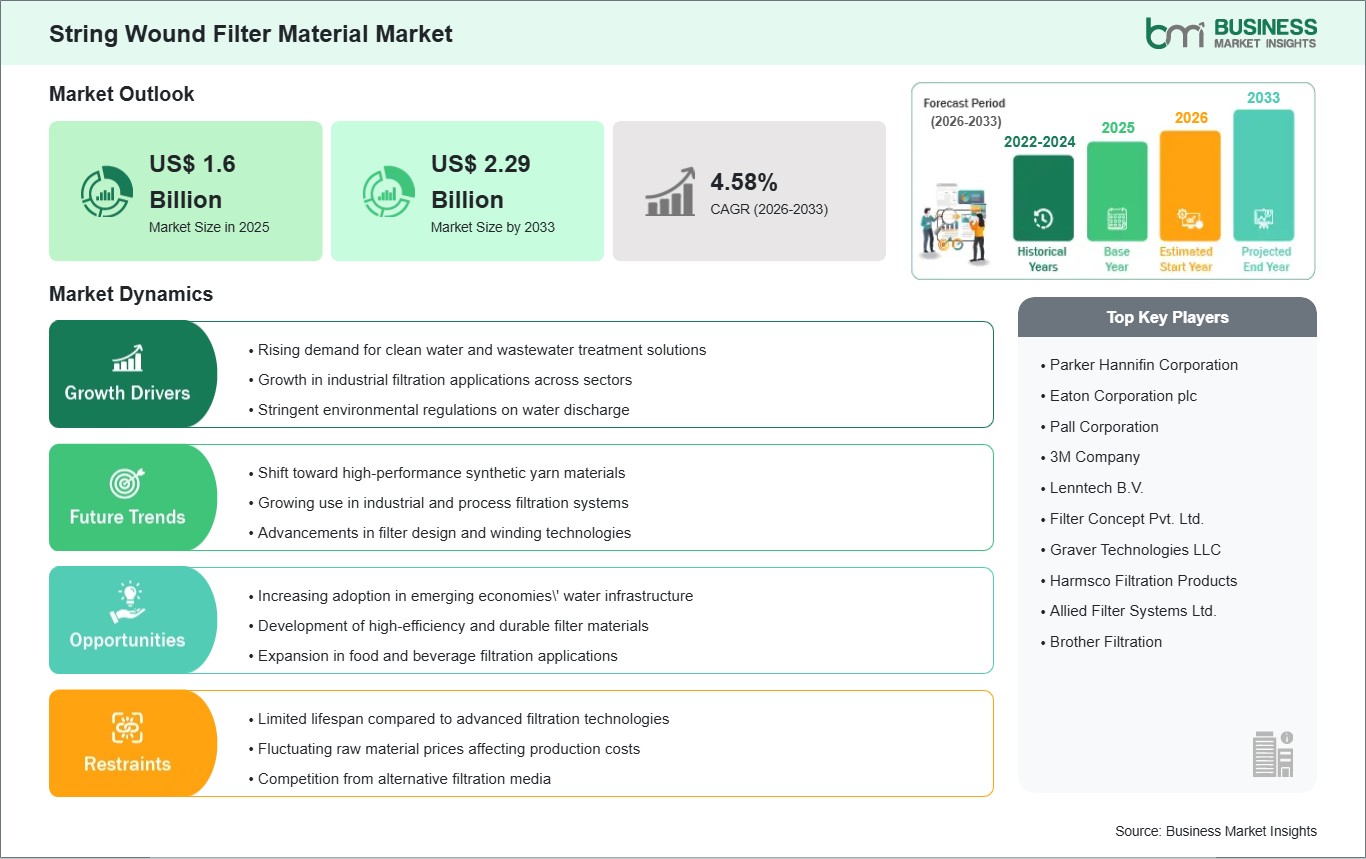
The market for string wound filter materials is experiencing steady growth due to the increased need for efficient and cost-effective solutions for filtration. The filters are widely used for the filtration of sediments and suspended materials. They are considered critical for maintaining the quality of water in various applications. Their design is simple, flexible, and suitable for different filtration environments. The market is influenced by environmental regulations, industrialization, and awareness of the need to conserve water. The market for polypropylene yarn and core is prominent due to their long-lasting nature, chemical resistance, and affordability. However, the market is challenged by the development of other technologies for filtration and the lifespan of the products. Despite these challenges, opportunities for growth are seen in developing markets and increased investments in water infrastructure. Continuous improvements in the design of the filters are also contributing to the growth of the market for string wound filter materials.
Segment Analysis
String Wound Filter Material Market Segmentation
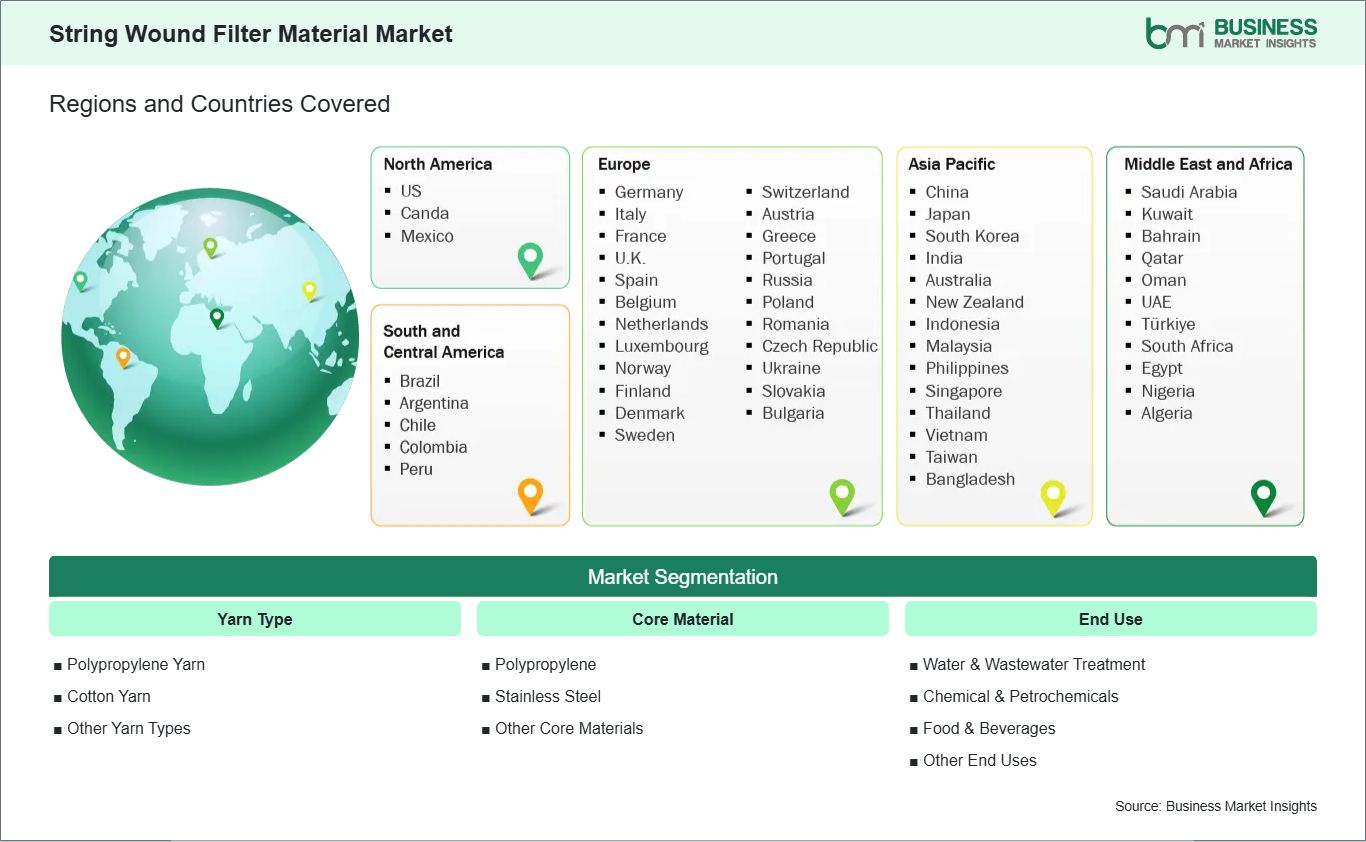
Key segments that contributed to the derivation of the String Wound Filter Material market analysis are yarn type, core material, and end use.
- By yarn type, the market is segmented into Polypropylene Yarn, Cotton Yarn, and Others. The Polypropylene Yarn segment dominated the market in 2025.
- By core material, the market is segmented into Polypropylene, Stainless Steel, and Others. The Polypropylene segment dominated the market in 2025.
- By end use, the market is segmented into Water & Wastewater Treatment, Chemical & Petrochemicals, Food & Beverages, and Others. The Water & Wastewater Treatment segment dominated the market in 2025.
Market Forces
String Wound Filter Material Market Drivers and Opportunities
Rising demand for clean water and wastewater treatment solutions
The rising demand for clean water and wastewater treatment solutions is a major driver of the string wound filter material market. Increasing population growth, urbanization, and industrialization are putting significant pressure on water resources, leading to a greater need for effective filtration systems. String wound filters play a crucial role in removing suspended particles, sediments, and impurities from water, making them essential in municipal and industrial water treatment processes. Their cost-effectiveness and adaptability to various filtration requirements make them widely used across developing and developed regions. Additionally, governments and regulatory bodies are enforcing stringent standards for water quality and wastewater discharge. This is encouraging industries to adopt reliable filtration solutions, thereby boosting demand for string wound filter materials and supporting sustained market growth.
Increasing adoption in emerging economies' water infrastructure
The increasing adoption of filtration solutions in emerging economies presents significant growth opportunities for the string wound filter material market. Rapid urbanization and industrial expansion in countries across Asia-Pacific, Latin America, and Africa are driving investments in water treatment infrastructure. Governments in these regions are focusing on improving access to clean drinking water and enhancing wastewater treatment capabilities. This is creating strong demand for cost-effective and efficient filtration materials, including string wound filters, which are suitable for large-scale deployment. Moreover, the growing awareness of water conservation and environmental sustainability is encouraging industries to implement advanced filtration systems. As infrastructure development continues, manufacturers have the opportunity to expand their presence and cater to the increasing demand, driving long-term market growth.
Size and Share Analysis
String Wound Filter Material Market Size and Share Analysis
The global String Wound Filter Material market is experiencing steady growth, with market size and share analysis reflecting evolving treatment preferences and competitive dynamics among key players. The report evaluates important subsegments categorized within yarn type, core material, and end use, highlighting their respective contributions to overall market performance.
By yarn type, the Polypropylene Yarn subsegment dominated the market in 2025 due to its superior chemical resistance, durability, and cost efficiency, making it ideal for diverse filtration applications in water treatment and industrial processes.
By core material, the Polypropylene subsegment dominated the market in 2025 due to its lightweight structure, corrosion resistance, and lower cost, enabling widespread adoption across multiple filtration systems and industries.
By end use, the Water & Wastewater Treatment subsegment dominated the market in 2025 due to rising concerns over water quality, increasing industrial discharge, and the growing need for effective filtration solutions worldwide.
Report Coverage
String Wound Filter Material Market Report Coverage and Deliverables
The "String Wound Filter Market Size and Forecast (2022 - 2033)" report provides a detailed analysis of the market covering below areas:
- String Wound Filter market size and forecast at the regional and country levels for segments covered under the scope
- String Wound Filter market trends, as well as drivers, restraints, and opportunities
- String Wound Filter market analysis covering key trends, regional framework, major players, regulations, and recent developments
- Industry landscape and competition analysis covering market concentration, heat map analysis, prominent players, and recent developments for the String Wound Filter market
- Detailed company profiles, including SWOT analysis
Geographic Insights
String Wound Filter Material Market Geographic Insights
The geographical scope of the String Wound Filter Material market report is divided into: North America, Asia Pacific, Europe, Middle East & Africa, and South & Central America. North America held the largest share in 2025.
North America dominates the string wound filter material market due to advanced water treatment infrastructure and strict environmental regulations governing water quality and wastewater discharge. The region has a strong presence of industrial sectors such as chemicals, food processing, and pharmaceuticals, which extensively use filtration systems. High awareness regarding water conservation and the need for efficient filtration technologies are driving the adoption of string wound filter materials. Additionally, continuous investments in upgrading water treatment facilities and maintaining compliance with regulatory standards further support market growth in the region. Technological advancements and the presence of key market players contribute to the development of high-performance filtration products.
Meanwhile, Asia-Pacific is expected to witness significant growth due to rapid industrialization, increasing population, and rising investments in water treatment infrastructure. Governments in emerging economies are focusing on improving water quality and expanding wastewater treatment capacity, creating substantial demand for string wound filter materials in the region.
Industry Activity
Recent Developments
The String Wound Filter Material market is evaluated by gathering qualitative and quantitative data post primary and secondary research, which includes important corporate publications, association data, and databases. A few of the key developments in the String Wound Filter Material market are:
- In March 2023, Parker Hannifin announced that it had introduced advanced string wound filter materials with higher dirt-holding capacity, targeting oil & gas, food & beverage, and pharmaceutical industries.
- In September 2023, Eaton Filtration announced investments in its manufacturing facilities to increase production of string wound filter media, supporting rising demand in municipal water purification and industrial wastewater treatment.
- In May 2024, Filtration Group announced that it had launched eco-friendly string wound filter materials made from recycled fibers, aligning with global sustainability goals and offering lower environmental impact for industrial customers.
Trust & Transparency
Research Methodology
The market analysis combines proprietary research with secondary data from government agencies, company disclosures, regulatory filings, industry databases and expert interviews. Market estimates are validated through data triangulation, cross-market benchmarking and analyst
review.
View Full Research Methodology
Key Sources Referred:
American Filtration & Separations Society (AFS) Water Quality Association (WQA) International Water Association (IWA) European Water Filter Manufacturers Association (EWFMA) ASTM International - Committee on Filtration Materials Company Websites Company Annual Reports Company Investor Presentations