Market Summary
Executive Summary and Global Market Analysis
Industrial filtration components designed for particulate capture in dust collection systems are commonly known as filter bags. The textile elements designed through engineering techniques are incorporated into baghouses for the separation of fine particles of dust present in exhaust gases produced through industrial processes. The usage of such filters is prevalent in a number of fields including the cement industry, mining sector, power plants, and chemical processing industries.
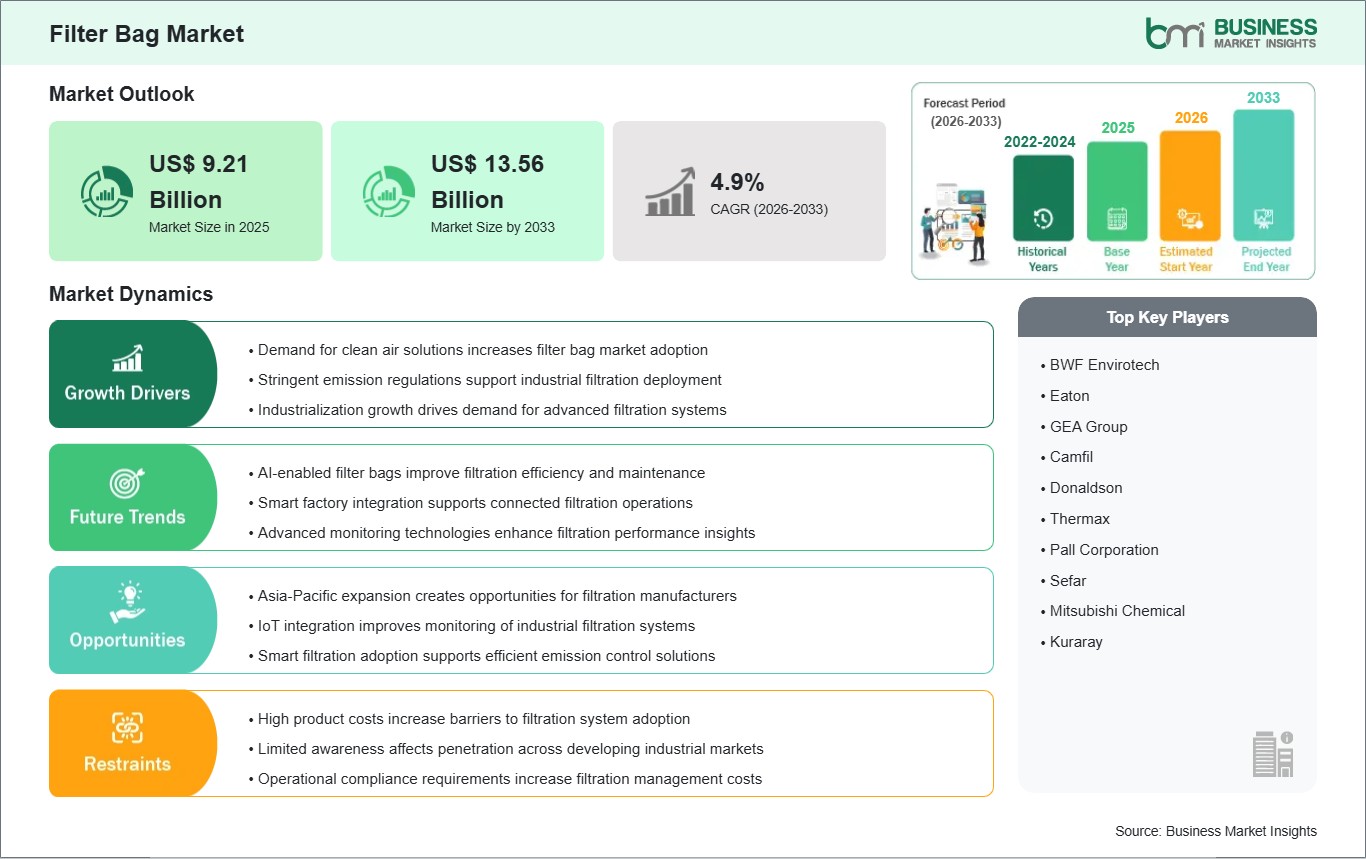
Expansion of market is being affected by the increasing pressure from stringent regulations regarding the quality of air, along with increased attention on safety conditions in workplaces. The need for better dust collection equipment to lower particulate emissions and conform to environmental standards is leading companies to invest in such technology. Increased production in industries which require huge amounts of energy is also contributing towards higher demand for such filters.
The demands are different according to the type of filtration, the materials used, and application areas of these systems. The most preferred system used in dusty locations is the pulse jet system. This preference is attributed to the efficiency associated with its performance when the system operates continuously. Shaker and reverse air systems are still in use in the industries due to their reliability in controlling moderate amounts of dust particles.
Technological advancements are improving filtration performance through enhanced fiber engineering, surface treatment techniques, and optimized dust release properties. Integration of monitoring systems is enabling better pressure control and maintenance scheduling in industrial environments. These improvements support extended operational life and reduced downtime. As industrial automation progresses, filter bag systems are increasingly incorporated into connected dust management infrastructure, improving reliability, operational visibility, and overall efficiency across large-scale industrial applications.
Segment Analysis
Filter Bag Market Segmentation
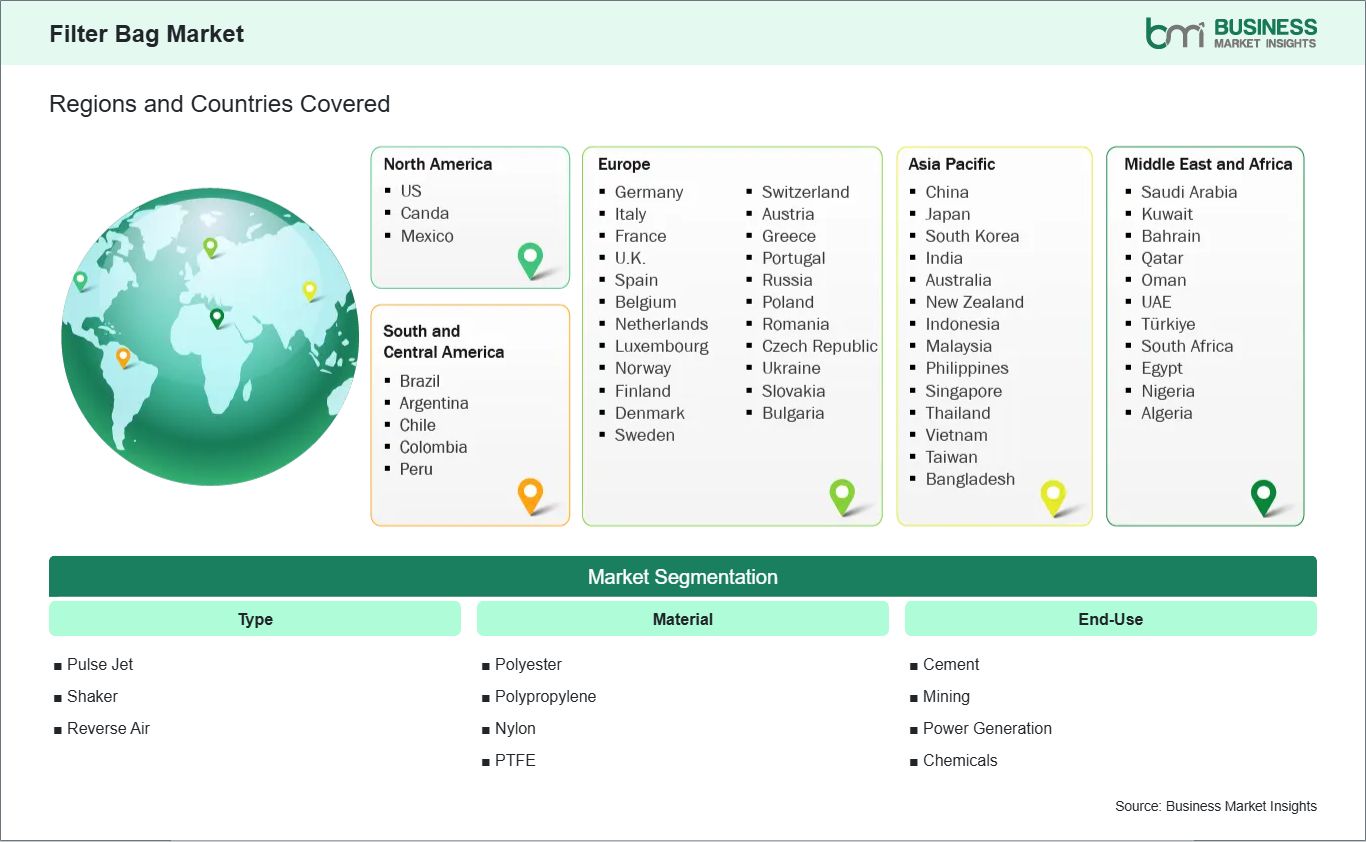
The filter bag market is segmented based on type, material, and end-use, reflecting the increasing emphasis on industrial emission control, particulate filtration efficiency, and compliance with environmental regulations across heavy-duty manufacturing and process industries.
By Type
- Pulse Jet - Enables high-efficiency dust cleaning in continuous industrial operations.
- Shaker - Utilized in moderate dust environments with mechanical cleaning systems.
- Reverse Air - Provides gentle cleaning suitable for low-pressure filtration applications.
By Material
- Polyester - Widely adopted for general industrial dust filtration performance.
- Polypropylene - Offers strong chemical resistance in corrosive environments.
- Nylon - Delivers durability under high-stress filtration conditions.
- PTFE - Used in extreme temperature and aggressive chemical applications.
By End Use
- Cement - Supports high-dust emission control during production processes.
- Mining - Used for managing particulate-heavy extraction environments.
- Power Generation - Enables emission reduction in combustion-based operations.
- Chemicals - Ensures filtration stability in reactive and corrosive processes.
Market Forces
Filter Bag Market Drivers and Opportunities
Rising demand for clean air
Industrial expansion has intensified the need for effective particulate control systems across manufacturing environments. Regulatory mechanisms have encouraged industries to utilize filtration systems to control their emission of particles into the atmosphere. The utilization of filter bags is growing common in dust collectors as a means of ensuring clean air and meeting environmental regulations. The need for this technology is growing due to its direct influence on the approval process of high-emission industries.
Higher expectations regarding better air quality are changing the ways companies look at industrial equipment selection and maintenance. Higher investment is being made by the industry in filtration equipment that is more efficient, with the aim of minimizing the impact on the environment and minimizing health hazards at work. This can be seen especially among industries where constant emissions occur and efficient filtration is required all the time.
Integration with IoT
Industrial filtration systems are increasingly incorporating sensor-based monitoring technologies for real-time performance tracking. The use of IoT in the development of such filter bags enables the operator to keep track of the differential pressures, dust levels, and cleaning schedules. This makes monitoring more efficient as it prevents any form of unexpected breakdown. Predictive maintenance has become efficient with the help of IoT.
The future expansion of intelligent filtration systems is likely to result in better lifecycle management and operational accuracy. The use of data analytics will ensure that cleaning cycles can be optimized and energy consumption minimized through dust collector systems. Through integration into industrial automation systems, monitoring of facilities will become easier. With the progression of industrial digitalization, smart filtration systems are set to bring many benefits.
Size and Share Analysis
Filter Bag Market Size and Share Analysis
The filter bag market size is expected to reach US$ 13.56 billion by 2033 from US$ 9.21 billion by 2025. The market is estimated to record a CAGR of 4.9% during 2026 to 2033. Market expansion is supported by increasing industrial emission control requirements, expansion of heavy manufacturing activities, and stricter environmental compliance norms across cement, mining, power generation, and chemical industries worldwide. Rising focus on air quality management continues to strengthen adoption of advanced dust filtration systems across industrial operations.
By Type, pulse jet filter bags account for a dominant share due to their superior cleaning efficiency and suitability for continuous high-dust industrial environments. Shaker systems hold a significant position in moderate dust applications, while reverse air systems maintain relevance in low-pressure filtration settings requiring gentle cleaning cycles.
By Material, polyester holds a major share supported by its wide industrial applicability and balanced filtration performance. Polypropylene continues to expand in chemically aggressive environments due to strong resistance properties. PTFE maintains steady growth in high-temperature and corrosive applications, while nylon is used in specialized heavy-duty filtration conditions requiring enhanced durability.
By End-Use, cement industry applications dominate the market due to high particulate emissions during production processes and continuous need for dust control systems. Mining follows with strong demand driven by extraction-related dust generation. Power generation and chemical industries maintain steady adoption as regulatory pressure increases, requiring efficient filtration systems to ensure emission compliance and operational safety standards.
Report Coverage
Filter Bag Market Report Coverage and Deliverables
The "Filter Bag Market Size and Forecast (2022 - 2033)" report provides a detailed analysis of the market covering below areas:
- Market size and forecast at global, regional, and country levels for all key market segments covered under the scope
- Market trends, along with market dynamics such as drivers, restraints, and key opportunities
- Market analysis covering key trends, global and regional frameworks, major players, regulations, and recent developments
- Industry landscape and competitive analysis covering market concentration, heat map analysis, prominent players, and recent developments
- Detailed company profiles, including SWOT analysis
Geographic Insights
Filter Bag Market Geographic Insights
The Filter Bag Market shows diverse regional adoption patterns influenced by industrialization levels, environmental regulations, manufacturing density, and emission control requirements. Across global regions, industries are increasingly prioritizing air quality management systems to comply with regulatory frameworks and operational safety standards. This has led to broader adoption of filtration technologies across heavy industrial sectors.
North America demonstrates strong deployment supported by strict environmental regulations and advanced industrial infrastructure. Industries in this region focus on upgrading existing dust collection systems to meet compliance standards. The presence of established manufacturing and energy sectors further strengthens demand for high-efficiency filtration solutions across multiple operational environments.
Asia Pacific represents a key growth region driven by rapid industrial expansion and large-scale manufacturing activities. Cement, mining, and power generation sectors significantly contribute to filter bag demand. Increasing emphasis on emission reduction and industrial modernization is encouraging wider adoption of advanced filtration systems across production facilities.
Europe shows steady adoption supported by stringent environmental policies and sustainability initiatives across industrial operations. Emerging markets in Latin America, the Middle East, and Africa are witnessing gradual uptake as industrial infrastructure develops and regulatory frameworks strengthen. Expansion of mining and energy projects in these regions continues to support demand for durable and high-performance filtration solutions.
Industry Activity
Recent Developments
The filter bag market is evaluated by gathering qualitative and quantitative data post primary and secondary research, which includes important corporate publications, association data, and databases. Recent developments and news in the market include:
- In November 2025, EXAIR Corporation announced the launch of an upgraded Chip Vac Filter Bag made from singed polyester fabric, designed to improve dust retention, reduce particle re-entrainment, and enhance durability for industrial vacuum and chip collection systems used in machining and manufacturing environments.
- In September 2025, Filtertechnik Jager GmbH announced the launch of the Cora Pleat filter element for bag filter housings, a new pleated design that significantly increases filtration surface area, improves efficiency, and extends service life of existing bag filter systems used in industrial air and fluid filtration applications.
Trust & Transparency
Research Methodology
The market analysis combines proprietary research with secondary data from government agencies, company disclosures, regulatory filings, industry databases and expert interviews. Market estimates are validated through data triangulation, cross-market benchmarking and analyst
review.
View Full Research Methodology
Key Sources Referred:
S. Environmental Protection Agency (EPA)European Environment Agency (EEA)International Energy Agency (IEA)World Bank Industrial Development DataJournal of Industrial Air Pollution Control StudiesASTM International Filtration StandardsUnited Nations Industrial Development Organization (UNIDO)National environmental regulatory agencies