
Trash Bags Market Outlook: Size, Share, Trends, Growth Analysis, Competitive Landscape & Forecast, 2026-2033

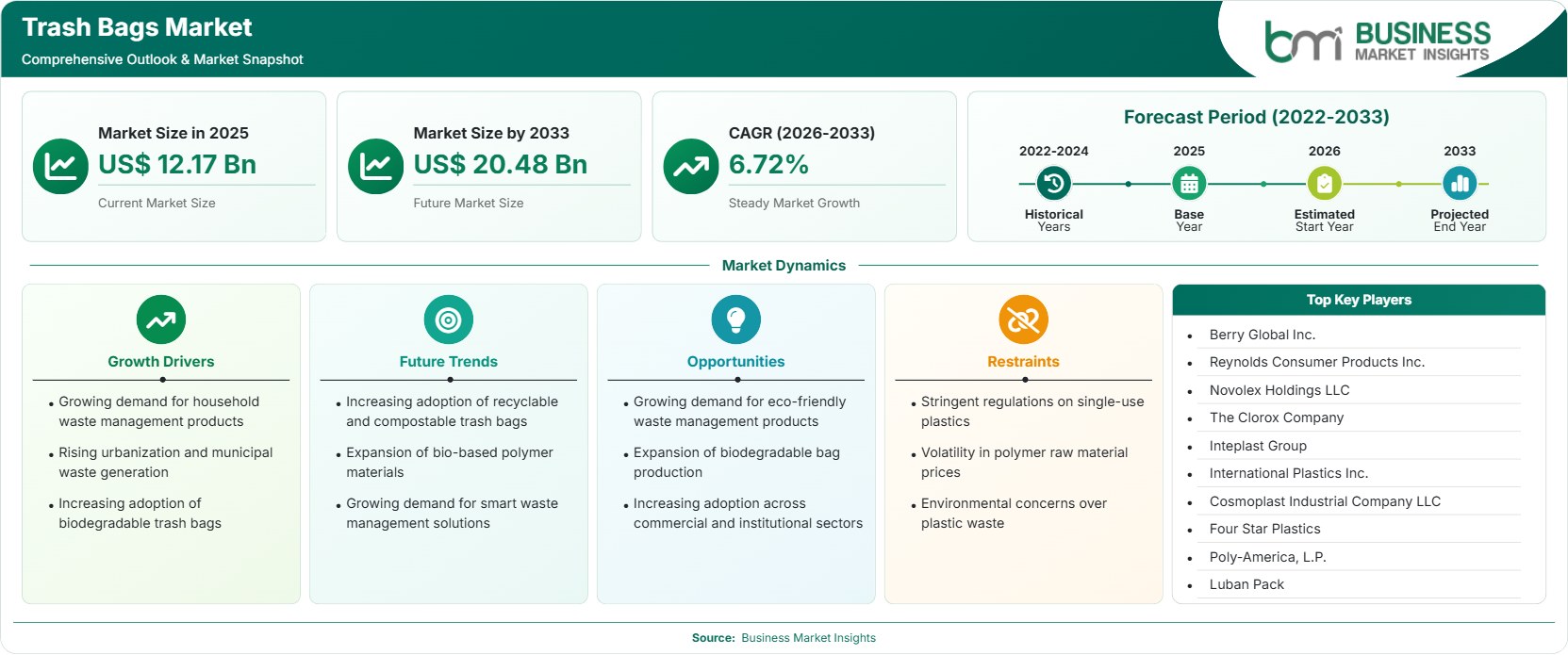
The Trash Bags Market size was valued at US$ 12.17 Billion in 2025 and is projected to reach US$ 20.48 Billion by 2033, growing at a CAGR of 6.72% from 2026 to 2033, driven by rising waste generation, sustainability initiatives, biodegradable material adoption, urban expansion, and increasing demand from residential, commercial, and industrial users.

Report Coverage
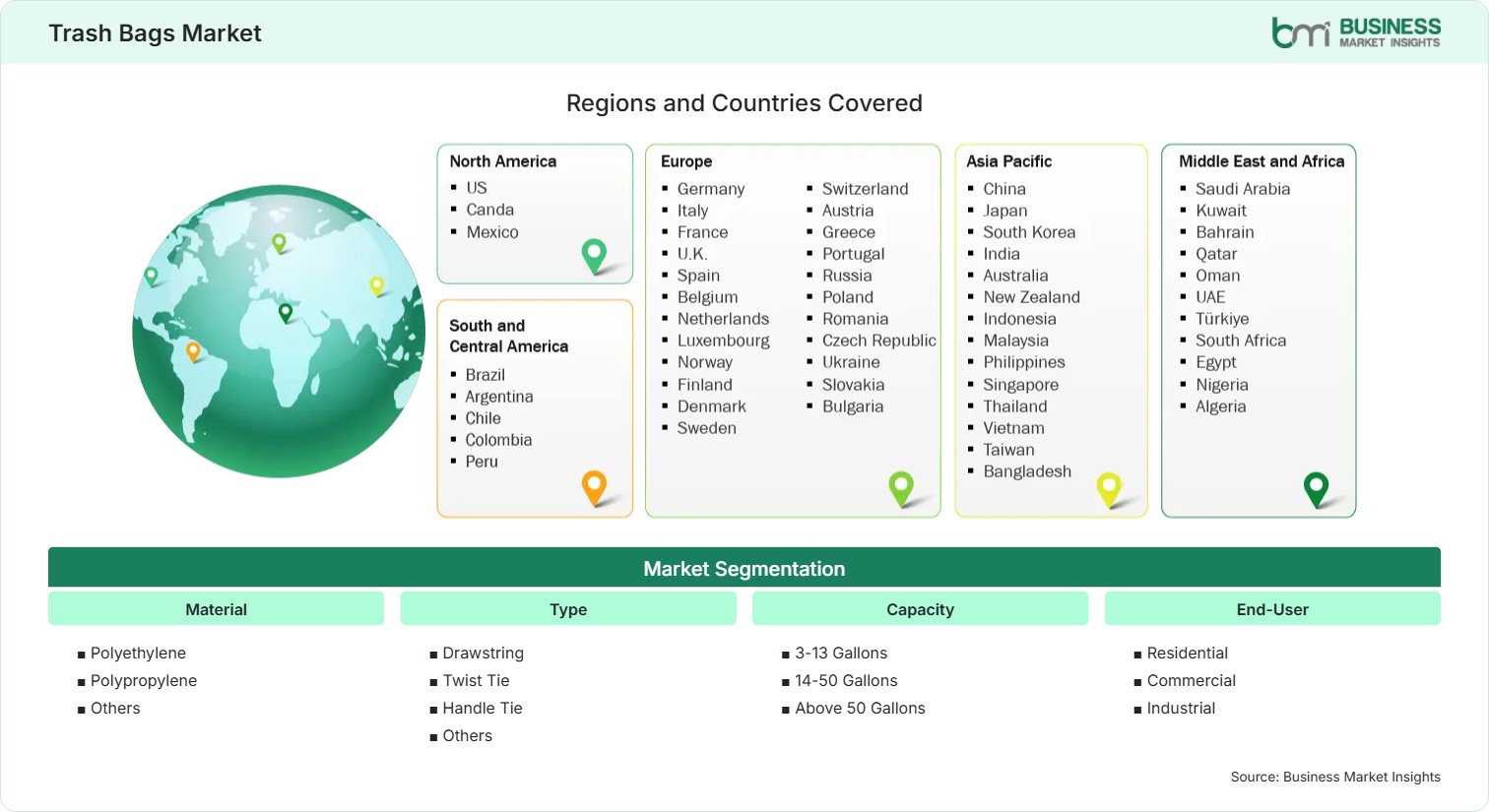
  • Material: Polyethylene , Polypropylene , Others
  • Type: Drawstring, Twist Tie, Handle Tie, Others
  • Capacity: 3-13 Gallons, 14-50 Gallons, Above 50 Gallons
  • End-User: Residential, Commercial, Industrial
US$ 12.17 Bn Market size in 2025
US$ 20.48 Bn Market Size by 2033
6.72% CAGR, 2026 - 2033
2026-2033 Forecast Period

01 AI Overview

Trash Bags Market Summary

  • North America Region: North America holds a market share of 34%–38% in 2025, growing with a CAGR of 6.1%–6.6% influenced by household waste management demand, recycling initiatives, sustainable packaging adoption, and municipal waste infrastructure development. The U.S. market demonstrates consistent expansion with a CAGR of 6.2%–6.7% from 2026–2033, supported by consumer preference for durable bags, organized retail channels, and environmentally conscious products.
  • Fastest Growing Region: Asia Pacific holds a market share of 27%–31% in 2025, growing with a CAGR of 7.2%–7.8% influenced by rapid urbanization, rising municipal waste generation, expanding commercial sectors, improved sanitation systems, and increasing adoption of biodegradable waste management solutions.
  • Leading Segment: Polyethylene (PE) holds a market share of 62%–66% in 2025, growing with a CAGR of 6.3%–6.8% influenced by cost efficiency, durability, widespread availability, flexible manufacturing capabilities, and extensive adoption across residential and commercial waste disposal applications.
  • High Growth Segment: Biodegradable trash bag applications within sustainable material categories hold a market share of 10%–14% in 2025, growing with a CAGR of 8.0%–8.6% influenced by environmental regulations, consumer awareness, corporate sustainability goals, and demand for reduced plastic waste solutions.
  • Key Market Opportunity: Growing sustainability requirements, biodegradable material innovation, and expanding commercial waste management applications are creating opportunities through advanced product development, regulatory alignment, and improved environmental performance.
  • Major Market Players: Berry Global Inc., Reynolds Consumer Products Inc., Novolex Holdings LLC, The Clorox Company, Inteplast Group, International Plastics Inc., Cosmoplast Industrial Company LLC, Four Star Plastics, Poly-America, L.P., and Luban Pack.
02 Strategic Insights

Trash Bags Market: Strategic Insights

Trash Bags Market Strategic Framework
FREE PDF
Request your free sample
Request free sample
03 Stakeholder View

Key Takeaways

  • The market ecosystem is shifting toward integrated waste management solutions, connecting polymer suppliers, manufacturers, distributors, retailers, and sustainability-focused organizations to improve product efficiency and environmental outcomes.
  • Sustainable materials represent a major growth opportunity as consumers, businesses, and governments increasingly prioritize biodegradable and recycled trash bag solutions over conventional plastic alternatives.
  • Product innovation is advancing through improved durability, enhanced sealing technologies, recycled polymer usage, and development of bags designed for specific waste disposal requirements.
  • Asia Pacific provides a strong investment opportunity due to rapid urbanization, expanding municipal waste systems, industrial development, and increasing awareness of sustainable waste management practices.
  • Competitive strategies are increasingly focused on mergers, partnerships, sustainable product launches, and manufacturing expansion to strengthen market positioning and address evolving regulatory requirements.
  • Commercial and institutional applications are becoming important growth areas as businesses adopt structured waste management practices and seek reliable disposal products.
04 Geographic Outlook

Trash Bags Market Regional Highlights

North America Trash Bags Market

North America accounted for a 34%–38% share in 2025 and is projected to expand at a CAGR of 6.1%–6.6% from 2026–2033. The Trash Bags Market share in North America is supported by demand for premium durable bags, recycled materials, and sustainable solutions across residential and commercial applications.

  • The United States remains the largest contributor due to established retail networks, strong consumer awareness, and widespread household waste disposal practices.
  • Canada is experiencing increased adoption of sustainable trash bags due to environmental initiatives, recycling programs, and growing preference for biodegradable alternatives.
  • Manufacturers are investing in recycled polymer technologies and improved product designs to meet sustainability expectations from consumers and businesses.
  • Commercial waste management demand is expanding through hospitality, healthcare, and institutional sectors requiring specialized disposal solutions.
  • Retail channels continue supporting product accessibility through supermarkets, home improvement stores, and online purchasing platforms.

US Trash Bags Market

The US Trash Bags Market represented a 29%–33% share of the global market in 2025 and is expected to grow at a CAGR of 6.2%–6.7% during 2026–2033. Growth is driven by strong residential consumption, increasing waste generation, sustainability-focused purchasing behavior, and established waste management infrastructure.

  • Household demand remains significant due to frequent waste disposal requirements, convenience preferences, and widespread adoption of branded trash bag products.
  • Sustainable product adoption is increasing as consumers seek recycled content bags and biodegradable alternatives aligned with environmental concerns.
  • Commercial users are driving demand through offices, retail facilities, restaurants, and institutions requiring reliable waste disposal solutions.
  • Online retail growth is improving product accessibility through subscription models, digital promotions, and direct-to-consumer purchasing options.

Europe Trash Bags Market

Europe accounted for a 22%–26% share of the Trash Bags Market in 2025 and is projected to register a CAGR of 6.0%–6.5% from 2026–2033. The region is influenced by strict environmental policies, recycling targets, and increasing demand for sustainable waste management products. Germany, the United Kingdom, France, and Italy represent major contributors, while Germany and the United Kingdom show stronger adoption due to advanced recycling systems and environmental awareness.

  • Germany is supporting market growth through waste separation practices, recycling infrastructure, and increasing preference for sustainable household products.
  • The United Kingdom is experiencing demand growth through environmental regulations, retail availability, and consumer interest in biodegradable waste solutions.
  • France and Italy are adopting sustainable waste products as municipalities and businesses strengthen environmental management practices.
  • European manufacturers are focusing on recycled polymers, reduced plastic usage, and improved product sustainability.
  • Regulatory pressure on conventional plastics is encouraging innovation in alternative materials and environmentally friendly designs.

Asia Pacific Trash Bags Market

Asia Pacific represented a 27%–31% share of the Trash Bags Market in 2025 and is expected to expand at a CAGR of 7.2%–7.8% from 2026–2033. The region is the fastest-growing market due to rapid urbanization, increasing municipal waste generation, industrial expansion, and improving sanitation infrastructure. China, India, Japan, South Korea, and Southeast Asian countries are contributing through growing consumption and investment in waste management systems.

  • China is expanding demand through urban population growth, municipal waste initiatives, and increasing commercial waste disposal requirements.
  • India is witnessing higher adoption due to urban development, sanitation programs, and increasing awareness of organized waste management practices.
  • Japan and South Korea support sustainable product demand through advanced recycling systems and environmentally conscious consumers.
  • Southeast Asian countries are creating opportunities through rising urban populations, commercial expansion, and improving retail distribution networks.
  • Manufacturers are increasing local production capacity to address regional demand and reduce supply chain challenges.

Rest of World Trash Bags Market

Rest of World accounted for a 9%–12% share of the Trash Bags Market in 2025 and is projected to grow at a CAGR of 5.8%–6.4% from 2026–2033. South and Central America are supported by urban growth, increasing waste generation, and improving municipal systems. Middle East and Africa markets are developing through infrastructure investments, commercial expansion, and rising awareness regarding organized waste disposal practices.

  • Brazil is contributing through expanding urban waste management needs, retail growth, and increasing adoption of household disposal products.
  • Latin American countries are improving waste infrastructure while encouraging adoption of efficient and sustainable waste disposal solutions.
  • Middle Eastern markets are creating demand through commercial development, hospitality expansion, and increased environmental management initiatives.
  • African urban centers are gradually adopting organized waste solutions due to population growth and improving sanitation systems.
  • Regional manufacturers are focusing on affordable products and localized distribution strategies to address diverse market requirements.
Global Market Geography
FREE PDF
Request your free sample
Request free sample
05 Segment Analysis

Trash Bags Market Segmentation

Material

The Material segment represents a major component of the Trash Bags Market, with Polyethylene (PE) accounting for a 62%–66% share in 2025 and growing at a CAGR of 6.3%–6.8% during 2026–2033. PE-based bags dominate due to durability, flexibility, cost efficiency, and broad manufacturing adoption. The segment benefits from demand across residential, commercial, and industrial applications, while sustainable polymer alternatives continue gaining attention.

  • Polyethylene (PE): Polyethylene remains the preferred material due to strength, lightweight characteristics, moisture resistance, and suitability for large-scale trash bag production across multiple end-user segments.
    • Low Density Polyethylene (LDPE): LDPE is widely used for flexible trash bags requiring stretchability, impact resistance, and reliable performance in household and commercial waste applications.
    • High Density Polyethylene (HDPE): HDPE offers higher strength and puncture resistance, supporting applications requiring durable bags for heavier waste disposal requirements.
    • Linear Low Density Polyethylene (LLDPE): LLDPE provides enhanced flexibility and tear resistance, making it suitable for manufacturers seeking improved performance with reduced material usage.
  • Polypropylene (PP): Polypropylene-based products are gaining interest due to strength, chemical resistance, and potential applications requiring specialized waste handling performance.

Type

The Type segment includes various closure and handling formats designed to meet consumer convenience and application requirements. Drawstring products represented a 34%–38% share in 2025 and are projected to grow at a CAGR of 6.5%–7.0% during 2026–2033. The Trash Bags Market scope is expanding through innovations focused on easy handling, improved sealing, and user-friendly disposal solutions across households and commercial facilities.

  • Drawstring: Drawstring bags maintain strong demand due to convenient closure mechanisms, easy transportation, odor control benefits, and widespread household adoption.
  • Twist Tie: Twist tie bags remain popular due to affordability, simple sealing functionality, and suitability for routine residential waste disposal applications.
  • Handle Tie: Handle tie products are gaining adoption through improved carrying convenience, leak prevention features, and increased usage in households and retail environments.

Capacity

The Capacity segment reflects diverse waste disposal requirements across household, commercial, and industrial applications. Bags with 14-50 Gallons accounted for a 42%–46% share in 2025 and are expected to grow at a CAGR of 6.4%–6.9% from 2026–2033. Demand is supported by commercial facilities, larger households, and institutional users requiring higher-volume waste management solutions.

  • 3-13 Gallons: Small-capacity bags are primarily used for household bins, kitchens, bathrooms, and daily waste disposal activities requiring convenience.
  • 14-50 Gallons: Medium-capacity bags dominate due to balanced size, durability, and suitability across residential, commercial, and institutional waste management applications.
  • Above 50 Gallons: Large-capacity bags support industrial and heavy-duty waste disposal requirements where increased volume handling and strength are essential.

End-User

The End-User segment demonstrates broad adoption across residential, commercial, and industrial applications. Residential users accounted for a 48%–52% share in 2025 and are expected to grow at a CAGR of 6.2%–6.7% during 2026–2033. Rising waste generation, urban lifestyles, and increasing focus on household hygiene continue supporting demand across consumer markets.

  • Residential: Residential applications represent the largest usage area due to daily waste disposal needs, household convenience requirements, and increasing adoption of sustainable products.
  • Commercial: Commercial users are adopting advanced waste bags across offices, restaurants, hospitality facilities, and retail locations requiring efficient waste management practices.
  • Industrial: Industrial applications require high-strength solutions for manufacturing waste, facility operations, and large-volume disposal requirements across different sectors.
06 Market Forces

Trash Bags Market Dynamics

Key Market Drivers

Growing demand for household waste management products

Rising household waste generation and increasing focus on cleanliness are strengthening demand for reliable waste disposal solutions. Expanding urban households, changing lifestyles, and greater awareness of hygiene standards are encouraging consumers to adopt durable and convenient trash bags. Manufacturers are developing products with improved strength, leak resistance, odor-control features, and recycled content to address evolving household requirements. Companies are also improving packaging efficiency and distribution networks to enhance product accessibility through retail and online channels. These developments reflect changing Trash Bags Market trends toward convenience, sustainability, and improved waste handling performance.

Rising urbanization and municipal waste generation

Rapid urbanization is resulting in increasing volumes of waste generated in municipal areas and a need for improved waste collection and disposal products. Growing residential areas, commercial and public infrastructure need steady supplies of waste management products. The municipal bodies are enhancing the waste management infrastructure, and the companies are making efforts to dispose of their waste systematically so that they can fulfill the environmental requirements. The increasing demand for systematic waste collection is fueling the demand for various types of bags and other characteristics. Developing countries are creating more opportunities due to increased urban populations and the development of waste management infrastructure.

Increasing adoption of biodegradable trash bags

Environmental issues and sustainability efforts have led to increased adoption of biodegradable and compostable garbage bag solutions. There is now a growing desire among consumers, organizations, and even governments for solutions that minimize reliance on traditional plastic components. Companies are working hard to develop bio-based and recycled polymers, along with other improved technologies, to meet sustainability demands. Waste-reduction and sustainable-use-of-plastic campaigns are prompting companies to produce more eco-friendly products.

Key Market Opportunities

Growing demand for eco-friendly waste management products

Growing environmental consciousness presents a chance for businesses working on innovative trash bags through recycled polymers and biodegradable materials. There is increased selectivity by consumers and institutions when it comes to choosing products that are aligned with sustainability. Businesses that focus on investing in environmental materials stand a chance to create a unique product offering and build their brands. There is also an opportunity by retailers who are increasingly expanding the category of sustainable products in reaction to changes in consumer behavior. The opportunities exist considering company sustainability strategies and growing demand for less damaging products.

Expansion of biodegradable bag production

The expansion of biodegradable bag production provides opportunities for manufacturers to strengthen their presence in sustainability-focused markets. Advances in polymer technology are enabling development of products with improved strength, usability, and environmental performance. There are increasing investments in research and manufacturing capability owing to increased demand for alternative materials. There is an increase in regulations concerning the use of traditional plastic products that have encouraged firms to explore alternative ways of production using renewable materials. This will make more biodegradable products available for consumption. Investments in manufacturing capability and material collaborations should ensure greater success in terms of scalability and manufacture of sustainable trash bag products.

Increasing adoption across commercial and institutional sectors

Commercial and institutional sectors are creating new opportunities due to increasing emphasis on structured waste management practices. Offices, healthcare centers, hospitality providers, educational centers, and industries need waste disposal products with varying capacity and longevity requirements. With increasing emphasis on workplace cleanliness and compliance with environmental regulations, there is increasing need for companies to improve their waste management systems. Manufacturers can leverage the situation by designing products that suit large-scale applications and specific industry needs. The development of infrastructure facilities in developing nations is also driving demand. Companies offering customized services, bulk purchases, and effective delivery services will find opportunities among these growing end users.

Market Restraints and Challenges

Stringent regulations on single-use plastics

Factor: Stringent regulations on single-use plastics are increasing compliance requirements for trash bag manufacturers by limiting the use of conventional plastic materials. Impact: Companies may face higher research, production, and reformulation costs while adapting to alternative materials and changing regulatory standards. Governments in various regions have adopted strategies that aim at lowering plastic waste and promoting sustainability. Companies must adopt biodegradable materials, recycling techniques, and better production methods to remain competitive in the market. Such policy shifts could prove to be challenging for companies that rely heavily on polyethylene production.

Volatility in polymer raw material prices

Factor: Volatility in polymer raw material prices affects manufacturing costs by creating uncertainty in procurement and production planning. Impact: Fluctuating input expenses can reduce profit margins, increase pricing pressure, and influence supply chain stability for trash bag producers. Polymer prices are affected by crude oil fluctuations, energy costs, transportation expenses, and global supply-demand conditions. Manufacturers relying heavily on polyethylene and polypropylene materials must develop effective sourcing strategies to manage cost variations. Large companies may reduce exposure through supplier diversification and operational efficiency, while smaller producers may experience greater financial pressure.

07 Company Analysis

Competitive Landscape

The Trash Bags Market analysis highlights a competitive environment shaped by global packaging manufacturers, waste management product suppliers, and companies focusing on sustainable material innovation. Market participants are strengthening their positions through product diversification, recycled material adoption, manufacturing expansion, and improved distribution networks.

Company Name

Overview

Products and Services relevant to this market

Berry Global Inc.

Berry Global Inc. is a global packaging manufacturer providing engineered plastic solutions across multiple industries.

Provides trash bags, flexible packaging products, recycled plastic solutions, and sustainable waste management packaging products.

Reynolds Consumer Products Inc.

Reynolds Consumer Products Inc. manufactures consumer household products with strong presence in storage and waste categories.

Offers trash bags, household waste disposal products, food storage solutions, and consumer-focused packaging products.

Novolex Holdings LLC

Novolex Holdings LLC is a packaging company specializing in sustainable and customized flexible packaging solutions.

Provides waste bags, recycled-content products, commercial trash liners, and specialized packaging solutions.

The Clorox Company

The Clorox Company is a consumer products company offering cleaning, household, and waste management-related products.

Provides Glad trash bags, odor-control solutions, household waste products, and advanced disposal technologies.

Inteplast Group

Inteplast Group is a diversified plastics manufacturer serving industrial, commercial, and consumer markets.

Produces trash liners, can liners, plastic bags, and customized waste management products.

International Plastics Inc.

International Plastics Inc. supplies flexible plastic products for commercial, industrial, and institutional users.

Provides trash bags, can liners, recycling bags, and customized plastic waste solutions.

Cosmoplast Industrial Company LLC

Cosmoplast Industrial Company LLC manufactures plastic products serving consumer and industrial applications.

Offers garbage bags, household waste products, plastic packaging solutions, and related disposable products.

Four Star Plastics

Four Star Plastics specializes in manufacturing flexible plastic products for different customer requirements.

Provides trash bags, industrial liners, custom plastic bags, and waste disposal solutions.

Poly-America, L.P.

Poly-America, L.P. is a major plastic products manufacturer with extensive production capabilities.

Supplies trash bags, construction liners, plastic films, and large-volume waste management products.

Luban Pack

Luban Pack provides packaging solutions with focus on flexible plastic products and waste management applications.

Offers garbage bags, disposable plastic products, packaging materials, and customized waste solutions.

10 Trust & Transparency

Research Methodology

The market analysis combines proprietary research with secondary data from government agencies, company disclosures, regulatory filings, industry databases and expert interviews. Market estimates are validated through data triangulation, cross-market benchmarking and analyst review.

View Full Research Methodology

11 Questions Answered

Frequently Asked Questions

What information does the Trash Bags Market Report provide?

The Report provides analysis of market size, regional trends, segmentation, competitive landscape, growth factors, challenges, and opportunities influencing industry development through 2033.

Why are commercial users important for the market?

Commercial users require reliable waste disposal solutions across offices, hospitality facilities, healthcare centers, and institutions. Their demand supports growth in larger capacity bags and specialized waste management products.

What materials are commonly used in trash bag manufacturing?

Polyethylene remains the dominant material due to durability, flexibility, and cost efficiency. Manufacturers are also increasing the use of recycled polymers and biodegradable materials to meet sustainability requirements.

How does urban development influence trash bag demand?

Urban development increases household, commercial, and municipal waste generation, creating demand for efficient waste collection products and supporting market expansion across developing and developed regions.

What factors are supporting the expansion of sustainable Trash Bags Market forecasts?

Sustainable trash bag adoption is supported by environmental awareness, regulatory pressure, recycled material innovation, and increasing demand from consumers and businesses seeking reduced plastic waste solutions.

Access the Full Trash Bags Market Report

Get segment-level forecasts, regional estimates, competitive benchmarking, company profiles and downloadable Excel datasets.

Access the full Trash Bags Market Report
350 pages PDF & Excel | 2026-08-12