
Air Filters Market Outlook: Size, Share, Trends, Growth Analysis, Competitive Landscape & Forecast, 2026-2033

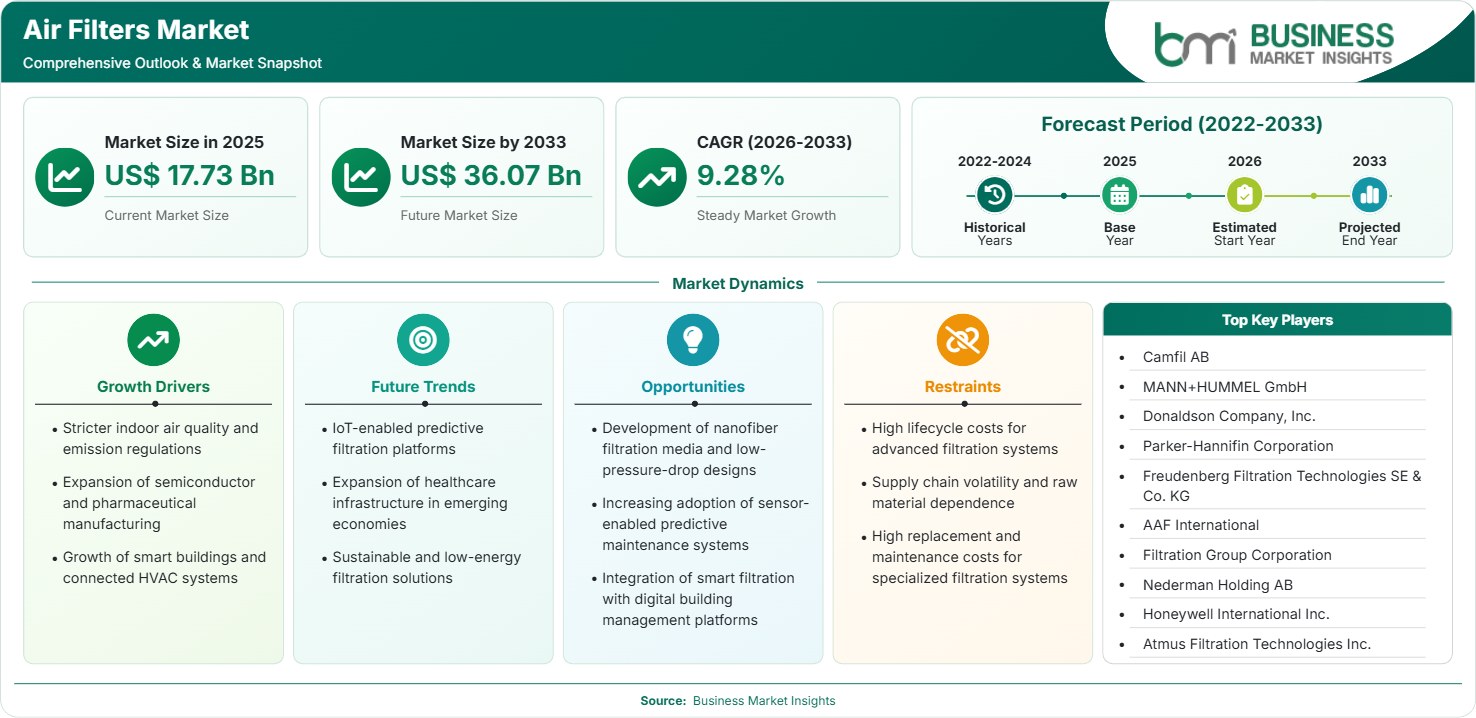
The Air Filters Market size was valued at US$ 17.73 Billion in 2025 and is projected to reach US$ 36.07 Billion by 2033, growing at a CAGR of 9.28% during 2026–2033. Rising indoor air quality concerns, stricter industrial emission standards, cleanroom expansion, energy-efficient HVAC adoption, and smart filtration technologies are creating substantial growth opportunities across residential, commercial, and industrial applications.

Report Coverage
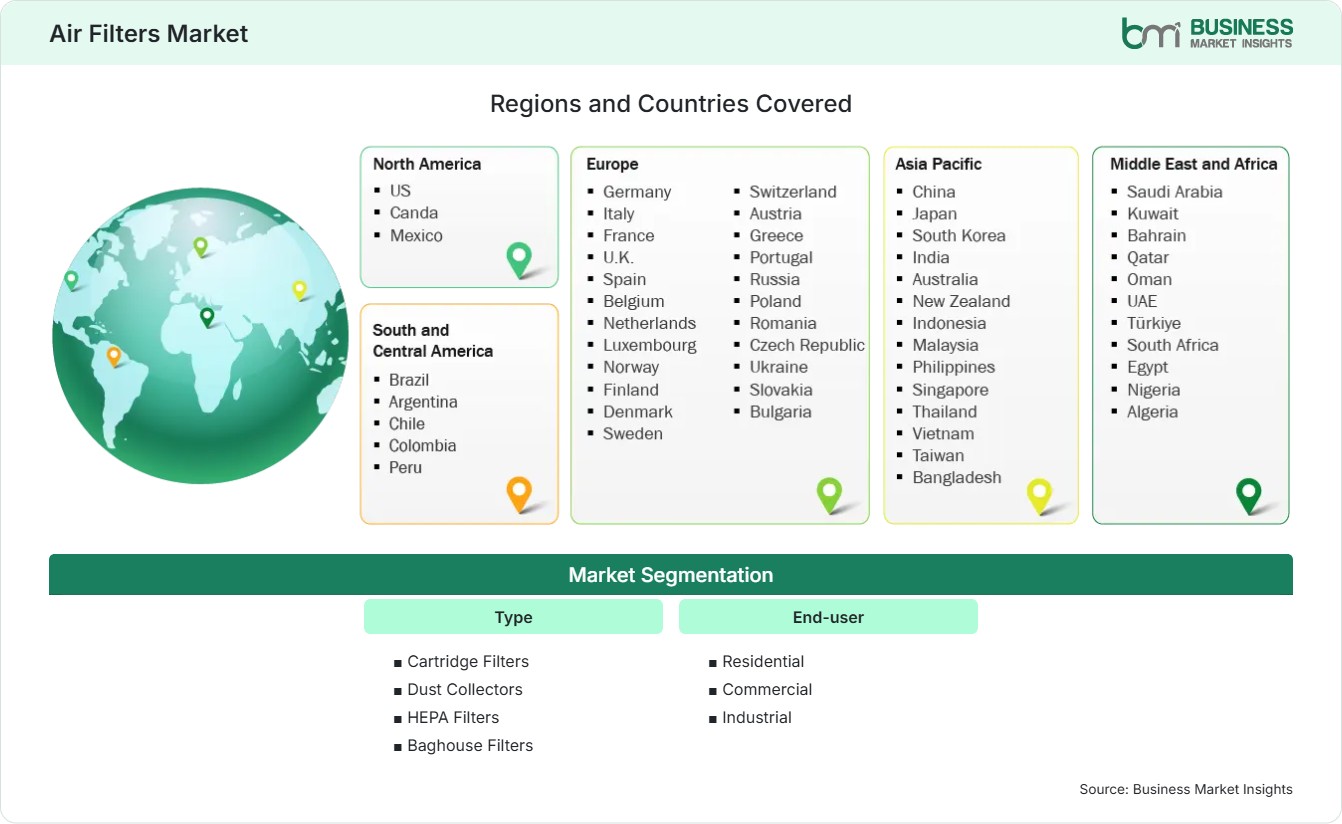
  • Type: Cartridge Filters, Dust Collectors, HEPA Filters, Baghouse Filters
  • End-user: Residential, Commercial, Industrial
US$ 17.73 Bn Market size in 2025
US$ 36.07 Bn Market Size by 2033
9.28% CAGR, 2026 - 2033
2026-2033 Forecast Period

AI Overview

Air Filters Market Summary

  • North America Region: North America holds a market share of 33%–36% in 2025, growing at a CAGR of 8.2%–8.8% during 2026–2033. Demand is supported by stringent indoor air quality regulations, data center expansion, healthcare infrastructure upgrades, and replacement demand across commercial HVAC systems.
    US market benefits from commercial retrofits, industrial compliance requirements, and advanced filtration adoption, expanding at approximately 8.4%–9.0% CAGR.
  • Fastest Growing Region: Asia Pacific accounts for 27%–30% share in 2025 and advances at 10.8%–11.5% CAGR during 2026–2033. Urbanization, manufacturing investments, healthcare construction, semiconductor capacity expansion, and worsening air pollution are stimulating accelerated filtration deployment across multiple industries.
  • Leading Segment: HEPA Filters represent a 28%–32% share in 2025 and grow at 9.0%–9.6% CAGR. Increasing deployment across healthcare facilities, pharmaceutical manufacturing, laboratories, electronics production, and premium commercial buildings sustains strong recurring replacement demand.
  • High Growth Segment: Industrial end-user accounts for 38%–42% share in 2025 and grows at 10.1%–10.8% CAGR. Industrial hygiene regulations, worker safety requirements, emission control investments, and clean manufacturing standards continue to reinforce adoption.
  • Key Market Opportunity: Expansion of smart building ecosystems creates demand for connected filtration systems that optimize energy consumption, monitor filter performance, enhance sustainability reporting, and improve occupant health outcomes across facilities globally.
  • Major Market Players: Camfil AB, MANN+HUMMEL GmbH, Donaldson Company, Inc., Parker-Hannifin Corporation, Freudenberg Filtration Technologies SE & Co. KG, AAF International, Filtration Group Corporation, Nederman Holding AB, Honeywell International Inc., and Atmus Filtration Technologies Inc.
Strategic Insights

Air Filters Market: Strategic Insights

Air Filters Market Strategic Framework
FREE PDF
Request your free sample
Request free sample
Stakeholder View

Key Takeaways

  • The value chain increasingly favors suppliers capable of combining filtration media, monitoring software, and aftermarket replacement services into integrated offerings.
  • Industrial facilities, pharmaceutical cleanrooms, and semiconductor fabs present the highest monetization potential because filtration performance directly affects production quality and compliance.
  • Product innovation is shifting toward nanofiber media, low-resistance HEPA platforms, antimicrobial coatings, and sensor-enabled predictive maintenance capabilities.
  • Asia Pacific offers the strongest investment case due to manufacturing expansion, air quality concerns, healthcare infrastructure spending, and favorable industrial policies.
  • Strategic acquisitions continue expanding geographic footprints and technology portfolios as leading vendors seek greater participation in specialty filtration applications.
  • Sustainability objectives are influencing procurement decisions, encouraging adoption of filters delivering longer service life and lower operating energy requirements.
Geographic Outlook

Air Filters Market Regional Highlights

North America Air Filters Market

North America accounted for approximately 33%–36% of the Air Filters Market share in 2025 and is projected to expand at 8.2%–8.8% CAGR through 2033. Demand remains supported by mature replacement cycles, healthcare facility upgrades, data center construction, and compliance-focused industrial spending. Building owners increasingly prioritize indoor air quality and energy efficiency simultaneously. Commercial HVAC modernization programs continue stimulating demand, while manufacturing facilities invest in advanced particulate management systems to satisfy occupational safety requirements and operational efficiency objectives.

  • Healthcare facilities increasingly deploy high-efficiency filtration systems to maintain controlled environments and improve infection-control performance.
  • Data center expansion supports demand for advanced air management technologies protecting sensitive electronic equipment.
  • Commercial retrofitting programs prioritize energy-efficient filtration solutions that reduce operating expenses while maintaining indoor quality.
  • Industrial operators adopt advanced particulate capture technologies to meet environmental and worker-safety requirements.

US Air Filters Market

The United States represented approximately 74%–78% of regional revenue in 2025 and is expected to grow at 8.4%–9.0% CAGR. Strong investment in commercial infrastructure, healthcare modernization, logistics facilities, and advanced manufacturing supports long-term demand. Federal attention toward indoor environmental quality, sustainability targets, and industrial compliance requirements strengthens adoption across public and private facilities. Growing adoption of smart building technologies further accelerates premium filtration deployment and aftermarket replacement demand.

  • Healthcare and pharmaceutical sectors continue expanding purchases of high-performance contamination-control systems.
  • Data center operators increasingly specify advanced filtration products to support long-term equipment reliability.
  • Industrial reshoring investments are creating opportunities across manufacturing and production facilities.
  • Smart building integration supports predictive maintenance and operational efficiency improvements.

Europe Air Filters Market

Europe was valued at 25% to 28% in 2025, and the region is projected to grow at a CAGR of 8.5% to 9.2%. The European market benefits from stringent environmental policies, energy transition initiatives, and sustainability-related construction upgrades. Germany is the biggest market contributor in the region, whereas Eastern European markets show better growth rates. Increasing usage of filtration systems for ESG purposes by commercial building operators. The healthcare, electronics manufacturing, and pharmaceutical sectors remain important consumers of premium filtration solutions across Europe.

  • Germany remains the largest country market, supported by strong industrial and manufacturing demand.
  • Poland and Czechia are among faster-growing locations due to industrial investment activity.
  • Building energy efficiency initiatives encourage replacement of older filtration systems.
  • Pharmaceutical and laboratory infrastructure investments continue strengthening demand.
  • Sustainability reporting requirements increasingly influence procurement decisions.

Asia Pacific Air Filters Market

The Asia Pacific region holds 27%-30% market share in 2025 and maintains a high regional CAGR of 10.8%-11.5% through 2033. Fast-paced industrial development, rising urban populations, infrastructure growth, and air pollution are driving the adoption of these products. China is the market leader, but India shows promising future growth. The semiconductor fabrication and pharmaceutical manufacturing plants are key reasons for growth.

  • China leads regional demand through extensive manufacturing and infrastructure investments.
  • India exhibits among the highest regional growth rates supported by industrial expansion.
  • Semiconductor and electronics manufacturing require contamination-controlled production environments.
  • Rising public awareness of indoor air quality boosts residential adoption.
  • Healthcare capacity expansion supports additional demand for HEPA-based solutions.

Rest of World Air Filters Market

Rest of World accounted for 11%–14% share in 2025 and is expected to expand at 9.4%–10.0% CAGR. South and Central America benefit from industrial modernization and commercial infrastructure investments. Middle East and Africa markets gain momentum from healthcare development, large construction projects, and industrial diversification initiatives. Saudi Arabia and the UAE lead regional demand, while Brazil remains the largest South American market. Increasing environmental awareness is improving long-term adoption prospects.

  • Brazil leads demand across South and Central America through industrial and commercial applications.
  • Saudi Arabia and UAE generate strong growth from construction and healthcare investments.
  • Industrial diversification programs create additional opportunities across manufacturing facilities.
  • Environmental regulations gradually encourage adoption of advanced filtration technologies.
  • Large infrastructure developments stimulate demand across commercial applications.
Global Market Geography
FREE PDF
Request your free sample
Request free sample
Segment Analysis

Air Filters Market Segmentation

Type

The type segment is still crucial for product differentiation and technology adoption. In 2025, HEPA filters were the largest, with a share of about 28%–32%, and are expected to expand at a 9.0%–9.6% CAGR. The market scope of the Air Filters Market is still growing because of increasing demand for higher filter efficiency while considering energy expenditure.

  • Cartridge Filters: Widely utilized across manufacturing and dust collection applications, supported by compact design, operational flexibility, and growing emphasis on workplace air quality management.
  • Dust Collectors: Increasingly adopted in production facilities to manage particulate emissions, improve worker safety, and comply with environmental standards governing industrial operations.
  • HEPA Filters: Strong demand from healthcare, laboratories, cleanrooms, and premium buildings due to exceptional particulate removal performance and contamination control requirements.
  • Baghouse Filters: Preferred in heavy industrial environments handling high dust loads, supporting regulatory compliance and operational continuity across processing industries.

End-User

The industrial application segment held a market share of 38%-42% in 2025 and is expected to grow at a CAGR of 10.1%-10.8%, making it the fastest-growing segment. The growing importance of environmental and safety regulations in the manufacturing industry is driving the growing adoption of air filters. The Air Filters Market trends increasingly highlight industrial demand for sophisticated particulate-control systems and monitoring technologies.

  • Residential: Consumer awareness regarding allergens, pollution exposure, and indoor health conditions continues encouraging adoption of advanced home filtration solutions.
  • Commercial: Offices, retail locations, airports, hospitals, and educational facilities increasingly prioritize air quality improvements and energy-efficient ventilation performance.
  • Industrial: Manufacturing, chemicals, pharmaceuticals, food processing, and electronics operations require dependable filtration technologies to protect processes and personnel.
Market Forces

Air Filters Market Dynamics

Key Market Drivers

Stricter Indoor Air Quality and Emission Regulations

Governments and regulatory bodies are continually setting stricter standards for air quality in commercial and industrial settings. The WHO guidance on particulate matter and occupational safety is affecting purchasing decisions. There is also an emerging trend in hospitals, educational institutions, airports, and other public buildings toward more efficient filtration systems. Stricter regulations are also pushing manufacturers to develop better particulate management systems. All these developments serve to increase replacement and installation activity. Such adoption is especially high in developed countries, where stringent compliance requirements and performance criteria prevail.

Expansion of Semiconductor and Pharmaceutical Manufacturing

The semiconductor wafer fabrication facilities and pharmaceutical manufacturing facilities operate in highly controlled environments, where even slight air contamination can impact production yield and quality. The ongoing investments by the global community in the manufacturing of semiconductors and biopharmaceuticals have made more room for premium filters. There is increased use of HEPA filters, which offer consistent filtration efficiency. The high-value manufacturing sectors prioritize reliability, validation, and contamination control. This has led to a strong demand for specialized filters.

Growth of Smart Buildings and Connected HVAC Systems

Building operators are using digital management systems that can monitor indoor environmental quality and equipment performance in real time. Connectivity in filtration devices helps optimize the maintenance schedule, save energy, and ensure occupant comfort. Sensor connectivity produces operational information that supports predictive maintenance and sustainable practices reporting efforts. Intelligent filtration is becoming highly valued in commercial office buildings, hospitals, data centers, and schools. With the development of smart building ecosystems worldwide, the use of advanced filtration solutions with analytics capabilities will become more prevalent in industry expenditures.

Key Market Opportunities

IoT-Enabled Predictive Filtration Platforms

System Connectivity Monitoring is one of the key areas of investment in business and industry. Sensors for monitoring air quality, differential pressure, and filter loading help schedule filter replacement without process downtime. Companies that utilize both hardware and software solutions, as well as service components, will generate steady streams of income. Digital Twins and Smart Asset Management solutions are becoming increasingly popular, adding to the value proposition. According to Long-Term Air Filters Market Forecasts, there is a growing interest in data-driven efficiency solutions that support sustainability objectives.

Expansion of Healthcare Infrastructure in Emerging Economies

Filtration solutions are experiencing a surge in demand due to the rapid development of healthcare infrastructure in Asia, the Middle East, and Latin America. Modern hospitals, laboratories, specialized treatment centers, and pharmaceutical plants need clean environments. The government continues to invest in healthcare infrastructure and preventive measures against infection outbreaks after learning from recent cases. Providers who demonstrate high-quality performance, customer support, and reasonable costs can be very successful in that market. Therefore, the emerging healthcare market can be a source of stable future income.

Sustainable and Low-Energy Filtration Solutions

The criterion by which products are judged is overall performance throughout the product lifecycle, not price at acquisition alone. Products that reduce airflow resistance while remaining effective filters may reduce energy use and help meet ESG goals. Sustainability-based procurement processes have become more popular among large corporations, hospitals, and governmental organizations. Manufacturers who invest in reusable components, longevity, and energy-efficient filter media will gain a competitive advantage.

Market Restraints and Challenges

High Lifecycle Costs for Advanced Filtration Systems

Factor: Premium filtration products often require higher acquisition costs, specialized installation, and recurring replacement expenditures. Impact: Small and medium-sized enterprises may delay adoption despite operational benefits. Cost sensitivity remains particularly relevant in emerging economies where budget constraints influence purchasing behavior. Facilities considering upgrades frequently evaluate return on investment against competing capital priorities. Although advanced systems deliver improved air quality and compliance outcomes, upfront and ongoing expenditures can reduce adoption speed within cost-conscious segments, especially where regulations are less stringent or enforcement remains inconsistent.

Supply Chain Volatility and Raw Material Dependence

Factor: Filtration media production relies on specialized materials, manufacturing equipment, and globally distributed supply networks. Impact: Disruptions can increase costs, extend lead times, and constrain availability. Manufacturers face challenges managing fluctuations in material pricing while preserving product performance and profitability. Geopolitical uncertainty, logistics disruptions, and industrial bottlenecks can create inventory pressures throughout the value chain. Sustained volatility may affect project timelines and procurement planning, particularly for applications requiring customized or certified filtration products.

Company Analysis

Competitive Landscape

The competitive landscape remains characterized by technology innovation, global distribution capabilities, and aftermarket service strength. Current Air Filters Market analysis indicates leading companies are emphasizing premium filtration media, digital monitoring platforms, and strategic acquisitions.

Company Name

Overview

Products and Services relevant to this market

Camfil AB

Global specialist focused on air quality and energy-efficient filtration technologies.

HEPA filters, industrial collectors, HVAC filtration systems, cleanroom solutions.

MANN+HUMMEL GmbH

International filtration leader serving automotive and industrial markets.

Air filtration media, cabin filters, industrial filtration systems.

Donaldson Company, Inc.

Major filtration manufacturer with extensive industrial presence.

Dust collectors, cartridge filters, process filtration solutions.

Parker-Hannifin Corporation

Diversified engineering company with advanced filtration offerings.

Industrial air filtration, HVAC products, contamination control systems.

Freudenberg Filtration Technologies SE & Co. KG

Leading provider of premium filtration technologies worldwide.

HEPA filters, Viledon filters, clean air solutions.

AAF International

Long-established filtration company serving diverse industries.

Commercial HVAC filtration, cleanroom systems, industrial filters.

Filtration Group Corporation

Broad filtration portfolio across multiple end markets.

Air purification systems, industrial filtration products.

Nederman Holding AB

Industrial air quality and environmental technology specialist.

Dust extraction systems, industrial air cleaning products.

Honeywell International Inc.

Technology company with a strong building solutions portfolio.

Building air filtration, HVAC solutions, indoor air quality technologies.

Atmus Filtration Technologies Inc.

Filtration-focused enterprise serving industrial and equipment markets.

Filtration media, industrial filtration products, aftermarket solutions.

Trust & Transparency

Research Methodology

The market analysis combines proprietary research with secondary data from government agencies, company disclosures, regulatory filings, industry databases and expert interviews. Market estimates are validated through data triangulation, cross-market benchmarking and analyst review.

View Full Research Methodology

Questions Answered

Frequently Asked Questions

What does an Air Filters Market Report typically evaluate?

A Market Report generally assesses market size, competitive positioning, segmentation, technology developments, demand drivers, regional opportunities, and future industry outlook.

Which region is expected to expand the fastest?

Asia Pacific is projected to record the strongest growth, supported by industrialization, healthcare infrastructure development, urbanization, and growing awareness of air quality.

How is technology changing filtration products?

Manufacturers are integrating nanofiber media, connected sensors, predictive maintenance tools, and low-pressure-drop designs to improve efficiency and performance.

What application area offers the strongest long-term potential?

Semiconductor manufacturing, pharmaceutical production, and healthcare facilities offer significant long-term potential because contamination control directly influences operational outcomes and compliance.

What factors are driving demand across end-use industries?

Increasing concerns regarding air pollution, workplace safety, cleanroom operations, and indoor environmental quality are accelerating filtration investments across residential, commercial, and industrial sectors.

Access the Full Air Filters Market Report

Get segment-level forecasts, regional estimates, competitive benchmarking, company profiles and downloadable Excel datasets.

Access the full Air Filters Market Report
350 pages PDF & Excel | 2026-08-27