
HEPA Filters Market Outlook: Size, Share, Trends, Growth Analysis, Competitive Landscape & Forecast, 2026-2033

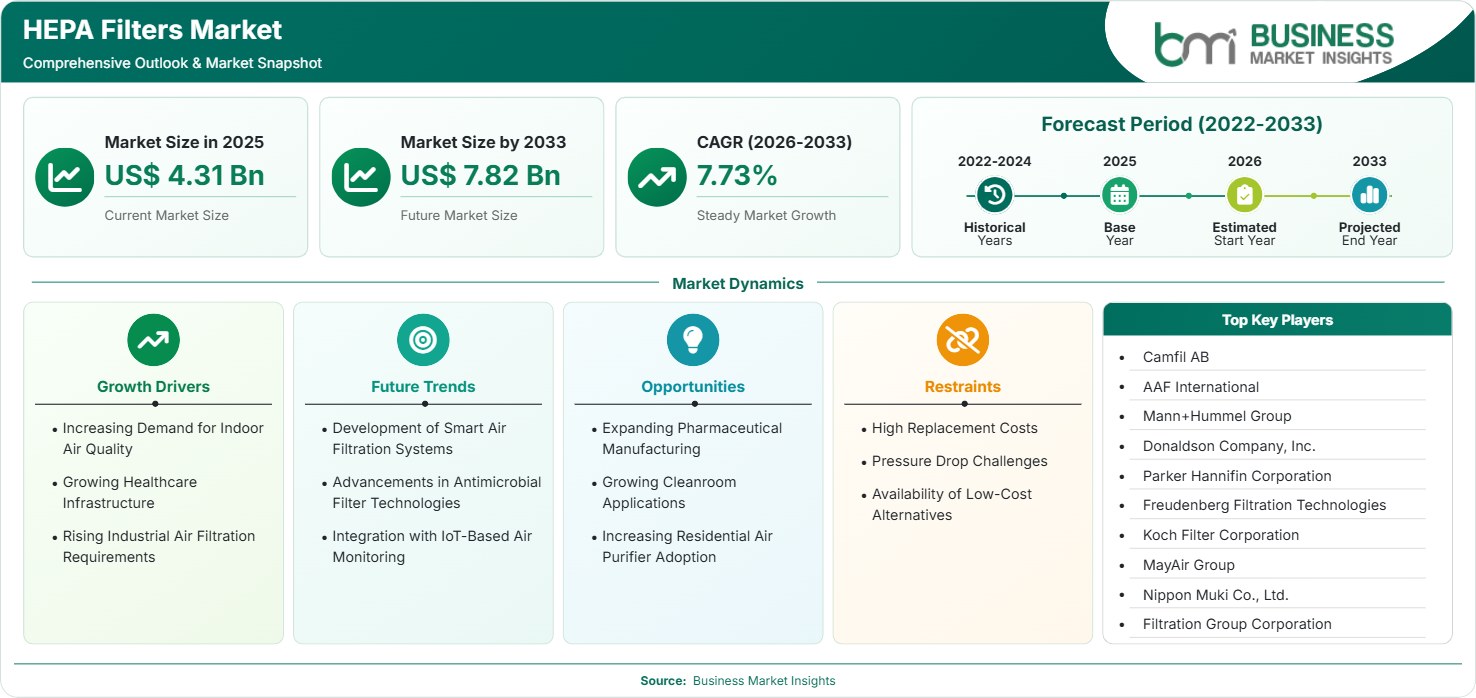
The HEPA Filters Market size was valued at US$ 4.31 Billion in 2025 and is projected to reach US$ 7.82 Billion by 2033, growing at a CAGR of 7.73% during 2026–2033, driven by rising indoor air quality awareness, healthcare infrastructure expansion, industrial cleanroom demand, and increasing investments in advanced filtration technologies worldwide.

Report Coverage
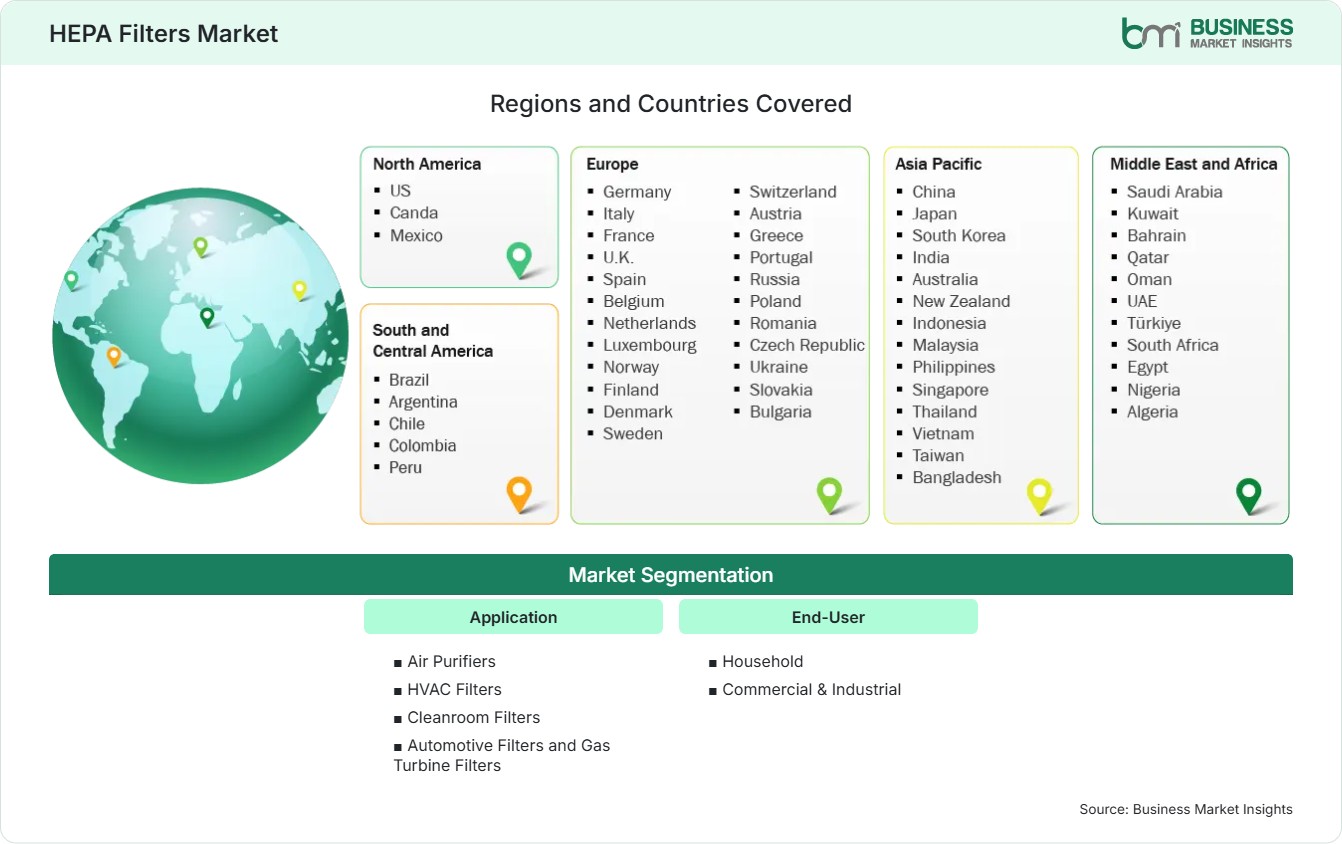
  • Application: Air Purifiers, HVAC Filters, Cleanroom Filters, Automotive Filters and Gas Turbine Filters
  • End-User: Household, Commercial & Industrial
US$ 4.31 Bn Market size in 2025
US$ 7.82 Bn Market Size by 2033
7.73% CAGR, 2026 - 2033
2026-2033 Forecast Period

01 AI Overview

HEPA Filters Market Summary

  • North America Region: North America holds 34%–37% market share in 2025 and is projected to grow at a 7.4%–7.8% CAGR during 2026–2033. Demand is supported by stringent indoor air quality regulations, healthcare modernization, pharmaceutical production, and commercial HVAC upgrades. The U.S. dominates regional revenue, advancing at a 7.5%–7.9% CAGR, driven by healthcare, semiconductor manufacturing, and commercial infrastructure investments.
  • Fastest Growing Region: Asia Pacific accounts for 27%–30% market share in 2025 and is forecast to expand at the fastest 8.3%–8.8% CAGR through 2033. Industrialization, urbanization, healthcare expansion, semiconductor fabrication, and stricter environmental regulations continue accelerating advanced air filtration adoption across regional economies.
  • Leading Segment: HVAC Filters represent 33%–36% market share in 2025 and are projected to register a 7.5%–7.9% CAGR. Commercial buildings, hospitals, airports, educational facilities, and smart infrastructure increasingly deploy high-efficiency filtration systems to enhance indoor environmental quality and regulatory compliance.
  • High Growth Segment: Cleanroom Filters account for 21%–24% market share in 2025 while recording the highest 8.5%–9.0% CAGR. Expanding pharmaceutical manufacturing, biotechnology research, semiconductor fabrication, and precision electronics production continue increasing demand for contamination-controlled environments.
  • Key Market Opportunity: Expanding pharmaceutical manufacturing, growing semiconductor investments, stricter workplace air quality regulations, and modernization of healthcare infrastructure create long-term opportunities for premium high-efficiency filtration technologies across developed and emerging economies.
  • Major Market Players: Camfil AB, AAF International, Mann+Hummel Group, Donaldson Company, Inc., Parker Hannifin Corporation, Freudenberg Filtration Technologies, Koch Filter Corporation, MayAir Group, Nippon Muki Co., Ltd., and Filtration Group Corporation.
02 Strategic Insights

HEPA Filters Market: Strategic Insights

HEPA Filters Market Strategic Framework
FREE PDF
Request your free sample
Request free sample
03 Stakeholder View

Key Takeaways

  • The value chain within the industry is becoming more and more integrated as filter media producers, HVAC equipment producers, cleanroom design firms, and digital monitoring systems suppliers work together to provide full indoor air quality solutions in health care institutions, industries, and commercial buildings.
  • There are opportunities for long-term development within pharmaceutical manufacturing, semiconductor manufacturing, biotechnology labs, and health care facilities since these areas demand highly efficient filtration and contamination control technologies along with strict adherence to international operational standards.
  • Innovations in the industry are focused on nanofiber filters, sustainable recyclable filters, antimicrobial filters, predictive maintenance systems, and smart sensors.
  • Asia Pacific presents the most attractive regional investment opportunity due to rapid industrial expansion, growing electronics manufacturing, healthcare infrastructure development, and increasing government initiatives supporting cleaner indoor environments across developing economies.
  • Strategic acquisitions, capacity expansion in manufacturing, regionalization of manufacturing facilities, and collaboration of filtration technology suppliers with HVAC manufacturers are increasingly reinforcing their competitive position while boosting their supply chain efficiency and availability of products globally.
  • Environmental performance standards have motivated manufacturers to design energy-efficient filter systems featuring reduced pressure drop parameters, as well as increased lifetime.
04 Geographic Outlook

HEPA Filters Market Regional Highlights

North America HEPA Filters Market

North America accounts for 34%–37% of global revenue in 2025 and is projected to expand at a 7.4%–7.8% CAGR through 2033. The region maintains industry leadership due to stringent indoor air quality regulations, advanced healthcare infrastructure, mature HVAC replacement demand, and strong investments in pharmaceutical and semiconductor manufacturing. The HEPA Filters Market share remains substantial as hospitals, laboratories, commercial buildings, and industrial facilities increasingly prioritize contamination control, energy-efficient ventilation systems, and regulatory compliance while supporting healthier indoor environments and sustainable building operations.

  • Regulatory agencies continue enforcing stricter indoor air quality standards across healthcare, educational institutions, airports, and commercial buildings, encouraging replacement of conventional filtration technologies with high-performance HEPA systems that improve occupant safety and operational compliance.
  • Pharmaceutical and biotech firms are also continuing their investments in contamination-free manufacturing plants that need advanced filtration systems to provide sterile environments and to ensure adherence to Good Manufacturing Practices regulations and international regulatory guidelines.
  • The fabrication plants for semiconductors increasingly use clean room filtration systems in order to reduce particles in the air and maintain high productivity amid increased investments in electronics manufacturing in the region.
  • Commercial real estate developers are designing green buildings that utilize efficient HVAC filtration systems in order to achieve good indoor environmental quality and minimize energy usage for certifications under internationally accepted sustainability standards.
  • Building automation systems include filtration monitoring, predictive maintenance, and air flow control technology for enhancing the efficiency of filtration systems and extending the performance life of equipment.

US HEPA Filters Market

The United States contributes 76%–79% of North American revenue and is expected to register a 7.5%–7.9% CAGR during the forecast period. Healthcare modernization, commercial infrastructure upgrades, advanced manufacturing investments, and expanding pharmaceutical production continue driving nationwide demand. Hospitals, research laboratories, clean manufacturing facilities, airports, and institutional buildings increasingly deploy HEPA Filters Market to improve indoor air quality, comply with regulatory standards, and enhance operational efficiency across diverse end-use industries.

  • Healthcare providers continue modernizing hospitals, surgical centers, and diagnostic laboratories with advanced ventilation systems incorporating HEPA filtration to reduce airborne contaminants, support infection prevention strategies, and improve patient safety.
  • Federal investments supporting semiconductor manufacturing and domestic pharmaceutical production encourage construction of contamination-controlled facilities requiring advanced filtration systems throughout production, packaging, testing, and research operations.
  • Commercial building owners increasingly retrofit HVAC systems with premium filtration technologies to improve employee wellness, satisfy sustainability objectives, and comply with evolving indoor air quality recommendations.
  • Growing adoption of intelligent building automation platforms enables predictive maintenance, filter performance monitoring, and energy optimization, reducing operating costs while extending equipment lifespan across commercial facilities.

Europe HEPA Filters Market

Europe HEPA Filters Market share represents 28%–31% of global demand in 2025 while recording a 7.2%–7.6% CAGR through 2033. Strict environmental regulations, sustainable building initiatives, and advanced healthcare systems continue supporting consistent market expansion. Germany remains the regional leader, while France and the United Kingdom maintain strong demand. Poland and Ireland demonstrate comparatively faster growth as pharmaceutical manufacturing, electronics production, and cleanroom investments expand across Central and Western Europe.

  • Germany strengthens regional leadership through advanced industrial manufacturing, pharmaceutical production, and continuous investments in energy-efficient commercial HVAC systems supporting stringent indoor environmental quality standards.
  • France expands healthcare infrastructure and biotechnology research facilities, increasing deployment of high-efficiency filtration technologies across laboratories, hospitals, and pharmaceutical manufacturing environments requiring contamination control.
  • The United Kingdom continues upgrading commercial buildings, transportation infrastructure, and healthcare facilities with advanced ventilation technologies aligned with sustainability objectives and modern workplace wellness initiatives.
  • Poland experiences rapid manufacturing expansion supported by foreign direct investment, increasing demand for industrial cleanrooms, electronics production facilities, and pharmaceutical manufacturing infrastructure.
  • European sustainability policies encourage manufacturers to develop recyclable filtration media, lower-energy HVAC solutions, and environmentally responsible production processes supporting long-term carbon reduction objectives.

Asia Pacific HEPA Filters Market

Asia Pacific HEPA Filters Market accounts for 27%–30% of global revenue in 2025 and is projected to expand at the fastest 8.3%–8.8% CAGR through 2033. China dominates regional demand through extensive manufacturing capacity and healthcare investments, while India, South Korea, and Southeast Asia emerge as rapidly expanding markets.

  • China continues investing in pharmaceutical manufacturing, semiconductor fabrication, healthcare infrastructure, and commercial construction, creating sustained demand for premium air filtration technologies supporting contamination-controlled environments.
  • India records one of the region's strongest expansion rates as healthcare modernization, commercial infrastructure development, and growing residential awareness of indoor air quality encourage widespread adoption of advanced filtration systems.
  • Japan strengthens demand through precision manufacturing, aging healthcare infrastructure modernization, and continuous technological innovation focused on high-performance, energy-efficient filtration products.
  • South Korea expands semiconductor fabrication capacity and biotechnology research investments, increasing deployment of advanced cleanroom filtration systems supporting high-value industrial manufacturing operations.
  • Southeast Asian economies continue attracting electronics manufacturing investments, encouraging construction of industrial facilities equipped with sophisticated ventilation and contamination-control technologies.

Rest of World HEPA Filters Market

The Rest of World region contributes 8%–10% of global revenue while registering a 7.0%–7.4% CAGR during the forecast period. South & Central America continue expanding healthcare investments and commercial infrastructure modernization, while the Middle East & Africa HEPA Filters Market trends strengthen demand through hospital construction, airport development, and industrial diversification initiatives.

  • Brazil leads regional demand through expanding pharmaceutical production, commercial construction projects, and modernization of healthcare facilities requiring reliable contamination-control solutions.
  • Mexico benefits from manufacturing expansion and increasing foreign investment in automotive, electronics, and medical device production requiring advanced industrial filtration systems.
  • The United Arab Emirates accelerates smart building development, healthcare expansion, and airport modernization projects utilizing premium HVAC filtration technologies to improve indoor environmental performance.
  • Saudi Arabia supports growing adoption through healthcare infrastructure investments, industrial diversification programs, and large-scale commercial development projects aligned with national economic transformation strategies.
  • South Africa gradually increases demand through mining support industries, healthcare modernization, food processing expansion, and improved industrial safety standards requiring enhanced air filtration performance.
Global Market Geography
FREE PDF
Request your free sample
Request free sample
05 Segment Analysis

HEPA Filters Market Segmentation

Application

The Application segment accounted for 58%–61% of the market in 2025 and is projected to register a 7.8%–8.2% CAGR through 2033. Growing investments in healthcare, commercial buildings, semiconductor manufacturing, and industrial contamination control continue driving adoption across diverse applications. The HEPA Filters Market scope continues expanding as stringent air quality regulations, sustainability initiatives, and technological advancements encourage broader deployment of high-efficiency filtration systems across critical environments.

  • Air Purifiers: Rising consumer awareness regarding airborne pollutants, allergens, and infectious particles continues increasing residential and commercial demand for portable and centralized air purification systems equipped with high-performance HEPA filtration technology.
  • HVAC Filters: Commercial complexes, hospitals, airports, educational institutions, and office buildings increasingly integrate HEPA filtration into HVAC systems to improve indoor air quality, comply with regulatory standards, and reduce airborne contamination risks.
  • Cleanroom Filters: Pharmaceutical manufacturing, biotechnology laboratories, semiconductor fabrication plants, and precision electronics production rely on HEPA filters to maintain contamination-controlled environments supporting consistent product quality and regulatory compliance.
  • Automotive Filters: Premium passenger vehicles, electric vehicles, and commercial transportation increasingly incorporate advanced cabin air filtration technologies that enhance passenger comfort while reducing exposure to particulate matter and harmful airborne pollutants.
  • Gas Turbine Filters: Power generation facilities and industrial operations deploy HEPA filtration solutions to protect turbine components from airborne contaminants, improving operational efficiency, reducing maintenance frequency, and extending equipment service life.

End-User

The End-User segment represents a critical component of the market, accounting for 39%–42% share in 2025 while expanding at a 7.4%–7.8% CAGR through 2033. Rising awareness regarding occupational health, regulatory compliance, and indoor environmental quality continues supporting adoption across residential, commercial, and industrial sectors. HEPA Filters Market trends increasingly favor energy-efficient filtration solutions capable of balancing superior particle removal with optimized airflow performance and reduced lifecycle operating costs.

  • Household: Increasing concern regarding allergies, respiratory diseases, wildfire smoke, and urban pollution encourages consumers to install HEPA-based air purification systems for healthier indoor living environments.
  • Commercial: Office buildings, retail centers, hotels, airports, schools, and healthcare facilities prioritize advanced filtration technologies to improve occupant wellness, satisfy building standards, and support sustainable facility management objectives.
  • Industrial: Pharmaceutical production, biotechnology, electronics manufacturing, food processing, automotive production, and chemical processing facilities increasingly deploy HEPA filtration to maintain product quality, workplace safety, and regulatory compliance.
06 Market Forces

HEPA Filters Market Dynamics

Key Market Drivers

Increasing Demand for Indoor Air Quality

Increasing concern about particulate matter, allergens, volatile contaminants, and micro-organisms in the air is continually driving up the demand for more efficient HEPA filtration systems. According to the World Health Organization, air pollution is one of the greatest environmental health risks, and it has called for the improvement of air quality standards by both the government and private institutions. Increasingly, building managers are equipping their HVAC systems with high-efficiency filters to promote healthier lifestyles and ensure compliance with environmental laws. These factors continue supporting long-term HEPA Filters Market growth across developed and emerging economies.

Growing Healthcare Infrastructure

The increase in hospital size, lab facilities, drug manufacturing plants, and biotech research institutes is continuing to drive the requirement for contamination control solutions. Healthcare institutes need high-performance filtration systems that are able to reduce the presence of airborne bacteria, ensure a sterile environment, and help implement measures for infection control. Higher investments in healthcare infrastructure in Asia Pacific, North America, Europe, and the Middle East continue to drive their acceptance. Higher spending on health care as well as the upgradation of existing health care facilities keeps driving the requirement for HEPA filters.

Rising Industrial Air Filtration Requirements

Industries such as semiconductor manufacturing, electronics, food processing, auto manufacturing, aerospace, and precision engineering are increasingly utilizing contamination-free environments to ensure product quality and efficiency in their operations. Companies are continuously using latest filtration systems for reduction of contamination by air particles and compliance with ever-increasing standards of quality. Expansion of industries, especially those of semiconductors and pharmaceuticals, will keep generating a steady demand for premium HEPA filters.

Key Market Opportunities

Expanding Pharmaceutical Manufacturing

Global pharmaceutical manufacturing capacity continues expanding through new production facilities, biologics manufacturing plants, vaccine production centers, and contract manufacturing organizations. HEPA Filters Market Forecasts indicate significant opportunities as contamination-control requirements become increasingly stringent across regulated pharmaceutical operations. Investors in the development of high-end clean room facilities will need filtration systems that can help maintain a sterile environment and comply with Good Manufacturing Practices. New pharmaceutical manufacturing centers being developed in Asia Pacific, Middle East, and Latin America add more business prospects for the future.

Growing Cleanroom Applications

Cleanroom use is still widening from pharmaceuticals to semiconductor fabrication, healthcare instruments, aerospace, precision engineering, nanotechnology, and biotechnological research. Rising manufacturing of sophisticated electronic parts, chips, and medical apparatus necessitates extremely clean manufacturing facilities where HEPA filtration acts as a crucial element of operations. Advances in technology, automation, and product quality specifications keep on driving the installation of next generation cleanrooms that have superior filtering systems for manufacturing processes.

Increasing Residential Air Purifier Adoption

Factors such as urbanization, increase in outdoor pollution, wildfires during different seasons, increased incidence of allergies, and the growing concern about respiratory health among the general public keep on fueling the demand for air purifiers that use HEPA filters in homes. In addition to all these factors, other technological advancements, including smart home integration, energy efficient devices, and high-end consumer electronics, help speed up the adoption rate by households.

Market Restraints and Challenges

High Replacement Costs

Factor: Premium HEPA filtration systems require regular replacement to maintain filtration efficiency, particularly within healthcare facilities, cleanrooms, and industrial manufacturing environments. Impact: Maintenance costs make adoption prohibitive for price-sensitive consumers, small business owners, and countries that have limited operational budgets. Businesses try to stretch the replacement interval in order to save money; however, this might compromise filtration effectiveness, raise the possibility of contamination, and violate stringent air quality guidelines, thus impeding widespread acceptance despite increased recognition of its importance.

Pressure Drop Challenges

Factor: HEPA filters inherently generate higher airflow resistance compared with conventional filtration products, requiring HVAC systems and industrial ventilation equipment to consume additional energy for maintaining designed airflow performance. Impact: Increased operational energy consumption may discourage facility operators prioritizing energy efficiency and lifecycle cost optimization. Manufacturers therefore continue investing in low-pressure-drop filtration media, optimized filter geometries, and innovative materials capable of balancing superior filtration efficiency with improved airflow characteristics and reduced long-term operating costs.

07 Company Analysis

Competitive Landscape

The HEPA Filters Market analysis indicates a competitive environment shaped by global filtration technology leaders, HVAC solution providers, industrial filtration specialists, and cleanroom technology companies. Key participants focus on product innovation, energy-efficient filtration media, customized solutions, geographic expansion, and strategic partnerships to strengthen their market positions. Companies are increasingly investing in advanced filter designs, sustainable materials, and digital monitoring capabilities to address evolving requirements across healthcare, pharmaceutical, semiconductor, commercial, and industrial applications.

Company Name

Overview

Products and Services relevant to this market

Camfil AB

Camfil AB is a global air filtration specialist providing clean air solutions for healthcare, commercial, industrial, and critical environments worldwide.

Offers HEPA filters, cleanroom filtration systems, molecular filtration solutions, and energy-efficient air filtration technologies for demanding applications.

AAF International

AAF International develops advanced air filtration solutions serving commercial buildings, healthcare facilities, industrial plants, and clean manufacturing environments.

Provides HEPA filtration products, HVAC filtration systems, cleanroom solutions, and customized air quality management technologies.

Mann+Hummel Group

Mann+Hummel Group is a filtration technology company delivering solutions across mobility, industrial, and life science sectors.

Manufactures air filtration systems, high-efficiency particulate filters, industrial filtration products, and clean air technologies for multiple industries.

Donaldson Company, Inc.

Donaldson Company, Inc. specializes in filtration solutions for industrial, commercial, and transportation applications with global operations.

Supplies air purification systems, industrial HEPA filtration products, dust collection technologies, and advanced filtration components.

Parker Hannifin Corporation

Parker Hannifin Corporation provides motion and control technologies along with filtration solutions for industrial and healthcare applications.

Offers air filtration systems, contamination control products, compressed air filtration, and specialized filtration technologies.

Freudenberg Filtration Technologies

Freudenberg Filtration Technologies develops innovative filtration solutions for automotive, industrial, healthcare, and environmental applications.

Provides HEPA filters, cleanroom filtration systems, industrial air filtration products, and customized separation technologies.

Koch Filter Corporation

Koch Filter Corporation manufactures commercial and industrial air filtration solutions focused on efficiency and indoor air quality improvement.

Supplies HEPA filters, HVAC filtration products, air purification systems, and replacement filtration solutions.

MayAir Group

MayAir Group specializes in air purification technologies serving semiconductor, healthcare, automotive, and commercial markets globally.

Provides cleanroom filtration systems, HEPA filters, air purification equipment, and contamination control solutions.

Nippon Muki Co., Ltd.

Nippon Muki Co., Ltd. develops advanced filtration technologies supporting semiconductor, pharmaceutical, and industrial applications.

Manufactures HEPA filters, ULPA filters, cleanroom products, and high-performance air purification solutions.

Filtration Group Corporation

Filtration Group Corporation delivers filtration technologies across healthcare, industrial, commercial, and transportation sectors.

Provides air filtration products, HEPA systems, industrial filtration solutions, and specialized contamination control technologies.

10 Trust & Transparency

Research Methodology

The market analysis combines proprietary research with secondary data from government agencies, company disclosures, regulatory filings, industry databases and expert interviews. Market estimates are validated through data triangulation, cross-market benchmarking and analyst review.

View Full Research Methodology

11 Questions Answered

Frequently Asked Questions

Where can companies find detailed market insights on this industry?

The HEPA Filters Market Report provides analysis covering market dynamics, segmentation, regional trends, competitive developments, growth opportunities, and future industry outlook.

What role does sustainability play in filtration technology development?

Manufacturers are focusing on recyclable materials, low-pressure-drop designs, energy-efficient filtration media, and longer service-life products to reduce environmental impact and improve lifecycle economics.

Why are cleanroom applications important for HEPA filter manufacturers?

Cleanrooms require highly controlled environments for pharmaceutical production, semiconductor manufacturing, biotechnology research, and medical device production, making advanced HEPA filtration essential for maintaining contamination-free operations.

How are smart technologies influencing HEPA filtration solutions?

Smart sensors, predictive maintenance platforms, and digital monitoring systems are improving filter performance tracking, optimizing replacement schedules, and helping facility operators reduce energy consumption and operational costs.

What factors are increasing demand for HEPA filtration systems?

Growing awareness of indoor air quality, rising healthcare infrastructure investments, increasing pharmaceutical manufacturing, and stricter industrial contamination standards are key factors driving adoption across residential, commercial, and industrial applications.

Access the Full HEPA Filters Market Report

Get segment-level forecasts, regional estimates, competitive benchmarking, company profiles and downloadable Excel datasets.

Access the full HEPA Filters Market Report
350 pages PDF & Excel | 2026-08-12