Market Summary
Executive Summary and Global Market Analysis
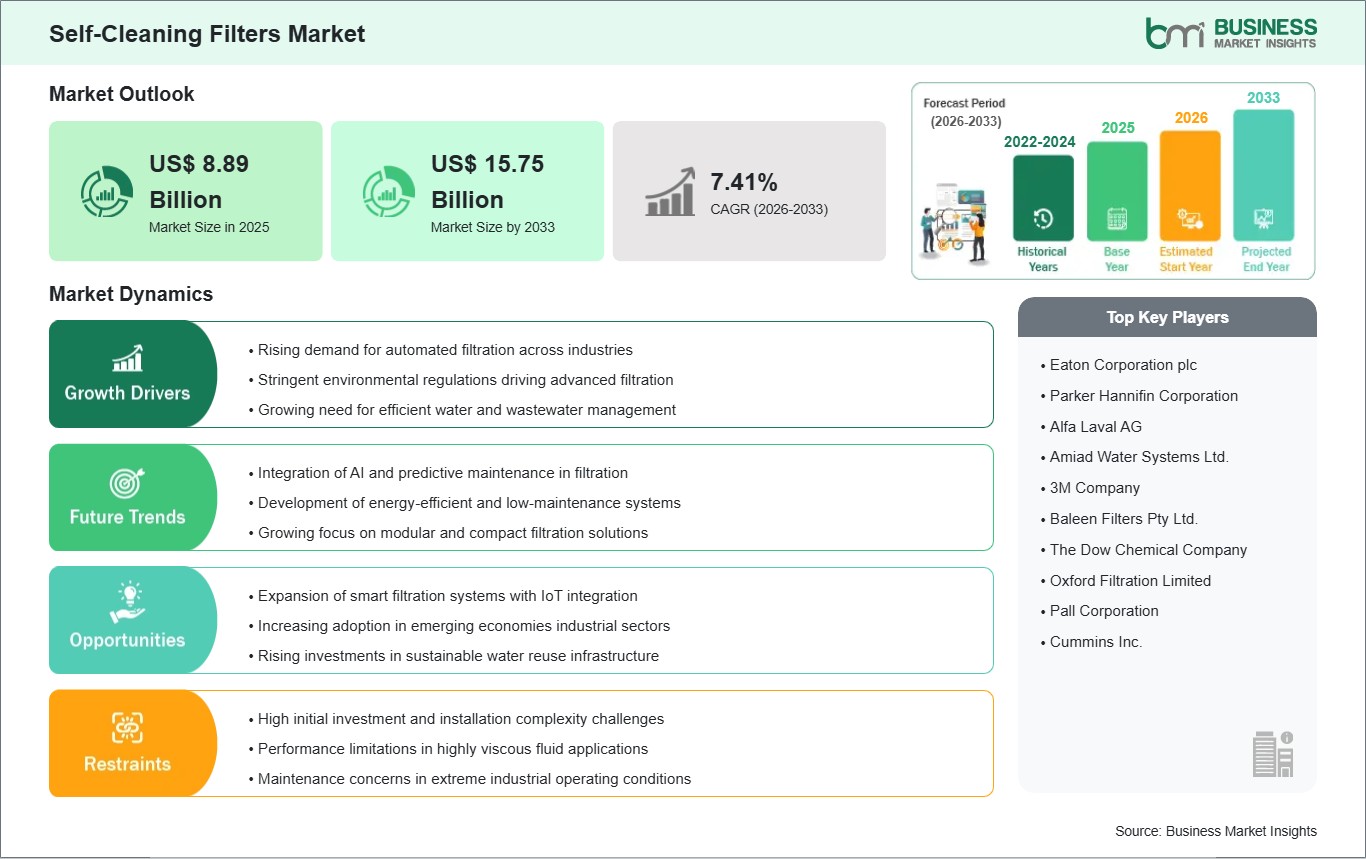
The worldwide self-cleaning filters industry is growing steadily because industrial automation increases, environmental regulations become more strict, and critical sectors need continuous filtration systems. Organizations are adopting self-cleaning filters because these devices decrease the need for human work while they improve system efficiency and decrease the need to fix equipment. The water industry, wastewater management, oil and gas sector, chemical manufacturing, food and beverage production, and electricity generation industry all use these systems to achieve dependable filtration results which lower their operational expenses. The need for environmentally friendly water management systems stands as the main factor that drives market growth.
Advanced filtration systems have become widely adopted because both governments and industries worldwide practice water reuse and effective resource management. The transition to smart manufacturing together with Industry 4.0 has boosted the development of automated filtration systems where self-cleaning filters maintain system reliability while decreasing the need for human maintenance work. The product efficiency improvements through sensor-based monitoring systems and automated backwashing systems and control system integration represent a new level of operational efficiency. The growing funding for infrastructure updates, especially within water utility and energy sectors, creates conditions that drive market expansion.
The market encounters specific limitations which create obstacles to its operation. High initial capital investment and installation complexity can deter small and medium enterprises from adopting these systems. Operational challenges arise when organizations need to manage highly viscous or heavily contaminated fluids which restrict their ability to operate effectively in specific niche markets. The market will maintain its worldwide growth because organizations continue to develop new products while people learn about the financial benefits of their operations.
Segment Analysis
Self-Cleaning Filters Market Segmentation
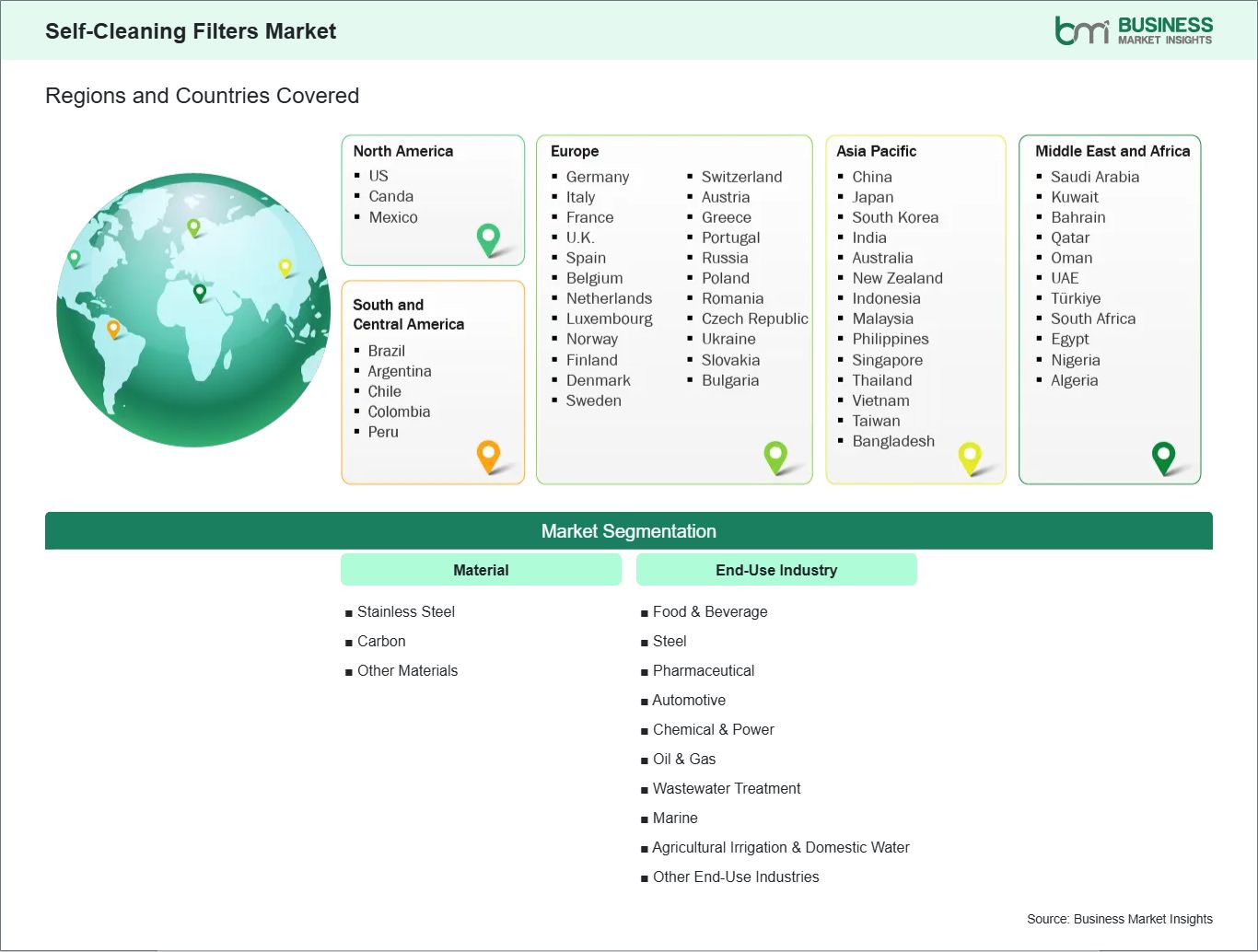
Key segments that contributed to the derivation of the self-cleaning filters market analysis are material and end-use industry.
- By material, the self-cleaning filters market is segmented into stainless steel, carbon, others. The stainless steel segment dominated the market in 2025.
- In terms of end-use industry, the self-cleaning filters market is categorized into food & beverage, steel, pharmaceutical, automotive, chemical & power, oil & gas, wastewater treatment, marine, agricultural irrigation & domestic water, others. The wastewater treatment segment dominated the market in 2025.
Market Forces
Self-Cleaning Filters Market Drivers and Opportunities
Rising demand for automated filtration across industries
Industries that need continuous filtration systems which need minimal human work to operate are now driving the global self-cleaning filters market. Manufacturing facilities throughout North America Europe and Asia operate their production processes with automated systems which create better efficiency through fewer operational interruptions. The chemical and pharmaceutical sectors demonstrate this trend because these industries depend on process control to avoid production interruptions from unexpected equipment failures. Self-cleaning filters allow plants to keep steady operations because they eliminate the necessity of regular manual filter cleaning. All water treatment plants across the globe now utilize automated filter systems to handle changes in water flow and pollution levels.
The municipal utilities in developed countries and developing countries both experience advantages from systems which operate without human monitoring to handle different operational demands. The system ensures both regulatory compliance and better service reliability to the end users. The oil and gas industry and power generation sector require automated systems to protect their delicate machinery from damage caused by tiny particles. Self-cleaning filters provide organizations with constant operational protection which helps them maintain their vital business operations and secure their valuable equipment.
Expansion of smart filtration systems with IoT integration
The combination of IoT and smart technologies with self-cleaning filters creates a worldwide impact. Manufacturers now include sensors together with connectivity capabilities which permit them to track filter operations in real time. The system enables technicians to conduct remote system evaluations while receiving system notifications which permit them to investigate potential system failures that occur in multiple locations. Smart filtration systems enable organizations to conduct data analytics which allows them to monitor contamination patterns together with filter operational patterns.
The organization uses data insights to determine optimal cleaning schedules which allows them to extend component lifespan and reduce total ownership costs. Water reuse programs in utilities use these features to maintain quality standards while meeting compliance requirements without needing extensive manual monitoring. Industrial sectors now implement IoT-based self-cleaning filters because these systems support their digital transformation goals. The system integration with plant control networks produces better operational visibility which enables predictive maintenance operations that enhance equipment performance.
Size and Share Analysis
Self-Cleaning Filters Market Size and Share Analysis
The self-cleaning filters market demonstrates steady growth, with size and share analysis highlighting evolving trends and competitive dynamics among key players. The report examines subsegments categorized within material and end-use industry, offering insights into their contribution to overall market performance.
By material, the stainless steel subsegment dominated the market in 2025, driven by its superior corrosion resistance, durability, and suitability for harsh operating environments.
In terms of end-use industry, the wastewater treatment subsegment dominated the market in 2025, driven by increasing demand for efficient filtration in water purification and reuse applications.
Report Coverage
Self-Cleaning Filters Market Report Coverage and Deliverables
The "Self-Cleaning Filters Market Size and Forecast (2022 - 2033)" report provides a detailed analysis of the market covering below areas:
- Self-Cleaning Filters Market size and forecast at global, regional, and country levels for all the key market segments covered under the scope
- Self-Cleaning Filters Market trends, as well as drivers, restraints, and opportunities
- Self-Cleaning Filters Market analysis covering key trends, global and regional framework, major players, regulations, and recent developments
- Industry landscape and competition analysis covering market concentration, heat map analysis, prominent players, and recent developments for the Self-Cleaning Filters Market
- Detailed company profiles, including SWOT analysis
Geographic Insights
Self-Cleaning Filters Market Geographic Insights
The geographical scope of the Self-Cleaning Filters Market report is divided into North America, Asia Pacific, Europe, Middle East & Africa, and South & Central America. North America held the largest share in 2025.
The global self-cleaning filters market presents different market trends in various regions, while North America emerges as the leading market because of its modern industrial facilities and strict enforcement of regulations and early adoption of automated filtration systems. The region experiences high demand because water treatment and oil & gas and power generation sectors need continuous operations that meet environmental regulations. Rapid industrial growth and urban development and increased water and wastewater treatment investments drive the fast expansion of Asia Pacific markets in emerging economies that prioritize resource efficiency and pollution control.
European markets focus on sustainable practices and circular economy principles, as industries work to decrease their water use and achieve better operational results through advanced filtration technologies. Food and beverage and chemical industries adopt energy-efficient manufacturing methods and strict environmental regulations, which drive their implementation of sustainability practices. The Middle East and Africa region is expanding through increased funding for desalination projects and oil and gas operations and water recycling programs, which use self-cleaning filters to protect equipment during extreme conditions and maintain operational performance.
South and Central America is seeing constant adoption of technologies that governments and industries use to improve water management systems and operational efficiency in their mining and agricultural and municipal water treatment operations. The entire world is currently experiencing a shift towards automated systems that promote sustainability while requiring less maintenance but different levels of economic growth and regulatory systems and industrial development have created varying rates and extents of technological adoption.
Industry Activity
Recent Developments
The Self-Cleaning Filters Market is evaluated by gathering qualitative and quantitative data post primary and secondary research, which includes important corporate publications, association data, and databases. A few of the key developments in the self-cleaning filters market are:
- In March 2025, Tekleen Automatic Filters, LLC announced the launch of its advanced self‑cleaning water filtration solution, designed to help industries reduce maintenance, optimize operations, and improve water sustainability by providing automated, continuous filtration that eliminates manual cleaning downtime across manufacturing, agriculture, water systems, HVAC, and energy sectors.
- In February 2026, Russell Finex Ltd. highlighted the application of its Self‑Cleaning Russell Eco Filter® in the specialty liquid chemicals sector to ensure consistent product quality and operational efficiency in automated chemical production environments, emphasizing the role of self‑cleaning filters in supporting contamination‑free processes.
Trust & Transparency
Research Methodology
The market analysis combines proprietary research with secondary data from government agencies, company disclosures, regulatory filings, industry databases and expert interviews. Market estimates are validated through data triangulation, cross-market benchmarking and analyst
review.
View Full Research Methodology
Key Sources Referred:
World Health Organization (WHO) Organisation for Economic Cooperation and Development (OECD) The World Bank Group Worldometer The Lancet International Bar Association International Trade Administration