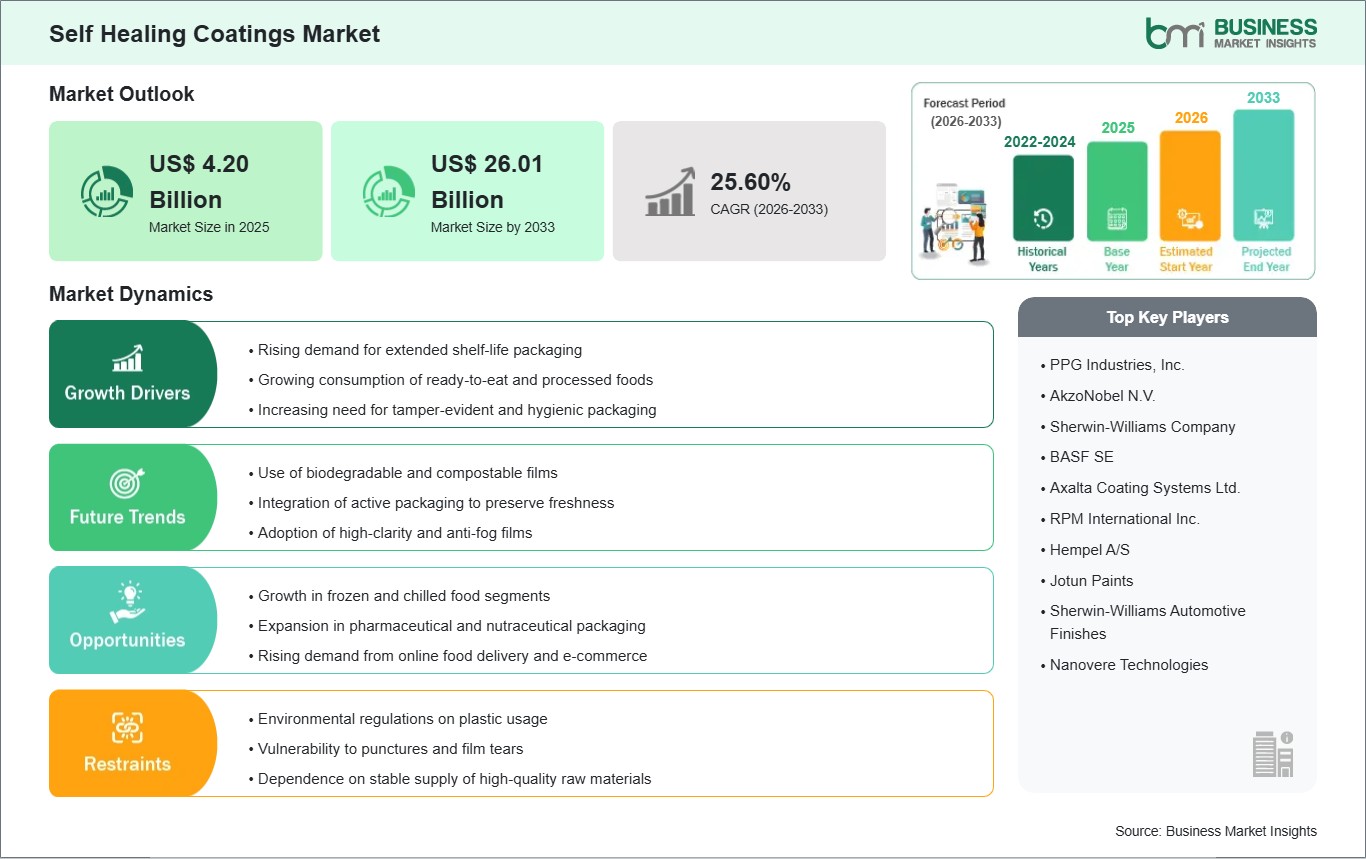
The Self Healing Coatings Market size is expected to reach US$ 26.01 billion by 2033 from US$ 4.2 billion in 2025. The market is estimated to record a CAGR of 25.60% from 2026 to 2033.
The self-healing coatings market is expanding at a dynamic rate globally, with industries increasingly focusing on durability, maintenance reduction, and sustainability. Self-healing coatings are high-tech coatings that have the ability to heal minor damages on their own, thus increasing the lifespan of surfaces. The increasing need for self-healing coatings is mainly due to the need for cost-effective maintenance solutions, increasing environmental sustainability, and high-performance coatings.
For instance, the advancements in technology, including microcapsule-based, vascular, and polymer-based self-healing technologies, are helping create more flexible uses, including marine coatings resistant to corrosion, scratch-resistant automotive finishes, etc. Organizations are increasingly focusing on creating multifunctional coatings, including self-healing coatings, which can provide additional benefits, including ultraviolet stability, anti-fouling, heat stability, etc., to address the complex needs of industries.
However, there are certain limitations faced in the self-healing coatings market, which are affecting the growth of the market. Some of these limitations include the high costs of producing self-healing coatings, which are affecting the mass adoption of self-healing coatings, particularly in industries that are highly price-sensitive, etc. Despite these limitations, the self-healing coatings market is expected to witness growth due to the increasing focus on performance-oriented, sustainable, protective coatings, coupled with the developments in nanotechnology, which are helping create new possibilities in the self-healing coatings market.

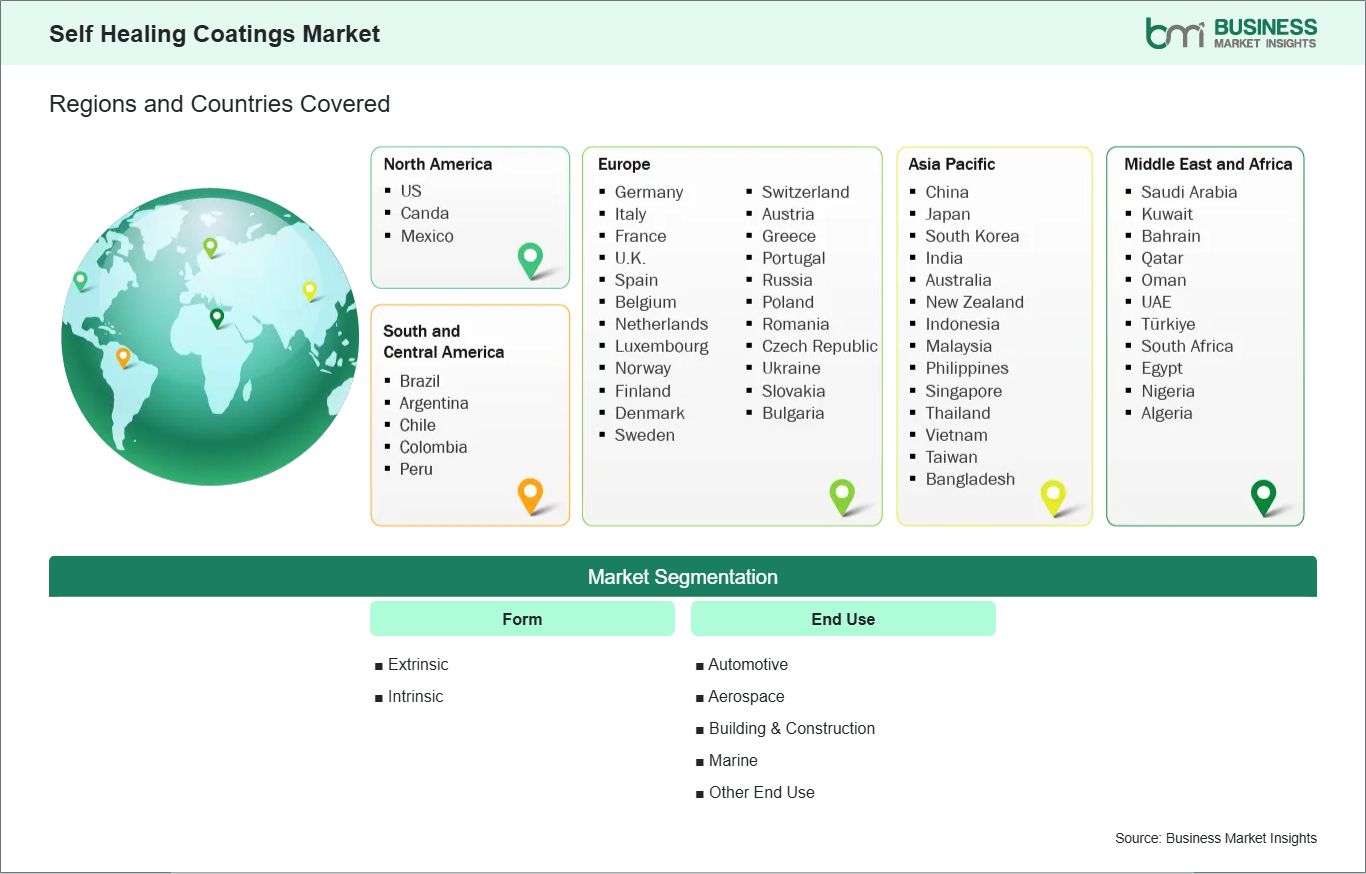
Key segments that contributed to the derivation of the self healing coatings market analysis are form and end use.
The Western European market for self-healing coatings is being driven by the increased use of biodegradable and compostable films in food and consumer packaging. Germany, France, and the Netherlands are the key players in the market, using these types of packaging to meet the needs and requirements of the market, as well as the consumers, as they look to adopt more sustainable and environmentally friendly packaging solutions. Self-healing coatings are being applied to the packaging to ensure the barrier properties are maintained, thus extending the product's shelf life without compromising its biodegradable nature. In Germany, for example, several startups in Bavaria are using polylactic acid (PLA) films coated with self-healing coatings to ensure that the packaging is not torn during transport, as the country is keen on maintaining the high standards required by retailers.
In France, packaging companies that cater to organic and premium food brands are now using self-healing coatings that can mend minor damages to compostable packaging films. This ensures the packaging is not compromised, especially in the case of bakery and confectionery items being shipped to urban areas such as Paris and Lyon. The self-healing coatings ensure the packaging is not only maintained but also reduces the amount of packaging waste, especially in the European Union. In the Netherlands, major supermarkets are now trialing the use of compostable packaging films, especially for ready-to-eat salads and fruits, with the self-healing coatings being able to withstand the mechanical stress experienced in the logistics chain.
The need to promote the use of sustainable packaging in Western Europe is also driving the need for cooperation between chemical companies and packaging companies. Self-healing coatings are being developed that are suitable for compostable packaging, ensuring that the packaging can be sent back into the ecosystem without the risk of microplastics being released into the environment. The need for sustainable packaging is driving the need for self-healing coatings, making them an important part of the green packaging drive in Western Europe.
The growing demand for frozen and chilled food production is also opening new doors for self-healing coatings. Western Europe is witnessing an increased demand for frozen foods, seafood, and chilled ready-to-eat products, especially in Spain, Italy, and the UK. Self-healing coatings are used for plastic and composite packaging materials to prevent any damage, such as microcracks and punctures, that may occur during the freezing and cold chain transportation of products, which is important for maintaining the quality of the product. For instance, frozen meal production, especially for cities such as Milan and Turin, is utilizing self-healing coatings to reduce any spoilage and returns resulting from minor damage to packaging materials.
In the UK, the ready meal market, which is witnessing a boom, has led to the early adoption of high-performance films with self-healing capabilities. According to reports from retailers, the failure of the packaging material during transportation is one of the major factors affecting the loss of products, particularly in the chilled food area, as temperature variations can cause stress in the films. Self-healing coatings can provide the benefits of natural healing of minor scratches, thereby increasing the shelf life of the products. Spanish frozen seafood exporters in the region of Galicia are using self-healing coatings in the vacuum packaging of frozen fillets, which are then transported over long distances to the continental region.
In addition, the rising demand for premium and convenient food products is driving Western European packaging manufacturers to make use of multilayer films with self-healing coatings in the packaging of frozen and chilled food products. This will enable the products to reach the end consumer in the best possible condition, while the self-healing coatings will reduce the amount of food and packaging waste, which is in line with the sustainability requirements. As frozen and chilled food consumption continues to rise, self-healing coatings are expected to become a standard feature in high-performance packaging solutions across the region.

The self healing coatings market is experiencing steady growth, with market size and share analysis reflecting evolving treatment preferences and competitive dynamics among key players. The report evaluates important subsegments categorized within form and end use highlighting their respective contributions to overall market performance.
By form, the intrinsic subsegment dominated the Self healing coatings market in 2025 because they require no added capsules or fillers, leading to better long‑term performance and fewer compatibility issues with existing coating systems. These materials can self‑repair repeatedly rather than just once, which is increasingly valued in applications where maintenance access is limited.
In terms of end use, the autimotive subsegment dominated the self healing coatings market in 2025 because manufacturers want longer‑lasting exterior finishes that resist scratches and environmental wear without frequent repairs. With growth in electric vehicles and premium automotive segments, consumers and OEMs are prioritizing coatings that maintain a “like‑new” look and protect resale value.
| Report Attribute | Details |
|---|---|
| Market size in 2025 | US$ 4.20 Billion |
| Market Size by 2033 | US$ 26.01 Billion |
| Global CAGR (2026 - 2033) | 25.60% |
| Historical Data | 2022-2024 |
| Forecast period | 2026-2033 |
| Segments Covered | By Form
|
|
Regions and Countries Covered
| |
| North America | US, Canada, Mexico |
| Europe | Belgium, Austria, Finland, Denmark, Greece, Poland, Romania, Russia, Ukraine, Czech Republic, Slovakia, Bulgaria, Italy, Luxembourg, Germany, Switzerland, France, Netherlands, Norway, Portugal, Spain, Sweden, United Kingdom |
| Asia-Pacific | Australia, China, India, Japan, South Korea, Indonesia, Malaysia, Philippines, Singapore, Thailand, Vietnam, Bangladesh, New Zealand, Taiwan |
| South and Central America | Brazil, Argentina, Peru, Chile, Colombia |
| Middle East and Africa | Bahrain, Kuwait, Oman, Qatar, Saudi Arabia, United Arab Emirates, Turkiye, South Africa, Egypt, Algeria, Nigeria |
| Market leaders and key company profiles |
|
The "Self healing coatings market Size And Forecast (2022 - 2033)" report provides a detailed analysis of the market covering below areas:
The geographical scope of the Self healing coatings market report is divided into five regions: North America, Asia Pacific, Europe, Middle East & Africa, and South & Central America. The Self healing coatings market in North America is expected to grow during the forecast period.
North America is the largest market for global self-healing coatings, owing to its technological advancements, early adoption of advanced technologies, and mature industrial infrastructure. The automotive and aerospace industries in the region are major consumers of self-healing coatings, using them to ensure the safety, longevity, and appearance of the end product, while keeping replacement costs to a minimum. The use of self-healing coatings in electronic devices, especially smartphones and wearable electronics, is another factor that reinforces the position of North America as the largest market.
The region is home to major companies and research centers, and the emphasis on sustainability and environmental protection is motivating industries to invest in self-healing coatings, as they reduce the need for product replacement, thereby minimizing costs and the environmental impact. While these are the benefits, some of the problems with high manufacturing costs and lack of awareness in the industrial sector are expected to limit the market penetration. Nevertheless, the region will continue to lead due to high R&D capabilities, industrial acceptance, and early adoption of next-generation self-healing coatings in critical applications.

The self healing coatings market is evaluated by gathering qualitative and quantitative data post primary and secondary research, which includes important corporate publications, association data, and databases. A few of the key developments in the self healing coatings market are:
The Self Healing Coatings Market is valued at US$ 4.20 Billion in 2025, it is projected to reach US$ 26.01 Billion by 2033.
As per our report Self Healing Coatings Market, the market size is valued at US$ 4.20 Billion in 2025, projecting it to reach US$ 26.01 Billion by 2033. This translates to a CAGR of approximately 25.60% during the forecast period.
The Self Healing Coatings Market report typically cover these key segments-
The historic period, base year, and forecast period can vary slightly depending on the specific market research report. However, for the Self Healing Coatings Market report:
The Self Healing Coatings Market is populated by several key players, each contributing to its growth and innovation. Some of the major players include:
The Self Healing Coatings Market report is valuable for diverse stakeholders, including:
Essentially, anyone involved in or considering involvement in the Self Healing Coatings Market value chain can benefit from the information contained in a comprehensive market report.
Please tell us your area of interest
(Market Segments/ Regions and Countries/ Companies)