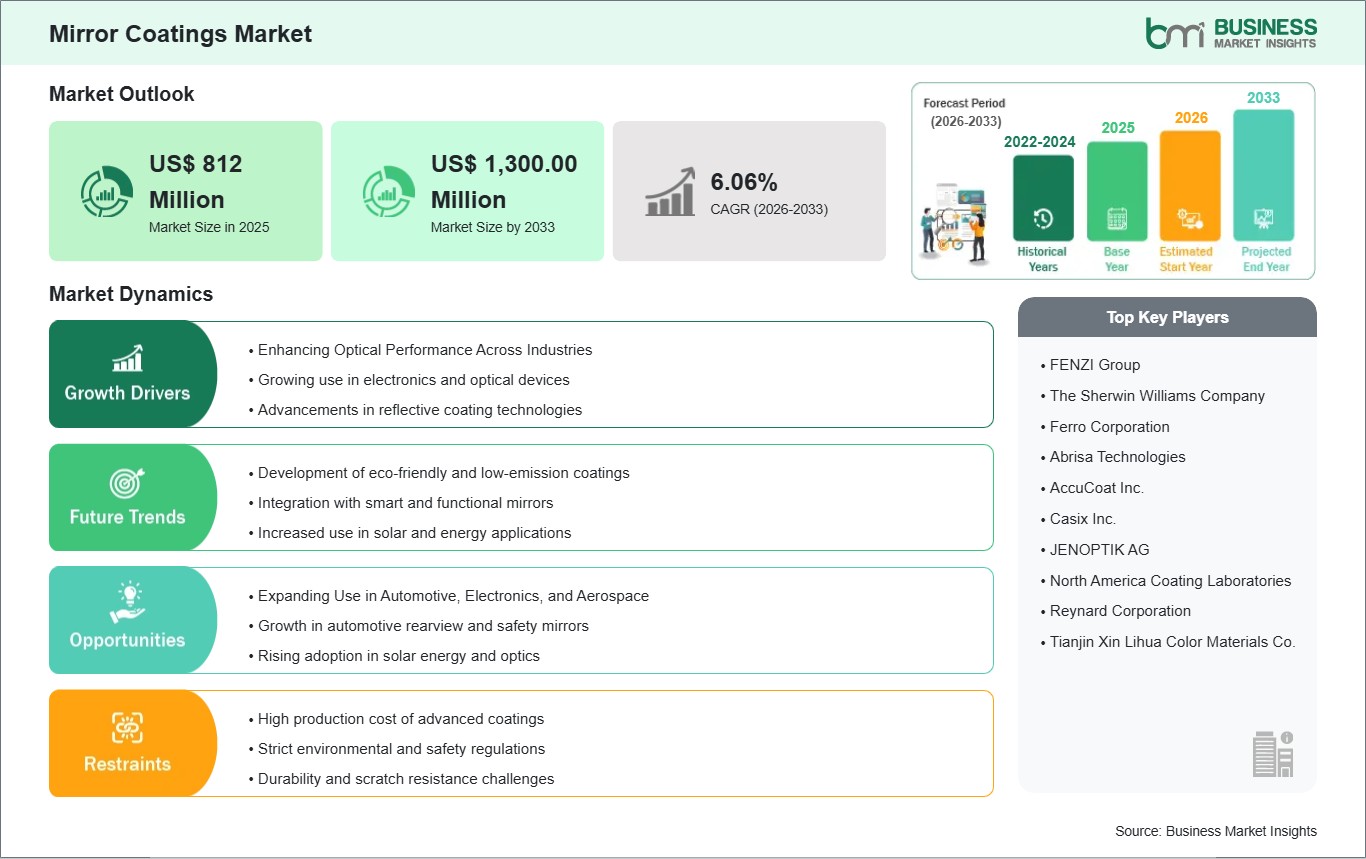
The Mirror Coatings Market size is expected to reach US$ 1,300.00 Million by 2033 from US$ 812 Million in 2025. The market is estimated to record a CAGR of 6.06% from 2026 to 2033.
As demand grows for high quality reflective surfaces in the construction, automotive, electrical and optical industries, the mirror coating market is growing steadily. The types of coatings often consist of thin films of metals, including aluminum, silver and gold, placed onto glass or plastic substrates. These coatings bring optical clarity, durability, and resistance to corrosion. The mirror coating market has strong potential within the architectural segment for the design of energy-efficient building façades and decorative interiors, as well as safety glass. Mirror coatings are also used in many parts of the automotive market, such as rear view mirrors, sensor parts in vehicles and smart mirror technology, which includes anti-glare, hydrophobic and electrochromic functions. Innovative coating technologies, including vacuum deposition, sputtering and environmentally friendly coatings, are developing the performance of mirror coatings while minimizing the impact on the environment. The growth of the mirror coating market is largely being driven by an increase in consumer interest in smart devices, reflective electronics and energy-efficient lighting.
However, the mirror coating market continues to face challenges concerning the high cost of production, coatings’ susceptibility to environmental degradation and stringent regulations on the coating process. Participants in the mirror coating market are investing heavily in R&D to create coatings that are durable and multifunctional, while also forming strategic alliances with glass manufacturers, electronics companies and construction companies to further grow their market presence. In summary, the species of the mirror coating market is highly favorable as a result of the joint influence of architectural modernization, automotive innovation and the.

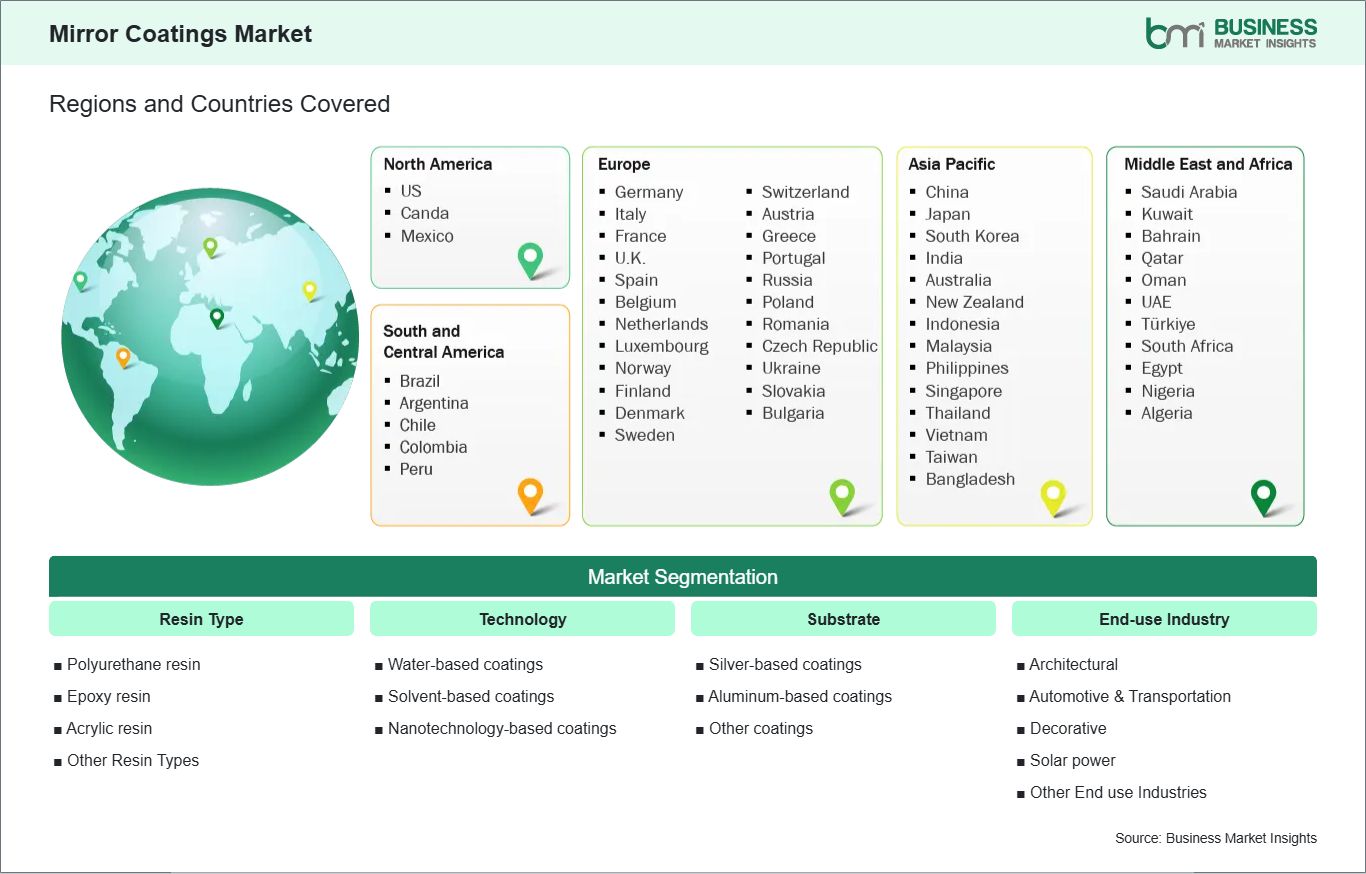
Key segments that contributed to the derivation of the mirror coatings market analysis are resin type, technology, substrate, and end-use industry.
The mirror coatings market is expanding because industries require materials that deliver exceptional reflectivity, long-lasting performance and precise optical capabilities. Mirror coatings create a protective layer on glass, metal and polymer surfaces, which improves light reflection and decreases energy waste and enhances visual performance for consumer electronics, automotive mirrors and optical instruments. High-quality coatings create clear reflections which maintain accurate visual representation in precision instruments, cameras and telescopes and high-end lighting systems.
Modern coating technologies provide better protection against scratches and corrosion while offering extended protection against environmental damage. The properties of this system enable products to function properly under severe humidity, temperature and chemical exposure conditions. The system enables production of coatings that possess predetermined spectral reflectivity and anti-reflective qualities that meet scientific, defense, and industrial optics demands.
Coated mirrors improve energy efficiency through their optical capabilities because they reflect light and heat in architectural and automotive applications. Manufacturers need to use advanced deposition techniques that create high-performance coatings that maintain uniformity while decreasing material waste. The demand for precision optics, energy-efficient building solutions and advanced display technologies drives the trend of using mirror coatings across multiple sectors. The material combines optical clarity with durability and functional customization, which makes it vital for use in modern industrial, commercial and consumer products.
The automotive, electronics and aerospace industries increasingly use mirror coatings because they improve performance, safety and visual appearance. Automotive coatings enable rearview and side mirror functions through their anti-glare, anti-fog and high-reflectivity capabilities, which help drivers maintain safe and comfortable driving. Coatings on mirrors and reflective surfaces improve electronic device displays and sensors, cameras, and optical modules, which enable progress in consumer electronics and imaging technology and augmented reality systems.
Mirror coatings provide aerospace and defense sectors with essential protective features for their high-precision instruments, optical sensors, and cockpit displays. The coatings create a protective shield that prevents abrasion, corrosion and environmental stress but still allows precise optical performance. Engineers use customizable spectral properties to design advanced optical systems that deliver dependable results in extreme settings.
The development work on advanced coating materials and deposition methods creates new opportunities for enhancing mirror coating performance while extending its effective service life. Manufacturers are investigating green manufacturing methods that use reduced energy consumption to comply with environmental regulations and sustainability standards. Mirror coatings have become crucial for various industries because they provide optical surfaces that meet the requirements for high performance, reliability and flexible usage. The technologies of the automotive, electronics and aerospace industries use their optical precision and protective features and ability to serve different purposes.
The mirror coatings market demonstrates steady growth, with size and share analysis highlighting evolving trends and competitive dynamics among key players. The report examines subsegments categorized within resin type, technology, substrate, and end-use industry, offering insights into their contribution to overall market performance.
By Resin Type, the polyurethane resin subsegment dominated the market in 2025, driven by its superior adhesion, durability, and reflective performance.
Based on Technology, the water-based coatings subsegment dominated the market in 2025, supported by environmental regulations and increasing adoption in construction and automotive sectors.
Based on Substrate, the silver-based coatings subsegment dominated the market in 2025, fueled by its high reflectivity and widespread use in mirrors and optical applications.
Based on End-use Industry, the architectural subsegment dominated the market in 2025, due to rising demand for decorative and energy-efficient building solutions.
| Report Attribute | Details |
|---|---|
| Market size in 2025 | US$ 812 Million |
| Market Size by 2033 | US$ 1,300.00 Million |
| Global CAGR (2026 - 2033) | 6.06% |
| Historical Data | 2022-2024 |
| Forecast period | 2026-2033 |
| Segments Covered | By Resin Type
|
|
Regions and Countries Covered
| |
| North America | US, Canada, Mexico |
| Europe | Belgium, Austria, Finland, Denmark, Greece, Poland, Romania, Russia, Ukraine, Czech Republic, Slovakia, Bulgaria, Italy, Luxembourg, Germany, Switzerland, France, Netherlands, Norway, Portugal, Spain, Sweden, United Kingdom |
| Asia-Pacific | Australia, China, India, Japan, South Korea, Indonesia, Malaysia, Philippines, Singapore, Thailand, Vietnam, Bangladesh, New Zealand, Taiwan |
| South and Central America | Brazil, Argentina, Peru, Chile, Colombia |
| Middle East and Africa | Bahrain, Kuwait, Oman, Qatar, Saudi Arabia, United Arab Emirates, Turkiye, South Africa, Egypt, Algeria, Nigeria |
| Market leaders and key company profiles |
|
The "Mirror Coatings Market Size and Forecast (2022 - 2033)" report provides a detailed analysis of the market covering below areas:
The geographical scope of the Mirror Coatings Market report is divided into North America, Asia Pacific, Europe, Middle East & Africa, and South & Central America. North America held the largest share in 2025.
Regional-level dynamics in the mirror coatings market reveal diverse growth patterns influenced by industrial development, regulatory standards, and technological adoption. North America is the dominant market, supported by mature construction and automotive sectors, high adoption of smart technologies, and stringent quality standards for coatings in optical and industrial applications. The United States leads in research and development of multifunctional mirror coatings and smart mirror solutions.
Europe shows steady growth, driven by energy-efficient construction mandates, sustainability initiatives, and the adoption of decorative and safety glass applications in Germany, France, and the UK.
Asia Pacific is the fastest-growing region, led by China, Japan, and South Korea, with rapid urbanization, large-scale infrastructure development, and growth in automotive manufacturing fueling demand for high-performance mirror coatings.
Middle East & Africa exhibits moderate growth, driven by luxury construction projects, commercial development, and the adoption of reflective coatings in industrial applications.
South & Central America is an emerging market, with gradual adoption in automotive, commercial construction, and electronics sectors, particularly in Brazil and Argentina, although market expansion is limited by price sensitivity and technological infrastructure.
Across all regions, growth is shaped by regulatory compliance, technological innovation, and increasing demand for durable, high-performance, and multifunctional mirror coating solutions.

The Mirror Coatings Market is evaluated by gathering qualitative and quantitative data post primary and secondary research, which includes important corporate publications, association data, and databases. A few of the key developments in the mirror coatings market are:
The Mirror Coatings Market is valued at US$ 812 Million in 2025, it is projected to reach US$ 1,300.00 Million by 2033.
As per our report Mirror Coatings Market, the market size is valued at US$ 812 Million in 2025, projecting it to reach US$ 1,300.00 Million by 2033. This translates to a CAGR of approximately 6.06% during the forecast period.
The Mirror Coatings Market report typically cover these key segments-
The historic period, base year, and forecast period can vary slightly depending on the specific market research report. However, for the Mirror Coatings Market report:
The Mirror Coatings Market is populated by several key players, each contributing to its growth and innovation. Some of the major players include:
The Mirror Coatings Market report is valuable for diverse stakeholders, including:
Essentially, anyone involved in or considering involvement in the Mirror Coatings Market value chain can benefit from the information contained in a comprehensive market report.
Please tell us your area of interest
(Market Segments/ Regions and Countries/ Companies)