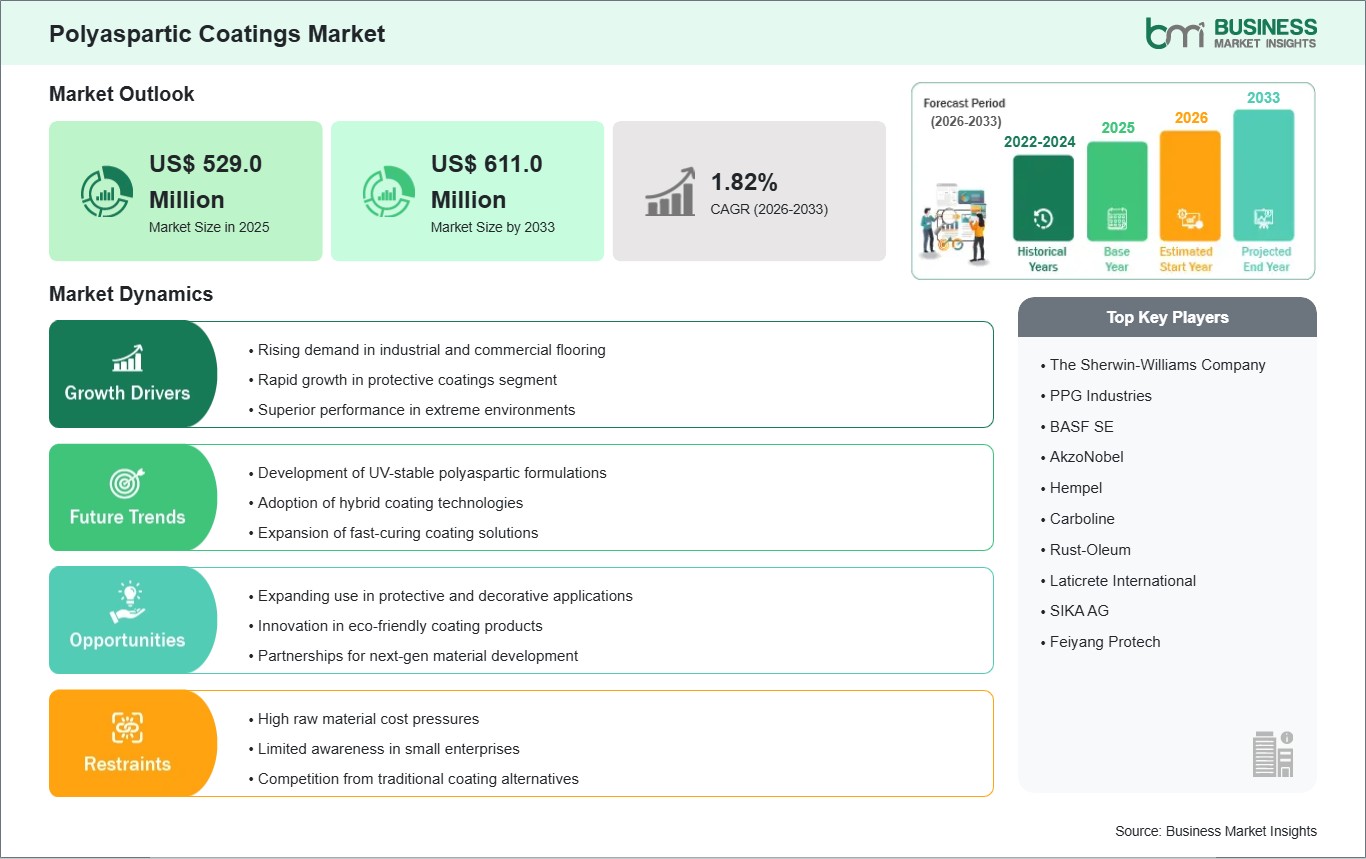
The Polyaspartic Coatings Market size is expected to reach US$ 611. million by 2033 from US$ 529. million in 2025. The market is estimated to record a CAGR of 1.82% from 2026 to 2033.
The market for polyaspartic coatings is growing at a healthy rate due to the increasing demand for advanced coating solutions that can offer rapid curing properties, excellent chemical resistance, and durability. Polyaspartic coatings are also gaining popularity due to their excellent performance under harsh environmental conditions, UV stability, and heavy traffic.
The market is growing due to increased spending on industrial infrastructure, rising demand for green construction products, and increasing demand for low-maintenance coating solutions that can also offer aesthetic flexibility. Advances in coating chemistry are also contributing to the growth of this market. These advances include rapid-curing polyaspartic blends and hybrid coating solutions that can offer greater flexibility in terms of application. Manufacturers are also increasingly focused on producing coatings that can offer longer pot life, excellent adhesion properties, and resistance to abrasion and chemicals. The market is highly competitive in nature, with both multinational and domestic players competing to offer cost-effective and advanced coating solutions.
Some of the major drivers of this market include the need for reduced downtime in industrial facilities, eco-friendly coatings that offer lower VOC emissions, and those used in high-growth end-use industries. Even though there are opportunities, challenges such as higher initial cost compared to conventional coatings and the requirement for skilled application may be factors that could influence the rate of adoption. Overall, the polyaspartic coatings market is a combination of innovation driven by performance, sustainability, and end-use industry demand for rapid application protective coatings.

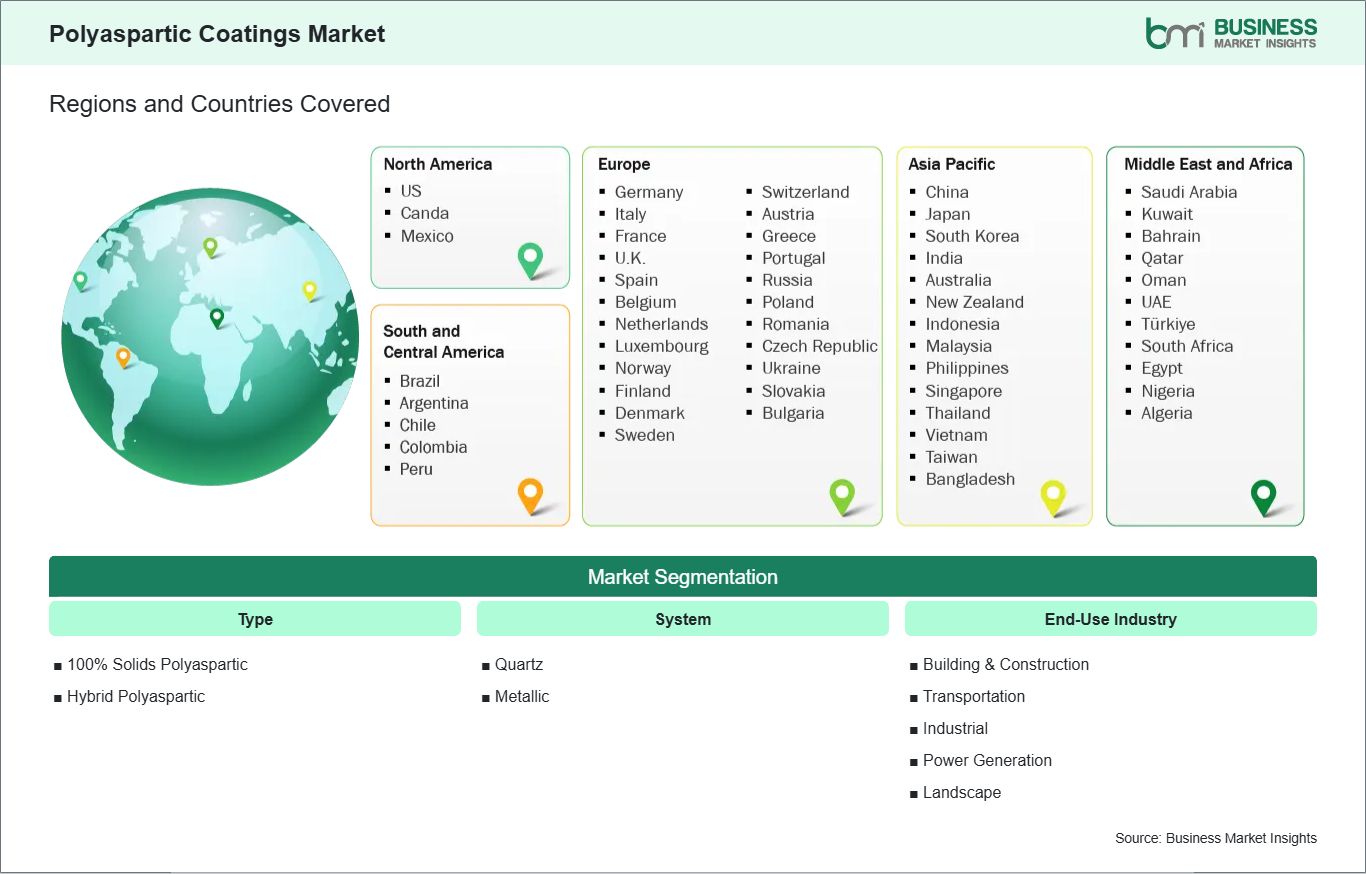
Key segments that contributed to the derivation of the polyaspartic coatings market analysis are type, systems, and end‑use industry.
The market for polyaspartic coatings is expanding significantly with the increasing demand for such coatings in industrial and commercial flooring applications. Polyaspartic coatings provide excellent advantages such as rapid curing and superior resistance to chemicals and abrasion. This makes them suitable for various industrial and commercial buildings. Their ability to provide long-lasting and seamless flooring with excellent aesthetic appearance is also a major reason for the increased demand for polyaspartic coatings in the market. Increasing demand for long-lasting and excellent flooring materials in modern industrial and commercial buildings is driving the market for polyaspartic coatings.
Polyaspartic coatings are also gaining popularity in the market owing to their excellent aesthetic appearance. These coatings can be formulated in various colors and can provide excellent UV resistance. This makes them suitable for various interior and exterior applications. They can provide excellent aesthetic appearance in various commercial buildings such as retail stores, offices, and showrooms. Their excellent aesthetic appearance and long-lasting characteristics are driving the market for polyaspartic coatings.
Sustainability considerations further support market growth. Polyaspartic coatings emit low levels of volatile organic compounds (VOCs) and can be applied quickly, reducing energy consumption and environmental impact. They are compatible with green building standards, making them attractive for environmentally conscious developers. As industries increasingly focus on efficiency, sustainability, and high-performance materials, polyaspartic coatings are emerging as a key solution in modern construction and renovation projects.
Polyaspartic coatings are gaining popularity in the market for protective coatings owing to their superior resistance to chemicals, abrasion, and moisture. Industries such as the automotive sector, manufacturing sector, and logistics sector are using polyaspartic coatings for the protection of concrete surfaces, metal surfaces, and other surfaces. These coatings provide long-lasting protection with minimal downtime and are a cost-effective solution for industries. As industries focus more on the efficiency and safety of operations, polyaspartic coatings are becoming a norm in the market for protective coatings.
In the market for decorative coatings, polyaspartic coatings are gaining popularity owing to their ability to provide a visually appealing surface with the addition of metallic finishes and decorative flakes. These coatings can provide long-lasting decorative finishes and can be used in residential areas, commercial areas, and other areas where people can see the coatings. As the market is moving towards visually appealing surfaces in modern buildings and homes, polyaspartic coatings are gaining popularity in the market for decorative coatings.
Technological advancements in polyaspartic coating formulations and application methods are further fueling growth. Improvements in curing speed, adhesion, and substrate compatibility make these coatings more versatile and easier to apply. Additionally, innovations aimed at improving sustainability, such as low-VOC and water-based formulations, are attracting environmentally conscious customers. As awareness of high-performance, low-maintenance, and eco-friendly coatings increases, polyaspartic coatings are poised to become a leading material in both protective and decorative applications globally.
The polyaspartic coatings market demonstrates steady growth, with size and share analysis highlighting evolving trends and competitive dynamics among key players. The report examines subsegments categorized within type, systems, and end‑use industry, offering insights into their contribution to overall market performance.
By Type, the 100% solids polyaspartic subsegment dominated the market in 2025, driven by its excellent curing properties and low VOC content.
Based on System, the quartz subsegment dominated the market in 2025, supported by its widespread use in flooring and decorative applications that demand enhanced aesthetics and durability.
On the Basis of End‑Use Industry, the building & construction subsegment dominated the market in 2025, driven by the growing adoption of protective and decorative coating systems in commercial and residential infrastructure.
| Report Attribute | Details |
|---|---|
| Market size in 2025 | US$ 529.0 Million |
| Market Size by 2033 | US$ 611.0 Million |
| Global CAGR (2026 - 2033) | 1.82% |
| Historical Data | 2022-2024 |
| Forecast period | 2026-2033 |
| Segments Covered | By Type
|
|
Regions and Countries Covered
| |
| North America | US, Canada, Mexico |
| Europe | Belgium, Austria, Finland, Denmark, Greece, Poland, Romania, Russia, Ukraine, Czech Republic, Slovakia, Bulgaria, Italy, Luxembourg, Germany, Switzerland, France, Netherlands, Norway, Portugal, Spain, Sweden, United Kingdom |
| Asia-Pacific | Australia, China, India, Japan, South Korea, Indonesia, Malaysia, Philippines, Singapore, Thailand, Vietnam, Bangladesh, New Zealand, Taiwan |
| South and Central America | Brazil, Argentina, Peru, Chile, Colombia |
| Middle East and Africa | Bahrain, Kuwait, Oman, Qatar, Saudi Arabia, United Arab Emirates, Turkiye, South Africa, Egypt, Algeria, Nigeria |
| Market leaders and key company profiles |
|
The "Polyaspartic Coatings Market Size and Forecast (2022 - 2033)" report provides a detailed analysis of the market covering below areas:
The geographical scope of the Polyaspartic Coatings Market report is divided into North America, Asia Pacific, Europe, Middle East & Africa, and South & Central America. North America held the largest share in 2025.
The polyaspartic coatings market exhibits significant regional variation based on industrial development, construction activity, and environmental standards, with North America dominating the market due to its advanced industrial base, stringent quality regulations, and high demand in commercial and infrastructure projects. The United States and Canada lead adoption in warehouses, manufacturing facilities, and public infrastructure, driven by early adoption of innovative coating technologies and emphasis on long-term durability.
In Europe, growth is supported by sustainability mandates, industrial modernization, and decorative architectural trends in countries such as Germany, France, and the UK, emphasizing low-VOC, environmentally friendly coatings.
Asia Pacific is emerging as a rapidly expanding market, fueled by urbanization, industrialization, and infrastructure investments in China, India, and Australia, where demand is driven by large-scale commercial and industrial flooring projects that require fast-curing, high-durability solutions.
The Middle East & Africa region is gradually increasing adoption, particularly in industrial and commercial infrastructure, supported by government-led construction projects and imports of advanced polyaspartic formulations.
South & Central America is witnessing steady growth, led by Brazil, Mexico, and Argentina, driven by industrial flooring, logistics hubs, and commercial construction, though cost considerations and limited local manufacturing capacity influence adoption strategies.
Regional dynamics collectively highlight the impact of industrial maturity, regulatory frameworks, and application-specific requirements on global market growth for polyaspartic coatings.

The Polyaspartic Coatings Market is evaluated by gathering qualitative and quantitative data post primary and secondary research, which includes important corporate publications, association data, and databases. A few of the key developments in the polyaspartic coatings market are:
The Polyaspartic Coatings Market is valued at US$ 529.0 Million in 2025, it is projected to reach US$ 611.0 Million by 2033.
As per our report Polyaspartic Coatings Market, the market size is valued at US$ 529.0 Million in 2025, projecting it to reach US$ 611.0 Million by 2033. This translates to a CAGR of approximately 1.82% during the forecast period.
The Polyaspartic Coatings Market report typically cover these key segments-
The historic period, base year, and forecast period can vary slightly depending on the specific market research report. However, for the Polyaspartic Coatings Market report:
The Polyaspartic Coatings Market is populated by several key players, each contributing to its growth and innovation. Some of the major players include:
The Polyaspartic Coatings Market report is valuable for diverse stakeholders, including:
Essentially, anyone involved in or considering involvement in the Polyaspartic Coatings Market value chain can benefit from the information contained in a comprehensive market report.
Please tell us your area of interest
(Market Segments/ Regions and Countries/ Companies)