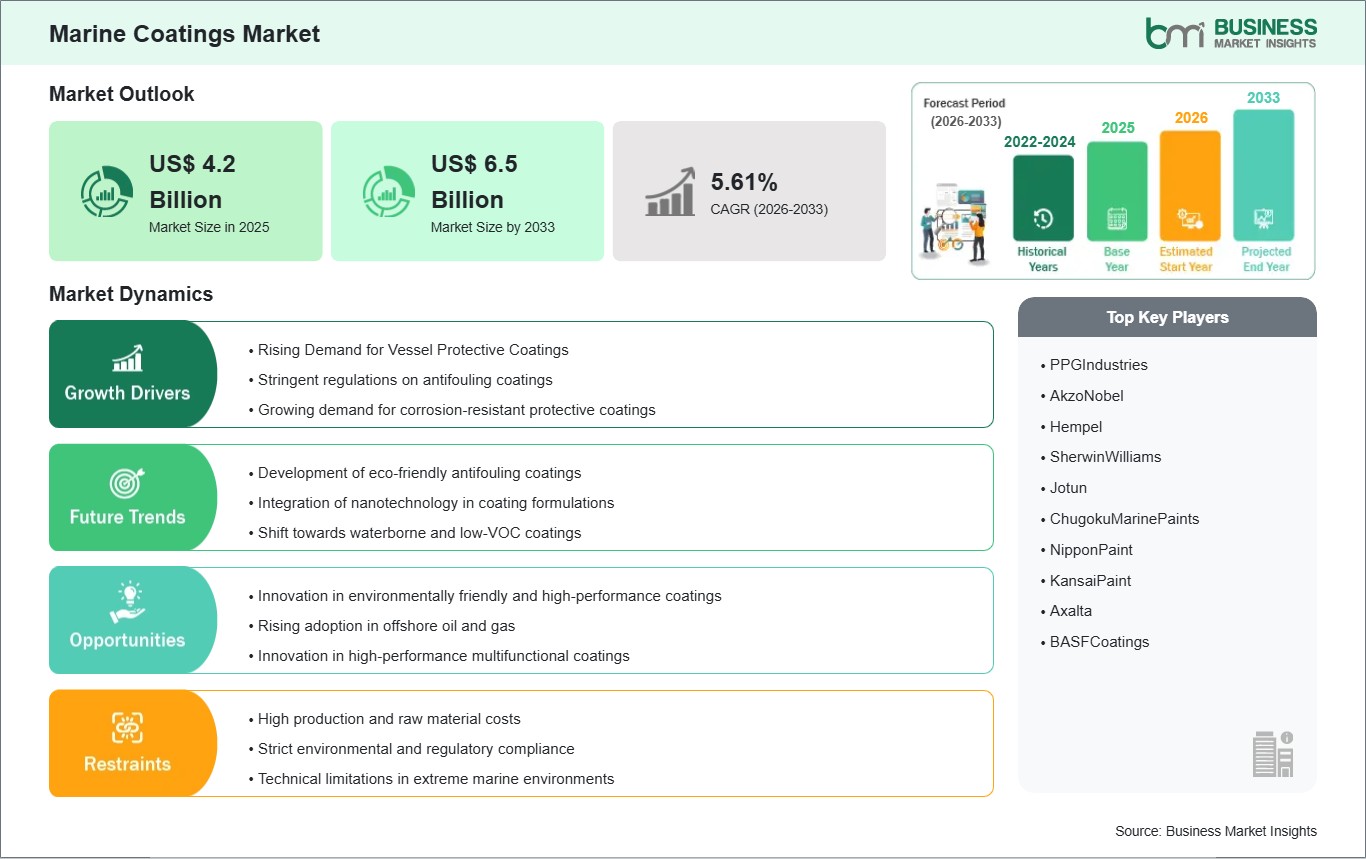
The Marine Coatings Market size is expected to reach US$ 6.5 Billion by 2033 from US$ 4.2 Billion in 2025. The market is estimated to record a CAGR of 5.61% from 2026 to 2033.
The marine coatings market is growing at a steady rate, and this is attributed to the increased importance of protecting, preserving, and prolonging the lifespan of vessels in the shipping, marine, and naval industries. Marine coating is a type of coating that is applied for protective purposes and is required for vessels and marine infrastructure, as it has to withstand harsh marine weathering, corrosion, and wear and tear. The main type of marine coating is antifouling coating, which is made of a combination of epoxies, alkyds, and polyurethane and is applied to protect vessels and marine infrastructure against corrosion, fuel consumption, and maintenance costs.
The market is growing due to the increase in global shipping, expansion of commercial vessels, and the increase in naval vessels and offshore oil and gas activities. Regulatory drivers, including guidelines from the International Maritime Organization on biocides and VOC emissions, are driving up the pace for eco-friendly coatings, low-VOC coatings, and biocide-free coatings. Technological innovations are improving adhesion, abrasion resistance, anti-fouling properties, and smoothness of coatings. The new technologies are designed to increase fuel efficiency and decrease maintenance intervals. The new coatings also feature nanotechnology, self-healing properties, and long-lasting anti-fouling performance. The companies that are able to provide application-specific solutions, environmentally friendly coatings, and technical support are well-positioned to benefit from significant business opportunities in a competitive and specialized industry.

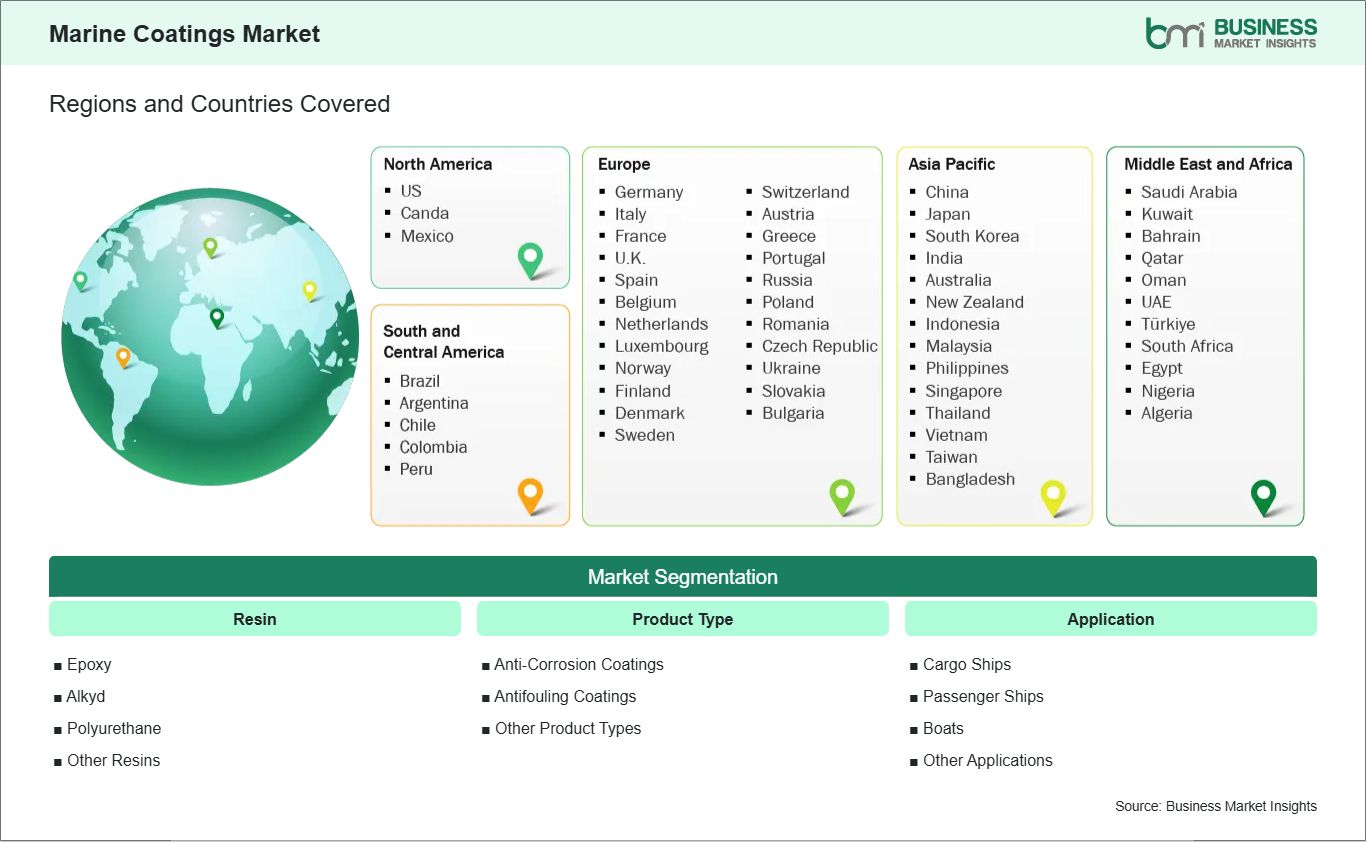
Key segments that contributed to the derivation of the marine coatings market analysis are resin, product type, and application.
The marine coatings market globally is growing, and this can be attributed to the increase in demand for protective coatings that offer protection to ships, boats, and other marine structures from extreme weather conditions. Marine coatings play a critical role in the prevention of corrosion, which can result from saltwater, ultraviolet rays, humidity, and marine growth. Marine coatings are also significant in the prevention of wear and tear, which can result from extreme weather conditions. This, in turn, leads to an increase in the lifespan of the vessel, which can be achieved through the use of marine coatings. Commercial vessels benefit from the use of marine coatings, which offer protection to the vessel, improve the vessel's speed, and increase the vessel's fuel efficiency. Luxury vessels benefit from the use of marine coatings, which offer aesthetic and protective benefits.
Offshore platforms, port infrastructure, and marine equipment also require coatings that can withstand abrasion, chemical exposure, and extreme weather. The focus on operational efficiency, durability, and lifecycle cost savings is driving broader adoption across various marine sectors. Manufacturers are responding with advanced formulations that balance protection, performance, and regulatory compliance. The combination of durability, efficiency, and environmental awareness is positioning the marine coatings market for steady long-term growth across commercial, recreational, and industrial applications worldwide.
Technological innovation is driving the development of eco-friendly, high-performance marine coatings. Manufacturers are producing low-VOC, solvent-free, and biocide-efficient coatings that comply with environmental regulations while delivering superior anti-fouling, corrosion-resistant, and wear-resistant properties. These coatings enable vessels and offshore structures to perform efficiently without harming the environment. R&D is enhancing durability, adhesion, and resistance to biofouling, chemical attack, and abrasion. Integration of advanced polymers, nanomaterials, and smart coatings helps reduce fuel drag, improve efficiency, and extend operational life. Customized formulations are being designed for specific vessel types, marine equipment, and offshore installations, ensuring optimal performance under challenging conditions.
Collaboration between coating manufacturers and end-users is supporting tailored solutions that meet both sustainability and operational goals. Combining environmental compliance, high performance, and application versatility is driving adoption across commercial shipping, recreational boating, and offshore infrastructure. These innovations are positioning the marine coatings market for sustained global growth.

The marine coatings market demonstrates steady growth, with size and share analysis highlighting evolving trends and competitive dynamics among key players. The report examines subsegments categorized within resin, product type, and application, offering insights into their contribution to overall market performance.
By Resin, the epoxy subsegment dominated the market in 2025, driven by its excellent corrosion resistance and durability in marine environments.
Based on Product Type, the anti‑corrosion coatings subsegment dominated the market in 2025, supported by widespread use for protecting underwater and above‑water vessel surfaces from degradation.
On the basis of Application, the cargo ships subsegment dominated the market in 2025, owing to high demand for protective coatings in merchant and bulk carrier fleets.
| Report Attribute | Details |
|---|---|
| Market size in 2025 | US$ 4.2 Billion |
| Market Size by 2033 | US$ 6.5 Billion |
| Global CAGR (2026 - 2033) | 5.61% |
| Historical Data | 2022-2024 |
| Forecast period | 2026-2033 |
| Segments Covered | By Resin
|
|
Regions and Countries Covered
| |
| North America | US, Canada, Mexico |
| Europe | Belgium, Austria, Finland, Denmark, Greece, Poland, Romania, Russia, Ukraine, Czech Republic, Slovakia, Bulgaria, Italy, Luxembourg, Germany, Switzerland, France, Netherlands, Norway, Portugal, Spain, Sweden, United Kingdom |
| Asia-Pacific | Australia, China, India, Japan, South Korea, Indonesia, Malaysia, Philippines, Singapore, Thailand, Vietnam, Bangladesh, New Zealand, Taiwan |
| South and Central America | Brazil, Argentina, Peru, Chile, Colombia |
| Middle East and Africa | Bahrain, Kuwait, Oman, Qatar, Saudi Arabia, United Arab Emirates, Turkiye, South Africa, Egypt, Algeria, Nigeria |
| Market leaders and key company profiles |
|
The "Marine Coatings Market Size and Forecast (2022 - 2033)" report provides a detailed analysis of the market covering below areas:
The geographical scope of the Marine Coatings Market report is divided into North America, Asia Pacific, Europe, Middle East & Africa, and South & Central America. North America held the largest share in 2025.
Regional dynamics in the marine coatings market reflect shipbuilding activity, offshore infrastructure development, and environmental regulatory frameworks. North America dominates, driven by the U.S. and Canadian commercial shipping, naval fleet modernization, and offshore oil and gas operations, where advanced epoxy and antifouling coatings are widely adopted to enhance durability and operational efficiency.
Europe is another key market, with Germany, Norway, Italy, and the UK leading in high-performance marine coatings for luxury yachts, commercial vessels, and offshore platforms. Strict EU environmental regulations encourage the use of low-VOC, biocide-free, and eco-friendly coating technologies.
In the Asia Pacific, rapid industrialization, expanding shipbuilding capacity, and growing demand for commercial and naval vessels in China, Japan, South Korea, and India are driving robust growth. This region also benefits from cost-effective manufacturing and a strong export-oriented maritime industry.
Middle East & Africa is an emerging market, with adoption primarily linked to offshore oil and gas infrastructure, commercial shipping, and port facilities in Saudi Arabia, UAE, and South Africa.
South & Central America, led by Brazil and Mexico, is gradually increasing consumption, driven by commercial shipping, fisheries, and ship repair activities. Across all regions, performance, regulatory compliance, and technological innovation remain key drivers shaping market growth and competitive positioning in the global marine coatings sector.

The Marine Coatings Market is evaluated by gathering qualitative and quantitative data post primary and secondary research, which includes important corporate publications, association data, and databases. A few of the key developments in the marine coatings market are:
The Marine Coatings Market is valued at US$ 4.2 Billion in 2025, it is projected to reach US$ 6.5 Billion by 2033.
As per our report Marine Coatings Market, the market size is valued at US$ 4.2 Billion in 2025, projecting it to reach US$ 6.5 Billion by 2033. This translates to a CAGR of approximately 5.61% during the forecast period.
The Marine Coatings Market report typically cover these key segments-
The historic period, base year, and forecast period can vary slightly depending on the specific market research report. However, for the Marine Coatings Market report:
The Marine Coatings Market is populated by several key players, each contributing to its growth and innovation. Some of the major players include:
The Marine Coatings Market report is valuable for diverse stakeholders, including:
Essentially, anyone involved in or considering involvement in the Marine Coatings Market value chain can benefit from the information contained in a comprehensive market report.
Please tell us your area of interest
(Market Segments/ Regions and Countries/ Companies)