Market Summary
Executive Summary and Global Market Analysis
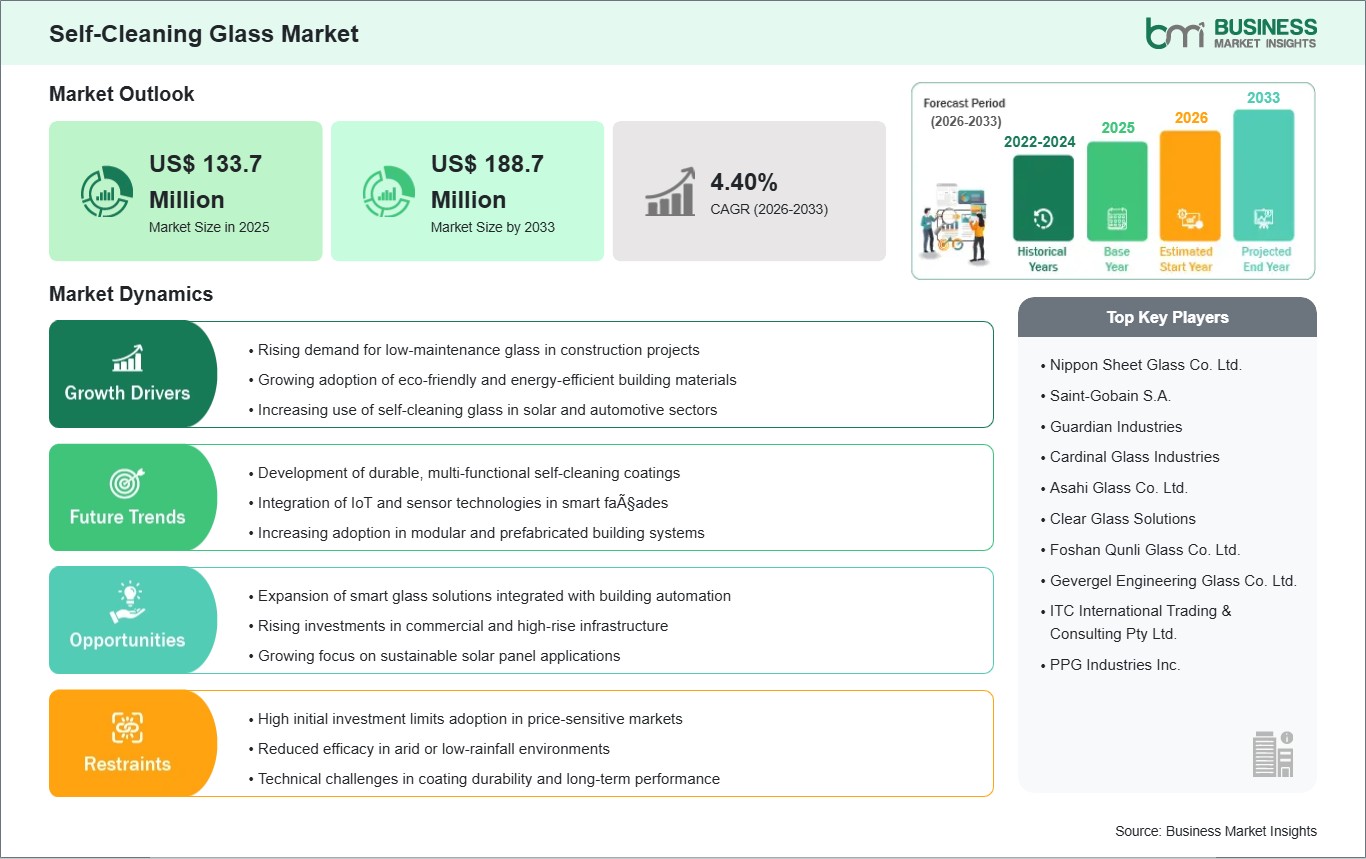
Sustainable building solutions which need no upkeep serve as fundamental market drivers for the global self-cleaning glass industry which has emerged as a crucial market force worldwide. Self-cleaning glass uses special coatings that enable rainwater and sunlight to eliminate surface dirt which helps to decrease cleaning costs while maintaining clear surfaces in areas with dust and pollution. The material demonstrates its ability to serve multiple building sectors through its use in home window systems and building shell systems and its use in advanced architectural glass systems for commercial and institutional projects. Green construction practices which promote sustainable building design represent a major force driving market expansion.
As governments and private developers worldwide adopt more stringent building standards, materials that contribute to lower resource usage, reduced cleaning labor, and minimized chemical cleaning agents are increasingly preferred. The product meets these requirements through its passive features which help organizations achieve energy and water resource reduction targets. Self-cleaning coatings now protect solar panels from dust, which reduces their energy efficiency in construction projects. Automotive original equipment manufacturers (OEMs) are investigating self-cleaning technologies which will enable their windshields and sunroofs to maintain safety through clear visibility. The market encounters specific limitations although there are evident patterns of market adoption.
The high-performance coatings market faces a barrier because cost factors make coatings unaffordable for price-sensitive markets which require customers to pay more upfront than they will save through future maintenance. The adoption process in certain regions experiences limitations because technical constraints decrease performance in environments with extremely low humidity and dry conditions. The combination of ongoing research and development work with broader sustainability initiatives creates worldwide market momentum which establishes self-cleaning glass as an essential material for multiple industrial applications.
Segment Analysis
Self-Cleaning Glass Market Segmentation
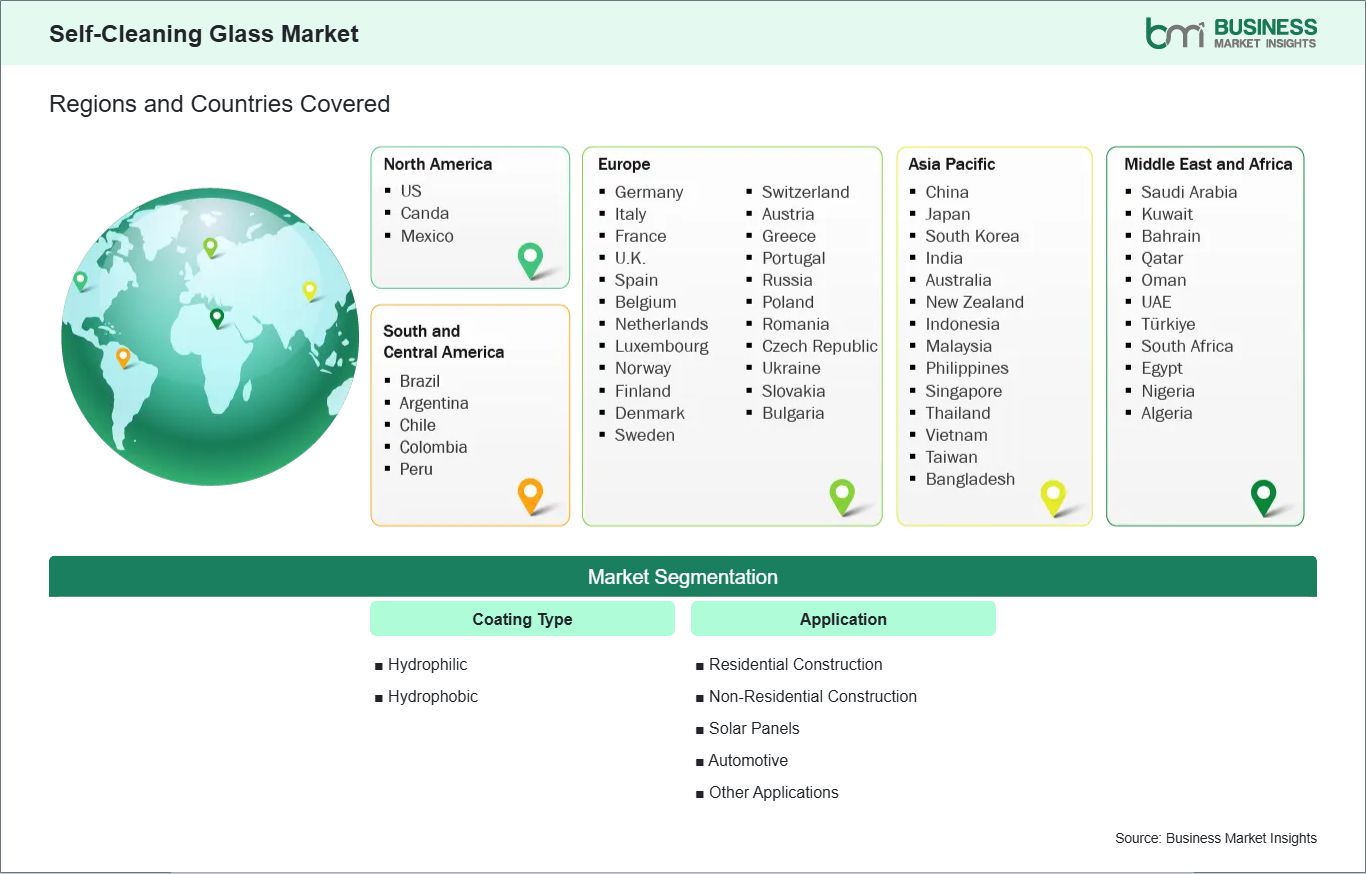
Key segments that contributed to the derivation of the self‑cleaning glass market analysis are coating type and application.
- By coating type, the self‑cleaning glass market is segmented into hydrophilic and hydrophobic. The hydrophilic segment dominated the market in 2025.
- Based on application, the self‑cleaning glass market is categorized into residential construction, non‑residential construction, solar panels, automotive, and other applications. The non-residential construction segment dominated the market in 2025.
Market Forces
Self-Cleaning Glass Market Drivers and Opportunities
Rising demand for low-maintenance glass in construction projects
The global adoption of self-cleaning glass is increasingly driven by the growing need for low-maintenance solutions in modern construction. Urban environments require commercial and high-rise buildings to use façade materials that maintain their visual appeal without needing frequent maintenance. Developers and facility managers find self-cleaning glass coatings to be valuable because these coatings reduce operational costs through decreased labor and water requirements while delivering extended product life. Homeowners desire smart sustainable solutions for their skylights windows and balcony enclosures which drives the residential construction market.
The hydrophilic coating segment is particularly favored because it leverages natural rainwater to remove dust and debris, providing consistent cleaning with minimal effort. Developers are increasingly specifying such materials in green and smart housing projects to align with energy efficiency and water conservation initiatives. Self-cleaning coatings generate operational advantages which increase their demand in multiple sectors including solar panels and automotive industries. For solar installations, maintaining panel efficiency without manual cleaning is critical, while in automotive applications, visibility and safety are enhanced with minimal maintenance. The broad applicability of self-cleaning glass technology across various industrial applications confirms its value as a solution for modern construction and industrial requirements.
Expansion of smart glass solutions integrated with building automation
The integration of self-cleaning glass with IoT and building automation systems creates intelligent building façades which achieve optimal cleaning schedules while conserving energy and tracking performance. The coating sensors provide real-time data about dirt buildup and weather patterns and system performance, enabling automatic system alerts and forecasted maintenance, which improves safety and decreases operational interruptions. The construction industry begins to adopt this practice because developers utilize unified systems to create environmentally friendly building solutions which major commercial structures and extensive public works projects require.
Smart integration enables self-cleaning coatings to decrease cleaning requirements while improving building systems, which helps organizations achieve both Industry 4.0 standards and green building certification programs such as LEED and BREEAM. The Asia Pacific region experiences rapid growth of these solutions, which combine self-cleaning glass technology with digital control systems to improve operational efficiency in urban areas that experience high population density. Advanced smart façades which use sustainable materials and require minimal upkeep according to growing demand, are now being used by corporate headquarters and shopping malls and airports throughout Europe and North America.
Size and Share Analysis
Self-Cleaning Glass Market Size and Share Analysis
The self‑cleaning glass market demonstrates steady growth, with size and share analysis highlighting evolving trends and competitive dynamics among key players. The report examines subsegments categorized within coating type and application, offering insights into their contribution to overall market performance.
By coating type, the hydrophilic subsegment dominated the market in 2025, driven by its high efficiency in dust and dirt removal using natural rain, making it more widely adopted in construction and solar applications.
Based on application, the non-residential construction subsegment dominated the market in 2025, driven by the growing demand for low-maintenance, self-cleaning glass in commercial buildings and high-rise infrastructures.
Report Coverage
Self-Cleaning Glass Market Report Coverage and Deliverables
The "Self‑Cleaning Glass Market Size and Forecast (2022 - 2033)" report provides a detailed analysis of the market covering below areas:
- Self‑Cleaning Glass Market size and forecast at global, regional, and country levels for all the key market segments covered under the scope
- Self‑Cleaning Glass Market trends, as well as drivers, restraints, and opportunities
- Self‑Cleaning Glass Market analysis covering key trends, global and regional framework, major players, regulations, and recent developments
- Industry landscape and competition analysis covering market concentration, heat map analysis, prominent players, and recent developments for the Self‑Cleaning Glass Market
- Detailed company profiles, including SWOT analysis
Geographic Insights
Self-Cleaning Glass Market Geographic Insights
The geographical scope of the Self‑Cleaning Glass Market report is divided into North America, Asia Pacific, Europe, Middle East & Africa, and South & Central America. North America held the largest share in 2025.
The Self-Cleaning Glass Market demonstrates different market behaviors across various regions because North America leads the market through its developed construction industry and its adoption of advanced building materials and its dedication to creating sustainable and energy-efficient construction facilities. Self-cleaning glass has become a preferred choice for commercial and high-rise office and institutional projects in the region because it lowers maintenance expenses and helps buildings achieve green building certification and it preserves the visual appearance of façades in urban areas that face pollution and particulate matter.
The Asia Pacific region experiences fast industrial development because urban areas expand and both residential and commercial building projects increase and the government supports energy-saving building products that need little maintenance. Self-cleaning glass technology has been implemented by China and India and Japan for use in their commercial buildings and their solar energy systems and their advanced home construction projects because it improves the material lifespan while it cuts down operating expenses. The European market operates under strict environmental protection laws and green building certification requirements and rising public interest in sustainable practices which result in hydrophilic coating applications in residential and commercial building projects. The Middle East and Africa region develops at a slow pace because the self-cleaning glass market grows through major commercial and hospitality projects found in the UAE and Saudi Arabia and South Africa which use self-cleaning glass to decrease water usage and cleaning requirements in severe dust-filled environments.
South and Central America shows consistent growth because of urban infrastructure development and increasing modern building investments and rising adoption of solar energy projects while Brazil and Mexico function as primary drivers of this trend. Market expansion occurs through three main trends which include smart building technology integration and user preference for surfaces that need minimal upkeep and requirements for buildings to be both energy-efficient and visually attractive. North America serves as the reference point for both technological progress and market development of self-cleaning glass technologies because different climatic conditions and cost factors and infrastructure development stages affect how countries adopt these technologies.
Industry Activity
Recent Developments
The Self‑Cleaning Glass Market is evaluated by gathering qualitative and quantitative data post primary and secondary research, which includes important corporate publications, association data, and databases. A few of the key developments in the self‑cleaning glass market are:
- In January 2026, Virtue Glass Group officially listed a self‑cleaning glass product in its catalog, describing its high‑performance easy‑clean coated glass designed for architectural, residential, automotive, and industrial applications, directly from the company`s official site.
- In April 2022, Pilkington Activ™ — the world`s first commercially available self‑cleaning glass by NSG Group (Pilkington) was featured in an official company news article explaining product technology, performance benefits, and installation considerations, reinforcing its continued relevance and promotion on the corporate news page.
Trust & Transparency
Research Methodology
The market analysis combines proprietary research with secondary data from government agencies, company disclosures, regulatory filings, industry databases and expert interviews. Market estimates are validated through data triangulation, cross-market benchmarking and analyst
review.
View Full Research Methodology
Key Sources Referred:
World Health Organization (WHO) Organisation for Economic Cooperation and Development (OECD) The World Bank Group Worldometer The Lancet International Bar Association International Trade Administration