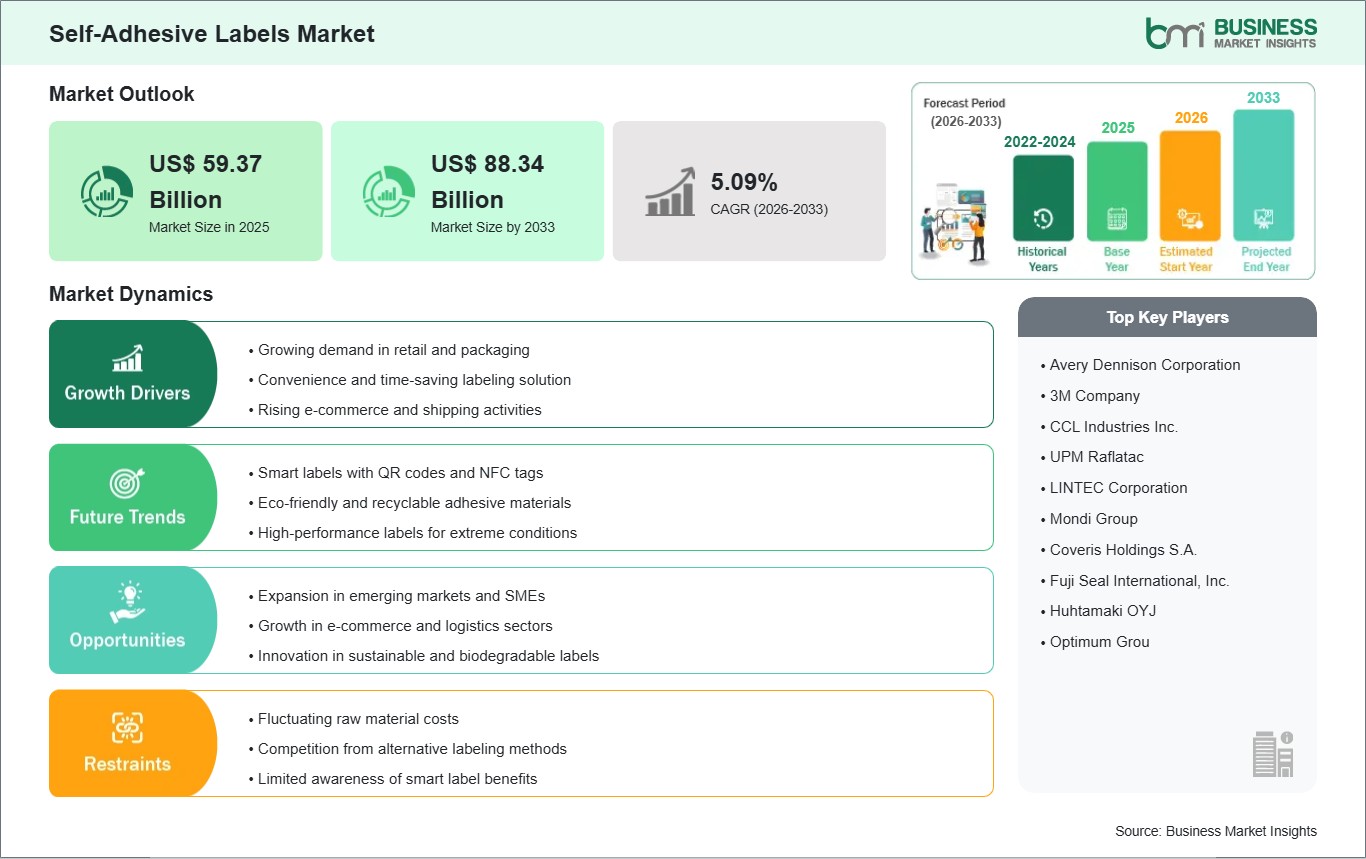
The Self-Adhesive Labels Market size is expected to reach US$ 88.34 billion by 2033 from US$ 59.37 billion in 2025. The market is estimated to record a CAGR of 5.09% from 2026 to 2033.
The global self-adhesive labels market is experiencing robust growth, driven by rising demand for convenient, cost-effective, and versatile labelling solutions across industries such as food and beverages, pharmaceuticals, logistics, retail, and personal care. Self-adhesive labels offer advantages like easy application, strong adhesion, print flexibility, and durability on various surfaces, making them ideal for both branding and regulatory compliance.
The increasing trend of e-commerce and packaged goods has significantly boosted demand, as businesses seek efficient, tamper-evident, and visually appealing labelling solutions to enhance product identity and traceability. Additionally, technological advancements in materials, adhesives, and printing methods such as digital and smart labels are enabling more customized, sustainable, and multifunctional labelling solutions. However, the market faces certain restraints.
The environmental impact of traditional adhesives and non-biodegradable label substrates is a growing concern, prompting stricter regulations on recyclable and eco-friendly materials. Additionally, high costs associated with advanced functional labels, such as RFID-enabled or temperature-sensitive labels, may limit adoption in price-sensitive segments. Despite these challenges, the market is evolving toward sustainable, smart, and high-performance self-adhesive labels that meet both commercial and regulatory demands, offering long-term growth opportunities across diverse applications globally.

Key segments that contributed to the derivation of the self-adhesive labels market analysis are composition, nature, type, technology and application.
The use of self-adhesive labels has emerged as a most sought-after option for businesses in Western Europe, considering their ease of use and the consequent efficiency in labelling operations. Businesses in countries such as Germany, France, and the UK are showing increasing inclination towards the use of self-adhesive labels for packaging, identification, and inventory management purposes, as they do not require any separate adhesive or any process of gluing. In addition to this, the self-adhesive labels provide the advantage of versatility in the materials and surfaces they can be applied to. For example, the food and drink industry in Belgium and Italy make use of the self-adhesive labels that are coated or laminated and can be read in refrigerated conditions. Similarly, the cosmetic and personal care industry in Scandinavian countries prefer the self-adhesive labels that are of high quality and visually appealing.
Small and medium-sized enterprises in Western Europe can also benefit from the self-adhesive labels because they provide the advantage of faster setup and reduced training needs. Retailers, producers of artisan products, and packaging services make use of the ready-to-use self-adhesive labels to increase the speed of product turnover and minimize downtime. Thus, the self-adhesive labels are an integral part of the Western European landscape.
The expansion of e-commerce and logistics in Western Europe is considered a key driver for self-adhesive label materials. In Western Europe, especially in Germany, the UK, and France, online retailing is growing rapidly. This has generated a large number of packages to be shipped, which can be easily done with self-adhesive label materials. These materials are easy to use for shipping companies, ensuring efficient and accurate tracking of packages, especially in international shipping.
Warehouse automation and smart fulfillment centers also contribute to market growth. In countries like the Netherlands and Spain, automated sorting and packing lines increasingly rely on durable self-adhesive labels compatible with barcode and QR code scanning systems. Labels must withstand temperature variations, friction, and transport handling while remaining readable, which has led suppliers to innovate with heat- and moisture-resistant adhesives as well as reinforced materials.
Additionally, sustainability considerations influence product choice. E-commerce and logistics players in Western Europe are seeking recyclable and eco-friendly labeling options that reduce environmental impact while meeting operational requirements. As consumer awareness of sustainable packaging rises, self-adhesive labels that combine durability, convenience, and environmental compliance are becoming standard across the region. The growth of online retail and modern logistics infrastructure ensures that the self-adhesive labels market in Western Europe will continue expanding steadily.
The global self-adhesive labels market is experiencing steady growth, with market size and share analysis reflecting evolving treatment preferences and competitive dynamics among key players. The report evaluates important subsegments categorized within composition, nature, type, technology, and application highlighting their respective contributions to overall market performance.
By composition the face stock subsegment dominated the market in 2025 because it forms the main printable surface and determines the visual appeal and durability of the label. Advances in paper and film-based face stocks provide strong print quality, flexibility, and resistance to moisture or abrasion, making it the key component in most labels.
By nature, the permanent segment subsegment dominated the market in 2025 because most industries prefer labels that stay fixed throughout the product’s lifecycle. They ensure durability during transportation, storage, and end-user handling, which is essential for branding, regulatory compliance, and traceability.
By type, the release liner segment subsegment dominated the market in 2025 because it protects the adhesive until application and allows smooth, precise label placement. It ensures consistency in high-speed production and prevents damage to the adhesive, which is critical in industrial-scale labeling.
By technology, the flexography subsegment dominated the market in 2025 because it is highly efficient for large-volume label printing, offers good quality on various substrates, and is cost-effective. Its ability to handle continuous rolls and multiple colors makes it ideal for self-adhesive label production.
By application, the food & beverages subsegment dominated the market in 2025 due to massive global production and high packaging standards. Labels are essential for branding, nutritional information, and regulatory compliance, creating consistent demand for self-adhesive solutions in this sector.
| Report Attribute | Details |
|---|---|
| Market size in 2025 | US$ 59.37 Billion |
| Market Size by 2033 | US$ 88.34 Billion |
| Global CAGR (2026 - 2033) | 5.09% |
| Historical Data | 2022-2024 |
| Forecast period | 2026-2033 |
| Segments Covered | By Composition
|
|
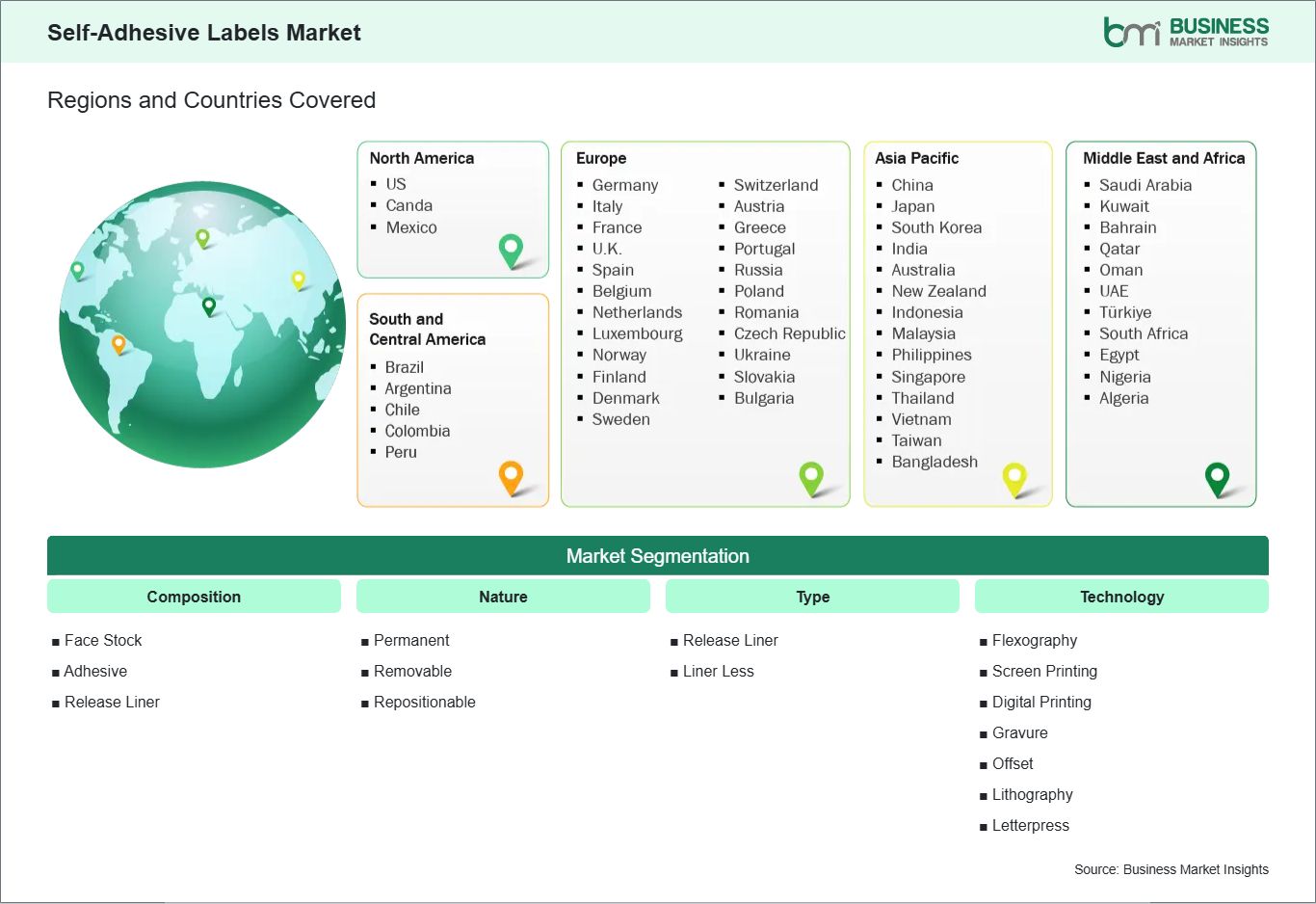
Regions and Countries Covered
| |
| North America | US, Canada, Mexico |
| Europe | Belgium, Austria, Finland, Denmark, Greece, Poland, Romania, Russia, Ukraine, Czech Republic, Slovakia, Bulgaria, Italy, Luxembourg, Germany, Switzerland, France, Netherlands, Norway, Portugal, Spain, Sweden, United Kingdom |
| Asia-Pacific | Australia, China, India, Japan, South Korea, Indonesia, Malaysia, Philippines, Singapore, Thailand, Vietnam, Bangladesh, New Zealand, Taiwan |
| South and Central America | Brazil, Argentina, Peru, Chile, Colombia |
| Middle East and Africa | Bahrain, Kuwait, Oman, Qatar, Saudi Arabia, United Arab Emirates, Turkiye, South Africa, Egypt, Algeria, Nigeria |
| Market leaders and key company profiles |
|
The "Self-Adhesive Labels Market Size and Forecast (2022 - 2033)" report provides a detailed analysis of the market covering below areas:
The geographical scope of the self-adhesive labels market report is divided into: North America, Asia Pacific, Europe, Middle East & Africa, and South & Central America. North America held the largest share in 2025.
North America dominates the self-adhesive labels market due to its mature manufacturing base, strong retail and e-commerce sectors, and early adoption of advanced labeling technologies. The United States, in particular, leads in adopting smart and functional labels for applications such as pharmaceutical traceability, food safety, and logistics management. North American manufacturers prioritize innovation in adhesives, sustainable substrates, and digital printing capabilities to meet consumer expectations for customization, durability, and eco-friendly packaging.
The region benefits from strict regulatory standards, particularly in pharmaceuticals and food products, which drive demand for high-quality, tamper-evident, and trackable labels. The growth of e-commerce and omnichannel retail has further accelerated demand for versatile, easy-to-apply labeling solutions that ensure brand consistency and product protection. While production costs and sustainability compliance can pose challenges, North America maintains leadership through technological innovation, robust supply chains, and a consumer preference for premium and functional labeling solutions. This makes the region a benchmark for smart, durable, and environmentally conscious self-adhesive label applications globally.

The self-adhesive labels market is evaluated by gathering qualitative and quantitative data post primary and secondary research, which includes important corporate publications, association data, and databases. A few of the key developments in the self-adhesive labels market are:
The Self-Adhesive Labels Market is valued at US$ 59.37 Billion in 2025, it is projected to reach US$ 88.34 Billion by 2033.
As per our report Self-Adhesive Labels Market, the market size is valued at US$ 59.37 Billion in 2025, projecting it to reach US$ 88.34 Billion by 2033. This translates to a CAGR of approximately 5.09% during the forecast period.
The Self-Adhesive Labels Market report typically cover these key segments-
The historic period, base year, and forecast period can vary slightly depending on the specific market research report. However, for the Self-Adhesive Labels Market report:
The Self-Adhesive Labels Market is populated by several key players, each contributing to its growth and innovation. Some of the major players include:
The Self-Adhesive Labels Market report is valuable for diverse stakeholders, including:
Essentially, anyone involved in or considering involvement in the Self-Adhesive Labels Market value chain can benefit from the information contained in a comprehensive market report.
Please tell us your area of interest
(Market Segments/ Regions and Countries/ Companies)