
3D Printing Filament Market Outlook: Size, Share, Trends, Growth Analysis, Competitive Landscape & Forecast, 2026-2033

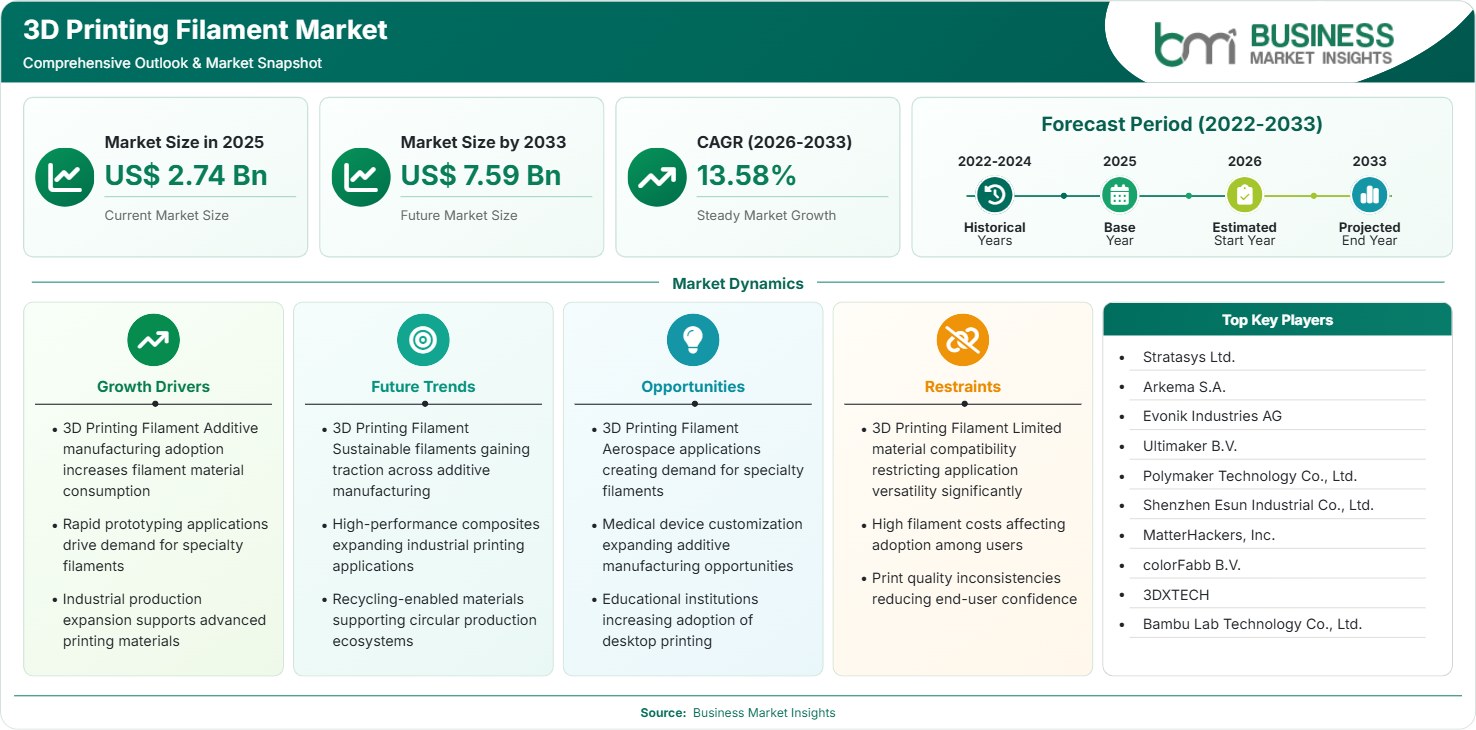
The 3D Printing Filament Market size was valued at US$ 2.74 Billion in 2025 and is projected to reach US$ 7.59 Billion by 2033, growing at a CAGR of 13.58% during 2026–2033, driven by engineering-material adoption, distributed production, rapid prototyping, composite filament innovation, and demand for lightweight customized components.

Report Coverage
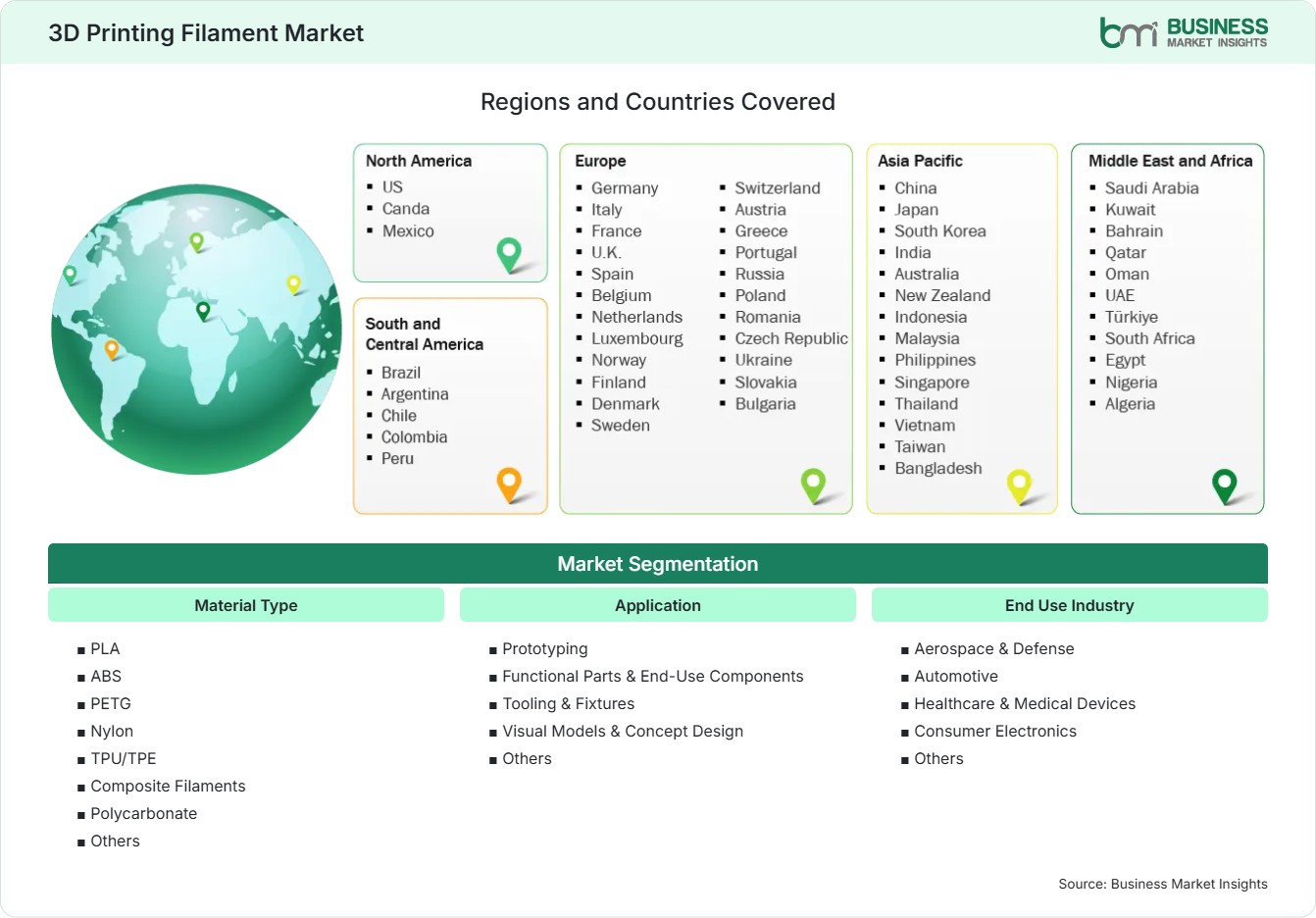
  • Material Type: PLA, ABS, PETG, Nylon, TPU/TPE, Composite Filaments, Polycarbonate, Others
  • Application: Prototyping, Functional Parts & End-Use Components, Tooling & Fixtures, Visual Models & Concept Design, Others
  • End Use Industry: Aerospace & Defense, Automotive, Healthcare & Medical Devices, Consumer Electronics, Others
US$ 2.74 Bn Market size in 2025
US$ 7.59 Bn Market Size by 2033
13.58% CAGR, 2026 - 2033
2026-2033 Forecast Period

AI Overview

3D Printing Filament Market Summary

  • North America Region: North America holds 32%–35% 3D Printing Filament Market share in 2025, growing at 11.5%–12.5% CAGR, supported by aerospace qualification, automotive tooling, localized production, healthcare prototyping, sustainable materials, and distributed manufacturing adoption across industrial users.
    The U.S. accounts for 25%–28% share within North America, with 11.7%–12.7% CAGR driven by industrial FFF adoption.
  • Fastest Growing Region: Asia Pacific holds 28%–32% share in 2025, growing at 15.0%–16.0% CAGR, driven by electronics manufacturing, printer adoption, domestic materials capacity, automation, prototyping, and expanding industrial production across regional supply chains.
  • Leading Segment: PLA holds 35%–38% share in 2025, growing at 11.8%–12.9% CAGR, supported by broad printer compatibility, affordability, easy processing, prototyping demand, color variety, and reliable dimensional performance for everyday industrial applications.
  • High Growth Segment: Composite Filaments hold 8%–11% 3D Printing Filament Market share in 2025, growing at 18.5%–20.5% CAGR, driven by carbon-fiber reinforcement, lightweight tooling, engineering applications, stiffness, thermal performance, and replacement of machined components in demanding workflows.
  • Key Market Opportunity: The strongest opportunity lies in engineering and composite filaments for production tooling, aerospace fixtures, automotive components, and distributed manufacturing, where performance requirements support premium pricing, qualification investments, and material demand.
  • Major Market Players: Stratasys Ltd.; Arkema S.A.; Evonik Industries AG; Ultimaker B.V.; Polymaker Technology Co., Ltd.; Shenzhen Esun Industrial Co., Ltd.; MatterHackers, Inc.; colorFabb B.V.; 3DXTECH; Bambu Lab Technology Co., Ltd.
Strategic Insights

3D Printing Filament Market: Strategic Insights

3D Printing Filament Market Strategic Framework
FREE PDF
Request your free sample
Request free sample
Stakeholder View

Key Takeaways

  • The polymer producers, the compounders, the filament extruders, the printer manufacturers, the software suppliers, the distributors, and the industrial users are now more and more linked together, with material qualification and printer compatibility becoming important factors for differentiation, together with price.
  • Since users take into account the total production costs, durability, lead time, and design flexibility, functional components, the tooling, the fixtures, and the engineering prototypes offer greater value capture than standard visual printing.
  • Filament development is moving towards application-specific performance because of the use of carbon-fiber reinforcement, high-temperature polymers, low-emission formulations, recycled feedstocks, traceable spools, and automated material profiles.
  • The Asia Pacific region has the highest electronics manufacturing density, is seeing greater industrial automation, benefits from large domestic printer ecosystems, and is developing its ability to process polymers, all of which provide opportunities for the local production of filament and its regional distribution.
  • More of the strategic effort is now being directed towards vertically integrated additive manufacturing ecosystems, and in May 2026 Stratasys agreed to buy Markforged, thus reinforcing its position in FFF solutions and the associated production processes.
  • The cost per usable part can be greatly influenced by factors such as qualification, drying, storage, dimensional consistency, and control of the print profile, which is why process reliability has become more important to industrial buyers.
Geographic Outlook

3D Printing Filament Market Regional Highlights

North America 3D Printing Filament Market

North America held a 32%–35% share in 2025 and is projected to expand at a 11.5%–12.5% CAGR in the 3D Printing Filament Market Forecast. Demand benefits from aerospace, defense, automotive, medical-device development, university research, and distributed manufacturing. Industrial buyers increasingly use engineering filaments for fixtures, ducts, housings, tooling, and replacement components.

  • People involved in the aerospace and defense sectors are placing greater importance on materials that are lightweight, capable of withstanding high temperatures, flame-retardant, and resistant to chemicals when being used for tooling and in some production situations.
  • Car manufacturers are now using reinforced polymers for fixtures, for assembly aids, for custom parts, and in development programs that call for faster design iteration.
  • In the field of healthcare, a preference is shown for using dimensional consistency and materials that are specific to each application, especially when it comes to anatomical models, surgical planning aids, and custom devices.
  • By producing locally, one depends less on long material lead times, which in turn supports domestic filament compounding, extrusion, distribution, and inventory management.

US 3D Printing Filament Market

The U.S. represented 25%–28% of the North American 3D Printing Filament Market demand in 2025 and is projected to grow at 11.7%–12.7% CAGR through 2033. Adoption is supported by aerospace manufacturing, defense procurement, automotive engineering, medical-device development, education, and professional prototyping. Domestic suppliers benefit from established additive manufacturing infrastructure and extensive printer installed bases.

  • There is a demand for reinforced and high-temperature polymers in the aerospace and defense sectors because weight reduction and quick tooling are important factors.
  • Healthcare and developers of medical devices use filament extrusion to produce patient-specific models, prototypes, guides, fixtures, and certain low-volume components.
  • U.S. distributors and suppliers of specialty materials are increasing access for professional, educational, research, and industrial users.

Europe 3D Printing Filament Market

Europe held 24%–27% 3D Printing Filament Market share in 2025 and is expected to grow at 12.5%–13.5% CAGR through 2033. Germany leads regional industrial adoption, while France, the UK, Italy, and the Netherlands provide strong ecosystems across machinery, chemicals, aerospace, automotive, and additive manufacturing. Germany is estimated to grow at 12.8%–13.8% CAGR, while the UK is modeled at 13.2%–14.2%.

  • Germany has automotive production, expertise in industrial automation, knowledge of machinery, and carries out research into additive manufacturing, all of which support the demand for engineering filament.
  • The UK obtains advantages from its aerospace, defense, healthcare innovation, and advanced manufacturing programs, which require rapid tooling and custom components.
  • In France and Italy, there are opportunities in the fields of aerospace, the automotive industry, industrial equipment, and design-oriented applications where the performance of materials and aesthetics come together.
  • European sustainability policies ask suppliers to record material composition, energy use, recyclability, and environmental performance.

Asia Pacific 3D Printing Filament Market

Asia Pacific held 28%–32% 3D Printing Filament Market share in 2025 and is forecast to expand at 15.0%–16.0% CAGR, making it the fastest-growing regional market. China remains the largest regional production and consumption center, while Japan, South Korea, and India strengthen industrial demand. China is modeled at 15.4%–16.4% CAGR and India at 16.2%–17.2%.

  • China enjoys the advantages of large-scale electronics and manufacturing supply chains, the widespread use of desktop printers, and the growing production of filament within the country.
  • India offers growth opportunities in the areas of industrial digitization, engineering education, automotive manufacturing, healthcare innovation, and in providing greater access to affordable additive manufacturing.
  • Japan and South Korea meet the demand for premium materials by means of their work in the fields of electronics, automotive engineering, robotics, and precision manufacturing.
  • Regional suppliers are now competing more by means of quick product launches, a wide variety of colors, customizing the materials, and having their distribution tailored to the local area.

Rest of World 3D Printing Filament Market

South and Central America represented part of the 10%–13% Rest of World 3D Printing Filament Market share in 2025 and are modeled to grow at 12.0%–13.0% CAGR. Brazil leads regional adoption through industrial manufacturing, education, automotive applications, and localized prototyping. Saudi Arabia and the United Arab Emirates are modeled at 13.0%–14.0% CAGR.

  • Because local manufacturing is being expanded and because adoption is driven by education, there is a growing demand for cheap PLA, PETG, ABS, and special materials in Brazil.
  • Mexico offers opportunities in the areas of automotive, electronics, aerospace, and manufacturing investments related to nearshoring.
  • As part of their wider industrial diversification initiatives, the Gulf economies are developing advanced manufacturing capabilities.
  • Africa is still relatively small but does have opportunities available via education, healthcare, local production, and prototyping related to infrastructure.
Global Market Geography
FREE PDF
Request your free sample
Request free sample
Segment Analysis

3D Printing Filament Market Segmentation

Material Type

Material Type remains the primary differentiation point because polymer chemistry determines printability, strength, thermal resistance, flexibility, durability, and cost. PLA leads with 35%–38% 3D Printing Filament Market share in 2025 and 11.8%–12.9% CAGR through 2034, while composite and engineering materials gain adoption where performance requirements justify higher material costs and specialized processing.

  • PLA (Polylactic Acid): PLA remains dominant because of easy processing, broad printer compatibility, strong surface quality, affordability, and extensive color availability across prototyping and consumer applications.
  • ABS (Acrylonitrile Butadiene Styrene): ABS supports durable housings, prototypes, and functional components requiring higher toughness and temperature resistance, although controlled printing environments remain important.
  • PETG (Polyethylene Terephthalate Glycol): PETG balances toughness, chemical resistance, printability, and surface quality, making it attractive for functional prototypes, containers, fixtures, and general manufacturing aids.
  • Nylon (Polyamide): Nylon provides toughness, fatigue resistance, and chemical durability for demanding components, tooling, brackets, housings, and applications exposed to repeated mechanical loads.
  • TPU/TPE (Thermoplastic Polyurethane/Elastomers): Flexible filaments enable seals, grips, gaskets, protective elements, wearable prototypes, and compliant components where elasticity and impact absorption are required.
  • Composite Filaments: Carbon-fiber and glass-fiber formulations improve stiffness and dimensional stability, supporting lightweight tooling, structural prototypes, fixtures, and production components.
  • Polycarbonate (PC): PC serves applications requiring impact strength, heat resistance, and dimensional stability, particularly industrial components, protective housings, and demanding functional prototypes.

Application

Application demand is moving from visualization toward functional production, with Prototyping remaining a major volume contributor while Functional Parts & End-Use Components capture higher-value opportunities. The 3D Printing Filament Market scope increasingly includes low-volume production, customized tooling, and distributed manufacturing alongside traditional design workflows.

  • Prototyping: Rapid material extrusion shortens design cycles, enables repeated physical validation, and reduces tooling dependence for product development teams.
  • Functional Parts & End-Use Components: Engineering polymers and composites allow selected components to move directly into service, especially where customization, low volume, or complex geometry offsets material costs.
  • Tooling & Fixtures: Lightweight jigs, gauges, drill guides, assembly fixtures, and manufacturing aids reduce lead times and can replace slower conventional fabrication.
  • Visual Models & Concept Design: PLA and PETG remain useful for appearance models, ergonomic validation, demonstrations, and early-stage product communication.

End Use Industry

End Use Industry demand reflects differences in qualification, geometry, production volume, and material-performance requirements. Aerospace & Defense and Automotive increasingly favor reinforced and engineering filaments, while Healthcare & Medical Devices emphasize repeatability and application-specific validation. Consumer Electronics supports rapid iteration and customized production.

  • Aerospace & Defense: Lightweight tooling, ducts, fixtures, prototypes, and selected production components create demand for high-performance polymers and reinforced filaments.
  • Automotive: Manufacturers use filament extrusion for prototypes, production aids, customized fixtures, replacement parts, and low-volume components requiring fast iteration.
  • Healthcare & Medical Devices: Applications include anatomical models, surgical planning, customized aids, research prototypes, and specialized devices requiring controlled material characteristics.
  • Consumer Electronics: Rapid product cycles encourage prototyping, housing development, ergonomic testing, fixtures, and customized components.
Market Forces

3D Printing Filament Market Dynamics

Key Market Drivers

Expansion of Functional Additive Manufacturing

The 3D Printing Filament Market growth is increasingly connected with functional production rather than visualization alone. Stratasys identifies applications spanning jigs and fixtures, production parts, composite tooling, rapid prototyping, aerospace, automotive, medical, and government uses. This diversification expands material requirements beyond standard PLA and ABS toward nylon, PC, reinforced polymers, and high-temperature formulations. ISO/ASTM 52900 provides an established vocabulary framework for additive manufacturing, while newer standards continue to strengthen qualification and process consistency.

High-Speed Printing and Material Optimization

The 3D Printing Filament Market trends increasingly reflect faster extrusion and improved material-process integration. Printer manufacturers are optimizing filament formulations, drying requirements, extrusion temperatures, cooling behavior, and software profiles to support higher throughput without sacrificing dimensional accuracy. Polymaker introduced PLA Pro in March 2026 as a toughened PLA formulation designed for higher-speed printing while retaining relatively simple processing requirements. UltiMaker is also expanding industrial material portfolios with PPS carbon fiber and Nylon CF Slide, showing how material development is increasingly synchronized with printer hardware and process control.

Shift Toward Reinforced and Engineering Polymers

There is a growing demand for materials that can be used to replace certain machined or molded parts. The use of carbon and glass fiber reinforcement increases stiffness and improves dimensional stability, whereas high-temperature polymers can withstand more severe conditions. UltiMaker states that its PPS carbon fiber can be used as an alternative to less demanding steel, aluminum, and PEEK applications, and its Nylon CF Slide is aimed at wear-heavy applications, which have previously been met with POM. Arkema's Kepstan PEKK range shows the wider shift towards ultra-high-performance polymers that are suitable for use with FFF and other processing techniques. This trend results in a higher value per kilogram of material, since industrial customers buy the material based on its performance, the availability of qualification support, process stability, and application reliability rather than just using commodity resin.

Key Market Opportunities

Localized Filament Manufacturing and Distribution

By regionalizing their operations, filament manufacturers can set up extrusion, compounding, warehousing, and technical support facilities nearer to the main areas where printers are located. The need to avoid supply chain disruptions, the uncertainty surrounding tariffs, high freight costs, and customers' demand for shorter lead times all act to promote local sourcing. IATA recorded a 3.4% increase in global air-cargo demand in 2025 and pointed out the shift in trade routes, such as the growing traffic between Europe and Asia. For filament suppliers, regional production helps to reduce their inventory risk and allows for better responsiveness to requirements relating to specific applications, colors, diameters, formulations, and customer qualification.

Composite Filaments for Lightweight Tooling

Composite filaments provide a great opportunity since it is possible to substitute certain metal tooling, fixtures, and brackets with lighter polymer ones. The addition of carbon fiber increases stiffness without losing the geometric flexibility linked with material extrusion. In sectors such as aerospace, automotive, robotics, electronics, and industrial equipment, benefits can be obtained in cases where tooling weight has an impact on ergonomics, setup time, or the way equipment is handled. UltiMaker's PPS CF positioning shows how it is possible to meet applications that have so far been fulfilled by steel, aluminum, or more expensive high-performance polymers.

Sustainable and Traceable Material Platforms

The environmental requirements offer an opportunity to suppliers who use recycled or bio-based raw materials, together with documented performance. Sustainability can take on commercial significance when buyers require proof regarding the source of the material, the manufacturing controls, the emissions, the possibility of recycling, and the consistent mechanical properties. The IEA states that the industry is responsible for 30% of global energy consumption and identifies electrification and the integration of renewable energy as key measures for decarbonization.

Market Restraints and Challenges

Material Moisture, Storage, and Processing Sensitivity

The fact is that hygroscopic polymers like nylon and some engineering materials take in moisture while being stored, which may lead to bubbling, uneven extrusion, weak bonding between layers, surface flaws, and changes in dimensions. As a result, industrial users must have drying equipment, practice controlled storage, follow proper handling procedures, and use validated printing settings, thus increasing the complexity of operations and the total cost of managing the material. This problem is particularly important in production situations where repeatability is more crucial than just achieving a successful print. Suppliers, therefore, need packaging that provides better protection against moisture, includes clear instructions for drying, ensures reliable spool geometry, and maintains stable formulation control.

Qualification Costs for High-Performance Materials

The need for application-specific validation, along with process documentation, traceability, and repeatability, is common in areas such as aerospace, defense, medical, and automotive applications before materials can be admitted to controlled production processes. As a result, qualification leads to longer development times and higher testing costs, which in turn limit the ability to quickly switch between suppliers even if the alternative filaments have similar advertised properties. Although the ISO/ASTM frameworks are helping to improve industrial qualification practices, material validation is still dependent on the specific application.

Company Analysis

Competitive Landscape

The competitive structure combines integrated additive manufacturing companies, polymer specialists, filament manufacturers, distributors, and technology-focused material developers. 3D Printing Filament Market analysis increasingly centers on formulation expertise, printer compatibility, production consistency, engineering support, and application qualification rather than simple spool pricing.

Company Name

Overview

Products and Services relevant to this market

Stratasys Ltd.

Major additive manufacturing company with extensive FDM expertise and an industrial customer base across multiple sectors.

FDM thermoplastic materials including PLA, ABS, nylon, PC, TPU, reinforced polymers, support materials, and application-specific engineering materials.

Arkema S.A.

Specialty materials producer with high-performance polymer expertise serving demanding industrial applications.

Kepstan PEKK and advanced polymer materials supporting FFF and other additive manufacturing processes, with high-temperature and chemical-resistance characteristics.

Evonik Industries AG

German specialty chemicals company supplying advanced polymer technologies for additive manufacturing.

High-performance polymer materials and specialty chemistry supporting engineering applications, material formulation, and advanced additive manufacturing.

Ultimaker B.V.

Industrial desktop additive manufacturing company with integrated printer, software, and material ecosystems.

PLA, PETG, ABS, nylon, PC, TPU, PPS carbon fiber, Nylon CF, and other validated filament solutions.

Polymaker Technology Co., Ltd.

Filament specialist focused on desktop and professional material development across multiple polymer families.

PLA, PETG, ABS, TPU, PC, nylon, composite, support, and application-oriented filament products.

Shenzhen Esun Industrial Co., Ltd.

Chinese material manufacturer specializing in environmentally oriented polymers and 3D printing materials.

PLA, PCL, ABS, PETG and other filament materials supported by polymer research, manufacturing, and global distribution.

MatterHackers, Inc.

U.S.-based 3D printing supplier serving professional, educational, industrial, and maker customers.

Broad filament distribution, specialty materials, 3D printing supplies, software, technical support, and digital fabrication solutions.

colorFabb B.V.

Netherlands-based filament developer focused on specialty, composite, and functional material formulations.

PLA, PETG, flexible, wood-filled, metal-filled, carbon-fiber, and specialty filament materials for diverse printing applications.

3DXTECH

Specialty filament supplier focused on engineering and high-performance material applications.

Carbon-fiber, glass-fiber, high-temperature, ESD-safe, chemical-resistant, and engineering-grade filament formulations.

Bambu Lab Technology Co., Ltd.

Additive manufacturing company integrating printers, software, automation, and material ecosystems for accessible high-speed printing.

PLA, PETG, ABS, TPU, engineering and specialized filaments, including application-oriented and home-use material formulations.

Trust & Transparency

Research Methodology

The market analysis combines proprietary research with secondary data from government agencies, company disclosures, regulatory filings, industry databases and expert interviews. Market estimates are validated through data triangulation, cross-market benchmarking and analyst review.

View Full Research Methodology

Questions Answered

Frequently Asked Questions

Why are high-performance filaments more expensive than standard PLA?

High-performance filaments often require specialized polymers, reinforcement, controlled compounding, tighter extrusion parameters, moisture management, advanced packaging, and application validation. Their higher price can be justified when improved performance reduces machining, tooling, component weight, production time, or replacement frequency.

How is sustainability influencing filament development?

Suppliers are exploring recycled content, bio-based polymers, lower-impact production, improved packaging, material traceability, and take-back approaches. Sustainability increasingly interacts with procurement requirements, particularly where manufacturers track material origin and environmental performance across production processes.

What determines filament selection for an industrial application?

Selection depends on mechanical requirements, thermal exposure, chemical environment, flexibility, dimensional stability, printer compatibility, moisture sensitivity, production volume, qualification requirements, and total cost per usable part rather than filament price alone.

Why are composite filaments gaining industrial attention?

Composite filaments combine polymer matrices with reinforcing materials such as carbon or glass fiber. They can improve stiffness, dimensional stability, and strength-to-weight performance, making them suitable for tooling, fixtures, brackets, and selected production components.

What material is most widely used for general 3D printing applications?

PLA remains the most broadly accessible material because it combines easy processing, good surface quality, wide printer compatibility, affordability, and extensive color availability. Its lower processing complexity makes it particularly suitable for prototyping, education, visual models, and many general-purpose printed components.

Access the Full 3D Printing Filament Market Report

Get segment-level forecasts, regional estimates, competitive benchmarking, company profiles and downloadable Excel datasets.

Access the full 3D Printing Filament Market Report
350 pages PDF & Excel | 2026-10-12
Similar Research

Related Market Reports