Military 3D Printing Market Outlook (2022-2033)

Historic Data: 2022-2024   |   Base Year: 2025   |   Forecast Period: 2026-2033
Report Content: Market Scope, Market Segmentation, Market Dynamics, and Competitive Analysis

Report Coverage:
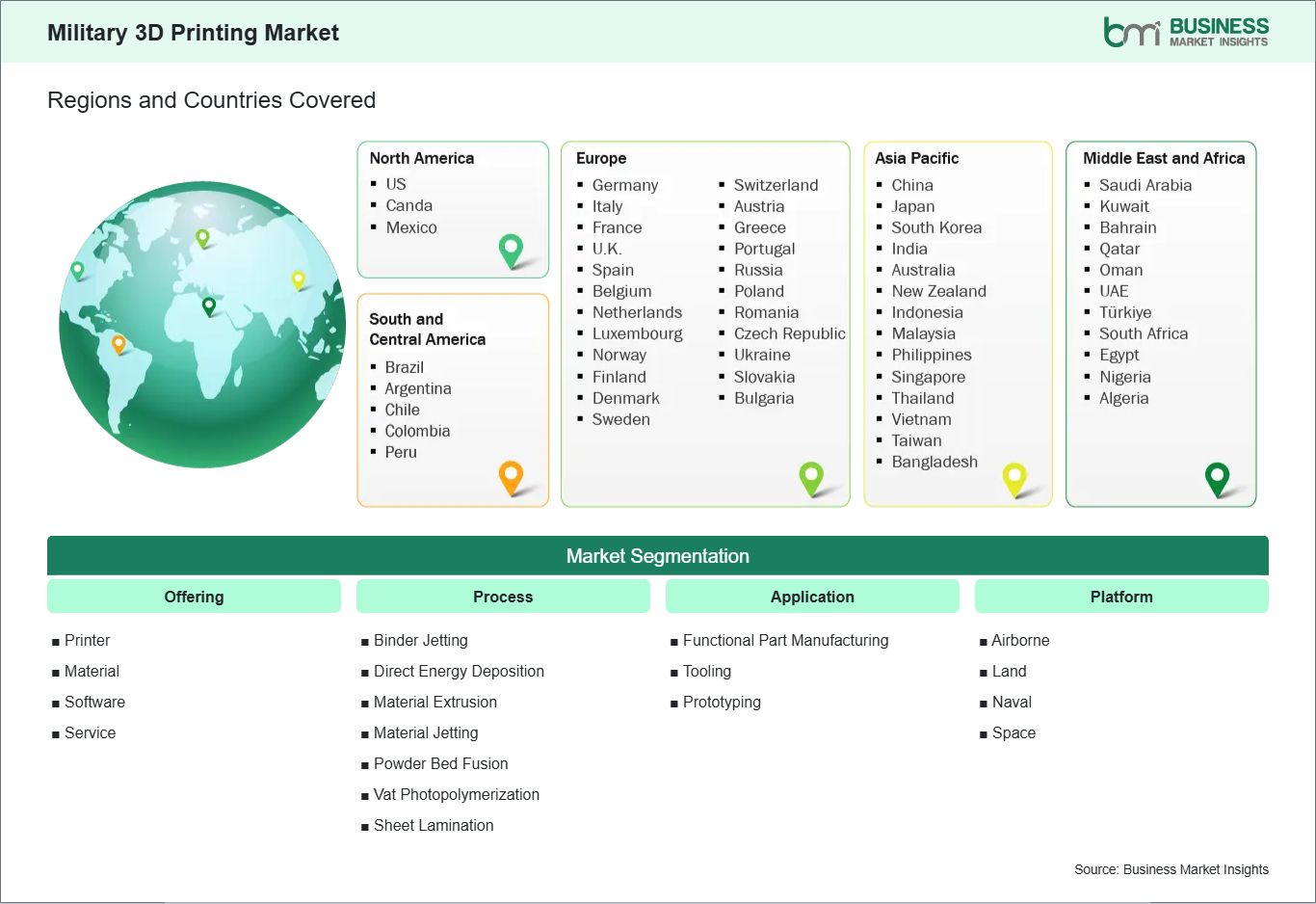
  • Offering (Printer, Material, Software, Service)
  • Process (Binder Jetting, Direct Energy Deposition, Material Extrusion, Material Jetting, Powder Bed Fusion, Vat Photopolymerization, Sheet Lamination)
  • Application (Functional Part Manufacturing, Tooling, Prototyping)
  • Platform (Airborne, Land, Naval, Space)

No. of Pages: 422
Report Code: BMIPUB00034077
Category: Chemicals and Materials
Military 3D Printing Market

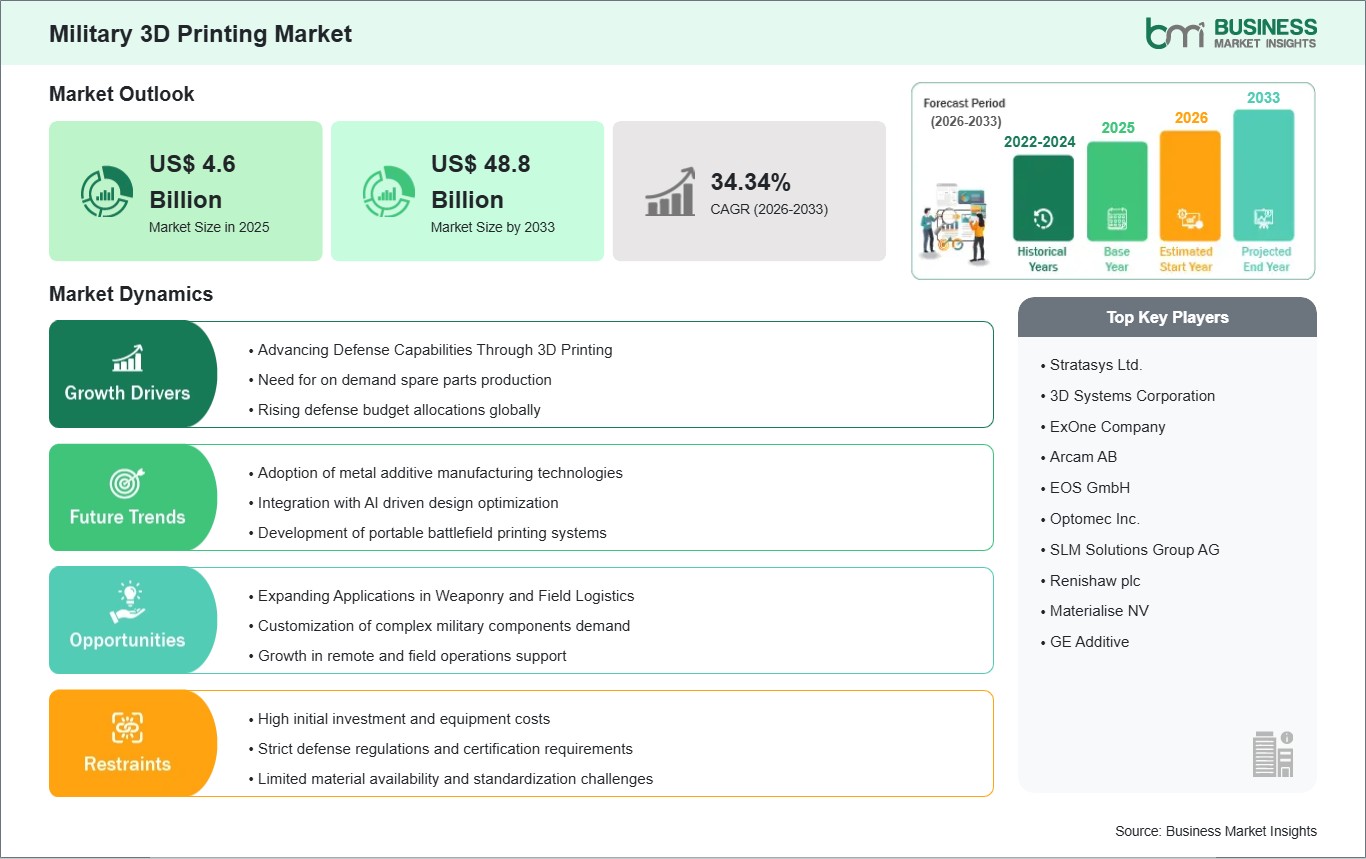
The Military 3D Printing Market size is expected to reach US$ 48.8 Billion by 2033 from US$ 4.6 Billion in 2025. The market is estimated to record a CAGR of 34.34% from 2026 to 2033.

Executive Summary and Global Market Analysis:

The military 3D printing is rapidly growing due to the increased use of additive manufacturing (AM) technologies by military organizations to save time, and to improve supply chain robustness. 3D printing offers benefits as an alternative to traditional prototyping, as well as on-demand production of spare parts, and the production of complex, lightweight components for military aircraft, ships, ground vehicles and unmanned systems helping to increase operational readiness. The scope of materials used in metal-, polymer-, and composite-based 3D printing is expanding due to new material developments resulting in greater capabilities, such as producing components with high strength, heat resistance, and multiple functions with shorter lead times.

The growth of 3D printing technology is also helped by the transformation of how military organizations acquire goods; through using distributed manufacturing, the reduction of logistical constraints and enabling the delivery of critical equipment needed in remote locations or environments. The combination of 3D printing along with simulation, AI-based design optimization, and cyber-security protocols enables the production of custom-designed and mission-specific items. There are however, several challenges impeding the widespread adoption of AM in the military, including regulations for approval, dangers of the unknown through no standardization of materials, concerns regarding intellectual property, and high upfront capital investment. The major participants in the military 3D printing market are forming strategic partnerships with military organizations, commercial aerospace manufacturers, and technology companies developing a strong portfolio of materials and providing the capability to support end-to-end processes from design through production.

Military 3D Printing Market - Strategic Insights:

global-market-strategic-framework
Get more information on this report

Military 3D Printing Market Segmentation Analysis:

Key segments that contributed to the derivation of the military 3D printing market analysis are offering, process, application, and platform.

  • Offering, the military 3D printing market is segmented into printer, material, software, and service. The printer segment dominated the market in 2025.
  • Process, the military 3D printing market is classified into binder jetting, direct energy deposition, material extrusion, material jetting, powder bed fusion, vat photopolymerization, and sheet lamination. The powder bed fusion segment dominated the market in 2025.
  • Application, the military 3D printing market is classified into functional part manufacturing, tooling, and prototyping. The functional part manufacturing segment dominated the market in 2025.
  • Platform, the military 3D printing market is segmented into airborne, land, naval, and space. The land platform segment dominated the market in 2025.

Military 3D Printing Market Drivers and Opportunities:

Advancing Defense Capabilities Through 3D Printing

The military sector is increasingly using 3D printing technology to improve efficiency in their operations, cut costs, and speed up production of their equipment. This technology is helpful in responding to changing needs in a quick and efficient manner, unlike traditional manufacturing processes that involve a longer supply chain and longer production times, where 3D printing technology makes it possible to manufacture parts closer to where they are needed.

3D printing technology offers a unique opportunity to make parts that are light, strong, and resistant to wear and tear, and this is crucial in the manufacturing of military vehicles, aircraft, and ships, where such materials are needed to improve their efficiency and reduce their weight, fuel, and maintenance costs. This technology is also useful in designing new parts, where engineers can make parts with unique geometries that cannot be made with traditional manufacturing processes.

Beyond prototyping, 3D printing enables cost-effective production of spare parts, reducing reliance on inventory storage and lowering logistical burdens. Military organizations can produce components on-site during operations, which minimizes downtime and enhances operational sustainability. As defense forces prioritize modernization and efficiency, the adoption of 3D printing is expected to expand across multiple applications, from armored vehicles and drones to weapons systems. The technology`s combination of speed, customization, and material efficiency positions it as a transformative tool in the modernization of military manufacturing processes and strategic defense planning.

Expanding Applications in Weaponry and Field Logistics

3D printing technology has revolutionized the way military forces think about weapons and operations. With this technology, the military can produce complex weapon parts, ammunition, and equipment that are specific to their needs. This has reduced their reliance on external sources and has shortened their supply lines.

3D printing has also enabled the military to produce weapons and equipment in remote bases. This has allowed them to replace damaged equipment with new ones in a matter of time. The military can also produce lightweight equipment that is durable and meets their needs. This has improved their mobility in the field. Additionally, the technology has enabled the military to produce customized tools and accessories. This has allowed them to adapt to different tactical situations.

In addition to weaponry, the technology is being integrated into field logistics and maintenance operations, where spare parts and specialized equipment can be manufactured in real time. This approach reduces the need for extensive inventory and transport, which is particularly valuable in remote or resource-constrained locations. With ongoing innovations in materials, software, and printing technology, 3D printing is becoming an essential element of military modernization. Its ability to deliver rapid, cost-effective, and highly adaptable manufacturing solutions ensures that it will continue to expand across defense applications worldwide.

Military 3D Printing Market Size and Share Analysis:

The military 3D printing market demonstrates steady growth, with size and share analysis highlighting evolving trends and competitive dynamics among key players. The report examines subsegments categorized within offering, process, application, and platform, offering insights into their contribution to overall market performance.

By Offering, the printer subsegment dominated the market in 2025, driven by increasing adoption of 3D printing for operational efficiency and rapid part replacement.

Based on Process, the powder bed fusion subsegment dominated the market in 2025, supported by its precision, material versatility, and widespread use in defense applications.

Based on Application, the functional part manufacturing subsegment dominated the market in 2025, fueled by demand for lightweight, high-strength components for military operations.

Based on Platform, the land subsegment dominated the market in 2025, due to high adoption of 3D printing in ground vehicles and equipment maintenance.

Military 3D Printing Market Report Highlights:

Report Attribute Details
Market size in 2025 US$ 4.6 Billion
Market Size by 2033 US$ 48.8 Billion
Global CAGR (2026 - 2033)34.34%
Historical Data 2022-2024
Forecast period 2026-2033
Segments Covered By Offering
  • Printer
  • Material
  • Software
  • Service
By Process
  • Binder Jetting
  • Direct Energy Deposition
  • Material Extrusion
  • Material Jetting
  • Powder Bed Fusion
  • Vat Photopolymerization
  • Sheet Lamination
By Application
  • Functional Part Manufacturing
  • Tooling
  • Prototyping
By Platform
  • Airborne
  • Land
  • Naval
  • Space
Regions and Countries Covered
North America US, Canada, Mexico
Europe Belgium, Austria, Finland, Denmark, Greece, Poland, Romania, Russia, Ukraine, Czech Republic, Slovakia, Bulgaria, Italy, Luxembourg, Germany, Switzerland, France, Netherlands, Norway, Portugal, Spain, Sweden, United Kingdom
Asia-Pacific Australia, China, India, Japan, South Korea, Indonesia, Malaysia, Philippines, Singapore, Thailand, Vietnam, Bangladesh, New Zealand, Taiwan
South and Central America Brazil, Argentina, Peru, Chile, Colombia
Middle East and Africa Bahrain, Kuwait, Oman, Qatar, Saudi Arabia, United Arab Emirates, Turkiye, South Africa, Egypt, Algeria, Nigeria
Market leaders and key company profiles
  • Stratasys Ltd.
  • 3D Systems Corporation
  • ExOne Company
  • Arcam AB
  • EOS GmbH
  • Optomec Inc.
  • SLM Solutions Group AG
  • Renishaw plc
  • Materialise NV
  • GE Additive
Get more information on this report

Military 3D Printing Market Report Coverage and Deliverables:

The "Military 3D Printing Market Size and Forecast (2022 - 2033)" report provides a detailed analysis of the market covering below areas:

  • Military 3D Printing Market size and forecast at global, regional, and country levels for all the key market segments covered under the scope
  • Military 3D Printing Market trends, as well as drivers, restraints, and opportunities
  • Military 3D Printing Market analysis covering key trends, global and regional framework, major players, regulations, and recent developments
  • Industry landscape and competition analysis covering market concentration, heat map analysis, prominent players, and recent developments for the Military 3D Printing Market
  • Detailed company profiles, including SWOT analysis

Military 3D Printing Market Geographic Insights:

The geographical scope of the Military 3D Printing Market report is divided into North America, Asia Pacific, Europe, Middle East & Africa, and South & Central America. North America held the largest share in 2025.

Regional-level dynamics in the military 3D printing market reveal varied growth influenced by defense budgets, technological adoption, and modernization priorities. North America dominates the market, supported by substantial defense expenditure, advanced R&D infrastructure, and the early adoption of 3D printing in aerospace, naval, and land systems. The United States leads in deploying metal and polymer 3D printing for mission-critical applications and spare parts logistics.

Europe demonstrates steady growth, driven by defense modernization programs, cross-border collaborative projects, and demand for lightweight, high-performance components in the UK, Germany, and France. The region emphasizes compliance with stringent material and operational standards.

Asia Pacific is the fastest-growing region due to increasing defense spending, growing indigenous defense manufacturing capabilities, and adoption of additive manufacturing in countries like China, India, and Japan. Efforts to localize supply chains and develop high-strength printing materials further boost growth.

Middle East & Africa shows moderate growth, driven by modernization of military equipment, investments in defense infrastructure, and adoption of lightweight and rapid-production solutions for operational efficiency.

South & Central America is an emerging region, with gradual uptake in defense research and limited deployment in naval and land applications, constrained by budget limitations and technological infrastructure.

Across all regions, growth is shaped by rising defense modernization programs, adoption of cutting-edge materials, and demand for rapid, flexible manufacturing solutions.

global-market-geography
Get more information on this report

Military 3D Printing Market Research Report Guidance:

  • The report includes qualitative and quantitative data in the Military 3D Printing Market across offering, process, application, platform, and geography.
  • The report starts with the key takeaways (chapter 2), highlighting key trends and outlook of the Military 3D Printing Market.
  • Chapter 3 focuses on the research methodology of the study.
  • Chapter 4 includes ecosystem analysis.
  • Chapter 5 highlights the major industry dynamics in the Military 3D Printing Market, including factors that are driving the market, prevailing deterrents, potential opportunities, as well as future trends. Impact analysis of these drivers and restraints is also covered in this section.
  • Chapter 6 discusses the Military 3D Printing Market scenario, in terms of historical market revenues, and forecast till the year 2033.
  • Chapters 7 to 11 cover Military 3D Printing Market segments across offering, process, application, platform, and geography across North America, Asia Pacific, Europe, the Middle East & Africa, and South & Central America. They cover the market revenue forecast and factors driving the market.
  • Chapter 12 describes the competitive analysis along with the heat map analysis for the key players operating in the market.
  • Chapter 13 describes the industry landscape analysis. It provides detailed descriptions of business activities such as market initiatives, new developments, mergers, and joint ventures globally, along with a competitive landscape.
  • Chapter 14 provides detailed profiles of the major companies operating in the Military 3D Printing Market. Companies have been profiled on the basis of their key facts, business descriptions, products, financial overview, SWOT analysis, and key developments.
  • Chapter 15, i.e., the appendix, is inclusive of a brief overview of the company, a list of abbreviations, and a disclaimer.

Military 3D Printing Market News and Key Development:

The Military 3D Printing Market is evaluated by gathering qualitative and quantitative data post primary and secondary research, which includes important corporate publications, association data, and databases. A few of the key developments in the military 3D printing market are:

  • In September 2025, UltiMaker B.V. announced that it had launched its Secure Line defense‑grade 3D printer series — the UltiMaker S6 Secure and UltiMaker S8 Secure specifically designed for secure, on‑demand additive manufacturing in high‑security and military environments, with features like air‑gapped USB workflows, encrypted file handling, and rugged hardware to support decentralized production across land, sea, and air operations.
  • In August 2024, Supernova Industries Corp announced that it had launched Supernova Defense & Space, a dedicated business unit focused on deploying its Viscous Lithography Manufacturing (VLM) technology to 3D print military‑grade energetic materials (e.g., components for solid rocket motors) for defense and hypersonic applications, marking a strategic expansion into defense additive manufacturing.

Key Sources Referred:

  • International Organization for Standardization (ISO)
  • American Society for Testing and Materials (ASTM International)
  • Bureau of Indian Standards (BIS)
  • Environmental Protection Agency (EPA), USA
  • European Chemicals Agency (ECHA)
  • Central Pollution Control Board (CPCB), India
  • Ministry of Chemicals and Fertilizers, India
  • American Chemistry Council (ACC)
  • Indian Chemical Council (ICC)
  • European Chemical Industry Council (Cefic)
  • Specialty Chemical Association of India (SCAI)
  • Company Websites
  • Company Annual Reports
  • Company Investor Presentations
The List of Companies - Military 3D Printing Market
  • Stratasys Ltd.
  • 3D Systems Corporation
  • ExOne Company
  • Arcam AB
  • EOS GmbH
  • Optomec Inc.
  • SLM Solutions Group AG
  • Renishaw plc
  • Materialise NV
  • GE Additive
Frequently Asked Questions
How big is the Military 3D Printing Market?

The Military 3D Printing Market is valued at US$ 4.6 Billion in 2025, it is projected to reach US$ 48.8 Billion by 2033.

What is the CAGR for Military 3D Printing Market by (2026 - 2033)?

As per our report Military 3D Printing Market, the market size is valued at US$ 4.6 Billion in 2025, projecting it to reach US$ 48.8 Billion by 2033. This translates to a CAGR of approximately 34.34% during the forecast period.

What segments are covered in this report?

The Military 3D Printing Market report typically cover these key segments-

  • Offering (Printer, Material, Software, Service)
  • Process (Binder Jetting, Direct Energy Deposition, Material Extrusion, Material Jetting, Powder Bed Fusion, Vat Photopolymerization, Sheet Lamination)
  • Application (Functional Part Manufacturing, Tooling, Prototyping)
  • Platform (Airborne, Land, Naval, Space)

What is the historic period, base year, and forecast period taken for Military 3D Printing Market?

The historic period, base year, and forecast period can vary slightly depending on the specific market research report. However, for the Military 3D Printing Market report:

  • Historic Period : 2022-2024
  • Base Year : 2025
  • Forecast Period : 2026-2033
  • Who are the major players in Military 3D Printing Market?

    The Military 3D Printing Market is populated by several key players, each contributing to its growth and innovation. Some of the major players include:

  • Stratasys Ltd.
  • 3D Systems Corporation
  • ExOne Company
  • Arcam AB
  • EOS GmbH
  • Optomec Inc.
  • SLM Solutions Group AG
  • Renishaw plc
  • Materialise NV
  • GE Additive
  • Who should buy this report?

    The Military 3D Printing Market report is valuable for diverse stakeholders, including:

    • Investors: Provides insights for investment decisions pertaining to market growth, companies, or industry insights. Helps assess market attractiveness and potential returns.
    • Industry Players: Offers competitive intelligence, market sizing, and trend analysis to inform strategic planning, product development, and sales strategies.
    • Suppliers and Manufacturers: Helps understand market demand for components, materials, and services related to concerned industry.
    • Researchers and Consultants: Provides data and analysis for academic research, consulting projects, and market studies.
    • Financial Institutions: Helps assess risks and opportunities associated with financing or investing in the concerned market.

    Essentially, anyone involved in or considering involvement in the Military 3D Printing Market value chain can benefit from the information contained in a comprehensive market report.

    Available Report Formats

    pdf-format excel-format pptx-format
    Buy Now
    Sales Assistance
    +1 646 791 7070 (US & UK)
    Customization Form

    Please tell us your area of interest
    (Market Segments/ Regions and Countries/ Companies)