
Yeast Extract Market Outlook: Size, Share, Trends, Growth Analysis, Competitive Landscape & Forecast, 2026-2033

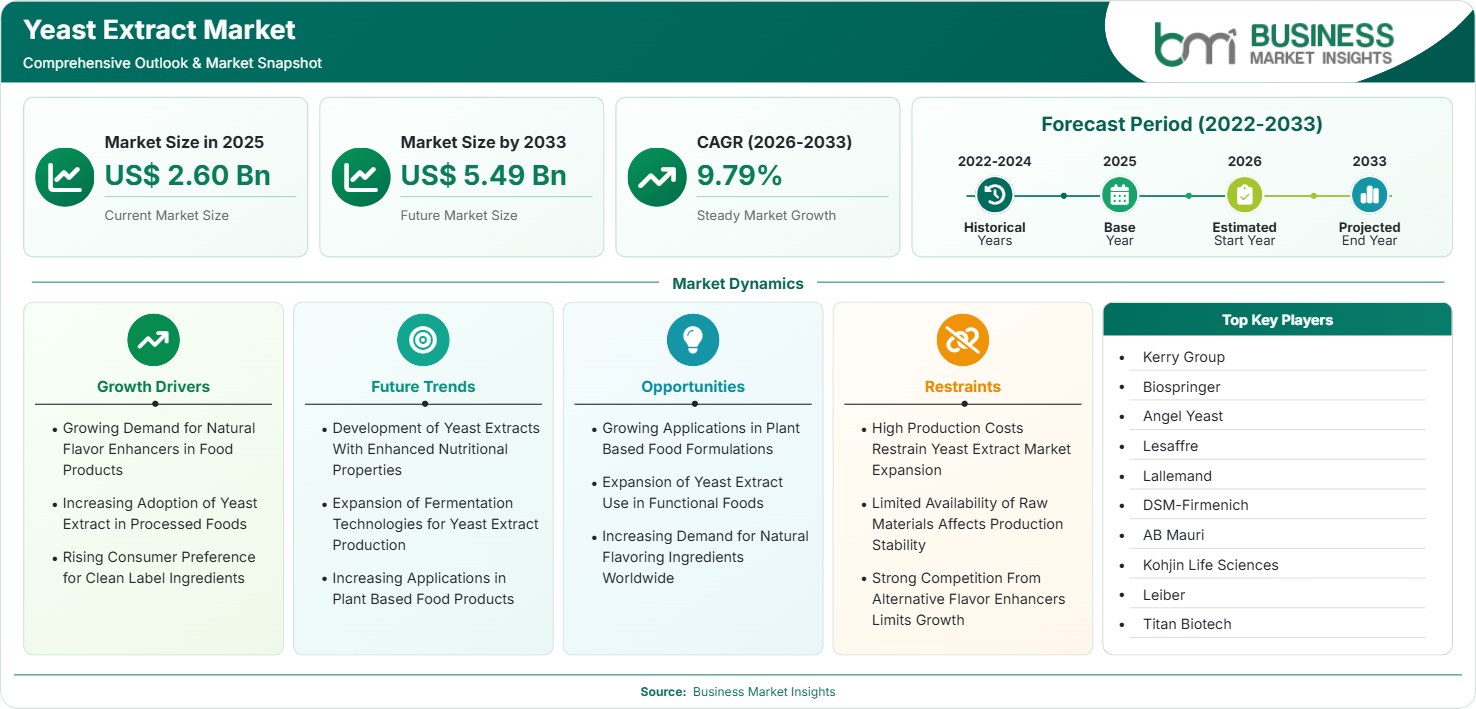
The Yeast Extract Market size was valued at US$ 2.60 billion in 2025 and is projected to reach US$ 5.49 billion by 2033, growing at a CAGR of 9.79% during 2026–2033, driven by demand for natural flavor enhancers, clean-label ingredients, processed foods, plant-based formulations, functional nutrition, and natural savory solutions.

Report Coverage
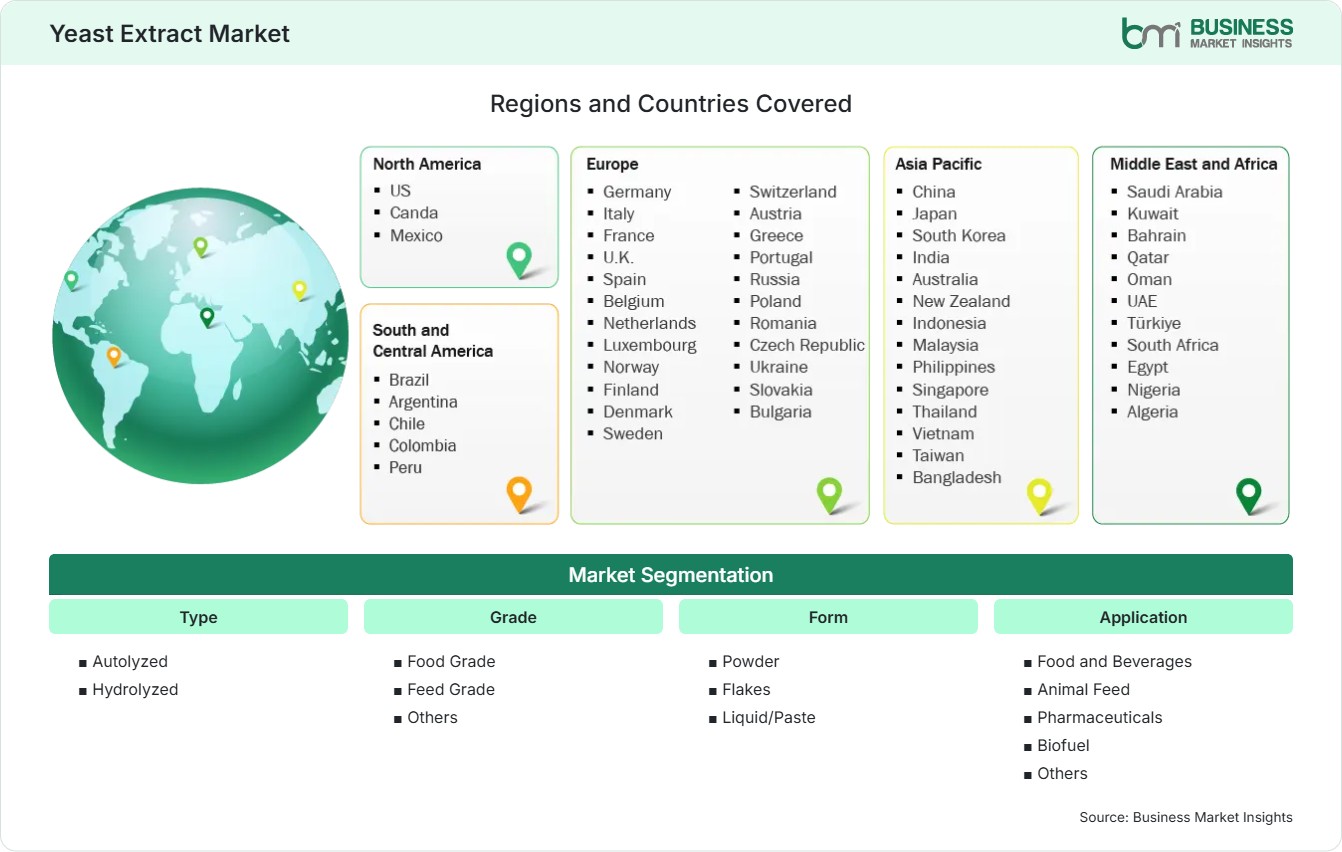
  • Type: Autolyzed, Hydrolyzed
  • Grade: Food Grade, Feed Grade, Others
  • Form: Powder, Flakes, Liquid/Paste
  • Application: Food and Beverages, Animal Feed, Pharmaceuticals, Biofuel, Others
US$ 2.60 Bn Market size in 2025
US$ 5.49 Bn Market Size by 2033
9.79% CAGR, 2026 - 2033
2026-2033 Forecast Period

01 AI Overview

Yeast Extract Market Summary

  • North America Region: North America held an estimated 28%–32% share in 2025 and is projected to grow at a 8.7%–9.1% CAGR, supported by clean-label reformulation, processed food innovation, plant-based products, functional nutrition, and demand for natural savory flavor systems. The U.S. Yeast Extract Market is projected to grow at a 8.8%–9.2% CAGR, driven by food reformulation and consumer demand for recognizable ingredients.
  • Fastest Growing Region: Asia Pacific held an estimated 31%–35% share in 2025 and is projected to grow at a 10.5%–10.9% CAGR, supported by expanding processed food production, rising disposable incomes, growing convenience food consumption, plant-based product development, and increasing adoption of natural flavoring ingredients.
  • Leading Segment: Food and Beverages held an estimated 58%–62% share in 2025 and is projected to grow at a 9.5%–9.9% CAGR, supported by bakery, processed foods, dairy, alcoholic beverages, and savory applications seeking natural flavor enhancement.
  • High Growth Segment: Plant-based food formulations held an estimated 12%–16% share in 2025 and are projected to grow at a 11.0%–11.4% CAGR, driven by demand for umami flavor, nutritional enhancement, clean-label positioning, and improved sensory performance.
  • Key Market Opportunity: Expansion of plant-based and functional food categories creates opportunities for yeast extract suppliers to provide natural umami, nutritional, and clean-label solutions tailored to evolving consumer preferences.
  • Major Market Players: Kerry Group plc, Biospringer, Angel Yeast Co., Ltd., Lesaffre, Lallemand Inc., dsm-firmenich AG, AB Mauri, Kohjin Life Sciences Co., Ltd., Leiber GmbH, Titan Biotech Ltd.
02 Strategic Insights

Yeast Extract Market: Strategic Insights

Yeast Extract Market Strategic Framework
FREE PDF
Request your free sample
Request free sample
03 Stakeholder View

Key Takeaways

  • The value chain is becoming more integrated as suppliers combine fermentation expertise, extraction technology, flavor science, and application support to deliver customized savory and nutritional ingredients.
  • Plant-based foods offer a strong growth avenue because yeast extract can improve umami depth, mask undesirable notes, and strengthen sensory performance without relying exclusively on artificial flavor enhancers.
  • Product innovation is moving toward specialized extracts with targeted flavor profiles, improved solubility, nutritional benefits, and compatibility with clean-label formulation requirements.
  • Asia Pacific offers a compelling investment case because expanding processed food manufacturing, rising convenience consumption, and increasing demand for natural ingredients are creating opportunities for local production and distribution.
  • Strategic investments in fermentation capacity, product development, and specialty ingredient portfolios are likely to intensify competition among global suppliers and regional specialists.
  • Raw material security and production efficiency are becoming important competitive factors as suppliers seek consistent quality while managing fermentation, processing, energy, and logistics costs.
04 Geographic Outlook

Yeast Extract Market Regional Highlights

North America Yeast Extract Market

North America held an estimated 28%–32% share in 2025 and is projected to grow at a 8.7%–9.1% CAGR through 2033. The region benefits from established processed food industries and strong demand for clean-label ingredients. The U.S. represents the dominant Yeast Extract Market, while Canada contributes through growing interest in natural food formulations. Plant-based foods, functional nutrition, and savory snacks continue creating new application opportunities.

  • U.S. food manufacturers are increasingly reformulating processed foods and snacks with natural flavor enhancers that deliver savory depth while supporting cleaner ingredient declarations.
  • Plant-based meat and dairy alternatives are creating demand for yeast extract as manufacturers seek stronger umami profiles and improved sensory performance.
  • Functional food innovation is encouraging suppliers to develop extracts that combine flavor enhancement with nutritional attributes and formulation versatility.
  • Established ingredient distributors and technical service networks support broader adoption by helping manufacturers optimize dosage, flavor balance, and processing performance.

US Yeast Extract Market

The U.S. represented an estimated 25%–29% share in 2025 and is projected to grow at a 8.8%–9.2% CAGR through 2033. Demand is supported by processed foods, plant-based products, savory snacks, and clean-label reformulation. Food manufacturers are increasingly seeking natural alternatives for flavor enhancement, while specialty extracts are gaining attention in functional foods and nutritional formulations.

  • Plant-based food producers are using yeast-derived ingredients to improve savory depth, compensate for flavor limitations, and create more appealing alternatives to conventional animal-based products.
  • Clean-label product development is encouraging manufacturers to replace artificial flavor enhancers with naturally derived ingredients that provide recognizable functionality.
  • Demand for convenient meals and savory snacks is expanding opportunities for yeast extracts in sauces, seasonings, soups, and ready-to-eat products.
  • Technical collaboration between ingredient suppliers and food manufacturers is supporting customized flavor development and improved formulation efficiency.

Europe Yeast Extract Market

Europe held an estimated 25%–29% share in 2025 and is projected to grow at a 8.9%–9.3% CAGR through 2033. Germany, France, the UK, and Italy are leading Yeast Extract Markets supported by mature food processing industries. Germany is projected to grow at a 9.0%–9.4% CAGR, while France benefits from strong demand for natural ingredients and growing plant-based food innovation.

  • Germany's large processed food industry supports yeast extract adoption across savory foods, bakery products, sauces, soups, and convenience-oriented formulations.
  • France benefits from increasing demand for natural and clean-label ingredients, with yeast extracts supporting flavor development across premium and specialty food categories.
  • The UK provides opportunities through expanding plant-based and reduced-additive food categories where manufacturers seek effective natural flavor enhancement.
  • European ingredient suppliers are strengthening traceability and sustainability practices to meet increasingly demanding food manufacturer procurement requirements.

Asia Pacific Yeast Extract Market

Asia Pacific represented an estimated 31%–35% Yeast Extract Market share in 2025 and is projected to grow at a 10.5%–10.9% CAGR through 2033. China, Japan, India, and South Korea are important markets, with India projected to grow at a 11.2%–11.6% CAGR. Expanding food processing, rising urbanization, and increasing consumption of convenience products support regional demand.

  • China offers significant potential through its large processed food industry and expanding applications of natural flavor enhancers in convenience and packaged foods.
  • India is experiencing increased demand for natural ingredients as food manufacturers expand processed, plant-based, and functional product portfolios for urban consumers.
  • Japan's sophisticated food industry supports specialized yeast extract applications where manufacturers prioritize precise flavor profiles, nutritional functionality, and high formulation consistency.
  • South Korea's convenience food and plant-based product development is creating opportunities for yeast extracts in savory meals, snacks, sauces, and functional formulations.

Rest of World Yeast Extract Market

South and Central America accounted for an estimated 7%–9% share in 2025 and are projected to grow at a 9.2%–9.6% CAGR through 2033. Brazil and Mexico lead regional opportunities. The Middle East and Africa represented an estimated 5%–7% share and are projected to grow at a 8.8%–9.2% CAGR, supported by food processing expansion and demand for natural ingredients.

  • Brazil offers opportunities through its large processed food industry, where manufacturers increasingly seek natural flavor enhancers for savory products, snacks, and convenience foods.
  • Mexico's expanding packaged food sector is supporting demand for yeast-derived flavoring solutions across sauces, seasonings, processed foods, and ready-to-eat meals.
  • The UAE is emerging as an important food processing and distribution hub, creating opportunities for specialty natural ingredients across premium and functional food applications.
  • Saudi Arabia's expanding food manufacturing capabilities and changing consumer preferences are supporting demand for natural flavor systems in convenience and processed food products.
Global Market Geography
FREE PDF
Request your free sample
Request free sample
05 Segment Analysis

Yeast Extract Market Segmentation

Type

Autolyzed yeast extract held an estimated 54%–58% share in 2025 and is projected to grow at a 9.4%–9.8% CAGR between 2026–2034. Its broad flavor profile supports extensive food applications, while hydrolyzed extracts offer opportunities for targeted flavor intensity and functional formulations. Growing demand for natural savory ingredients is supporting innovation across both product categories.

  • Autolyzed: Autolyzed yeast extracts deliver rich savory flavors through controlled cellular breakdown, supporting applications in soups, sauces, snacks, seasonings, bakery products, and processed foods.
  • Hydrolyzed: Hydrolyzed yeast extracts provide targeted flavor compounds and strong umami characteristics, supporting specialized formulations requiring enhanced taste intensity and consistent processing performance.

Grade

Food Grade held an estimated 68%–72% share in 2025 and is projected to grow at a 9.7%–10.1% CAGR between 2026–2034. Demand is supported by processed foods, bakery, dairy, beverages, and plant-based formulations. Feed Grade benefits from nutritional applications, while other grades serve specialized industrial and formulation requirements.

  • Food Grade: Food-grade extracts support savory flavor enhancement and clean-label formulations across processed foods, bakery, dairy, beverages, snacks, and plant-based products.
  • Feed Grade: Feed-grade yeast extracts provide nutritional and functional benefits in animal nutrition, supporting palatability, gut health strategies, and formulation improvements for livestock and aquaculture.
  • Others: Other grades address specialized applications requiring specific technical or nutritional properties, creating opportunities across industrial biotechnology, research, and emerging formulation categories.

Form

Powder held an estimated 52%–56% share in 2025 and is projected to grow at a 9.5%–9.9% CAGR between 2026–2034. Powder offers handling, storage, transportation, and dosing advantages. Flakes provide differentiated processing characteristics, while liquid and paste forms support applications requiring rapid incorporation and direct integration into sauces, marinades, and liquid food systems.

  • Powder: Powdered yeast extract offers convenient storage, transport, and dosing, supporting dry seasoning blends, soups, snacks, bakery products, and processed food applications. a
  • Flakes: Flake formats provide distinct handling characteristics and are suitable for manufacturers seeking convenient incorporation into selected food formulations and seasoning systems.
  • Liquid/Paste: Liquid and paste extracts enable rapid incorporation into wet formulations, supporting sauces, marinades, soups, dressings, and other products requiring direct flavor integration.

Application

Food and Beverages held an estimated 62%–66% share in 2025 and is projected to grow at a 9.8%–10.2% CAGR between 2026–2034. Bakery, alcoholic beverages, dairy, and processed foods remain important applications. Animal feed, pharmaceuticals, and biofuel provide diversification opportunities as manufacturers explore nutritional, fermentation, and biotechnology-related uses.

  • Food and Beverages: Food and beverage applications represent the core demand base, with yeast extracts supporting natural savory flavor, umami enhancement, nutritional positioning, and clean-label reformulation.
    • Bakery: Yeast extracts support savory bakery formulations, seasoning systems, and specialty products where manufacturers seek enhanced flavor complexity and natural ingredient positioning.
    • Alcoholic Beverages: Specialized yeast-derived ingredients can support flavor development and fermentation-related applications, creating opportunities for beverage manufacturers seeking differentiated product characteristics.
    • Dairy Products: Yeast extracts support savory dairy applications and plant-based alternatives, helping manufacturers improve flavor depth and address sensory challenges in reduced-animal-ingredient products.
    • Processed Foods: Processed foods represent a major application area, with extracts used in soups, sauces, snacks, ready meals, seasonings, and convenience products.
    • Others: Other food and beverage applications provide opportunities for customized flavor systems across emerging categories requiring natural savory enhancement and clean-label formulation.
  • Animal Feed: Yeast extracts support animal nutrition applications through palatability and functional benefits, creating opportunities as feed manufacturers seek specialized nutritional ingredients and alternatives.
  • Pharmaceuticals: Pharmaceutical applications use yeast-derived ingredients in specialized nutritional and biotechnology-related formulations, supported by ongoing research into functional and fermentation-derived compounds.
  • Biofuel: Biofuel applications offer emerging opportunities for yeast-derived technologies and fermentation expertise as biotechnology companies explore more efficient renewable fuel production pathways.
  • Others: Other applications include specialized biotechnology and industrial uses where yeast-derived compounds provide nutritional, functional, or processing advantages.
06 Market Forces

Yeast Extract Market Dynamics

Key Market Drivers

Growing Demand for Natural Flavor Enhancers in Food Products

The current trends among consumers involve looking for foods whose ingredients have easily identifiable components, prompting food manufacturers to find ways of using fewer artificial flavor enhancers and creating more natural solutions. Yeast extract has the capacity to provide a savory and umami taste and is versatile when incorporated into different types of foods, including processed foods, snacks, sauces, soups, and ready meals. The Yeast Extract Market growth is being boosted by this trend, as food manufacturers increasingly seek to enhance flavor without complicating the formulation process. There are also increased developments involving specialty extracts for particular tastes.

Increasing Adoption of Yeast Extract in Processed Foods

With the development of processed and convenient foods, yeast extracts have found an increasingly wider scope of applications. Ready meals, sauces, soups, flavors, snacks, and savory foods need components that will guarantee the same taste when produced in large volumes. Yeast extracts offer flexibility to flavor formulations and are easy to integrate into various products. With urbanization and changes in consumer lifestyles, there has been increased consumption of convenient foods, especially in developing countries. In addition, manufacturers are looking into yeast extracts as a way of providing complex taste formulation to reformulated products that have less salt content or lack artificial additives.

Rising Consumer Preference for Clean Label Ingredients

Preferences for clean-label foods are driving purchases and are motivating food manufacturers to look at their lists of ingredients. Increasingly, consumers demand products that are considered natural, identifiable, and minimally processed, thus allowing the use of ingredients derived from yeast in their products. This Yeast Extract Market trend is closely related to this tendency, as yeast extract can contribute to savory functionalities while maintaining its status as a natural ingredient. Manufacturers are looking for ways to improve the sensory profile of these extracts so they can be used as replacements for conventional flavors.

Key Market Opportunities

Growing Applications in Plant Based Food Formulations

Plant-based food companies continue to struggle to provide satisfying savory options and to eliminate unwanted flavors associated with certain plant proteins. Yeast extracts have the potential to create umami depth, add complexity to flavors, and develop better sensory profiles. There is a market potential for yeast extracts in plant-based meats, plant-based dairy products, ready meals, dressings, and snacking products. Value creation for suppliers lies in their ability to formulate yeast extracts according to different plant proteins and production processes. However, there is potential to go beyond simply adding flavors by leveraging the nutritional positioning of yeast ingredients.

Expansion of Yeast Extract Use in Functional Foods

There are several options for yeast extracts, as consumers look for products that provide both taste and added nutritional or wellness benefits. Ingredients from yeast can add nutritional value and also enhance the flavor of foods. As such, yeast-based ingredients can be used in products that fall within the categories of fortified foods, nutritionals, and functional products. There is an opportunity to create unique products by combining yeast extracts with other components such as proteins, fiber, vitamins, minerals, or botanical ingredients. This is especially true for convenient products like bars, beverages, and meals.

Increasing Demand for Natural Flavoring Ingredients Worldwide

The trend towards using natural ingredients in flavoring is creating opportunities for companies manufacturing yeast extract in both developed and developing markets for food consumption. These companies are looking for ways of providing products that will give good taste performance while enabling them to market their products as natural. This has presented an opportunity for them to increase production capacity, manufacture products tailored to meet specific applications, and enhance distribution within different regions. The Yeast Extract Market forecast remains favorable due to growth in demand for savory solutions with natural labels.

Market Restraints and Challenges

High Production Costs Restrain Yeast Extract Market Expansion

Factor: Yeast extract production requires controlled fermentation, specialized processing, energy, quality management, and downstream purification capabilities that can increase manufacturing expenses. Impact: Production costs could increase due to raw material costs and affect usage by food manufacturers concerned about cost sensitivity, especially when a cheaper alternative for flavoring is available. There is also a reduction in costs by suppliers as a result of improving processes and fermentation techniques. Nevertheless, such situations may be further worsened by increases in energy, labor, transport, and processing costs. There is thus a need for firms to balance product quality with competitiveness in terms of price.

Limited Availability of Raw Materials Affects Production Stability

Factor: Yeast extract production depends on reliable access to suitable yeast biomass and other raw materials, making supply availability an important consideration for manufacturers. Impact: Fluctuations in the supply of raw materials may affect production, costs, storage of products, and the reliability of customers. Sourcing raw materials from suppliers with diverse distribution channels and strong ties to the fermentation industry helps mitigate the risk of local shortages. Strategic purchase and planning of productions may also be employed. Nonetheless, agricultural inputs, fermentation in industry, and logistics may still pose challenges to the supply of raw materials. Consistent quality of raw materials is equally vital, as it influences extract quality.

07 Company Analysis

Competitive Landscape

The competitive environment includes global food ingredient suppliers, specialized yeast producers, fermentation companies, and biotechnology-oriented manufacturers. The Yeast Extract Market analysis indicates that competitive differentiation increasingly depends on product consistency, flavor performance, clean-label credentials, fermentation capabilities, application expertise, and the ability to develop customized solutions for plant-based and functional food manufacturers.

Company Name

Overview

Products and Services relevant to this market

Kerry Group plc

Global taste and nutrition company serving food, beverage, and nutrition manufacturers worldwide.

Yeast extracts, savory flavor systems, taste modulation, clean-label solutions, and application support.

Biospringer

Specialized yeast ingredient business focused on natural flavor and nutritional solutions.

Yeast extracts, savory ingredients, umami solutions, nutritional yeast products, and formulation expertise.

Angel Yeast Co., Ltd.

Global yeast biotechnology company with broad fermentation and food ingredient capabilities.

Yeast extracts, nutritional yeast ingredients, fermentation products, and functional food solutions.

Lesaffre

International fermentation company with extensive expertise in yeast and biotechnology applications.

Yeast extracts, nutritional ingredients, fermentation technologies, and food formulation solutions.

Lallemand Inc.

Global biotechnology company specializing in yeast, bacteria, and fermentation-derived ingredients.

Yeast extracts, specialty yeast products, fermentation solutions, and nutritional applications.

dsm-firmenich AG

Global nutrition, health, and bioscience company serving food and ingredient markets.

Nutritional ingredients, fermentation technologies, taste solutions, and specialty food applications.

AB Mauri

Global yeast and bakery ingredient supplier with extensive fermentation expertise.

Yeast extracts, bakery yeast, fermentation ingredients, and food processing solutions.

Kohjin Life Sciences Co., Ltd.

Japanese specialty ingredient company focused on functional and nutritional food ingredients.

Yeast-derived ingredients, nutritional solutions, specialty food ingredients, and formulation support.

Leiber GmbH

Yeast specialist producing ingredients for food, feed, and biotechnology applications.

Yeast extracts, nutritional yeast products, feed ingredients, and specialty fermentation solutions.

Titan Biotech Ltd.

Biotechnology company supplying yeast-derived and specialty ingredients across multiple industries.

Yeast extracts, nutritional ingredients, fermentation products, and specialty biotechnology solutions.

10 Trust & Transparency

Research Methodology

The market analysis combines proprietary research with secondary data from government agencies, company disclosures, regulatory filings, industry databases and expert interviews. Market estimates are validated through data triangulation, cross-market benchmarking and analyst review.

View Full Research Methodology

11 Questions Answered

Frequently Asked Questions

What factors could affect future market expansion?

Production costs, raw material availability, energy prices, and supply chain stability may influence expansion. Suppliers with diversified sourcing, efficient fermentation systems, and specialized product portfolios can reduce operational exposure.

How does fermentation technology influence the Yeast Extract Market?

Fermentation expertise affects yield, consistency, flavor characteristics, nutritional composition, and production efficiency. Advances in fermentation and downstream processing can help suppliers develop specialized extracts and improve manufacturing economics.

Which product form is widely used?

Powdered yeast extract is widely used because it offers convenient handling, storage, transportation, and dosing. Liquid and paste formats remain relevant for sauces, marinades, soups, and other wet formulations.

Why are plant-based foods an important application?

Plant-based products often require stronger flavor systems to improve sensory acceptance. Yeast extracts can provide umami depth and help mask undesirable notes, making them useful in plant-based meat, dairy alternatives, sauces, and prepared foods.

What is driving demand for yeast extract products?

The Yeast Extract Market report identifies clean-label demand, natural flavor enhancement, processed food expansion, plant-based product development, and consumer preference for savory and umami-rich foods as important growth factors.

Access the Full Yeast Extract Market Report

Get segment-level forecasts, regional estimates, competitive benchmarking, company profiles and downloadable Excel datasets.

Access the full Yeast Extract Market Report
350 pages PDF & Excel | 2026-08-04