
Whiskey Market Outlook: Size, Share, Trends, Growth Analysis, Competitive Landscape & Forecast, 2026-2033

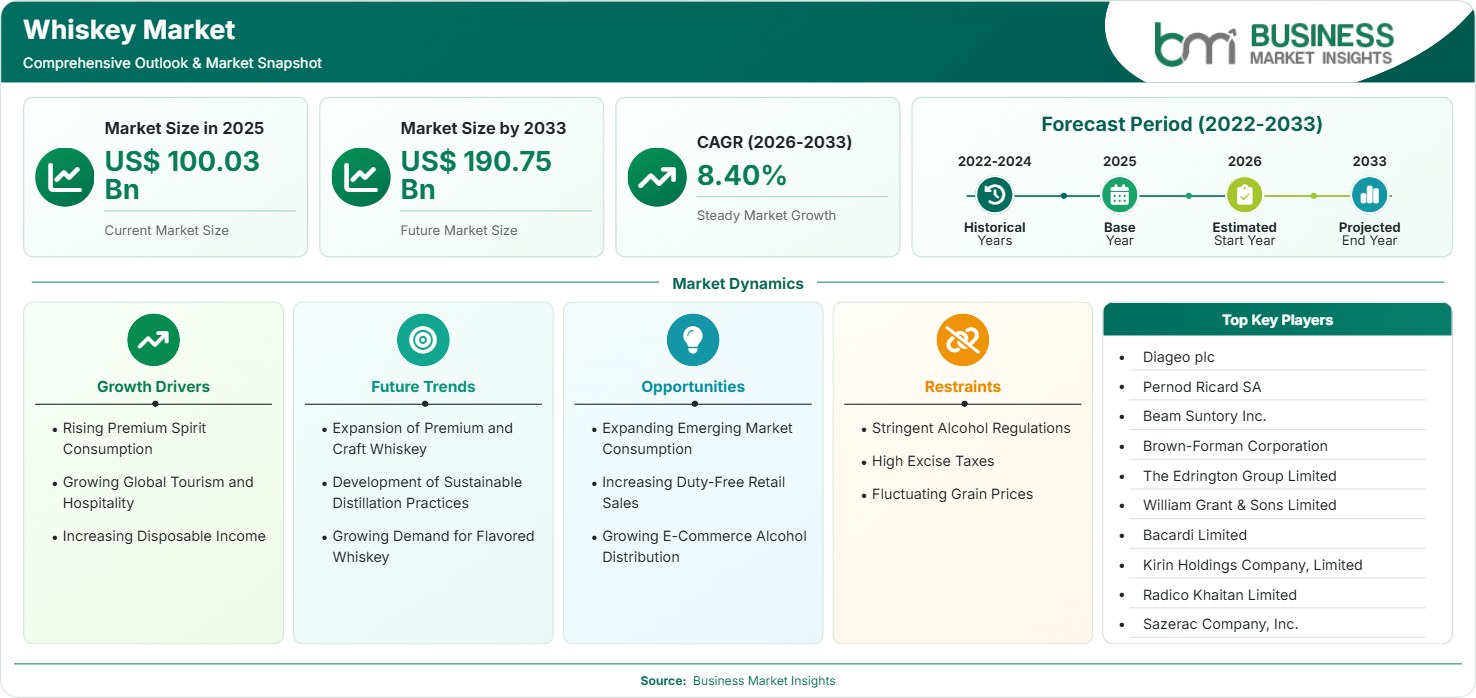
The Whiskey Market size was valued at US$ 100.03 Billion in 2025 and is projected to reach US$ 190.75 Billion by 2033, growing at a CAGR of 8.40% during 2026–2033. Rising premium spirit consumption, expanding tourism, increasing disposable income, and innovation in premium offerings are creating new opportunities for global distillers and distribution networks.

Report Coverage
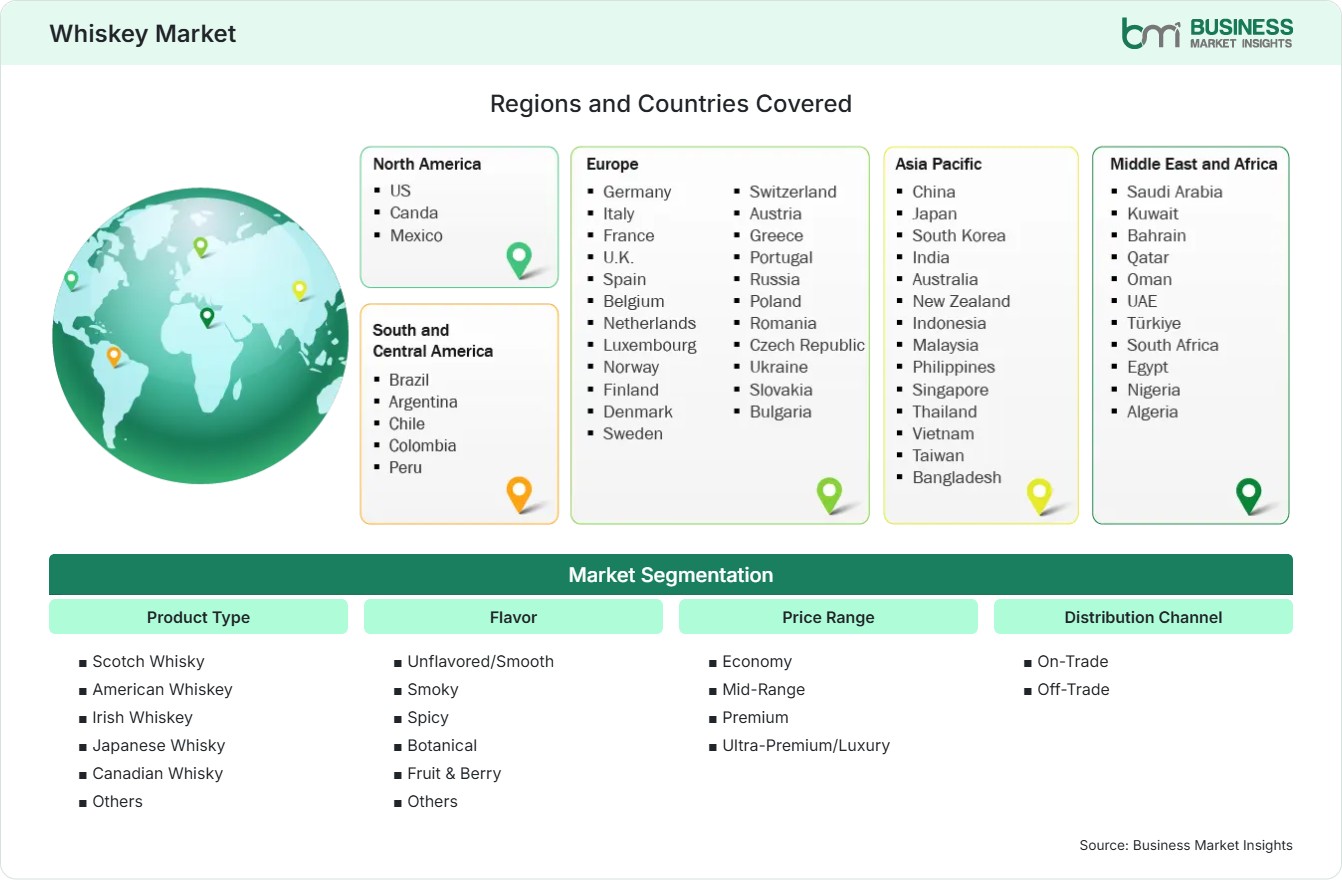
  • Product Type: Scotch Whisky, American Whiskey, Irish Whiskey, Japanese Whisky, Canadian Whisky, Others
  • Flavor: Unflavored/Smooth, Smoky, Spicy, Botanical, Fruit & Berry, Others
  • Price Range: Economy, Mid-Range, Premium, Ultra-Premium/Luxury
  • Distribution Channel: On-Trade, Off-Trade
US$ 100.03 Bn Market size in 2025
US$ 190.75 Bn Market Size by 2033
8.40% CAGR, 2026 - 2033
2026-2033 Forecast Period

AI Overview

Whiskey Market Summary

  • North America Region: North America holds 35%–38% market share in 2025 and is projected to grow at a 7.6%–8.2% CAGR during 2026–2033. Strong premium whiskey demand, established distilling heritage, expanding tourism, and premium retail channels continue supporting regional leadership. The U.S. remains the largest regional market with a 7.8%–8.3% CAGR, driven by premiumization, craft distilling expansion, and sustained consumer demand.
  • Fastest Growing Region: Asia Pacific accounts for 24%–27% market share in 2025 while advancing at a 9.8%–10.5% CAGR through 2033. Rising middle-class income, premium brand preference, expanding hospitality industries, and increasing international whiskey consumption continue accelerating regional demand.
  • Leading Segment: Scotch Whisky represents 37%–41% market share in 2025 and is projected to register a 7.9%–8.5% CAGR during 2026–2033. Strong export demand, premium positioning, geographical indication protection, and global consumer recognition continue supporting segment leadership.
  • High Growth Segment: Ultra-Premium/Luxury accounts for 18%–22% market share in 2025 while expanding at a 10.5%–11.2% CAGR through 2033. Premium gifting trends, limited-edition releases, collector demand, luxury retail expansion, and rising disposable incomes continue supporting accelerated growth.
  • Key Market Opportunity: Premium product innovation, digital retail expansion, experiential tourism, sustainable distillation practices, and growing demand across emerging economies are creating attractive long-term opportunities for producers, distributors, and hospitality operators.
  • Major Market Players: Diageo plc, Pernod Ricard SA, Beam Suntory Inc., Brown-Forman Corporation, The Edrington Group Limited, William Grant & Sons Limited, Bacardi Limited, Kirin Holdings Company, Limited, Radico Khaitan Limited, and Sazerac Company, Inc.
Strategic Insights

Whiskey Market: Strategic Insights

Whiskey Market Strategic Framework
FREE PDF
Request your free sample
Request free sample
Stakeholder View

Key Takeaways

  • The value chain is increasingly integrated as distillers strengthen relationships with grain suppliers, cooperages, distributors, hospitality operators, and premium retailers to improve supply resilience and enhance product quality.
  • Premium and ultra-premium categories present the strongest long-term revenue opportunities because consumers increasingly value aged products, authentic craftsmanship, limited editions, and premium brand experiences.
  • Innovation increasingly focuses on sustainable distillation, cask-finishing techniques, flavor diversification, digital consumer engagement, and premium packaging to strengthen competitive differentiation and brand loyalty.
  • India, China, Southeast Asia, and selected Middle Eastern tourism markets offer attractive expansion opportunities due to rising disposable income, premium hospitality growth, and evolving consumer preferences.
  • Strategic investments continue targeting premium visitor centers, distillery tourism, acquisition of craft brands, and expansion of international distribution networks to improve long-term profitability and global market presence.
Geographic Outlook

Whiskey Market Regional Highlights

North America Whiskey Market

North America accounted for 35%–38% of global revenue in 2025 and is projected to expand at a CAGR of 7.6%–8.2% during 2026–2033. Premiumization, a well-established distilling industry, and strong consumer preference for American whiskey and bourbon continue supporting regional demand. Craft distilleries are expanding production while premium retail and tourism strengthen brand visibility. The Whiskey Market share remains strong due to continuous product innovation and an extensive distribution network.

  • Premium bourbon and Tennessee whiskey continue gaining international recognition, encouraging producers to expand export capacity while strengthening premium brand positioning through aged and limited-edition expressions.
  • Craft distilleries are introducing small-batch products using locally sourced grains, unique barrel finishes, and sustainable production practices to attract younger consumers seeking authentic experiences.
  • Tourism linked to whiskey trails, distillery visits, and premium tasting experiences continues supporting direct-to-consumer sales and strengthening regional brand loyalty.
  • Premium retail chains and specialized liquor stores are expanding curated whiskey portfolios, providing consumers with greater product diversity across domestic and imported brands.

US Whiskey Market

The United States contributes 78%–82% of North American revenue and is forecast to register a CAGR of 7.8%–8.3% through 2033. Rising demand for premium bourbon, expanding craft distilling activity, and growing exports continue supporting market expansion. Consumer interest in premium experiences and innovative cask-aging techniques further strengthens product differentiation across established and emerging whiskey brands.

  • Kentucky remains the leading production hub, supported by established distilling expertise, premium bourbon heritage, and significant tourism activity.
  • Investments in visitor centers and experiential marketing continue strengthening consumer engagement while supporting premium product positioning.
  • Distillers increasingly focus on sustainability through renewable energy adoption, water conservation, and responsible grain sourcing across production facilities.

Europe Whiskey Market

Europe Whiskey Market represented 29%–32% of global revenue in 2025 and is projected to grow at a CAGR of 7.9%–8.5% during the forecast period. Strong heritage brands, geographical indication protection, and premium export demand continue supporting regional leadership. Scotland remains the dominant production center, while Ireland experiences rapid capacity expansion driven by global premium whiskey consumption.

  • Scotland leads regional production through internationally recognized Scotch whisky brands supported by long-established distilling expertise and expanding premium exports.
  • Ireland is among the fastest-growing markets, recording an estimated 8.9%–9.5% CAGR through 2033 due to new distillery investments and growing international demand.
  • Distillers continue investing in sustainable production technologies, energy-efficient operations, and premium visitor experiences to strengthen competitiveness.
  • European producers increasingly introduce limited-edition releases and innovative cask-finishing techniques to attract collectors and premium consumers.

Asia Pacific Whiskey Market

Asia Pacific accounted for 24%–27% of global revenue in 2025 and is expected to register the fastest growth at a CAGR of 9.8%–10.5% during 2026–2033. Rising disposable incomes, premium beverage preferences, expanding hospitality industries, and increasing urbanization continue supporting regional demand. Japan maintains a strong reputation for premium whisky production, while India and China are becoming major consumption markets due to evolving lifestyles and premium brand acceptance.

  • India remains one of the largest consumption markets, supported by rising middle-class incomes, expanding premium retail channels, and increasing demand for premium domestic and imported whiskey.
  • Japan continues strengthening its global reputation through award-winning premium whiskies, limited-edition releases, and continuous investment in quality production standards.
  • China records rapid premium spirit consumption as younger consumers increasingly purchase imported whiskey through luxury retail outlets and digital commerce platforms.
  • Premium hotels, restaurants, bars, and tourism continue expanding across the region, creating sustained demand for high-value whiskey products.

Rest of World Whiskey Market

Rest of World represented 8%–11% of global market revenue in 2025 and is projected to expand at a CAGR of 8.3%–8.9% during 2026–2033. South & Central America benefits from increasing premium spirit consumption, while the Middle East & Africa is witnessing steady growth through hospitality expansion, tourism, and premium retail development.

Growing urban populations, international tourism, and premium lifestyle trends continue improving market prospects. Expanding duty-free retail, luxury hotels, and premium dining experiences further support whiskey sales across several emerging economies.

  • Brazil remains the leading South American market owing to increasing premium spirit consumption and the expansion of organized retail and hospitality sectors.
  • Mexico continues recording healthy demand for imported premium whiskey as premium bars, restaurants, and specialty liquor retailers expand across major cities.
  • United Arab Emirates is among the fastest-growing markets with an estimated 9.1%–9.7% CAGR, supported by luxury tourism, international hospitality brands, and expanding duty-free sales.
  • Investments in premium retail formats and tourism infrastructure continue creating attractive long-term opportunities for international whiskey producers.
Global Market Geography
FREE PDF
Request your free sample
Request free sample
Segment Analysis

Whiskey Market Segmentation

Product Type

Product Type accounted for 37%–41% of total market revenue in 2025 and is projected to register a CAGR of 7.9%–8.5% during 2026–2033. The Whiskey Market scope continues expanding through product innovation, premiumization, geographical indication protection, and increasing consumer preference for authentic regional whiskey styles.

  • Scotch Whisky: Maintains leadership because of strong global brand recognition, premium positioning, protected origin status, and consistent export demand across developed and emerging markets.
  • American Whiskey: Benefits from rising international demand for bourbon and Tennessee whiskey, supported by premiumization, craft distilling, and expanding export opportunities.
  • Irish Whiskey: Continues gaining popularity through smoother flavor profiles, increasing production capacity, and growing international distribution across premium retail channels.
  • Japanese Whisky: Premium craftsmanship, limited production, and international recognition continue supporting strong consumer demand and premium pricing worldwide.
  • Canadian Whisky: Maintains stable demand through versatile flavor profiles, established exports, and increasing interest among premium whiskey consumers.
  • Others: Regional whiskey varieties continue expanding their presence through craft distilling, localized ingredients, and premium branding strategies.

By Flavor

By Flavor represented 26%–30% of market revenue in 2025 and is expected to grow at a CAGR of 8.4%–9.0% during the forecast period. Consumer experimentation, premium product innovation, and diversified taste preferences continue encouraging manufacturers to introduce distinctive flavor profiles across multiple whiskey categories.

  • Unflavored/Smooth: Remains the preferred choice for traditional consumers seeking classic taste profiles, premium quality, and versatile consumption occasions.
  • Smoky: Gains popularity among enthusiasts attracted to peated expressions, distinctive aromas, and premium Scotch whisky experiences.
  • Spicy: Appeals to consumers looking for richer flavor complexity created through rye content, barrel aging, and innovative maturation techniques.
  • Botanical: Emerging niche category combining whiskey with carefully selected botanical notes to attract experimental premium consumers.
  • Fruit & Berry: Growing demand among younger consumers supports innovation in flavored premium whiskey offerings with balanced sweetness and distinctive aromas.
  • Others: Manufacturers continue introducing limited-edition flavor combinations inspired by regional ingredients and evolving consumer preferences.

By Price Range

By Price Range accounted for 29%–33% of total market revenue in 2025 and is projected to expand at a CAGR of 8.6%–9.2% during 2026–2033. Premiumization remains the primary growth catalyst as consumers increasingly seek higher-quality products, aged expressions, collectible releases, and distinctive brand experiences. The Whiskey Market trends increasingly reflect consumer willingness to pay for authenticity, craftsmanship, and limited-edition offerings.

  • Economy: Maintains consistent demand among value-conscious consumers through broad retail availability, competitive pricing, and established domestic brands across emerging and mature markets.
  • Mid-Range: Continues attracting mainstream consumers seeking improved quality, recognizable brands, and balanced pricing suitable for regular consumption and gifting occasions.
  • Premium: Benefits from increasing disposable income, premium gifting trends, hospitality expansion, and consumer preference for aged and craft whiskey products.
  • Ultra-Premium/Luxury: Driven by collectors, affluent consumers, luxury gifting, and exclusive limited-edition releases that strengthen brand prestige and profitability.

By Distribution Channel

Distribution Channel represented 42%–46% of total market revenue in 2025 and is anticipated to register a CAGR of 8.1%–8.7% through 2033. Growth is supported by expanding organized retail, premium hospitality, duty-free shopping, and digital commerce. Both on-trade and off-trade channels continue evolving to meet changing consumer purchasing behavior and premium brand engagement.

  • On-Trade (Bars & Pubs): Continues benefiting from premium cocktail culture, whiskey tasting events, and experiential consumption in urban hospitality venues.
  • On-Trade (Premium Restaurants): Premium dining establishments increasingly offer curated whiskey collections paired with gourmet cuisine to enhance customer experiences and premium beverage sales.
  • On-Trade (Hotels & Resorts): Luxury hotels expand premium whiskey portfolios through exclusive bars, lounges, and tourism-driven beverage programs targeting international travelers.
  • Off-Trade (Liquor Stores): Remains a major sales channel through specialized product selection, knowledgeable staff, and availability of premium domestic and imported whiskey brands.
  • Off-Trade (Supermarkets/Hypermarkets): Large retail chains continue improving premium shelf space while offering broader product accessibility and promotional campaigns.
  • Off-Trade (Online Retail): E-commerce platforms strengthen convenience through wider product availability, digital recommendations, premium subscriptions, and home delivery services where regulations permit.
  • Others: Duty-free outlets and specialty beverage retailers continue attracting premium consumers through exclusive product offerings and travel-related purchasing opportunities.
Market Forces

Whiskey Market Dynamics

Key Market Drivers

Rising Premium Spirit Consumption

Global consumers are progressively moving towards buying premium and ultra-premium spirits since their buying behavior is no longer guided by prices but quality and brand heritage. According to the Distilled Spirits Council of the United States (DISCUS), premium and super-premium spirits keep posting greater value growth than standard products. The Whiskey Market growth is driven by increasing preference for aging and limited edition whiskeys and premium gifting. Distillers are capitalizing on these factors through growing their portfolio of premium brands, offering unique cask finishing techniques and building visitor experiences to generate income.

Growing Global Tourism and Hospitality

International tourism and the expansion of premium hospitality continue supporting whiskey consumption through bars, luxury hotels, premium restaurants, and airport retail channels. According to UN Tourism, international travel has recovered strongly, creating additional opportunities for premium beverage sales. Distillery tourism has also become an important revenue stream, encouraging consumers to engage directly with heritage brands and premium tasting experiences. Growth in luxury travel across Asia Pacific, Europe, and North America further strengthens demand for premium whiskey products while increasing global brand visibility and consumer awareness.

Increasing Disposable Income

Increasing levels of household income, especially in the Asia Pacific region and select emerging economies, have been leading consumers to upgrade from basic spirits to premium whiskey brands. The IMF economic forecast remains optimistic about the future growth of disposable income in many emerging economies, allowing for more discretionary spending. Premium whiskey market is bought by consumers to celebrate special occasions and make presents, while young professionals have more willing to try out foreign brands.

Key Market Opportunities

Expanding Emerging Market Consumption

Urbanization, lifestyle changes, and increasing middle classes in India, China, Southeast Asia, Latin America, and certain African countries are providing new opportunities. The Whiskey Market Forecasts indicate there will be more investments in localized distribution, premium marketing, and production alliances as the demand increases. Foreign companies keep on investing in regional manufacturing, developing retail outlets, and designing products based on local tastes. This way, not only is their accessibility improved but also their global penetration into the premium segment.

Increasing Duty-Free Retail Sales

The rise in international air traffic is further reinforcing the trend of sale of duty-free whiskey at airports and other significant centers of tourism. The performance of premium and limited editions of brands has been especially good in travel retail since consumers look out for items not available in normal retail stores. There is increased cooperation between manufacturers and retailers of airports to offer travel-only versions of products, thus boosting sales in premium brands by targeting high-value travelers.

Growing E-Commerce Alcohol Distribution

The use of digital platforms for purchasing premium whiskies is changing the purchasing experience due to increased access to the products, consumer education, and personalized suggestions. Markets where online sales of alcohol are allowed still record growth through mobile platforms, subscription models, and direct-to-consumer strategies. Through investments in reliable delivery services, digital marketing, and omnichannel sales, manufacturers are reaching the young generation.

Market Restraints and Challenges

Stringent Alcohol Regulations

Factor: Alcohol production, marketing, advertising, labeling, and retail sales remain highly regulated across multiple countries with differing compliance requirements. Impact: Increased regulatory complexity leads to higher operational expenses, delays in products’ introductions into the market, constrains the possibilities of promotion, and sets additional barriers for manufacturers to enter markets. Restrictions on advertising, sponsorship, and sales can decrease consumer communication and slow down the development of brands. It is necessary for businesses to constantly adjust to changing national regulations and marketing responsibly.

High Excise Taxes

Factor: Governments frequently impose high excise duties and indirect taxes on alcoholic beverages to generate revenue and address public health objectives. Impact: Higher taxation increases retail prices, reduces affordability, and may shift demand toward lower-priced alternatives or illicit products in price-sensitive markets. Premium brands are comparatively more resilient, yet sustained tax increases can still influence purchasing frequency and consumption patterns. Manufacturers increasingly optimize pricing strategies, operational efficiency, and premium product differentiation to preserve competitiveness despite rising tax burdens.

Company Analysis

Competitive Landscape

Competition is characterized by premium brand portfolios, continuous product innovation, strategic acquisitions, expanding international distribution, and investments in sustainable distillation. Whiskey Market analysis indicates that established producers are strengthening their competitive positions through premiumization, digital consumer engagement, distillery tourism, and expansion into high-growth emerging markets.

Company Name

Overview

Products and Services Relevant to this Market

Diageo plc

Global beverage leader with an extensive portfolio of premium and luxury spirits supported by worldwide distribution.

Scotch whisky, premium whiskey brands, visitor experiences, brand marketing, and global distribution services.

Pernod Ricard SA

International spirits producer focused on premiumization, innovation, and sustainable production practices.

Scotch whisky, Irish whiskey, premium spirits, distribution, and brand development solutions.

Beam Suntory Inc.

Global whiskey producer recognized for premium bourbon and Japanese whisky portfolios.

Bourbon, Japanese whisky, premium spirits, aged expressions, and innovation in whiskey production.

Brown-Forman Corporation

Leading premium spirits company with strong heritage whiskey brands and extensive global operations.

Tennessee whiskey, bourbon, premium spirits, tourism experiences, and international distribution.

The Edrington Group Limited

Premium spirits producer emphasizing luxury Scotch whisky and global brand expansion.

Single malt Scotch whisky, premium spirits, luxury brand management, and visitor centers.

William Grant & Sons Limited

Family-owned distiller known for premium Scotch whisky and innovation across global markets.

Blended whisky, single malt whisky, premium spirits, and international brand development.

Bacardi Limited

Global spirits company expanding premium whiskey offerings alongside diversified beverage portfolios.

Premium whiskey brands, spirits distribution, marketing, and international retail solutions.

Kirin Holdings Company, Limited

Diversified beverage manufacturer with investments across premium alcoholic beverage categories.

Japanese whisky, premium beverages, production technologies, and international distribution.

Radico Khaitan Limited

Major Indian spirits producer expanding premium whiskey offerings across domestic and export markets.

Indian whisky, premium spirits, manufacturing, distribution, and brand innovation.

Sazerac Company, Inc.

International beverage company recognized for premium American whiskey and bourbon production.

Bourbon, rye whiskey, premium spirits, visitor experiences, and global distribution networks.

Trust & Transparency

Research Methodology

The market analysis combines proprietary research with secondary data from government agencies, company disclosures, regulatory filings, industry databases and expert interviews. Market estimates are validated through data triangulation, cross-market benchmarking and analyst review.

View Full Research Methodology

Questions Answered

Frequently Asked Questions

What does the Whiskey Market Report provide for businesses?

The report delivers comprehensive insights into competitive positioning, regional opportunities, market segmentation, consumer preferences, technology developments, investment trends, and future business opportunities.

How does premiumization influence industry growth?

Consumers increasingly prefer aged, craft, and limited-edition products, encouraging manufacturers to invest in innovation, premium packaging, sustainable production, and enhanced brand experiences that improve profitability.

Which region is expected to witness the fastest growth?

Asia Pacific is forecast to record the highest growth owing to rising middle-class populations, increasing premium beverage consumption, expanding hospitality infrastructure, and growing demand for international whiskey brands.

Which product category leads the market?

Scotch Whisky remains the leading product segment due to strong international brand recognition, premium positioning, geographical indication protection, and sustained export demand across developed and emerging markets.

What factors are driving the Whiskey Market?

Premiumization, rising disposable income, tourism growth, expanding hospitality industries, and increasing consumer demand for premium spirits continue supporting long-term market expansion globally.

Access the Full Whiskey Market Report

Get segment-level forecasts, regional estimates, competitive benchmarking, company profiles and downloadable Excel datasets.

Access the full Whiskey Market Report
350 pages PDF & Excel | 2026-08-18
Similar Research

Related Market Reports