Walking Assist Devices Market Outlook (2022-2033)

Historic Data: 2022-2024   |   Base Year: 2025   |   Forecast Period: 2026-2033
Report Content: Market Scope, Market Segmentation, Market Dynamics, and Competitive Analysis

Report Coverage:
  • Product Type (Gait Belt and Lift Vest, Cane, Crutch, Walker, Wheelchair, and Power Scooter)
  • End User (Homecare and Hospital)

No. of Pages: 398
Report Code: BMIPUB00034614
Category: Life Sciences
Walking Assist Devices Market

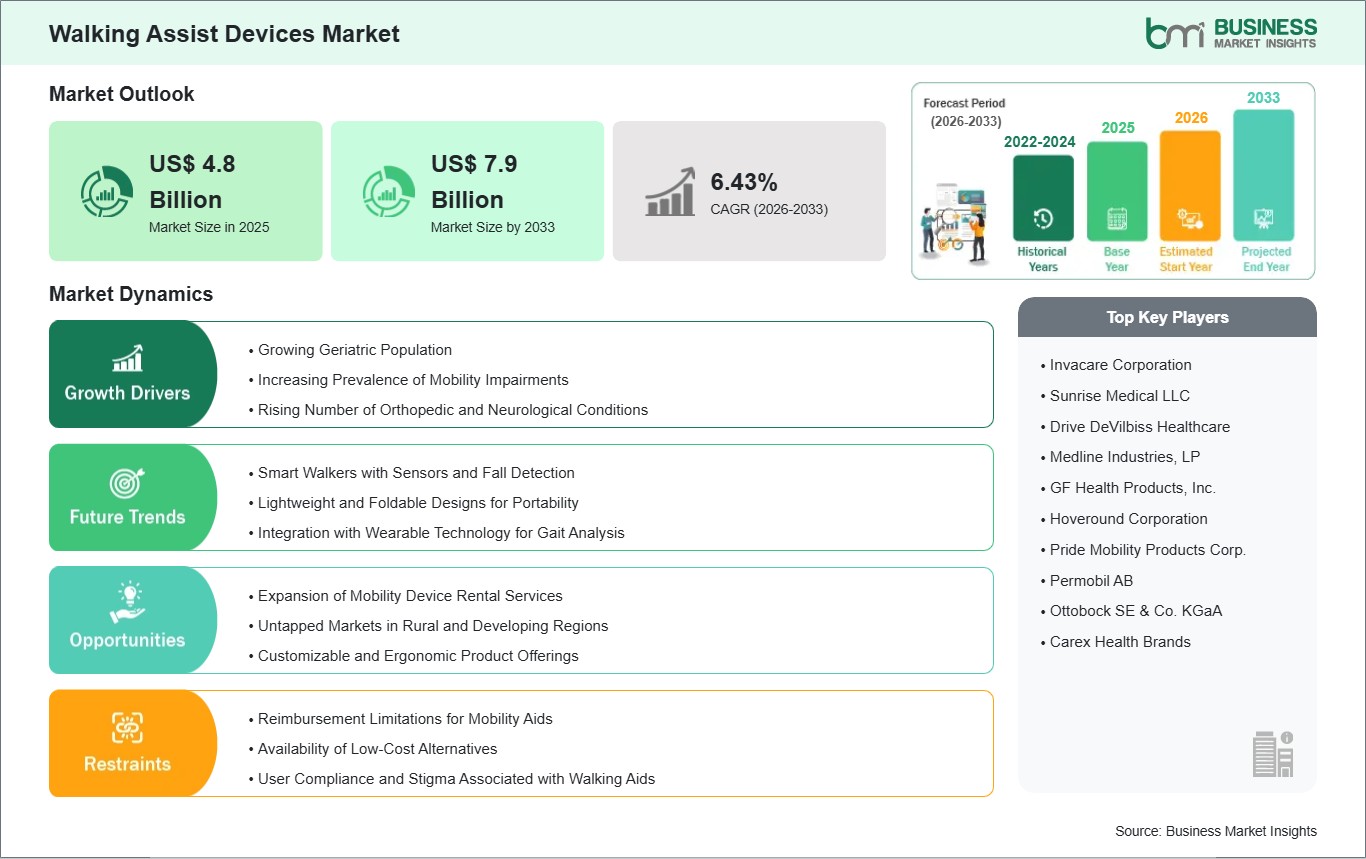
The Walking Assist Devices Market size is expected to reach US$ 7.9 billion by 2033 from US$ 4.8 billion in 2025. The market is estimated to record a CAGR of 6.43% from 2026 to 2033.

Executive Summary and Global Market Analysis:

Walking assist devices refer to a specialized category of medical and rehabilitative tools designed to enhance mobility, balance, and safety for individuals with functional impairments. The walking assist devices market is a critical pillar of the global assistive technology sector, providing immense strategic value across hospitals, rehabilitation centers, and home care environments. Market expansion is fundamentally driven by the global aging population, who exhibit an increasing prevalence of mobility-limiting conditions such as osteoarthritis, osteoporosis, and sarcopenia.

Furthermore, the rising incidence of neurological disorders, including Parkinson`s disease, multiple sclerosis, and stroke-related hemiplegia, and the growth in post-surgical rehabilitation requirements are accelerating the demand for supportive equipment. The shift toward autonomous living and the integration of ergonomic, user-centric designs are improving patient independence and reducing the social and economic burden of immobility.

However, several factors can restrain market growth. The high cost of advanced technological solutions, particularly powered exoskeletons and AI-integrated robotic walkers, remains a significant barrier for individual consumers and smaller clinics. Inconsistent reimbursement policies across different regions can limit the acquisition of high-end mobility aids, often requiring substantial out-of-pocket expenditures. Additionally, the industry faces challenges related to product safety and stability; improper device selection or mechanical failure can lead to secondary injuries or falls, necessitating rigorous regulatory oversight and extensive patient training programs.

Despite these hurdles, the market holds significant opportunities in the development of smart mobility ecosystems, where devices sync with wearable health trackers and telehealth platforms. The rise of modular and foldable designs for enhanced portability and the expansion of e-commerce distribution channels, which facilitate direct-to-consumer access, are expected to support long-term development within the sector. Manufacturers are also finding growth potential in the pediatric segment, focusing on specialized gait trainers for children with developmental challenges like cerebral palsy.

Walking Assist Devices Market - Strategic Insights:

global-market-strategic-framework
Get more information on this report

Walking Assist Devices Market Segmentation Analysis:

Key segments that contributed to the derivation of the Walking Assist Devices market analysis are product type and end user.

  • By Product Type, the market is segmented into Gait Belt and Lift Vest, Cane, Crutch, Walker, Wheelchair, and Power Scooter.
  • By End User, the market is categorized into Homecare and Hospital.

Walking Assist Devices Market Drivers and Opportunities:

Rising Geriatric Population and Increasing Mobility Impairments

The primary driver for the Walking Assist Devices Market is the accelerating global increase in the aging population and the corresponding rise in mobility-related disorders. The Growing Prevalence of Musculoskeletal Conditions, such as osteoarthritis, osteoporosis, and post-fracture rehabilitation needs, serves as a foundational catalyst, as these conditions create a sustained demand for canes, walkers, crutches, and rollators. This momentum is further reinforced by the Increasing Incidence of Neurological Disorders and Disabilities, including stroke, Parkinson`s disease, and spinal cord injuries, which necessitate long-term or permanent mobility assistance. In parallel, Rising Road Accidents and Sports Injuries are contributing to a steady inflow of patients requiring temporary walking support during recovery phases. From a healthcare systems perspective,

Expanding Access to Rehabilitation Services and Home Healthcare is significantly boosting device adoption, as patients increasingly prefer cost-effective, home-based recovery solutions over prolonged hospital stays. Furthermore, Growing Awareness of Fall Prevention and Independent Living among the elderly population is compelling both caregivers and individuals to proactively adopt walking aids. Together, these factors demographic expansion, chronic disease burden, and rehabilitation demand—are ensuring a stable and expanding growth trajectory for the global Walking Assist Devices Market.

Smart Mobility Integration and Ergonomic Innovation Driving Next-Generation Solutions

A significant high-value opportunity lies in the integration of Walking Assist Devices with Smart Technologies and Connected Health Ecosystems. Advanced mobility aids are increasingly being developed with embedded sensors, GPS tracking, and fall detection systems that enable real-time monitoring and emergency alerts, particularly benefiting elderly users living alone. There is also a major growth frontier in the Development of Lightweight, Foldable, and Ergonomically Optimized Designs; manufacturers are leveraging advanced materials such as carbon fiber and aluminum alloys to enhance portability without compromising durability. Furthermore, the Emergence of AI-Powered Gait Analysis and Rehabilitation Feedback Systems presents a transformative opportunity, as these devices can provide personalized insights to improve patient mobility outcomes.

The expansion of Premium Rollators with Integrated Seating, Storage, and Shock Absorption Systems is creating a lucrative segment catering to active senior consumers seeking comfort and independence. Beyond functionality, Increasing Demand for Aesthetically Appealing and Customizable Devices is reshaping product design, reducing the stigma traditionally associated with assistive aids. Companies investing in Sustainable Materials, Modular Components, and Multi-Functional Hybrid Devices are well-positioned to capture high-growth, innovation-driven segments within the global Walking Assist Devices Market.

Walking Assist Devices Market Size and Share Analysis:

The Walking Assist Devices market demonstrates steady growth, with size and share analysis revealing evolving trends and competitive positioning among key players. The report examines subsegments categorized within product type and end user, offering insights into their contribution to overall market performance.

Based on product type, the Wheelchairs subsegment holds the primary market presence, acting as the essential high-value hub for individuals with severe or permanent mobility impairments. These systems are indispensable for the market, maintaining a significant position as the central solution for non-ambulatory patients requiring long-distance or high-stability mobility. While Canes, Crutches, and Gait Belts provide critical support for temporary injuries and minor stability issues, they hold secondary positions. A notable trend is the surge in the Walker and Power Scooter subsegments, which are registering the highest pace of adoption. Walkers, particularly rollators, are becoming essential for Versatile Daily Ambulation, as their stability and integrated features such as seating and storage make them the preferred choice for the active geriatric population. Simultaneously, Power Scooters are registering significant traction as a standard for Extended Outdoor Autonomy, allowing users to navigate community environments with minimal physical exertion.

Walking Assist Devices Market Report Highlights:

Report Attribute Details
Market size in 2025 US$ 4.8 Billion
Market Size by 2033 US$ 7.9 Billion
Global CAGR (2026 - 2033)6.43%
Historical Data 2022-2024
Forecast period 2026-2033
Segments Covered By Product Type
  • Gait Belt and Lift Vest
  • Cane
  • Crutch
  • Walker
  • Wheelchair
  • Power Scooter
By End User
  • Homecare and Hospital
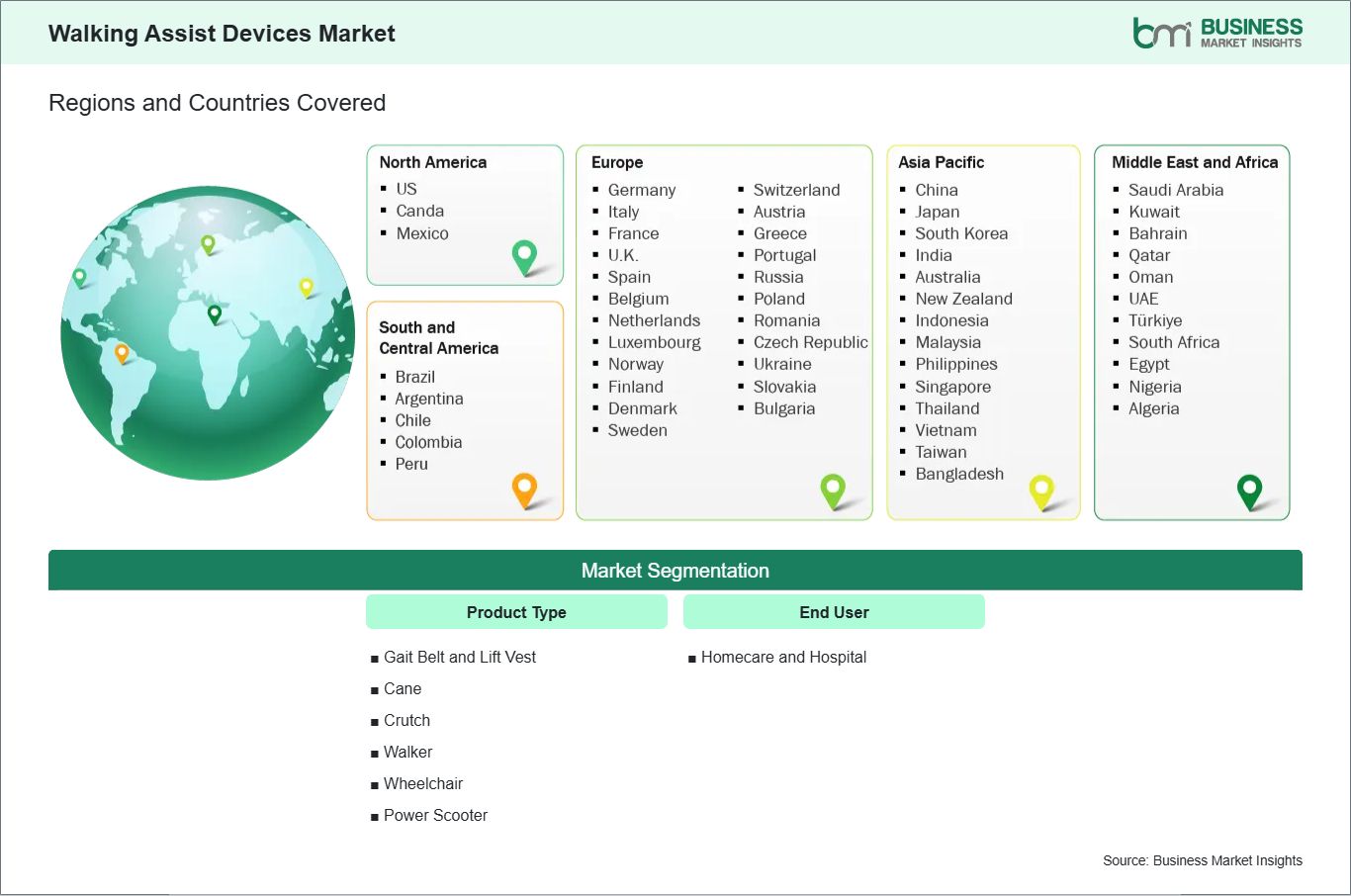
Regions and Countries Covered
North America US, Canada, Mexico
Europe Belgium, Austria, Finland, Denmark, Greece, Poland, Romania, Russia, Ukraine, Czech Republic, Slovakia, Bulgaria, Italy, Luxembourg, Germany, Switzerland, France, Netherlands, Norway, Portugal, Spain, Sweden, United Kingdom
Asia-Pacific Australia, China, India, Japan, South Korea, Indonesia, Malaysia, Philippines, Singapore, Thailand, Vietnam, Bangladesh, New Zealand, Taiwan
South and Central America Brazil, Argentina, Peru, Chile, Colombia
Middle East and Africa Bahrain, Kuwait, Oman, Qatar, Saudi Arabia, United Arab Emirates, Turkiye, South Africa, Egypt, Algeria, Nigeria
Market leaders and key company profiles
  • Invacare Corporation
  • Sunrise Medical LLC
  • Drive DeVilbiss Healthcare
  • Medline Industries, LP
  • GF Health Products, Inc.
  • Hoveround Corporation
  • Pride Mobility Products Corp.
  • Permobil AB
  • Ottobock SE & Co. KGaA
  • Carex Health Brands
Get more information on this report

Walking Assist Devices Market Report Coverage and Deliverables:

The "Walking Assist Devices Market Size and Forecast (2022–2033)" report provides a detailed analysis of the market covering below areas:

  • Walking Assist Devices market size and forecast at global, regional, and country levels for all market segments covered under the scope
  • Walking Assist Devices market trends, as well as drivers, restraints, and opportunities
  • Walking Assist Devices market analysis covering key trends, global and regional framework, major players, regulations, and recent developments
  • Industry landscape and competition analysis covering market concentration, heat map analysis, prominent players, and recent developments for the Walking Assist Devices market
  • Detailed company profiles, including SWOT analysis

Walking Assist Devices Market Geographic Insights:

The geographical scope of the Walking Assist Devices market report is divided into five regions: North America, Asia Pacific, Europe, Middle East & Africa, and South & Central America.

North America currently maintains the largest market share, supported by a substantial geriatric population, a well-established healthcare reimbursement framework, and high adoption rates for advanced robotic exoskeletons and smart mobility aids.

Europe represents a mature and technologically sophisticated market where growth is sustained by rigorous safety standards and an institutional focus on long-term rehabilitation for chronic musculoskeletal conditions.

Asia Pacific is identified as the most rapidly advancing region, propelled by accelerating healthcare modernization, high birth volumes transitioning into an aging demographic, and significant public investments in domestic manufacturing for affordable mobility solutions.

The Asia-Pacific Walking Assist Devices Market is segmented into China, Japan, South Korea, India, Australia, and the Rest of Asia Pacific. China serves as a central engine for regional expansion, driven by large-scale government initiatives to modernize elderly care infrastructure and a rising demand for specialized walkers in urban centers. India is witnessing a notable transition as private diagnostic and rehabilitation chains expand their portfolios to address the needs of a burgeoning middle-class population. Japan continues to prioritize high-precision instrumentation, focusing on the integration of AI-powered gait analysis and connected smart canes to ensure independent living for its substantial geriatric population.

global-market-geography
Get more information on this report

Walking Assist Devices Market Research Report Guidance:

  • The report includes qualitative and quantitative data in the Walking Assist Devices market across product type, end user, and geography.
  • The report starts with the key takeaways (chapter 2), highlighting the key trends and outlook of the Walking Assist Devices market.
  • Chapter 3 focuses on the research methodology of the study.
  • Chapter 4 includes ecosystem analysis.
  • Chapter 5 highlights the major industry dynamics in the Walking Assist Devices market, including factors that are driving the market, prevailing deterrents, potential opportunities, as well as future trends. Impact analysis of these drivers and restraints is also covered in this section.
  • Chapter 6 discusses the Walking Assist Devices market scenario, in terms of historical market revenues, and forecast till the year 2033.
  • Chapters 7 to 9 cover Walking Assist Devices market segments by product type, end user, and geography across North America, Europe, Asia Pacific, Middle East and Africa, and South and Central America. They cover the market revenue, forecast, and factors driving the market.
  • Chapter 11 describes the competitive analysis along with the heat map analysis for the key players operating in the market.
  • Chapter 12 describes the industry landscape analysis. It provides detailed descriptions of business activities such as market initiatives, new developments, mergers, and joint ventures globally, along with a competitive landscape.
  • Chapter 13 provides detailed profiles of the major companies operating in the Walking Assist Devices market. Companies have been profiled on the basis of their key facts, business descriptions, products and services, financial overview, SWOT analysis, and key developments.
  • Chapter 14, i.e., the appendix, is inclusive of a brief overview of the company, list of abbreviations, and disclaimer.

Walking Assist Devices Market News and Key Development:

The Walking Assist Devices market is evaluated by gathering qualitative and quantitative data post primary and secondary research, which includes important corporate publications, association data, and databases. A few of the key developments in the Walking Assist Devices market are:

  • In January 2025, WIRobotics announced the U.S. launch of WIM, a 1.6 kg wearable walking assist device featuring AI-driven gait analysis, multiple assistive modes, and CES Innovation Awards recognition. Targeting seniors, patients in rehab, and active users, WIM demonstrated a 78% improvement in physical functions during usability testing, expanding the company`s footprint from South Korea to the U.S. market.
  • In June 2024, Drive DeVilbiss Healthcare acquired Mobility Designed, Inc., including the M+D Comfort Crutch and ComboStix, enhancing its walking assist devices portfolio. This strategic move integrates advanced industrial design to improve mobility solutions.

Key Sources Referred:

  • World Bank – Global Trade Indicators
  • World Trade Organization (WTO)
  • (International Monetary Fund )IMF
  • International Trade Administration (ITA)
  • Company website
  • Company annual reports
  • Company investor presentations
The List of Companies - Walking Assist Devices Market
  • Invacare Corporation
  • Sunrise Medical LLC
  • Drive DeVilbiss Healthcare
  • Medline Industries, LP
  • GF Health Products, Inc.
  • Hoveround Corporation
  • Pride Mobility Products Corp.
  • Permobil AB
  • Ottobock SE & Co. KGaA
  • Carex Health Brands
Frequently Asked Questions
How big is the Walking Assist Devices Market?

The Walking Assist Devices Market is valued at US$ 4.8 Billion in 2025, it is projected to reach US$ 7.9 Billion by 2033.

What is the CAGR for Walking Assist Devices Market by (2026 - 2033)?

As per our report Walking Assist Devices Market, the market size is valued at US$ 4.8 Billion in 2025, projecting it to reach US$ 7.9 Billion by 2033. This translates to a CAGR of approximately 6.43% during the forecast period.

What segments are covered in this report?

The Walking Assist Devices Market report typically cover these key segments-

  • Product Type (Gait Belt and Lift Vest, Cane, Crutch, Walker, Wheelchair, and Power Scooter)
  • End User (Homecare and Hospital)

What is the historic period, base year, and forecast period taken for Walking Assist Devices Market?

The historic period, base year, and forecast period can vary slightly depending on the specific market research report. However, for the Walking Assist Devices Market report:

  • Historic Period : 2022-2024
  • Base Year : 2025
  • Forecast Period : 2026-2033
  • Who are the major players in Walking Assist Devices Market?

    The Walking Assist Devices Market is populated by several key players, each contributing to its growth and innovation. Some of the major players include:

  • Invacare Corporation
  • Sunrise Medical LLC
  • Drive DeVilbiss Healthcare
  • Medline Industries, LP
  • GF Health Products, Inc.
  • Hoveround Corporation
  • Pride Mobility Products Corp.
  • Permobil AB
  • Ottobock SE & Co. KGaA
  • Carex Health Brands
  • Who should buy this report?

    The Walking Assist Devices Market report is valuable for diverse stakeholders, including:

    • Investors: Provides insights for investment decisions pertaining to market growth, companies, or industry insights. Helps assess market attractiveness and potential returns.
    • Industry Players: Offers competitive intelligence, market sizing, and trend analysis to inform strategic planning, product development, and sales strategies.
    • Suppliers and Manufacturers: Helps understand market demand for components, materials, and services related to concerned industry.
    • Researchers and Consultants: Provides data and analysis for academic research, consulting projects, and market studies.
    • Financial Institutions: Helps assess risks and opportunities associated with financing or investing in the concerned market.

    Essentially, anyone involved in or considering involvement in the Walking Assist Devices Market value chain can benefit from the information contained in a comprehensive market report.

    Available Report Formats

    pdf-format excel-format pptx-format
    Buy Now
    Sales Assistance
    +1 646 791 7070 (US & UK)
    Customization Form

    Please tell us your area of interest
    (Market Segments/ Regions and Countries/ Companies)