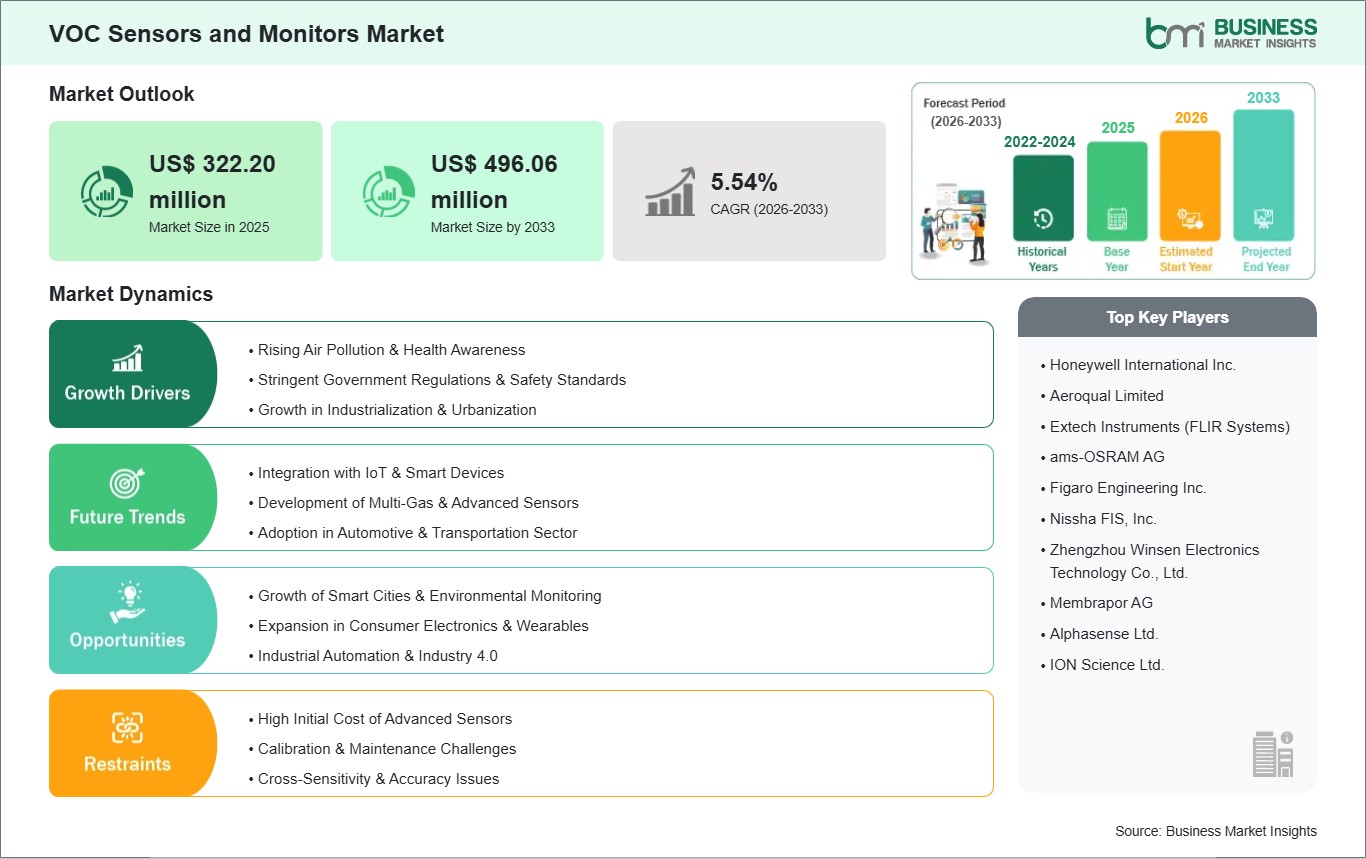
The VOC Sensors and Monitors Market size is expected to reach US$ 496.06 million by 2033 from US$ 322.2 million in 2025. The market is estimated to record a CAGR of 5.54% from 2026 to 2033.
VOC (volatile organic compound) sensors and monitors refer to high-precision analytical instruments engineered to detect and measure the concentration of carbon-based chemical vapors, such as formaldehyde, benzene, and toluene, within the ambient atmosphere. By utilizing specialized sensing architectures, including metal-oxide semiconductors (MOS) and photoionization detectors (PID), these systems translate chemical interactions into quantifiable electronic data. This technology is fundamental to maintaining indoor air quality (IAQ) and ensuring occupational safety across the chemical manufacturing, oil and gas, and pharmaceutical industries. Market expansion is being propelled by the rapid global shift toward healthy building certifications, the rising institutional demand for real-time hazardous leak detection, and a surge in the integration of air quality sensors into consumer electronics and smart home ecosystems.
However, several factors may restrain market progression. The high capital intensity associated with high-fidelity monitoring arrays, particularly those utilizing premium PID lamps for sub-ppm (parts per million) sensitivity remains a primary hurdle for small and medium-sized enterprises (SMEs). The industry also faces technical challenges regarding cross-sensitivity and environmental interference, where humidity and the presence of non-target gases can lead to inaccurate readings or significant calibration drift. Additionally, the ongoing global semiconductor supply constraints continue to impact the production of the micro-controllers and communication modules required for wireless, IoT-enabled sensors. These hurdles, compounded by a lack of globally harmonized protocols for sensor interoperability and long-term data reliability, increase the total cost of ownership and require significant strategic investment in advanced machine-learning calibration models.
Despite these hurdles, the market outlook remains favorable. Opportunities are emerging through the adoption of smart building automation systems that utilize VOC telemetry to dynamically adjust ventilation rates, thereby optimizing energy consumption without compromising occupant health. The expansion of the hydrogen economy is gaining significant traction; the market is witnessing the launch of specialized hydrogen-compatible PID sensors designed to ensure safety in new green energy infrastructure. Furthermore, the growth of miniaturized MEMS (micro-electro-mechanical systems) sensors aligns with global goals for portable, wearable personal exposure monitoring. Collectively, these innovations position the VOC sensors and monitors industry for sustained long-term development as a cornerstone of the modern, digitized, and health-centric global environment.

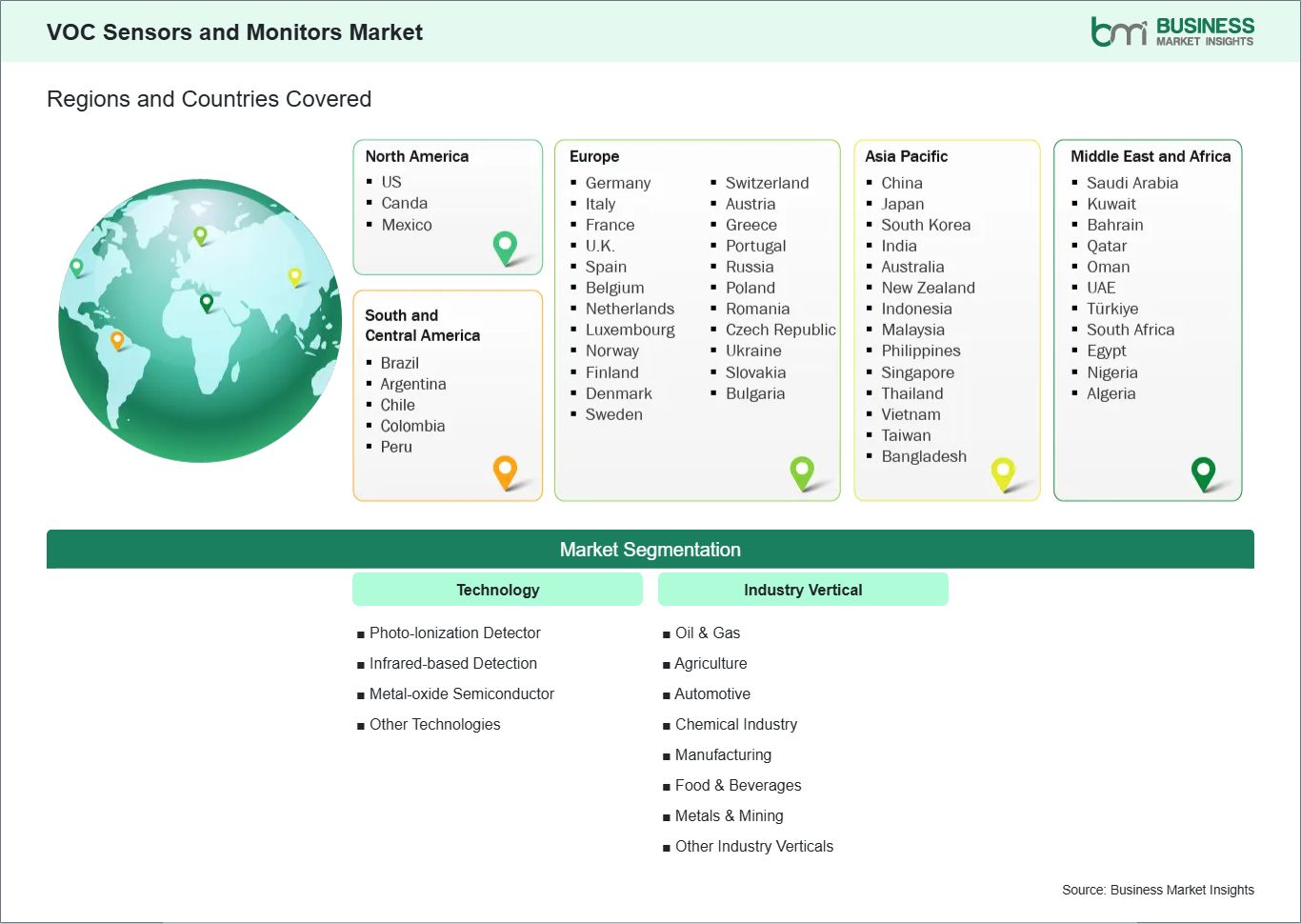
Key segments that contributed to the derivation of the VOC Sensors and Monitors market analysis are technology and industry vertical.
The VOC (volatile organic compound) sensors and monitors market is being driven by the growing need for air quality monitoring, workplace safety, and regulatory compliance across industries such as petrochemicals, automotive, manufacturing, and healthcare. VOCs are harmful pollutants that contribute to environmental degradation and health risks, making their detection critical in both industrial and urban settings. Governments worldwide are enforcing stricter regulations on emissions, reinforcing adoption of VOC monitoring solutions to ensure compliance. The expansion of smart manufacturing and industrial automation is amplifying demand, as VOC sensors integrate seamlessly into monitoring systems to provide real‑time data and early warnings.
Rising public awareness of indoor air quality is also driving adoption in residential and commercial spaces, particularly in regions with high pollution levels. Additionally, the growth of pharmaceutical and food industries is fueling demand for VOC monitoring to maintain product safety and quality. Collectively, regulatory mandates, industrial modernization, and health awareness are propelling sustained growth in the global VOC sensors and monitors market.
Opportunities in the VOC sensors and monitors market are expanding through the integration of IoT connectivity, artificial intelligence, and smart city initiatives. IoT‑enabled VOC sensors are gaining traction, offering real‑time monitoring, predictive analytics, and seamless data sharing across industrial plants, healthcare facilities, and urban infrastructures. AI‑driven platforms are opening lucrative opportunities by enabling advanced pattern recognition, automated alerts, and predictive maintenance, reducing risks and operational costs.
The growing emphasis on sustainability and green building standards is encouraging deployment of VOC monitoring systems in smart homes and offices, aligning with global decarbonization goals. Emerging applications in automotive and transportation are also driving innovation, as VOC sensors are increasingly used to monitor cabin air quality and emissions. Additionally, the expansion of smart cities and environmental monitoring projects is fueling demand for advanced VOC solutions that ensure public health and safety. Vendors who focus on cost‑effective, interoperable, and AI‑driven monitoring systems are well‑positioned to capture growth. The convergence of IoT, AI, and sustainability underscores a transformative trajectory for the global VOC sensors and monitors market.

The VOC Sensors and Monitors market demonstrates steady growth, with size and share analysis revealing evolving trends and competitive positioning among key players. The report examines subsegments categorized within technology and industry vertical, offering insights into their contribution to overall market performance.
Based on Technology, the Photo‑Ionization Detector (PID) subsegment holds a strong presence in the market. PIDs are indispensable for detecting low concentrations of volatile organic compounds with high sensitivity, making them widely adopted in industrial hygiene, environmental monitoring, and safety applications. The Infrared‑based Detection subsegment is essential for identifying hydrocarbons and VOCs in harsh environments, offering durability and reliability in the oil & gas and chemical industries. The Metal‑Oxide Semiconductor subsegment anchors demand in cost‑effective, compact sensors used in automotive, consumer electronics, and indoor air quality monitoring. The Other technologies category includes emerging detection methods that are critical for specialized applications requiring advanced accuracy and adaptability.
| Report Attribute | Details |
|---|---|
| Market size in 2025 | US$ 322.20 million |
| Market Size by 2033 | US$ 496.06 million |
| Global CAGR (2026 - 2033) | 5.54% |
| Historical Data | 2022-2024 |
| Forecast period | 2026-2033 |
| Segments Covered | By Technology
|
|
Regions and Countries Covered
| |
| North America | US, Canada, Mexico |
| Europe | Belgium, Austria, Finland, Denmark, Greece, Poland, Romania, Russia, Ukraine, Czech Republic, Slovakia, Bulgaria, Italy, Luxembourg, Germany, Switzerland, France, Netherlands, Norway, Portugal, Spain, Sweden, United Kingdom |
| Asia-Pacific | Australia, China, India, Japan, South Korea, Indonesia, Malaysia, Philippines, Singapore, Thailand, Vietnam, Bangladesh, New Zealand, Taiwan |
| South and Central America | Brazil, Argentina, Peru, Chile, Colombia |
| Middle East and Africa | Bahrain, Kuwait, Oman, Qatar, Saudi Arabia, United Arab Emirates, Turkiye, South Africa, Egypt, Algeria, Nigeria |
| Market leaders and key company profiles |
|
The "VOC Sensors and Monitors Market Size and Forecast (2022 - 2033)" report provides a detailed analysis of the market covering below areas:
The geographical scope of the VOC Sensors and Monitors market report is divided into five regions: North America, Asia Pacific, Europe, Middle East & Africa, and South & Central America.
North America maintains a preeminent position within the global industry, a status reinforced by the region's advanced environmental monitoring infrastructure and the early, large-scale adoption of smart building technologies. The regional landscape is characterized by high-density investments in the United States and Canada, where the transition toward Intelligent Indoor Air Quality (IAQ) Management has become a strategic priority for commercial real estate and healthcare sectors. This market leadership is further supported by stringent environmental mandates and the presence of major industry participants who are pioneering the integration of Photoionization Detectors (PID) and metal-oxide semiconductor sensors into broader occupational health and safety frameworks.
Technological progression in the United States and Canada is largely driven by a decisive shift toward IoT-Enabled Continuous Monitoring and Edge Analytics. These advanced systems utilize distributed sensor networks to perform real-time assessment of harmful compounds such as benzene and formaldehyde, allowing for the immediate activation of high-efficiency HVAC filtration when safe limits are exceeded. Furthermore, the region is witnessing an increasing utilization of Wearable VOC Monitors for industrial hygiene, providing personal exposure data that assists organizations in complying with rigorous U.S. EPA and OSHA guidelines. This focus on Data-Driven Wellness allows North American operators to enhance occupant health while simultaneously optimizing energy consumption in climate-controlled environments.

The VOC Sensors and Monitors market is evaluated by gathering qualitative and quantitative data post primary and secondary research, which includes important corporate publications, association data, and databases. A few of the key developments in the VOC Sensors and Monitors market are:
The VOC Sensors and Monitors Market is valued at US$ 322.20 million in 2025, it is projected to reach US$ 496.06 million by 2033.
As per our report VOC Sensors and Monitors Market, the market size is valued at US$ 322.20 million in 2025, projecting it to reach US$ 496.06 million by 2033. This translates to a CAGR of approximately 5.54% during the forecast period.
The VOC Sensors and Monitors Market report typically cover these key segments-
The historic period, base year, and forecast period can vary slightly depending on the specific market research report. However, for the VOC Sensors and Monitors Market report:
The VOC Sensors and Monitors Market is populated by several key players, each contributing to its growth and innovation. Some of the major players include:
The VOC Sensors and Monitors Market report is valuable for diverse stakeholders, including:
Essentially, anyone involved in or considering involvement in the VOC Sensors and Monitors Market value chain can benefit from the information contained in a comprehensive market report.
Please tell us your area of interest
(Market Segments/ Regions and Countries/ Companies)