
Vision Guided Inspection Equipment Market Outlook: Size, Share, Trends, Growth Analysis, Competitive Landscape & Forecast, 2022-2033

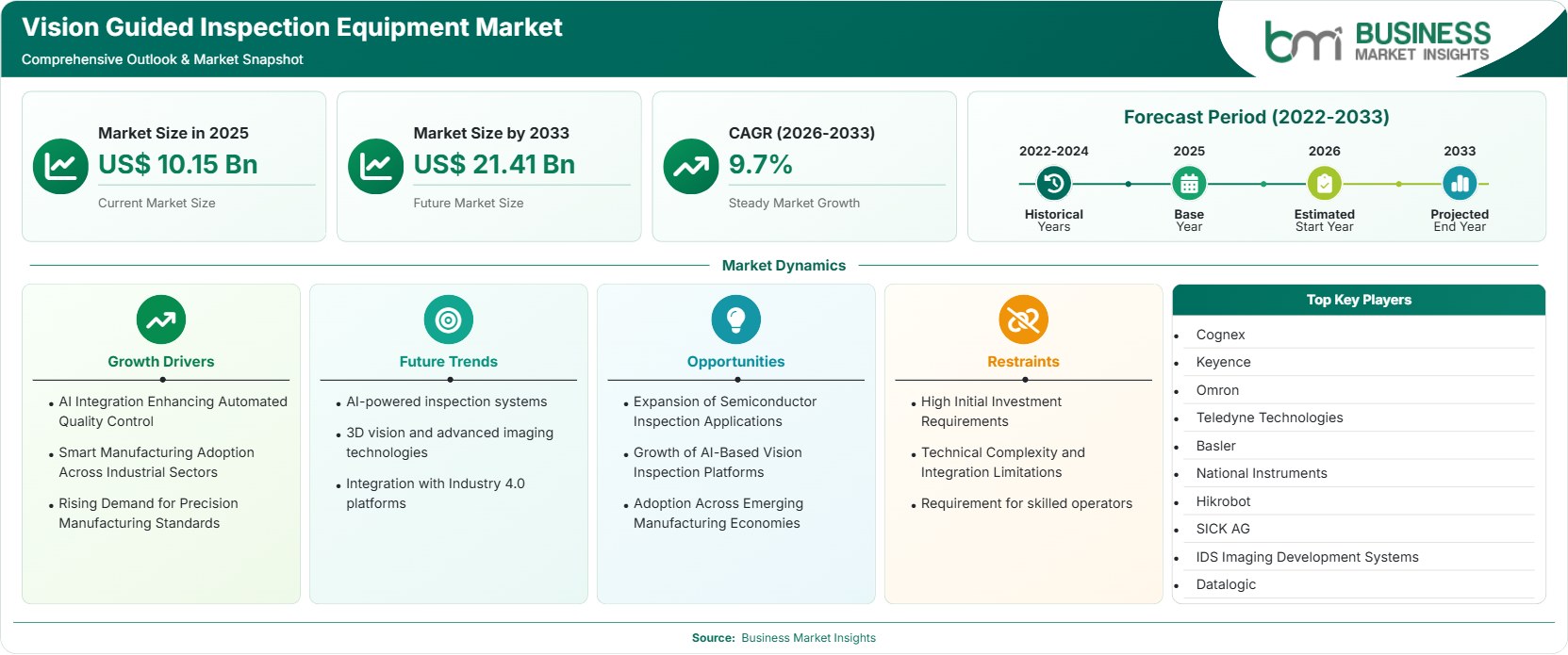
The Vision Guided Inspection Equipment Market size was valued at USD 10.15 Billion in 2025 and is projected to reach USD 21.41 Billion by 2033, growing at a CAGR of 9.7% during 2026–2033, driven by automation adoption, AI-enabled quality control, smart manufacturing expansion, and rising demand for precision inspection across industries.

Report Coverage
  • Offering: Hardware, Software, Services
  • Imaging Modality: 2D Vision Inspection, 3D Vision Inspection, Spectral Vision Inspection, Others
  • Deployment Type: Inline/In-Process Inspection, At-Line/Near-Line Inspection, Others
  • End-Use Industry: Electronics & Semiconductors, Automotive, Healthcare, Food & Beverage, Packaging & Printing, General Industrial Manufacturing, Aerospace & Defense, Logistics & Warehousing, Others
US$ 10.15 Bn Market size in 2025
US$ 21.41 Bn Market Size by 2033
9.7% CAGR, 2026 - 2033
2026-2033 Forecast Period

01 AI Overview

Vision Guided Inspection Equipment Market Summary

  • North America Region: North America is anticipated to reach 32%-35% by 2025, with a growth rate of 9.20%-9.70%, driven by industrial automation, semiconductor investments, AI integration, and advanced manufacturing projects. The US market is witnessing higher adoption with a CAGR of 9.40%-9.70% till
  • Fastest Growing Region: Asia Pacific holds 28%–31% share in 2025, expanding at 10.20%–10.80% CAGR driven by electronics manufacturing, factory automation, semiconductor expansion, and government-led industrial upgrading programs in China, Japan, South Korea, and India.
  • Leading Segment: 2D Vision Inspection is projected to hold a market share of 42%-45% in 2025, growing at an 8.90%-9.40% CAGR owing to its wide adoption, cost-effectiveness, proven imaging technology, and the need for fast defect
  • High Growth Segment: 3D Vision Inspection records 24%–27% share in 2025, advancing at 11.00%–11.60% CAGR driven by complex component inspection, robotics integration, dimensional accuracy, and use in automotive and semiconductor manufacturing.
  • Key Market Opportunity: The growth of AI inspection platforms provides opportunities through automated decision-making, edge computing, predictive quality analysis, and their use in new manufacturing centers where there is a need for increased production efficiency.
  • Major Market Players: Cognex Corporation, Keyence Corporation, OMRON Corporation, Teledyne Technologies Incorporated, Basler AG, National Instruments Corporation, Shenzhen HIKROBOT Co., Ltd., SICK AG, IDS Imaging Development Systems GmbH, and Datalogic S.p.A.
02 Strategic Insights

Vision Guided Inspection Equipment Market: Strategic Insights

Vision Guided Inspection Equipment Market Strategic Framework
FREE PDF
Request your free sample
Request free sample
03 Stakeholder View

Key Takeaways

  • The ecosystem is shifting towards developing systems in which camera systems, lighting units, processors, software algorithms, and networking will be integrated. Companies that can provide end-to-end solutions are more likely to develop valuable relationships with manufacturers.
  • Electronic goods producers, semiconductor devices, and automobiles present a good market opportunity for applying such technologies due to the increasing complexity of electronic components and the need for accurate inspection and measurement.
  • Artificial intelligence, machine learning, and edge computing change inspection technology by enabling faster anomaly detection, more flexible models, and reduced reliance on manual coding.
  • Asia Pacific provides a strong investment opportunity due to expanding electronics manufacturing capacity, semiconductor localization programs, and increasing automation adoption across China, Japan, South Korea, and India.
  • Strategic partnerships, technology acquisitions, and software-oriented investments is shaping competitive positioning as traditional vision companies improve their artificial intelligence capabilities, cloud connectivity, and industrial inspection capabilities.
  • Demand for a scalable inspection architecture is growing as companies seek systems that can handle diverse product configurations, shorter production timeframes, and specialized manufacturing needs.
04 Geographic Outlook

Vision Guided Inspection Equipment Market Regional Highlights

North America Vision Guided Inspection Equipment Market

North America market holds 32%–35% share in 2025 and expands at a CAGR of 9.20%–9.70% during 2026–2033. The region benefits from advanced manufacturing infrastructure, semiconductor investments, and strong automation adoption across automotive and electronics industries. The Vision Guided Inspection Equipment Market share reflects mature industrial technology deployment supported by innovation ecosystems.

  • The United States remains the dominant contributor with 9.40%–9.70% CAGR, supported by semiconductor investments, aerospace manufacturing, and AI-enabled industrial automation programs.
  • Canada supports regional expansion through automotive production, food processing automation, and adoption of quality inspection systems for export-oriented manufacturing operations.
  • Industrial robotics integration is increasing demand for intelligent inspection platforms capable of improving production accuracy and reducing manual quality checks.
  • Manufacturers are investing in AI-based vision systems to address labour shortages and enhance operational consistency across production facilities.

US Vision Guided Inspection Equipment Market

The US Vision Guided Inspection Equipment Market accounts for 26%–29% share in 2025 and grows at a CAGR of 9.40%–9.70% through 2033. The country benefits from semiconductor manufacturing expansion, defense production requirements, and automotive electrification trends. Market growth is supported by investments in smart factories and automated quality control systems.

  • Semiconductor fabrication expansion is increasing demand for high-resolution inspection systems capable of detecting microscopic manufacturing defects.
  • Automotive manufacturers are adopting machine vision platforms for battery inspection, component validation, and automated assembly verification processes.
  • Aerospace and defense suppliers are deploying advanced imaging technologies to improve precision manufacturing and compliance monitoring.

Europe Vision Guided Inspection Equipment Market

Europe Market maintains 24%–27% share in 2025 with a CAGR of 8.80%–9.30% during 2026–2033. Germany leads adoption through industrial automation expertise, while France, Italy, and the United Kingdom contribute through automotive, aerospace, and pharmaceutical manufacturing. Vision Guided Inspection Equipment Market share is supported by Industry 4.0 programs and strict quality requirements.

  • Germany demonstrates strong demand through automotive automation, robotics deployment, and precision engineering manufacturing capabilities.
  • France supports adoption through aerospace production, healthcare manufacturing, and government-backed digital industrial transformation initiatives.
  • Italy increases usage across packaging, machinery, and specialized manufacturing applications requiring automated inspection.
  • European manufacturers are prioritizing sustainable production through reduced material waste and improved process monitoring.

Asia Pacific Vision Guided Inspection Equipment Market

Asia Pacific market represents 28%–31% share in 2025 and achieves the highest CAGR of 10.20%–10.80% through 2033. China, Japan, South Korea, and India are key contributors due to electronics manufacturing growth, semiconductor investments, and factory automation expansion. The Vision Guided Inspection Equipment Market share reflects rapid industrial modernization.

  • China drives regional adoption through electronics manufacturing scale, robotics integration, and semiconductor production expansion initiatives.
  • Japan maintains technology leadership through precision manufacturing, automotive innovation, and advanced industrial automation expertise.
  • South Korea increases demand through semiconductor fabrication, display manufacturing, and high-speed inspection requirements.
  • India presents emerging opportunities through manufacturing localization programs and increasing industrial automation investments.

Rest of World Vision Guided Inspection Equipment Market

Rest of the market captures 10%–13% share in 2025 and grows at a CAGR of 9.00%–9.50% between 2026–2033. South and Central America are adopting automated inspection for food, automotive, and industrial applications, while Middle Eastern markets invest in advanced manufacturing diversification. Market growth is supported by industrial modernization.

  • Brazil leads regional adoption through automotive manufacturing, food processing, and industrial automation investments.
  • Mexico benefits from manufacturing relocation trends and increasing automotive production requiring automated inspection solutions.
  • Middle Eastern countries are integrating machine vision technologies into industrial diversification initiatives.
  • South African industries are adopting inspection systems for mining equipment, manufacturing, and quality improvement applications.
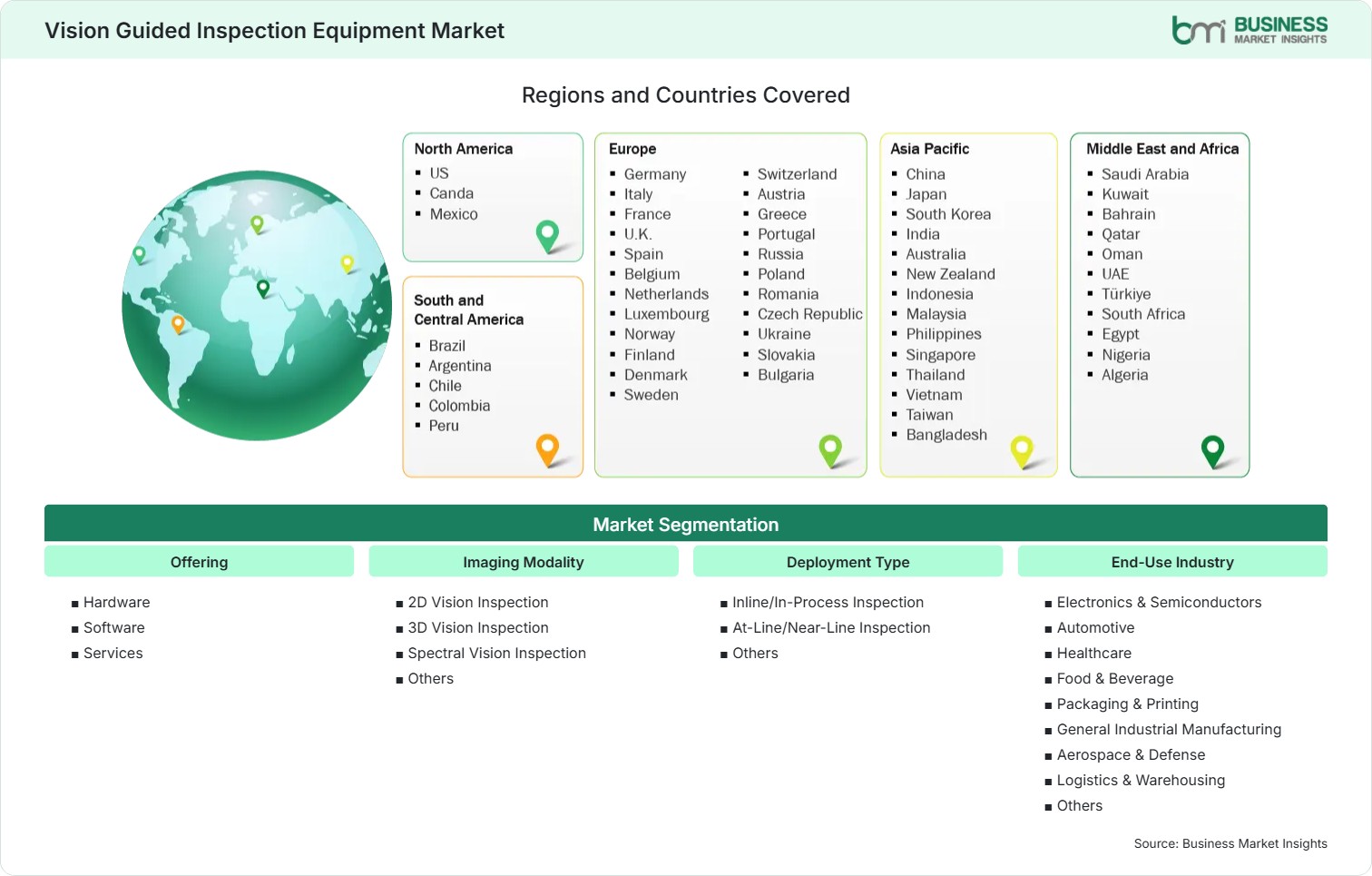
Global Market Geography
FREE PDF
Request your free sample
Request free sample
05 Segment Analysis

Vision Guided Inspection Equipment Market Segmentation

Imaging Modality

Imaging Modality represents a core technology segment with 2D Vision Inspection, 3D Vision Inspection, and Spectral Vision Inspection applications. The segment holds 100% market coverage with 2D Vision Inspection accounting for 42%–45% share in 2025 and growing at 8.90%–9.40% CAGR between 2026–2034. Vision Guided Inspection Equipment Market scope expands through advanced imaging accuracy, AI processing, and manufacturing automation requirements.

  • 2D Vision Inspection: Provides high-speed surface analysis, pattern recognition, and defect detection for electronics, packaging, and automotive components requiring efficient inspection workflows.
  • 3D Vision Inspection: Enables dimensional measurement, depth analysis, and complex component validation through advanced sensors supporting robotics and precision manufacturing applications.
  • Spectral Vision Inspection: Supports material identification, contamination detection, and quality analysis using wavelength-based imaging methods across specialized industrial applications.

Deployment Type

Deployment Type includes Inline/In-Process Inspection and At-Line/Near-Line Inspection solutions serving diverse manufacturing environments. Inline/In-Process Inspection leads adoption with 48%–51% share in 2025 and grows at 9.60%–10.10% CAGR between 2026–2034. Vision Guided Inspection Equipment market trends indicate increasing preference for real-time monitoring, automated rejection, and integrated production control systems.

  • Inline/In-Process Inspection: Delivers continuous production monitoring, immediate defect identification, and automated quality control integration within high-volume manufacturing operations.
  • At-Line/Near-Line Inspection: Provides flexible inspection capabilities near production areas where manufacturers require detailed analysis without interrupting continuous workflows.

End-Use Industry

End-Use Industry applications demonstrate broad adoption across electronics, automotive, healthcare, food manufacturing, packaging, aerospace, and logistics sectors. Electronics & Semiconductors represent the leading application area with 22%–25% share in 2025 and 10.00%–10.50% CAGR between 2026–2034. Vision Guided Inspection Equipment share benefits from increasing component complexity and manufacturing precision requirements.

  • Electronics & Semiconductors: Require advanced inspection systems for wafer analysis, component verification, and microscopic defect detection in high-value production environments.
  • Automotive: Uses vision systems for assembly verification, battery inspection, component measurement, and automated manufacturing quality assurance processes.
  • Healthcare: Applies inspection technologies for medical device manufacturing, packaging validation, and compliance-focused production monitoring.
  • Food & Beverage: Uses machine vision for packaging inspection, labeling verification, contamination detection, and production consistency.
  • Packaging & Printing: Adopts inspection systems for print quality, alignment verification, and defect prevention across high-speed production lines.
  • General Industrial Manufacturing: Deploys automated inspection for equipment components, precision parts, and process optimization across manufacturing facilities.
  • Aerospace & Defense: Requires high-accuracy inspection solutions for critical components, structural validation, and strict manufacturing standards.
  • Logistics & Warehousing: Integrates vision systems for barcode recognition, sorting accuracy, and automated material handling operations.
06 Market Forces

Vision Guided Inspection Equipment Market Dynamics

Key Market Drivers

AI Integration Enhancing Automated Quality Control

Artificial intelligence and deep learning technologies are accelerating Vision Guided Inspection Equipment Market growth by improving defect recognition, adaptive inspection capabilities, and process optimization. Manufacturers are integrating neural network models with industrial cameras to identify complex defects that traditional rule-based systems often miss. The International Federation of Robotics reported continued expansion of industrial automation installations globally, supporting demand for intelligent inspection solutions. Vision Guided Inspection Equipment trends indicate rising adoption of edge AI processors that reduce latency and enable real-time production decisions across electronics, automotive, and semiconductor manufacturing environments.

Smart Manufacturing Adoption Across Industrial Sectors

The transition toward Industry 4.0 manufacturing ecosystems is increasing demand for connected inspection platforms capable of integrating with robotics, manufacturing execution systems, and industrial networks. Vision Guided Inspection Equipment Market growth is supported by manufacturers seeking higher productivity, lower rejection rates, and improved traceability. Automotive and semiconductor producers are implementing automated inspection to manage increasing product complexity and quality requirements. Global initiatives focused on digital transformation, including smart factory programs across Europe and Asia Pacific, are creating sustained demand for scalable machine vision technologies with advanced analytics capabilities.

Rising Demand for Precision Manufacturing Standards

Increasing component miniaturization and tighter manufacturing tolerances are driving investments in advanced inspection systems. Electronics manufacturers require precise defect detection for semiconductor packages, printed circuit boards, and micro components where manual inspection cannot achieve required accuracy. Vision Guided Inspection Equipment trends demonstrate increased utilization of high-resolution cameras, three-dimensional imaging, and automated measurement technologies. Aerospace, healthcare, and automotive industries are also adopting inspection platforms to maintain compliance with strict quality standards while reducing production variability. These requirements continue strengthening adoption across global manufacturing environments.

Key Market Opportunities

Expansion of Semiconductor Inspection Applications

The semiconductor sector presents a major opportunity as manufacturers increase fabrication capacity and require advanced inspection throughout wafer processing, packaging, and assembly stages. Vision Guided Inspection Equipment market Forecasts indicate increasing investment in high-resolution imaging, defect classification software, and automated inspection platforms supporting semiconductor quality requirements. Government incentives for semiconductor localization in regions including North America and Asia Pacific are encouraging production expansion. Equipment providers offering specialized solutions for microscopic defect detection, thermal analysis, and automated measurement are positioned to benefit from growing semiconductor manufacturing complexity.

Growth of AI-Based Vision Inspection Platforms

AI-powered inspection platforms create opportunities for technology providers by enabling self-learning systems, predictive quality analytics, and flexible production adaptation. Manufacturers increasingly require inspection solutions that can handle multiple product variants without extensive manual reprogramming. Vision Guided Inspection Equipment Market opportunities are expanding through cloud-connected platforms, software subscriptions, and integrated analytics services. Companies investing in machine learning algorithms, industrial data management, and edge computing capabilities can address demand from manufacturers seeking improved efficiency and reduced operational costs across automated production environments.

Adoption Across Emerging Manufacturing Economies

Developing industrial economies are creating new opportunities as governments encourage manufacturing expansion, automation investments, and technology modernization. Countries across Southeast Asia, India, and Latin America are upgrading production capabilities to support electronics, automotive, and industrial exports. Vision Guided Inspection Equipment Forecasts highlight potential from manufacturers implementing automated quality systems for globally competitive production. Suppliers with localized service networks, adaptable pricing models, and industry-specific solutions can capture demand from emerging factories transitioning from manual inspection methods toward digitally controlled manufacturing processes.

Market Restraints and Challenges

High Initial Investment Requirements

Factor: High capital expenditure associated with advanced cameras, sensors, software platforms, and integration services remains a significant adoption barrier for small and medium manufacturers. Impact: Limited investment capacity can delay implementation of automated inspection systems, particularly in cost-sensitive industries and emerging markets. Although long-term operational benefits include reduced waste and improved productivity, organizations may require extended return-on-investment periods before deployment decisions. System customization requirements, integration complexity, and skilled workforce needs can further increase initial costs. These challenges influence adoption speed among smaller production facilities seeking automation upgrades.

Technical Complexity and Integration Limitations

Factor: Integration challenges involving existing production systems, diverse hardware architectures, and specialized programming requirements can restrict seamless deployment of inspection technologies. Impact: Manufacturers may experience implementation delays, higher maintenance requirements, and dependency on specialized technical expertise. Vision systems must operate reliably within dynamic production environments where lighting conditions, product variations, and process changes affect performance. Companies without experienced automation teams may face difficulties optimizing system accuracy. These limitations create demand for user-friendly platforms, standardized interfaces, and service-based solutions that simplify deployment and lifecycle management.

07 Company Analysis

Competitive Landscape

The Vision Guided Inspection Equipment Market analysis highlights competition among global machine vision providers offering advanced imaging hardware, AI software, automation solutions, and integrated inspection platforms. Leading companies are focusing on product innovation, industrial partnerships, and software enhancement to address rising demand across semiconductor, automotive, electronics, and manufacturing sectors.

Company Name

Overview

Products and Services relevant to this market

Cognex Corporation

Global machine vision specialist providing industrial automation inspection technologies and imaging solutions.

Vision sensors, industrial cameras, AI-based inspection software, barcode reading, and quality control systems.

Keyence Corporation

Japanese automation technology leader focused on sensors, measurement, and inspection equipment.

Machine vision systems, image processing tools, optical inspection, and automated measurement solutions.

OMRON Corporation

Industrial automation company delivering sensing and manufacturing technology solutions globally.

Vision inspection systems, robotics integration, quality control platforms, and factory automation solutions.

Teledyne Technologies Incorporated

Technology provider specializing in digital imaging and advanced sensing solutions.

Industrial cameras, imaging sensors, machine vision components, and inspection technologies.

Basler AG

Imaging company offering cameras and vision components for industrial applications.

Industrial cameras, vision systems, software tools, and image processing components.

National Instruments Corporation

Engineering technology company supporting automated testing and industrial measurement applications.

Vision software, imaging hardware integration, automated inspection platforms, and test solutions.

Shenzhen HIKROBOT Co., Ltd.

Machine vision manufacturer serving industrial automation and intelligent manufacturing markets.

Industrial cameras, vision sensors, smart inspection systems, and automation solutions.

SICK AG

Sensor technology company providing industrial detection and automation products.

Vision sensors, inspection systems, identification solutions, and industrial sensing technologies.

IDS Imaging Development Systems GmbH

German imaging company specializing in industrial camera technologies.

USB and GigE cameras, AI vision systems, image processing solutions, and inspection components.

Datalogic S.p.A.

Automation technology provider specializing in industrial identification and vision solutions.

Machine vision cameras, smart cameras, barcode systems, and automated inspection technologies.

08 Industry Activity

Recent Developments

March 2026

Basler AG announced a technology partnership with Orbbec to develop industrial 3D vision solutions for logistics and factory automation applications. The partnership expands Basler’s machine vision portfolio with 3D imaging capabilities for industrial automation systems.

November 2025

Teledyne Technologies Incorporated announced availability of new industrial CMOS image sensors through Teledyne Space Imaging, demonstrating continued development of advanced imaging technologies and sensor capabilities within Teledyne’s imaging portfolio.

October 2025

Cognex Corporation launched its Solutions Experience (SLX) Logistics Portfolio, an AI-powered machine vision solution line designed for automated logistics applications, including image capture, item detection, and inspection-related tasks.

June 2025

Cognex Corporation introduced OneVision, a cloud-based AI-powered machine vision platform designed to help manufacturers build, train, and scale AI vision applications. The platform supports industrial inspection workflows by simplifying AI model development and deployment for automated quality control applications.

10 Trust & Transparency

Research Methodology

The market analysis combines proprietary research with secondary data from government agencies, company disclosures, regulatory filings, industry databases and expert interviews. Market estimates are validated through data triangulation, cross-market benchmarking and analyst review.

View Full Research Methodology

11 Questions Answered

Frequently Asked Questions

What role will AI play in future inspection systems?

AI will enable adaptive inspection models, autonomous defect classification, predictive quality analytics, and faster deployment across changing production environments, reducing programming requirements and improving operational efficiency.

How does the Vision Guided Inspection Equipment Market Report support strategic planning?

The Market Report provides insights into technology adoption patterns, competitive positioning, application opportunities, regional developments, and investment priorities for stakeholders evaluating market expansion strategies.

Which industries are adopting advanced inspection systems fastest?

Semiconductor, electronics, automotive, and healthcare industries demonstrate strong adoption because they require precise quality validation, complex component inspection, and compliance with strict manufacturing standards.

How is sustainability affecting inspection technology adoption?

Sustainability initiatives are encouraging manufacturers to reduce material waste, minimize production defects, and improve resource efficiency. Automated inspection supports these goals by enabling early defect identification and optimized manufacturing processes.

What factors influence customer selection of vision inspection systems?

Selection depends on inspection accuracy, integration capability, processing speed, software flexibility, lifecycle support, and compatibility with existing automation infrastructure. Manufacturers increasingly evaluate AI capabilities, camera resolution, and deployment scalability before investing.

Access the Full Vision Guided Inspection Equipment Market Report

Get segment-level forecasts, regional estimates, competitive benchmarking, company profiles and downloadable Excel datasets.

Access the full Vision Guided Inspection Equipment Market Report
350 pages PDF & Excel | 2026-07-28