
Automated Guided Vehicle (AGV) Market Outlook: Size, Share, Trends, Growth Analysis, Competitive Landscape & Forecast, 2026-2033

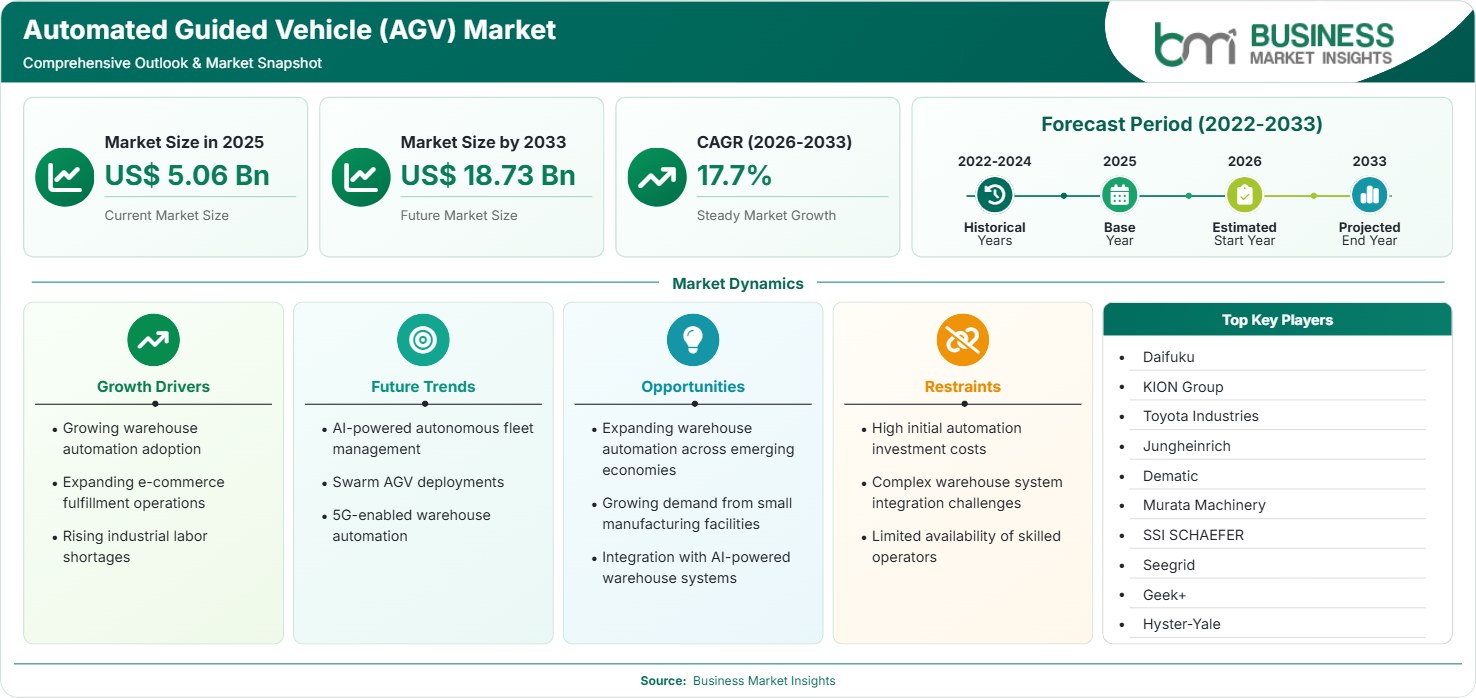
The Automated Guided Vehicle Market size was valued at US$ 5.06 Billion in 2025 and is projected to reach US$ 18.73 Billion by 2033, growing at a CAGR of 17.7% during 2026–2033. Market expansion is driven by increasing warehouse automation adoption, rapid growth of e-commerce fulfillment operations, rising industrial labour shortages, advancement in artificial intelligence-based logistics systems, and increasing demand for efficient material handling solutions.

Report Coverage
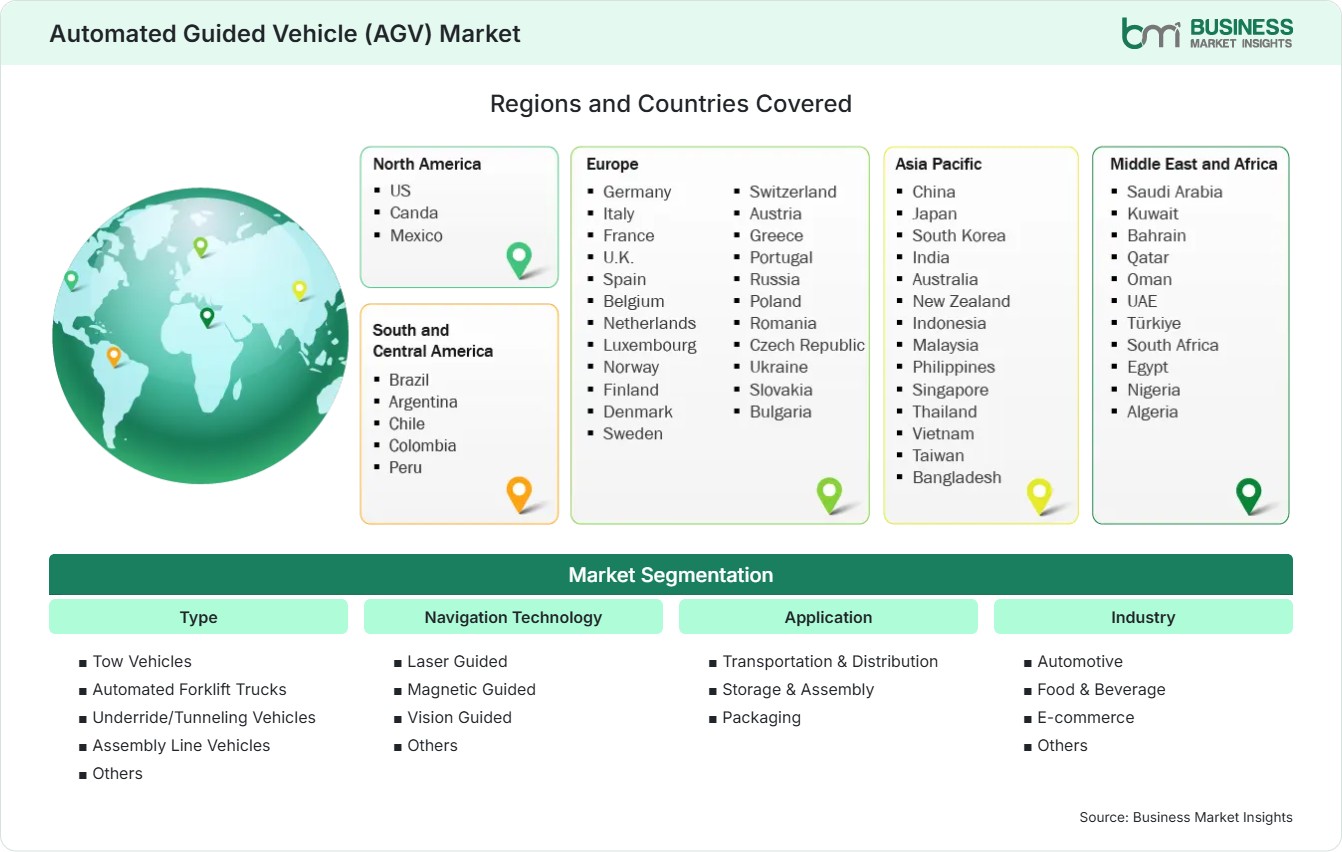
  • Type: Tow Vehicles, Automated Forklift Trucks, Underride/Tunneling Vehicles, Assembly Line Vehicles, Others
  • Navigation Technology: Laser Guided, Magnetic Guided, Vision Guided, Others
  • Application: Transportation & Distribution, Storage & Assembly, Packaging
  • Industry: Automotive, Food & Beverage, E-commerce, Others
US$ 5.06 Bn Market size in 2025
US$ 18.73 Bn Market Size by 2033
17.7% CAGR, 2026 - 2033
2026-2033 Forecast Period

AI Overview

Automated Guided Vehicle (AGV) Market Summary

  • North America Region: North America accounted for 29%–32% market share in 2025 and is projected to grow at a CAGR of 16.8%–17.4% during 2026–2033. Growth is supported by advanced logistics infrastructure, strong e-commerce activity, adoption of smart warehouses, and increasing investments in automated material handling systems. The United States market is expected to expand at a 17.0%–17.6% CAGR due to widespread automation adoption across manufacturing, retail, and distribution sectors.
  • Fastest Growing Region: Asia Pacific represents 38%–41% market share in 2025 and is projected to register the highest growth rate at a CAGR of 18.6%–19.3%, driven by expanding manufacturing capabilities, increasing industrial automation investments, e-commerce growth, and rising adoption of smart factory technologies.
  • Leading Segment: Automated Forklift Trucks represent 35%–38% automated guided vehicle market share in 2025 and are projected to grow at a CAGR of 17.9%–18.5%, supported by increasing demand for automated pallet movement, warehouse optimization, and safer material handling operations.
  • High Growth Segment: Vision Guided Navigation Technologies account for 18%–21% market share in 2025 and are expected to grow at a CAGR of 20.1%–20.8%, driven by improvements in artificial intelligence, machine vision, and flexible navigation capabilities.
  • Key Market Opportunity: Integration of AGVs with artificial intelligence, robotics platforms, warehouse management systems, and emerging market automation projects creates significant growth potential.
  • Major Market Players: Daifuku, KION Group, Toyota Industries, Jungheinrich, Dematic, Murata Machinery, SSI SCHAEFER, Seegrid, Geek+, Hyster-Yale.
Strategic Insights

Automated Guided Vehicle (AGV) Market: Strategic Insights

Automated Guided Vehicle (AGV) Market Strategic Framework
FREE PDF
Request your free sample
Request free sample
Stakeholder View

Key Takeaways

  • Warehouse automation is becoming a strategic priority as companies seek higher efficiency, improved inventory accuracy, and reduced dependence on manual labour.
  • AI-powered navigation and advanced sensor technologies are improving AGV flexibility and enabling deployment in complex industrial environments.
  • Asia Pacific offers strong growth potential due to manufacturing expansion, rising automation investments, and increasing adoption of smart factory solutions.
  • E-commerce companies are increasingly deploying AGVs to improve order fulfillment speed and manage growing warehouse volumes.
  • Small and medium-sized manufacturers represent an emerging opportunity as modular and scalable AGV solutions become more accessible.
  • Strategic partnerships between robotics companies, software providers, and logistics operators are accelerating innovation and market adoption.
Geographic Outlook

Automated Guided Vehicle (AGV) Market Regional Highlights

North America Automated Guided Vehicle Market

North America accounted for 29%–32% of global revenue in 2025 and is projected to expand at a CAGR of 16.8%–17.4% through 2033. The Automated Guided Vehicle Market share in the region is supported by advanced logistics networks, strong manufacturing automation adoption, expanding warehouse facilities, and increasing demand for operational efficiency. Companies across retail, automotive, healthcare, and distribution sectors are investing heavily in automated material handling technologies.

  • The United States leads regional adoption due to strong e-commerce growth and extensive warehouse modernization initiatives.
  • Logistics companies are deploying AGVs to improve fulfillment speed, reduce labor dependency, and optimize warehouse operations.
  • Manufacturing industries are integrating AGVs with robotics and smart factory systems to improve production efficiency.
  • Growing investments in artificial intelligence and industrial automation are supporting next-generation AGV development.
  • Large enterprises are increasingly adopting fleet management software to coordinate multiple autonomous vehicles.

US Automated Guided Vehicle Market

The United States represented 25%–28% of global revenue in 2025 and is expected to grow at a CAGR of 17.0%–17.6% during 2026–2033. Rising warehouse automation investments, labour shortages, expansion of online retail, and demand for faster supply chain operations continue driving adoption. Retailers, logistics providers, and manufacturers are increasingly implementing AGVs to improve productivity and operational reliability.

  • E-commerce fulfillment centers continue investing in automated transportation and sorting technologies.
  • Automotive manufacturers are adopting AGVs for assembly line material movement and component handling.
  • Distribution companies are integrating AGVs with warehouse management platforms for real-time operations.
  • Small and medium enterprises are gradually adopting compact and flexible automation solutions.

Europe Automated Guided Vehicle Market

Europe accounted for 24%–27% market share in 2025 and is forecast to grow at a CAGR of 17.2%–17.8% through 2033. Strong industrial automation adoption, advanced manufacturing capabilities, and emphasis on workplace safety are supporting automated guided vehicle market expansion. Germany, France, and the United Kingdom remain major contributors due to strong automotive, industrial, and logistics sectors.

  • Germany maintains leadership through advanced manufacturing automation and automotive production facilities.
  • European manufacturers are increasingly adopting AGVs to improve efficiency and address workforce challenges.
  • Sustainability initiatives are encouraging companies to optimize logistics operations and reduce energy consumption.
  • Smart factory development programs are increasing demand for connected autonomous vehicles.

Asia Pacific Automated Guided Vehicle Market

Asia Pacific represented 38%–41% of global revenue in 2025 and is expected to register the fastest growth at a CAGR of 18.6%–19.3% through 2033. The region benefits from expanding manufacturing industries, increasing e-commerce activity, rising automation investments, and government initiatives supporting industrial digitization.

  • China remains the largest regional market due to extensive manufacturing activity and rapid warehouse automation adoption.
  • Japan continues advancing robotics integration through sophisticated industrial automation systems.
  • India is experiencing rising AGV adoption due to expanding manufacturing facilities, logistics modernization, and e-commerce growth.
  • South Korea is investing in smart factories and automated production environments.
  • Southeast Asian countries are emerging as attractive markets due to industrial expansion and supply chain investments.

Rest of World Automated Guided Vehicle Market

The Rest of World region accounted for 5%–7% market share in 2025 and is projected to grow at a CAGR of 17.0%–17.6% through 2033. Latin America, the Middle East, and Africa are gradually adopting AGV technologies as companies modernize warehouses and manufacturing facilities. Increasing foreign investment in industrial infrastructure is supporting regional demand.

  • Brazil is expanding automation adoption across manufacturing and logistics sectors.
  • Mexico is benefiting from industrial development and automotive manufacturing investments.
  • Middle Eastern countries are investing in advanced logistics infrastructure and smart warehouses.
  • African markets are gradually adopting automation solutions through industrial modernization programs.
Global Market Geography
FREE PDF
Request your free sample
Request free sample
Segment Analysis

Automated Guided Vehicle (AGV) Market Segmentation

Type

The type segment represents the operational capabilities and deployment applications of automated guided vehicles across industrial environments. Automated Forklift Trucks accounted for 35%–38% market share in 2025 and are projected to grow at a CAGR of 17.9%–18.5% through 2033. The Automated Guided Vehicle Market scope is expanding as warehouses, manufacturing facilities, and distribution centers increasingly replace manual material handling equipment with autonomous transportation solutions.

  • Tow Vehicles: Continue gaining adoption in manufacturing plants and logistics facilities where multiple carts, trailers, and material units require automated movement across predefined routes.
  • Automated Forklift Trucks: Represent the largest product category due to increasing demand for automated pallet handling, warehouse storage operations, and improved workplace safety.
  • Underride/Tunneling Vehicles: Experience growing demand in e-commerce warehouses and automated storage environments because of their compact design and ability to operate beneath racks or transport platforms.
  • Assembly Line Vehicles: Support manufacturing automation by enabling continuous movement of components and materials between production stages, particularly in automotive and electronics industries.

Navigation Technology

Navigation technology plays a critical role in determining AGV flexibility, accuracy, safety, and operational efficiency. Traditional guided technologies continue supporting structured industrial environments, while advanced vision-based and artificial intelligence-driven navigation systems are expanding adoption in dynamic warehouses.

  • Laser Guided: Maintains significant market adoption due to high accuracy, reliability, and suitability for complex warehouse environments requiring precise navigation.
  • Magnetic Guided: Continues supporting applications with fixed pathways, offering cost-effective operation for manufacturing facilities with predictable material movement requirements.
  • Vision Guided: Represents the fastest-growing navigation category due to improvements in artificial intelligence, machine vision, and autonomous decision-making capabilities.

Application

The application segment reflects the expanding role of AGVs across logistics, manufacturing, and supply chain operations. Transportation and Distribution remain the leading application area as companies prioritize faster and more efficient movement of goods.

  • Transportation & Distribution: Represents the largest application segment due to increasing warehouse automation, e-commerce fulfillment requirements, and demand for efficient internal logistics.
  • Storage & Assembly: Expands through adoption in manufacturing plants where AGVs support component movement, inventory management, and production line automation.
  • Packaging: Gains importance as food, beverage, pharmaceutical, and consumer goods manufacturers automate packaging operations to improve consistency and reduce manual handling.

Industry

Industrial adoption of AGVs is increasing across multiple sectors as organizations focus on productivity improvement, operational safety, and supply chain optimization.

  • Automotive: Remains a major adopter due to complex assembly operations, high-volume production, and need for reliable component transportation.
  • Food & Beverage: Increasingly uses AGVs for warehouse movement, cold storage operations, packaging support, and hygiene-focused material handling.
  • E-commerce: Represents one of the fastest-growing applications because of increasing warehouse complexity, online order volumes, and demand for rapid fulfillment.
Market Forces

Automated Guided Vehicle (AGV) Market Dynamics

Key Market Drivers

Growing Warehouse Automation Adoption

Increasing warehouse automation adoption is one of the primary factors driving the growth of the Automated Guided Vehicle Market. Companies across retail, manufacturing, logistics, and distribution sectors are investing in automated material handling systems to improve operational efficiency, reduce errors, and optimize warehouse space utilization. The manual process that has been used in warehousing has been overtaken by automated processes that have the capability of performing repetitive transportation with high levels of precision and reliability. The growth of intelligent warehouses has resulted in an increase in the adoption of AGVs in conjunction with warehouse management systems, robotics systems, and inventory tracking systems. Growing demand for faster order processing and supply chain visibility continues encouraging businesses to adopt automated transportation solutions.

Expanding E-commerce Fulfillment Operations

The rapid expansion of e-commerce platforms is significantly increasing demand for automated warehouse technologies. Efficient and highly effective fulfillment centers are needed by online merchants and logistics firms to be able to handle a large number of orders quickly and accurately. AGVs allow the process of movement of materials and order fulfillment, giving organizations the chance to cope with increasing complexities in their operations. E-commerce firms are integrating more AGVs along with picking robots, automated storage facilities, and AI-enabled warehouse management systems. The requirement for quick deliveries, less dependency on labor, and better inventory control is driving adoption of such autonomous technologies. As online retail continues expanding globally, demand for AGVs in fulfillment centers is expected to increase significantly automated guided vehicle market forecast.

Rising Industrial Labour Shortages

Labour shortages across manufacturing and logistics industries are accelerating the adoption of automated guided vehicles. Companies are increasingly seeking automation solutions to address workforce availability challenges, reduce dependency on manual labour, and maintain operational continuity. AGVs are capable of offering consistent assistance in repetitive transport operations, allowing employees to concentrate on more important assignments. Industries facing challenges related to labour cost, labour availability, and workplace safety are becoming more and more interested in adopting such an automated material handling system. The combination of labour shortages, rising operational expenses, and demand for improved productivity is expected to remain a major driver for automated guided vehicle market growth.

Key Market Opportunities

Expanding Warehouse Automation Across Emerging Economies

Emerging economies present significant growth opportunities as manufacturers, retailers, and logistics providers increasingly modernize their warehouse infrastructure. Various countries within the Asia Pacific region, Latin America, and Middle East are embracing automation technology to enhance supply chain efficiency and growth in industries. The development of e-commerce markets, increasing foreign manufacturing investments, and government initiatives promoting industrial digitization are encouraging adoption of AGVs in emerging regions. Manufacturers offering affordable, scalable, and flexible automation solutions can benefit from increasing demand among businesses transitioning from traditional warehouse operations.

Growing Demand from Small Manufacturing Facilities

Small and medium-sized manufacturing facilities present an expanding opportunity for AGV providers as automation becomes more accessible through modular, cost-effective solutions. Earlier, AGV adoption was primarily concentrated among large enterprises due to high investment requirements. Nevertheless, technological development is making it possible for small firms to design and deploy automated processes to their specifications. Smaller AGVs, automated solutions on a subscription basis, and scalable fleet management software are helping smaller businesses overcome financial constraints. Intense competition, the need for improved efficiency, and cost optimization in manufacturing are driving smaller facilities to embrace autonomous material-handling technologies.

Integration with AI-Powered Warehouse Systems

Combining AGV platforms with artificial intelligence is one of the biggest growth opportunities in the market. Thanks to such systems, vehicles can analyze all data related to the process of their operation, calculate optimal routes, perform maintenance planning, and increase the overall efficiency of the warehouse. With modern machine learning algorithms, AGVs become adaptable and capable of working alongside other automated technologies. Integration of AI, robotics, cloud technology, and the Internet of Things has led to the development of intelligent warehouses. Firms more and more often start adopting AGV technologies that provide real-time decision-making and autonomous functioning capabilities. These automated guided vehicle market trends are expected to accelerate the transition toward fully automated and smart logistics environments.

Market Restraints and Challenges

High Initial Automation Investment Costs

Factor: Automated guided vehicles require significant upfront investments related to vehicle acquisition, software platforms, infrastructure upgrades, system integration, and employee training. Impact: High capital requirements can limit adoption among small and medium-sized enterprises and companies operating in cost-sensitive markets.

AGV implementation often involves additional expenses for warehouse redesign, charging infrastructure, fleet management systems, and maintenance capabilities. While these technologies provide long-term benefits through improved efficiency, reduced labour dependency, and higher productivity, the initial investment remains a major barrier for many organizations. Businesses with limited automation budgets may delay adoption or choose partially automated solutions instead.

Manufacturers are addressing this challenge by introducing modular AGV systems, flexible leasing models, and scalable automation solutions that allow companies to implement automation gradually. However, cost considerations continue influencing purchasing decisions, particularly among smaller organizations and emerging automated guided vehicle market users.

Complex Warehouse System Integration Challenges

Factor: Integration of AGVs with existing warehouse management systems, enterprise resource planning platforms, robotics solutions, and facility infrastructure can be technically complex. Impact: Compatibility issues, implementation delays, and operational disruptions may restrict adoption.

Modern warehouses often operate with multiple interconnected systems requiring seamless communication between AGVs, inventory management platforms, sensors, and automated equipment. Differences in software architecture, facility layouts, and operational requirements can create challenges during deployment. Companies may require specialized engineering support to customize AGV solutions according to specific workflows.

Successful implementation requires careful planning, employee training, system testing, and ongoing technical support. As warehouse environments become increasingly complex, demand is growing for AGV solutions offering better interoperability, flexible programming, and simplified integration capabilities.

Company Analysis

Competitive Landscape

The automated guided vehicle market analysis indicates a highly competitive environment driven by innovation in robotics, navigation technologies, artificial intelligence integration, and smart warehouse solutions. Leading companies are focusing on expanding product portfolios, improving autonomous capabilities, developing software-driven platforms, and strengthening partnerships with logistics providers and industrial manufacturers.

Companies are investing in advanced sensors, machine vision, cloud connectivity, and fleet management technologies to enhance AGV performance. Strategic collaborations between automation providers and end-user industries are accelerating deployment across manufacturing, e-commerce, automotive, and logistics sectors.

Company Name

Overview

Products and Services Relevant to this Market

Daifuku

Global material handling and automation company providing logistics solutions worldwide.

Automated guided vehicles, warehouse automation systems, material handling equipment, logistics software.

KION Group

Industrial automation company offering warehouse and supply chain solutions through its global brands.

AGVs, automated forklifts, warehouse management solutions, intralogistics technologies.

Toyota Industries

Global manufacturer of industrial equipment and material handling solutions.

Automated guided vehicles, automated forklifts, warehouse automation systems.

Jungheinrich

German intralogistics company specializing in warehouse equipment and automation technologies.

AGVs, automated warehouse systems, fleet management software, material handling solutions.

Dematic

Global logistics automation provider focused on intelligent supply chain solutions.

AGVs, automated storage systems, warehouse automation platforms, logistics software.

Murata Machinery

Japanese technology company providing automation solutions across industrial sectors.

AGVs, logistics automation systems, material handling technologies.

SSI SCHAEFER

Global provider of warehouse automation and storage solutions.

AGVs, automated warehouse systems, robotics solutions, intralogistics platforms.

Seegrid

Autonomous mobile robot company specializing in vision-based industrial automation.

Vision-guided AGVs, autonomous mobile robots, warehouse automation solutions.

Geek+

Robotics company focused on intelligent logistics automation solutions.

Autonomous mobile robots, warehouse robots, AI-powered logistics systems.

Hyster-Yale

Industrial equipment manufacturer providing material handling solutions globally.

Automated forklifts, warehouse equipment, industrial automation solutions.

Industry Activity

Recent Developments

November 2025

Dematic expanded its Automated Guided Vehicle (AGV) portfolio with the launch of the RTS 120 Reach Truck Series AGV. The new AGV is designed for high-bay warehouse racking applications and combines driverless automation with reach-truck functionality to improve automated storage and retrieval operations.

June 2025

Daifuku highlighted its TRVS Automated Guided Vehicle (AGV), a 6.5-ton-load-capacity vehicle designed for flexible automotive production lines. The AGV enables the replacement of fixed conveyor systems with more flexible automated transport solutions for vehicle manufacturing operations.

April 2025

Daifuku opened a new manufacturing plant in Hyderabad, India, to strengthen its local production capabilities for material handling automation systems. The expansion supports growing demand for automated logistics solutions, including AGV-based systems, across manufacturing and distribution industries.

March 2024

Toyota Material Handling Australia showcased its automated Toyota AGV reach forklift and CDI120 automated horizontal pallet carrier at the APPEX 2024 exhibition. The AGV solutions demonstrated driverless pallet movement, warehouse integration, and automated material transport capabilities.

Trust & Transparency

Research Methodology

The market analysis combines proprietary research with secondary data from government agencies, company disclosures, regulatory filings, industry databases and expert interviews. Market estimates are validated through data triangulation, cross-market benchmarking and analyst review.

View Full Research Methodology

Questions Answered

Frequently Asked Questions

What challenges limit AGV adoption?

High initial investment costs, complex system integration requirements, infrastructure modifications, and the need for technical expertise remain major challenges affecting adoption.

Why is Asia Pacific the fastest-growing region in the automated guided vehicle market report?

Asia Pacific benefits from expanding manufacturing industries, increasing e-commerce activity, government support for industrial automation, and rising investments in smart factory technologies.

How is artificial intelligence improving AGV performance?

AI enables advanced navigation, route optimization, predictive maintenance, obstacle detection, and autonomous decision-making, improving efficiency and flexibility in complex warehouse environments.

Which AGV type dominates the market?

Automated forklift trucks represent the leading segment because of their widespread use in warehouses, distribution centers, and manufacturing facilities for pallet transportation and storage operations.

What is driving growth in the Automated Guided Vehicle market?

Market growth is driven by increasing warehouse automation adoption, expansion of e-commerce fulfillment operations, rising labour shortages, smart manufacturing development, and demand for efficient material handling solutions.

Access the Full Automated Guided Vehicle (AGV) Market Report

Get segment-level forecasts, regional estimates, competitive benchmarking, company profiles and downloadable Excel datasets.

Access the full Automated Guided Vehicle (AGV) Market Report
350 pages PDF & Excel | 2026-08-03
Similar Research

Related Market Reports