
Automated Forklift Trucks Market Outlook: Size, Share, Trends, Growth Analysis, Competitive Landscape & Forecast, 2026-2033

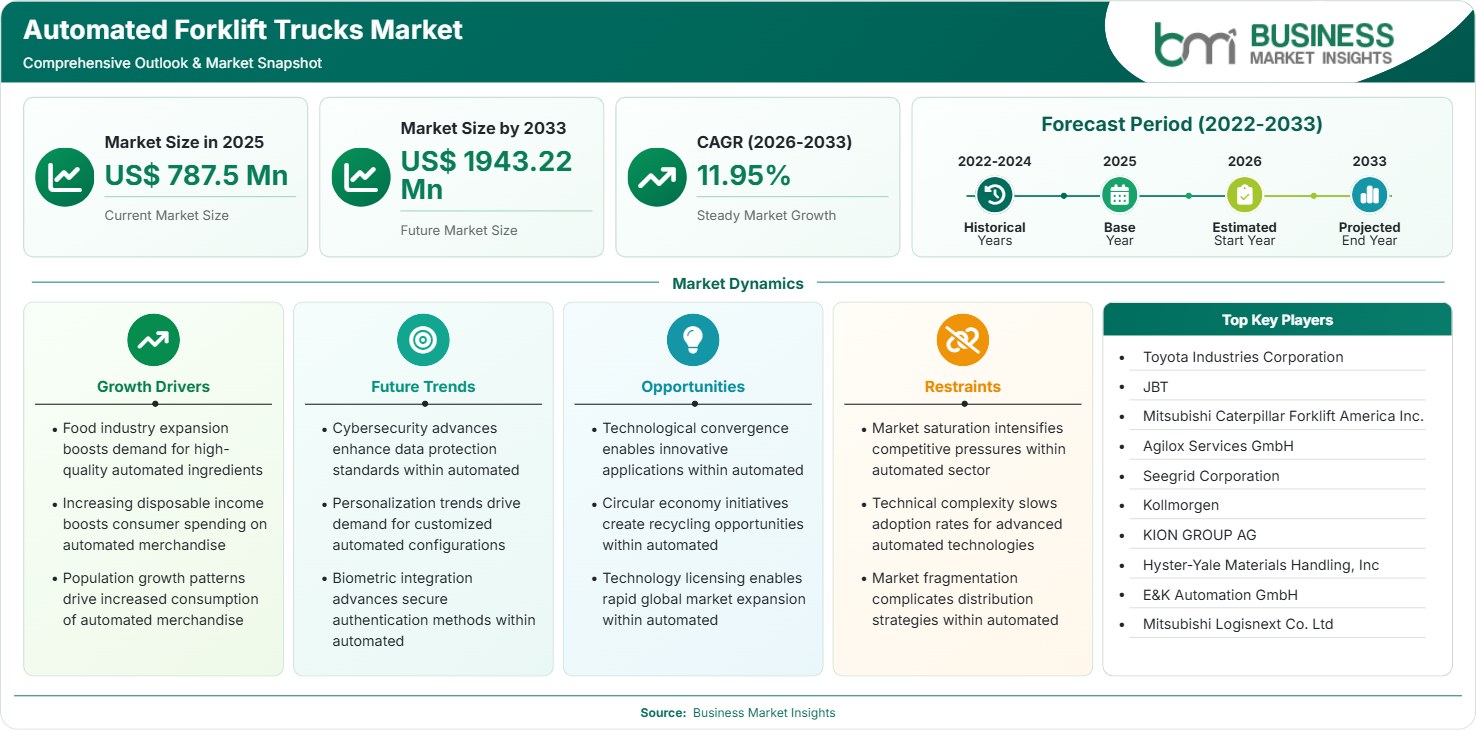
The Automated Forklift Trucks Market size was valued at US$ 787.5 Million in 2025 and is projected to reach US$ 1943.22 Million by 2033, growing at a CAGR of 11.95% during 2026–2033. Rising warehouse automation, labor shortages, Industry 4.0 adoption, AI-enabled fleet management, and expanding e-commerce logistics are accelerating deployment opportunities across manufacturing, distribution, and cold-chain operations.

Report Coverage
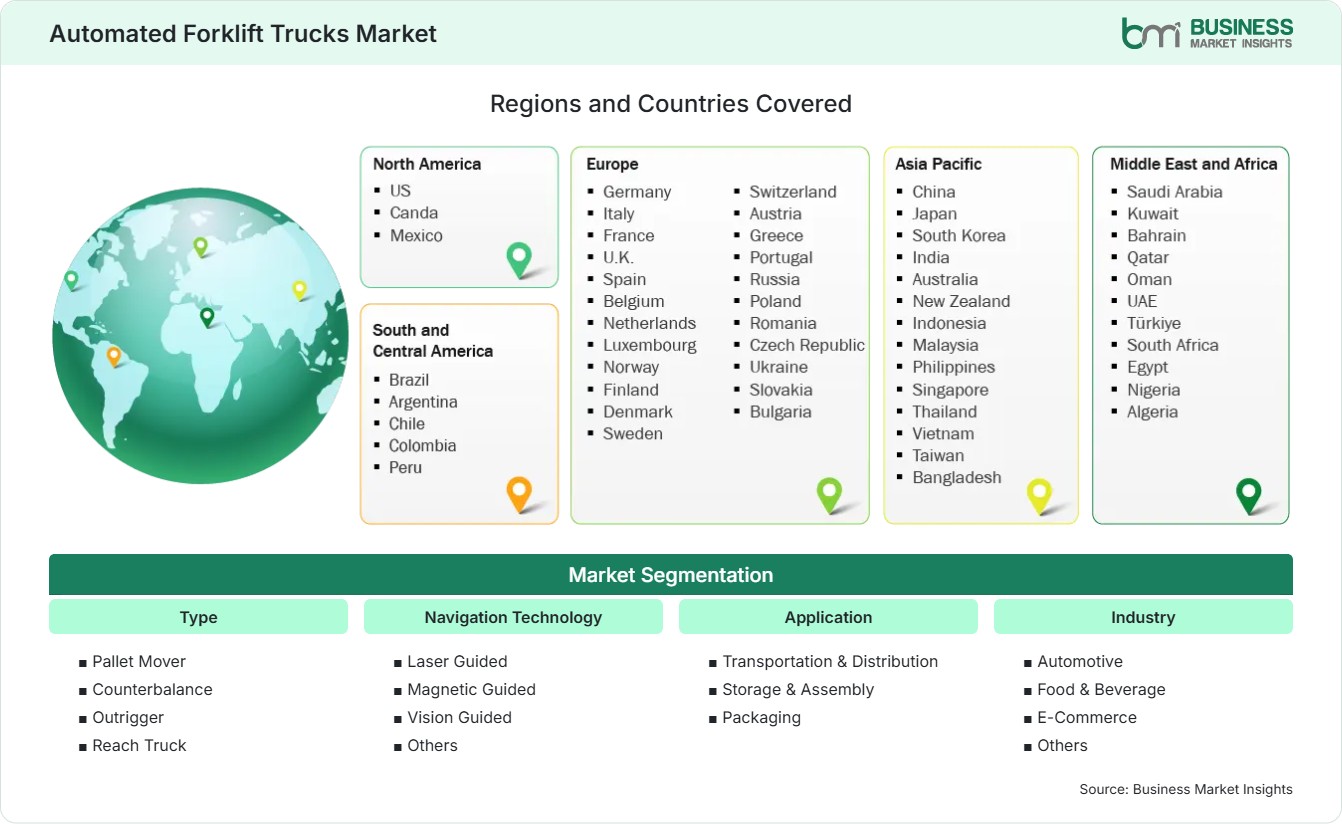
  • Type: Pallet Mover, Counterbalance, Outrigger, Reach Truck
  • Navigation Technology: Laser Guided, Magnetic Guided, Vision Guided, Others
  • Application: Transportation & Distribution, Storage & Assembly, Packaging
  • Industry: Automotive, Food & Beverage, E-Commerce, Others
US$ 787.5 Mn Market size in 2025
US$ 1943.22 Mn Market Size by 2033
11.95% CAGR, 2026 - 2033
2026-2033 Forecast Period

AI Overview

Automated Forklift Trucks Market Summary

  • North America Region: North America holds 34%–37% market share in 2025, growing with a CAGR of 11.2%–11.8% during 2026–2033. Strong warehouse automation investments, labor scarcity, digital logistics expansion, robotics integration, industrial safety regulations, and smart manufacturing initiatives continue creating significant commercial opportunities across diverse end-use industries.
    US Market: The United States represents 76%–80% of North American demand, supported by warehouse modernization, AI-enabled logistics platforms, and an estimated 11.3%–11.9% CAGR through 2033.
  • Fastest Growing Region: Asia Pacific accounts for 28%–31% of the Automated Forklift Trucks Market share in 2025 and is projected to expand at 13.2%–13.9% CAGR through 2033. Manufacturing relocation, warehouse digitization, government automation incentives, industrial robotics adoption, expanding retail logistics, and regional supply chain modernization collectively accelerate long-term deployment opportunities.
  • Leading Segment: Transportation & Distribution represents 42%–46% share in 2025 while advancing at 12.0%–12.6% CAGR. Growing distribution centers, omnichannel fulfillment requirements, autonomous pallet handling, warehouse throughput optimization, AI scheduling, and continuous investments in logistics automation sustain leadership across industrial facilities.
  • High Growth Segment: Vision-guided navigation contributes 20%–24% share during 2025 and is anticipated to record 14.0%–14.8% CAGR through 2033. Artificial intelligence vision systems, flexible warehouse layouts, dynamic obstacle detection, autonomous navigation improvements, and digital transformation initiatives are strengthening enterprise adoption in advanced logistics environments.
  • Key Market Opportunity: Increasing investments in fully autonomous distribution centers integrating AI, digital twins, cloud fleet orchestration, predictive maintenance, and industrial IoT platforms create scalable opportunities for equipment suppliers, software developers, and logistics operators worldwide.
  • Major Market Players: Toyota Industries Corporation, Jungheinrich AG, KION GROUP AG, Mitsubishi Logisnext Co., Ltd., Hyster-Yale Materials Handling, Inc., Crown Equipment Corporation, Seegrid Corporation, Oceaneering International, Inc., Balyo SA, and AGILOX Services GmbH.
Strategic Insights

Automated Forklift Trucks Market: Strategic Insights

Automated Forklift Trucks Market Strategic Framework
FREE PDF
Request your free sample
Request free sample
Stakeholder View

Key Takeaways

  • The competitive ecosystem increasingly combines forklift manufacturers, navigation software developers, battery suppliers, warehouse management platform providers, and systems integrators, creating integrated value chains that prioritize interoperability, lifecycle services, and recurring software revenues.
  • Transportation and distribution facilities continue presenting the strongest commercial upside as fulfillment centers expand automation investments to improve throughput, reduce labor dependency, minimize operational errors, and optimize inventory movement across increasingly complex supply networks.
  • Innovation is shifting from fixed-route automation toward AI-enabled perception, machine learning-based route optimization, collaborative fleet intelligence, digital twins, and cloud-connected predictive maintenance, enabling more adaptive warehouse operations with higher asset utilization.
  • Asia Pacific offers one of the strongest long-term investment opportunities, supported by manufacturing expansion, industrial automation initiatives, increasing warehouse construction, and sustained capital expenditure across logistics infrastructure in China, India, Vietnam, and Southeast Asia.
  • Strategic acquisitions increasingly target robotics software, autonomous navigation technologies, lithium-ion battery solutions, and warehouse automation specialists, reflecting industry preference for integrated automation portfolios capable of delivering end-to-end material handling solutions.
  • Sustainability objectives are encouraging adoption of energy-efficient electric autonomous forklifts, optimized fleet utilization, intelligent charging infrastructure, and data-driven operational management that reduce emissions while improving warehouse productivity.
Geographic Outlook

Automated Forklift Trucks Market Regional Highlights

North America Automated Forklift Trucks Market

North America accounted for 34%–37% of global revenue during 2025 and is forecast to expand at a CAGR of 11.2%–11.8% through 2033. The region benefits from widespread warehouse automation, advanced robotics integration, labor shortages, and extensive deployment of warehouse management software. Strong investments from third-party logistics providers, automotive manufacturers, food distribution companies, and e-commerce operators continue strengthening the Automated Forklift Trucks Market share while accelerating adoption of AI-enabled autonomous material handling technologies across large-scale industrial facilities.

  • Growing labor shortages encourage logistics operators to automate repetitive pallet movement, reducing operational costs while improving warehouse productivity, safety compliance, inventory visibility, and continuous operations across multi-shift fulfillment centers.
  • Expansion of omnichannel retail fulfillment continues increasing investments in autonomous warehouse equipment integrated with AI scheduling, industrial IoT platforms, cloud fleet management, and predictive maintenance capabilities.
  • Automotive manufacturing facilities increasingly deploy autonomous forklifts to synchronize production logistics, improve just-in-time material delivery, reduce downtime, and enhance workplace safety through intelligent navigation technologies.
  • Industrial safety regulations and digital manufacturing initiatives continue supporting investments in autonomous material handling equipment capable of minimizing workplace incidents while improving operational consistency and equipment utilization.
  • Increasing integration between warehouse management software and autonomous forklift fleets enables real-time inventory visibility, optimized routing, improved fleet coordination, and measurable operational efficiency gains.

US Automated Forklift Trucks Market

The United States accounts for 76%-80% of revenue in the North American Automated Forklift Trucks Market and is expected to grow at a CAGR of 11.3%-11.9% through 2033. The rise in warehouse construction, the use of artificial intelligence, the upgrading of fulfillment centers, robotics, and sophisticated cloud logistics systems help establish leadership within the country. Autonomous forklifts are becoming popular among big retail companies, third-party logistics firms, automobile makers, and food processing plants, which are increasingly prioritizing them to improve productivity, workforce safety, and supply chain resilience while supporting expanding domestic manufacturing initiatives.

  • Major retailers continue expanding automated fulfillment networks using autonomous forklifts integrated with warehouse execution systems to improve order accuracy, inventory movement, and labor efficiency across nationwide distribution facilities.
  • Domestic manufacturing reshoring initiatives encourage investment in intelligent factory automation where autonomous forklifts streamline material transport between production cells while reducing operational bottlenecks.
  • Rising investments in lithium-ion-powered industrial vehicles improve equipment availability, faster charging cycles, reduced maintenance requirements, and long-term sustainability performance across warehouse operations.
  • AI-powered fleet analytics and predictive maintenance platforms enable operators to optimize asset utilization, minimize downtime, and improve lifecycle management across expanding autonomous warehouse fleets.

Europe Automated Forklift Trucks Market

The European Automated Forklift Trucks market accounts for 25% - 28% of global demand in 2025 and is expected to grow at 10.8% - 11.4% through 2033. Advanced levels of industrial automation, safety regulations, and Industry 4.0 adoption continue to drive further adoption. The German market leads all national markets in Europe, and Poland stands out for high regional growth, driven by logistics, industrial infrastructure development, and automated warehousing that support regional supply chain transformation.

  • Germany maintains regional leadership through advanced manufacturing capabilities, strong adoption of warehouse automation, and continuous investment in industrial robotics that supports automotive and machinery production.
  • Poland records one of the strongest expansion rates as multinational logistics companies establish automated fulfillment centers that serve European distribution networks and cross-border e-commerce.
  • Sustainability initiatives encourage replacing conventional industrial vehicles with electric, autonomous alternatives featuring intelligent energy management and optimized operational efficiency.
  • Growing investments in pharmaceuticals and cold-chain logistics are accelerating demand for highly reliable autonomous warehouse vehicles capable of operating safely in temperature-controlled environments.
  • Collaborative research among robotics companies, universities, and industrial manufacturers accelerates the commercialization of next-generation navigation, perception, and warehouse-intelligence technologies.

Asia Pacific Automated Forklift Trucks Market

Asia Pacific region holds a revenue share of 28% to 31% in the Automated Forklift Trucks Market in 2025 and will exhibit the fastest growth rate, at a 13.2% to 13.9% CAGR, until 2033. China continues to be the most prominent country owing to its manufacturing and warehouse investments in smart automation, whereas India is growing rapidly with support from logistics improvements, industrial corridor development, and expanding e-commerce infrastructure, and government initiatives promoting smart manufacturing across diverse industrial sectors.

  • China remains the leader in implementing autonomous warehouses with the help of highly developed manufacturing systems, robotization, and massive automation investments in the electronics and automotive sectors.
  • India is experiencing rapid growth due to the implementation of logistics parks, the construction of fulfillment centers, digital manufacturing initiatives, and the adoption of automated warehouses by local companies.
  • Southeast Asian countries are becoming popular destinations for relocating manufacturing operations, and investments in automated intralogistics are increasingly common in export-oriented industrial production.
  • Rising labor costs motivate manufacturers to deploy autonomous material handling technologies capable of improving productivity, operational consistency, and long-term warehouse efficiency.
  • Expansion of cold-chain logistics, food processing, and pharmaceutical manufacturing strengthens demand for reliable autonomous forklifts operating across specialized storage environments.

Rest of World Automated Forklift Trucks Market

Rest of World holds an 8%-10% share of global revenues by 2025, with a CAGR of 11.5%-12.1%. The South & Central America region sees its growth fueled by improvements in warehouse automation and investments in retail logistics driven by Brazil. The Middle East & Africa are seeing rising implementation in both the UAE and Saudi Arabia, owing to smart logistics corridors, industrial diversification programs, and expanding distribution infrastructure that supports regional trade.

  • * Brazil keeps on investing in warehouse automation due to its retail growth, manufacturing upgradation, and the use of intelligent logistics that assist in enhancing domestic distribution.
  • UAE autonomous warehousing is fast becoming popular due to smart logistics, well-developed ports, and regional logistics hubs that facilitate international trade.
  • In Saudi Arabia, economic diversification efforts are driving investment in automated manufacturing units, intelligent warehouses, and a digital logistics environment, in line with the country’s economic diversification plans.
  • Industries such as mining, food processing, and industrial manufacturing are increasingly exploring the use of autonomous forklifts to improve safety, productivity, and worker efficiency in challenging work environments.
  • Foreign investment in logistics infrastructure promotes the use of scalable warehouse automation technology, which helps in building resilient supply chains and efficient inventory management.
Global Market Geography
FREE PDF
Request your free sample
Request free sample
Segment Analysis

Automated Forklift Trucks Market Segmentation

Type

Type contributed significantly to industry revenue in 2025, accounting for about 36%–40% of total revenue, and is expected to grow at a CAGR of 11.7%–12.3% between 2023 and 2033. The choice of equipment depends on factors such as facility design, pallet density, lift height, aisle width, and complexity level. The scope of the Automated Forklift Trucks Market continues to expand, as the equipment takes over the roles of conventional forklift trucks in various industrial environments where constant material flow is essential.

  • Pallet Mover: Widely deployed in warehouses and distribution facilities for repetitive horizontal pallet transportation, pallet movers improve operational efficiency, minimize manual handling, enhance workplace safety, and support continuous automated logistics workflows across fulfillment operations.
  • Counterbalance: Counterbalance automated forklifts remain preferred for versatile indoor and outdoor applications requiring flexible load handling, supporting manufacturing, logistics, and industrial operations with reliable lifting performance across diverse warehouse environments.
  • Outrigger: Outrigger models provide enhanced stability during narrow-aisle operations and high-density storage applications, enabling precise pallet positioning, optimized warehouse space utilization, and efficient material movement within compact industrial facilities.
  • Reach Truck: Reach trucks are increasingly adopted for high-bay warehousing where vertical storage optimization is essential, delivering accurate pallet retrieval, improved inventory accessibility, and greater operational efficiency through autonomous navigation capabilities.

Navigation Technology

Navigation Technology is one of the most rapidly evolving areas within the sector, contributing 24%-28% of total market revenues by 2025, with growth at a CAGR of 12.8%-13.5% through 2033 in the Automated Forklift Trucks Market. The development of new sensor-based AI, computer vision, LiDAR, and SLAM technologies is enhancing accuracy, flexibility, and autonomous decision-making, enabling broader deployment in dynamic warehouse environments with changing layouts.

  • Laser Guided: Laser-guided systems remain widely implemented because of their proven positioning accuracy, dependable navigation performance, predictable route planning, and compatibility with structured warehouse environments requiring repeatable material handling operations.
  • Magnetic Guided: Magnetic-guided navigation continues serving facilities requiring reliable predefined travel paths, offering dependable operation, simplified maintenance, and cost-effective deployment for repetitive logistics workflows within established manufacturing environments.
  • Vision Guided: Vision-guided technologies leverage artificial intelligence, machine vision, and real-time object recognition to navigate dynamic environments, increasing operational flexibility while reducing dependence on physical infrastructure modifications inside warehouses.

Application

The applications segment is the highest revenue earner and accounted for about 42%-46% of the Automated Forklift Trucks Market in 2025 with a CAGR of 12.0%-12.6% from 2025 to 2033. Rising adoption of warehousing automation programs, omnichannel fulfillment, increasing inventory management complexity, and the need for quick order processing are among the factors driving demand for automated material handling systems across various logistics operations.

  • Transportation & Distribution: Distribution centers increasingly deploy autonomous forklifts to accelerate pallet movement, improve inventory flow, reduce labor dependency, and support high-volume fulfillment operations requiring continuous warehouse productivity.
  • Storage & Assembly: Manufacturing facilities adopt automated forklifts to streamline component transportation, synchronize production processes, improve inventory accuracy, and maintain uninterrupted material availability across assembly operations with minimal human intervention.
  • Packaging: Packaging facilities utilize autonomous forklifts for finished goods transportation, pallet staging, and production line support, improving operational consistency while reducing handling delays across high-throughput manufacturing environments.

Industry

Industry-specific uptake represented about 31% - 35% of overall Automated Forklift Trucks Market requirements in 2025 and is expected to grow at a CAGR of 12.4% - 13.1% during 2033. Growing digital transformation, labor optimization practices, warehouse upgrades, and intelligent manufacturing remain key drivers of adoption across various industries. More end users are seeking automation solutions that integrate with warehouse management systems and enterprise software.

  • Automotive: Automotive manufacturers deploy autonomous forklifts to support just-in-time production, improve component logistics, reduce assembly interruptions, and enhance operational efficiency throughout vehicle manufacturing and supplier facilities.
  • Food & Beverage: Food and beverage facilities increasingly implement automated forklifts to improve hygiene compliance, optimize cold-chain logistics, maintain product traceability, and ensure consistent material movement within temperature-controlled warehouse environments.
  • E-Commerce: E-commerce operators accelerate autonomous forklift adoption to support high-volume fulfillment, faster order processing, improved inventory management, scalable warehouse operations, and growing customer expectations for rapid product delivery.
Market Forces

Automated Forklift Trucks Market Dynamics

Key Market Drivers

Warehouse Automation Accelerates Autonomous Material Handling Adoption

Warehousing operations worldwide are undergoing rapid digital transformation as organizations pursue higher productivity, lower operating costs, and improved fulfillment accuracy. The Automated Forklift Trucks Market growth is strongly supported by investments in autonomous warehouses integrating warehouse management systems, industrial IoT, artificial intelligence, and real-time fleet optimization platforms. According to the International Federation of Robotics (IFR), there have been ongoing robot installations across industries worldwide, indicating consistent investment in automation technologies in manufacturing and logistics. Larger distribution centers are using autonomous forklifts to minimize manual labor and improve inventory traceability, while operating around the clock and across various shifts. This helps organizations generate higher returns on their investments, address labor shortages, and increase workplace safety and throughput efficiency without increasing the workforce.

Expansion of E-Commerce and Omnichannel Logistics Networks

Rapid growth in e-commerce and omnichannel retail fulfillment continues to drive demand for intelligent material-handling solutions capable of supporting high-volume warehouse operations. Global retailers and logistics service providers are developing fulfillment centers in proximity to their customers to minimize delivery time while ensuring that they have inventory available. The use of autonomous forklifts ensures continuous pallet handling, automated replenishment, and efficient dock-to-storage movement, eliminating logistical barriers that can arise during high demand. Higher parcel volumes and increased complexity in stock-keeping units force warehousing operations to ensure maximum storage efficiency and minimize any handling errors.

Industry 4.0 and Smart Manufacturing Investments Drive Fleet Modernization

Industrial firms in the automotive, electronics, food processing, pharmaceutical, and heavy industry sectors continue developing Industry 4.0 solutions that include connected devices, predictive analytics, cloud computing, and intelligent automation technologies. These modernization projects aim to replace human-controlled forklift trucks with autonomous units that can interact directly with manufacturing execution and enterprise resource planning systems. Automated Forklift Trucks Market trends show increasing demand for automation systems that provide users with real-time visibility, predictive maintenance, and efficient fleet operations. Companies also pay close attention to the development of electric autonomous forklift trucks to support sustainable policies by minimizing energy use and emissions.

Key Market Opportunities

AI-Driven Smart Warehouses Create Long-Term Automation Investment Potential

The transition toward fully autonomous warehouses presents one of the strongest expansion opportunities for equipment manufacturers, robotics developers, and warehouse software providers. According to the Automated Forklift Trucks Market Forecasts, organizations will continue to invest in technologies such as artificial intelligence, digital twins, the Industrial Internet of Things, and cloud-based fleet management as part of their future logistics centers. More major retailers, third-party logistics providers, and manufacturers are looking for automation solutions that can manage the operations of autonomous forklift trucks and other robots, such as picking robots, automatic storage and retrieval systems, and warehouse execution systems. An increasing demand for real-time operational intelligence, predictive maintenance, and energy optimization creates new revenue streams through software subscriptions, lifecycle services, and fleet analytics, while enhancing warehouse efficiency and reducing operating expenses.

Cold Chain and Pharmaceutical Logistics Expand Autonomous Equipment Demand

The healthcare, pharmaceutical, biotechnology, and food industries continue to expand temperature-controlled logistics infrastructure to meet growing global demand for sensitive products. Automation with safe-to-use forklift trucks in frozen warehouses is instrumental in enhancing inventory accuracy, minimizing product damage, and ensuring smooth business operations in such harsh conditions. Expansion of production capacity for pharmaceuticals, vaccines, and biologics is prompting warehouse owners to adopt advanced material-handling systems that comply with traceability regulations. Providers that supply navigational technology, corrosion-resistant parts, and low-temperature performance are likely to benefit from increased investment in cold chain infrastructure in North America, Europe, Asia-Pacific, and some locations in the Middle East.

Emerging Manufacturing Economies Offer Untapped Commercial Potential

The expansion of industries in India, Vietnam, Indonesia, Mexico, Poland, Brazil, and the Gulf countries is creating an ideal environment for investment in warehouse automation technology. Government schemes to promote intelligent manufacturing, industrial corridors, export-oriented manufacturing, and the development of logistics infrastructure are boosting demand for automated material-handling equipment. Manufacturers at multinational companies that shift production plants also need consistent warehouse automation systems to maintain operations across their manufacturing networks. Equipment vendors capable of supplying modular autonomous fleets and cloud-based fleet management will be able to establish sustainable customer relationships.

Market Restraints and Challenges

High Initial Capital Investment Limits Adoption Among Small Enterprises

Factor: Deployment of autonomous forklifts entails a considerable initial investment, including equipment purchases, navigation system setup, integration with warehouse management systems, employee training, and necessary modifications.

Impact: Smaller businesses tend to have longer payback periods due to their limited funds, making automation less attractive even when there is a tangible productivity gain. Costs associated with integration into warehouse management systems, industrial wireless systems, and safety validation add to implementation expenses. Businesses that lack sufficient financial resources choose warehouse upgrades over full-fledged automation solutions. While there is considerable economic benefit over time, the problem of financial limitations remains.

Complex System Integration and Cybersecurity Risks Increase Deployment Challenges

Factor: Autonomous forklifts require uninterrupted connection to warehouse management systems, cloud services, industrial IoT, navigation software, and enterprise systems, leading to integration difficulties and increased cybersecurity exposure.

Impact: Incompatibility with old infrastructure, lack of uniform communication protocols, and increased cybersecurity concerns can result in implementation delays and higher risks. The company needs to provide seamless interoperability and uninterrupted wireless communication while ensuring software upgrades are performed. Ransomware attacks against industrial infrastructure have been on the rise, necessitating additional investments in cybersecurity governance and monitoring.

Company Analysis

Competitive Landscape

The competitive landscape remains highly dynamic, with manufacturers enhancing autonomous driving features, software integration, lithium-ion technology, and intelligent fleet management systems. According to the Automated Forklift Trucks Market analysis increase in collaboration between manufacturers of industrial vehicles, robotics firms, warehouse automation companies, and software organizations to provide comprehensive intralogistics solutions.

Company Name

Overview

Products and Services Relevant to this Market

Toyota Industries Corporation

Global leader in material handling equipment with extensive manufacturing capabilities, advanced automation technologies, and worldwide service infrastructure supporting industrial logistics operations.

Autonomous forklifts, automated guided vehicles, electric forklifts, warehouse automation solutions, fleet management software, lithium-ion powered material handling equipment, and lifecycle maintenance services.

Jungheinrich AG

German intralogistics specialist recognized for warehouse automation, digital warehouse technologies, autonomous mobile solutions, and energy-efficient electric forklift innovation.

Automated guided forklifts, reach trucks, warehouse management software, lithium-ion battery systems, navigation technologies, fleet optimization, and warehouse automation integration services.

KION GROUP AG

Leading provider of industrial trucks and integrated supply chain solutions through globally recognized automation and warehouse technology brands.

Automated forklifts, autonomous warehouse vehicles, warehouse execution software, robotics integration, automated storage solutions, digital fleet management, and material handling services.

Mitsubishi Logisnext Co., Ltd.

Major global supplier of forklift trucks and logistics equipment serving manufacturing, retail, and warehouse automation customers across international markets.

Autonomous forklifts, electric lift trucks, warehouse vehicles, fleet monitoring systems, navigation technologies, logistics equipment, and industrial automation support solutions.

Hyster-Yale Materials Handling, Inc.

Industrial lift truck manufacturer focusing on intelligent material handling technologies, electrification, warehouse productivity, and connected fleet solutions.

Counterbalance forklifts, autonomous lift truck technologies, warehouse fleet management, electric forklifts, operator assistance systems, and industrial logistics equipment.

Crown Equipment Corporation

Global material handling manufacturer emphasizing connected warehouse technologies, operator productivity, equipment reliability, and integrated digital fleet management.

Reach trucks, pallet movers, warehouse automation equipment, fleet management software, electric forklifts, warehouse optimization technologies, and maintenance solutions.

Seegrid Corporation

Autonomous mobile robot developer specializing in vision-based industrial automation and intelligent pallet movement solutions for manufacturing and distribution facilities.

Autonomous lift trucks, AMRs, autonomous pallet transport, Fleet Central software, vision-guided navigation, fleet analytics, and warehouse automation platforms.

Oceaneering International, Inc.

Engineering and robotics company delivering autonomous vehicle technologies and industrial automation solutions supporting logistics and specialized material handling operations.

Autonomous navigation technologies, robotic vehicle platforms, industrial automation software, systems integration, remote operations, and intelligent mobility solutions.

Balyo SA

Robotics company focused on autonomous forklift automation using advanced navigation software integrated with established industrial vehicle platforms.

Autonomous reach trucks, counterbalance forklifts, pallet stackers, tugger robots, AGV software, warehouse automation platforms, and fleet orchestration solutions.

AGILOX Services GmbH

Austrian autonomous mobile robot developer providing decentralized fleet intelligence and flexible intralogistics automation for manufacturing and warehouse operations.

Autonomous mobile robots, driverless forklifts, fleet management software, decentralized navigation systems, warehouse automation solutions, and intelligent material transport platforms.

Trust & Transparency

Research Methodology

The market analysis combines proprietary research with secondary data from government agencies, company disclosures, regulatory filings, industry databases and expert interviews. Market estimates are validated through data triangulation, cross-market benchmarking and analyst review.

View Full Research Methodology

Questions Answered

Frequently Asked Questions

What technologies are shaping the next generation of autonomous forklifts?

Key innovations include LiDAR, machine vision, AI-powered navigation, digital twins, cloud fleet orchestration, industrial IoT connectivity, lithium-ion battery systems, predictive analytics, and interoperable warehouse management platforms that improve automation flexibility and operational performance.

What does the Automated Forklift Trucks Market Report typically evaluate?

The report examines market size, competitive positioning, technology evolution, regional demand, regulatory influences, segmentation, investment opportunities, innovation trends, company strategies, and long-term industry outlook to support informed business and investment decisions.

How does artificial intelligence improve autonomous forklift performance?

Artificial intelligence enhances obstacle detection, route optimization, fleet coordination, predictive maintenance, dynamic decision-making, and warehouse traffic management. Combined with computer vision and sensor fusion, AI enables autonomous forklifts to operate safely within complex and changing warehouse environments.

Which industries are investing most heavily in automated forklift technologies?

Automotive, food and beverage, e-commerce, third-party logistics, pharmaceuticals, consumer goods, and electronics manufacturing represent the largest investors. These industries require continuous material movement, inventory accuracy, and scalable warehouse automation to improve productivity and meet increasing customer expectations.

What are the primary factors driving adoption of the automated forklift trucks market?

Growing warehouse automation, labor shortages, expanding e-commerce fulfillment, Industry 4.0 initiatives, and demand for improved workplace safety are accelerating adoption. Organizations also seek higher operational efficiency, real-time inventory visibility, and lower long-term operating costs through autonomous material handling technologies.

Access the Full Automated Forklift Trucks Market Report

Get segment-level forecasts, regional estimates, competitive benchmarking, company profiles and downloadable Excel datasets.

Access the full Automated Forklift Trucks Market Report
350 pages PDF & Excel | 2026-08-17