
Forklift Trucks Market Outlook: Size, Share, Trends, Growth Analysis, Competitive Landscape & Forecast, 2026-2033

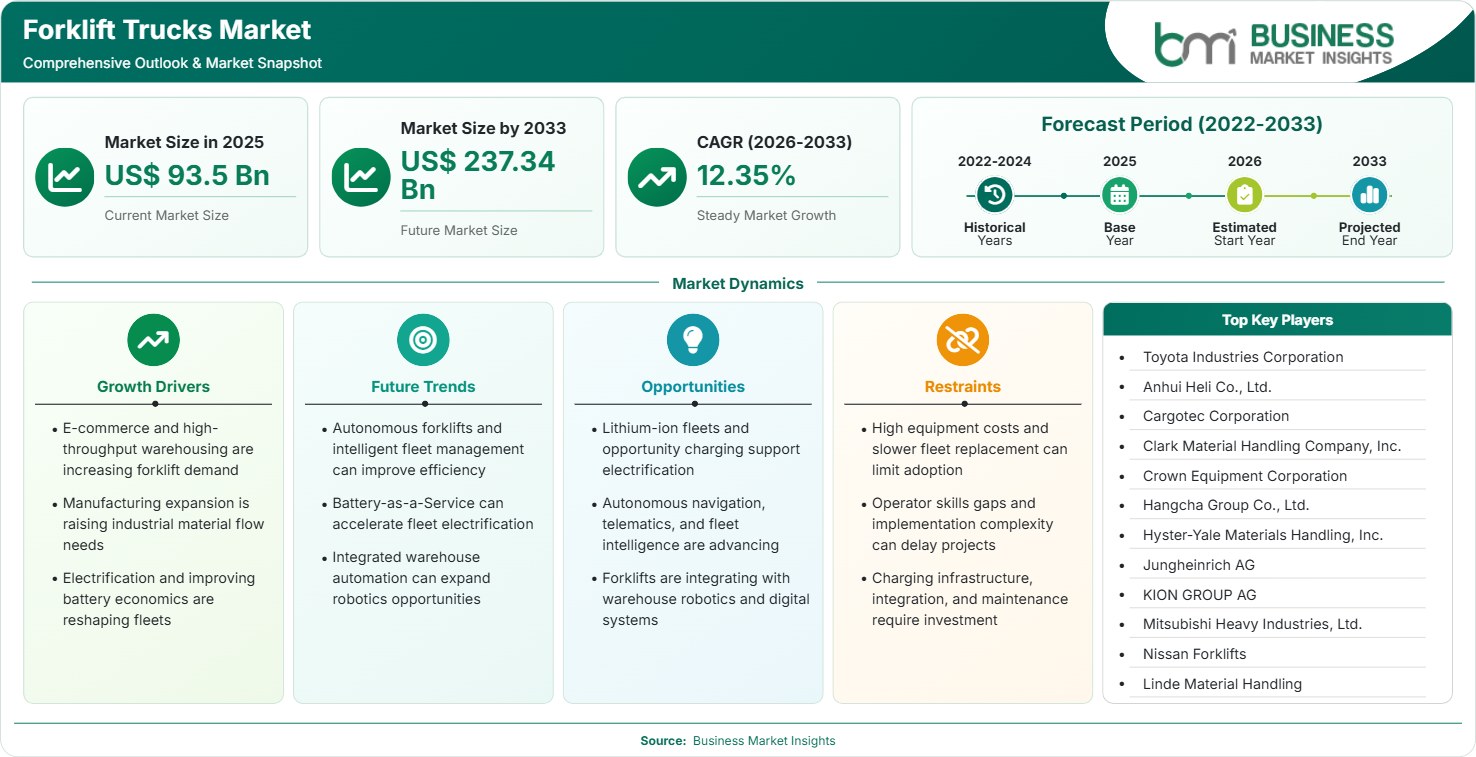
The Forklift Trucks Market size was valued at US$ 93.5 Billion in 2025 and is projected to reach US$ 237.34 Billion by 2033, growing at a CAGR of 12.35% during 2026–2033, driven by warehouse automation, e-commerce fulfillment, industrial expansion, fleet electrification, lithium-ion adoption, smart logistics, and demand for safer material-handling operations.

Report Coverage
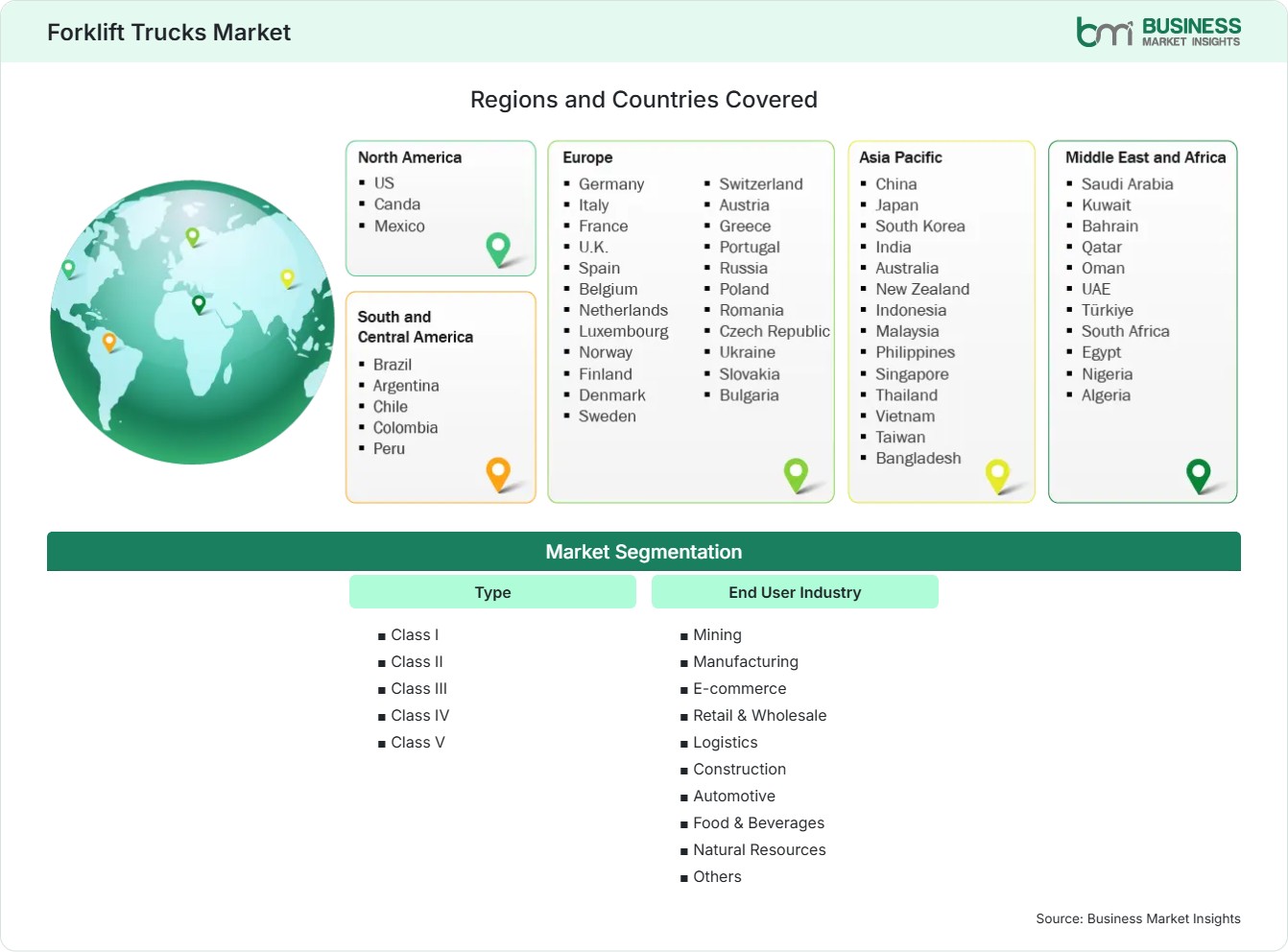
  • Type: Class I, Class II, Class III, Class IV, Class V
  • End User Industry: Mining, Manufacturing, E-commerce, Retail & Wholesale, Logistics, Construction, Automotive, Food & Beverages, Natural Resources, Others
US$ 93.5 Bn Market size in 2025
US$ 237.34 Bn Market Size by 2033
12.35% CAGR, 2026 - 2033
2026-2033 Forecast Period

AI Overview

Forklift Trucks Market Summary

  • North America Region: North America holds a Forklift Trucks Market share of 24%–27% in 2025, growing with a CAGR of 11.2%–11.9% during 2026–2033. Warehouse automation, reshoring, manufacturing investment, distribution-center expansion, and fleet electrification are increasing forklift utilization, while connected fleet-management systems improve uptime, safety, and operating efficiency across logistics and industrial facilities. The US market remains dominant in the region, supported by advanced warehousing and a CAGR of 11.4%–12.0% through 2033.
  • Fastest Growing Region: Asia Pacific accounts for a 46%–49% share in 2025 and is expected to expand at a CAGR of 13.6%–14.4% during 2026–2033. Rapid industrialization, expanding e-commerce fulfillment networks, manufacturing growth, infrastructure development, electrification initiatives, and rising investment in automated warehouses are strengthening demand across China, India, Japan, and Southeast Asia.
  • Leading Segment: Class III forklifts represent a 28%–31% share of the Forklift Trucks Market in 2025 and are projected to grow at a CAGR of 11.9%–12.7% during 2026–2033. Demand is supported by warehouse picking, order fulfillment, compact maneuverability, electric powertrains, lower indoor emissions, and increasing adoption across e-commerce and retail distribution operations.
  • High Growth Segment: E-commerce end users account for 18%–21% share of the Forklift Trucks Market in 2025 and are forecast to expand at a CAGR of 14.4%–15.2% during 2026–2033. Rapid parcel volumes, automated fulfillment centers, inventory turnover, multi-level warehousing, and demand for faster material movement are strengthening forklift fleet investments.
  • Key Market Opportunity: Lithium-ion electrification, autonomous forklifts, telematics, computer vision, and warehouse software integration are creating higher-value fleet solutions that improve productivity, reduce downtime, enhance safety, and support scalable automation.
  • Major Market Players: Toyota Industries Corporation; Anhui Heli Co., Ltd.; Cargotec Corporation; Clark Material Handling Company, Inc.; Crown Equipment Corporation; Hangcha Group Co., Ltd.; Hyster-Yale Materials Handling, Inc.; Jungheinrich AG; KION Group AG; Mitsubishi Heavy Industries, Ltd.; Nissan Forklifts; Linde Material Handling; Kalmar Corporation; Cesab Material Handling; Cimbria; Hyundai Corporation; Doosan Corporation; BYD Company Limited; SANY Group; Hangcha Group Co., Ltd.
Strategic Insights

Forklift Trucks Market: Strategic Insights

Forklift Trucks Market Strategic Framework
FREE PDF
Request your free sample
Request free sample
Stakeholder View

Key Takeaways

  • Supply chains are shifting from standalone vehicle procurement toward integrated fleets combining forklifts, batteries, charging infrastructure, telematics, warehouse software, and after-sales services.
  • E-commerce, third-party logistics, and high-throughput distribution centers offer the strongest upside because frequent order movements require reliable, compact, and increasingly automated material-handling equipment.
  • Product development is moving toward lithium-ion powertrains, autonomous navigation, regenerative systems, advanced operator-assistance features, and predictive maintenance capabilities that improve total cost of ownership.
  • Asia Pacific offers the strongest investment case as industrialization, manufacturing relocation, warehouse construction, and regional e-commerce expansion increase demand for both conventional and automated fleets.
  • Strategic partnerships across automation, robotics, batteries, software, and financing are increasing as manufacturers seek to build broader material-handling ecosystems and deepen customer relationships.
  • Fleet replacement cycles are becoming more technology-driven, with customers evaluating energy efficiency, connected diagnostics, safety analytics, and integration capabilities alongside vehicle capacity and purchase price.
Geographic Outlook

Forklift Trucks Market Regional Highlights

North America Forklift Trucks Market

North America accounted for 24%–27% of global revenue in 2025 and is projected to expand at a CAGR of 11.2%–11.9% through 2033. The region benefits from advanced logistics infrastructure, warehouse automation, manufacturing reshoring, and replacement demand for aging fleets. The Forklift Trucks Market share is reinforced by strong investment in distribution centers, cold-chain facilities, and industrial warehouses. Electric equipment adoption is accelerating as operators seek lower maintenance requirements, improved indoor air quality, and compliance with increasingly stringent workplace and environmental expectations across major industrial markets.

  • Automated distribution centers are increasing demand for compact electric forklifts, reach trucks, and connected equipment capable of operating alongside conveyors, autonomous mobile robots, and warehouse control systems.
  • Manufacturing reshoring and expansion of domestic production facilities are strengthening demand for heavy-duty material-handling equipment across automotive, industrial machinery, food processing, and consumer goods operations.
  • Fleet telematics adoption enables operators to monitor utilization, impacts, maintenance needs, battery performance, and operator behavior, creating measurable productivity and safety improvements.
  • Rental and leasing models are gaining traction because customers can modernize fleets while preserving capital for warehouse automation, inventory systems, and other operational investments.
  • Strong dealer and service networks remain important purchasing criteria because uptime, replacement parts availability, technician response times, and financing support influence total fleet economics.

US Forklift Trucks Market

The United States represented approximately 78%–82% of North American revenue in 2025 and is forecast to register a CAGR of 11.4%–12.0% of the Forklift Trucks Market through 2033. Expanding fulfillment infrastructure, industrial investment, and warehouse modernization support equipment demand. The country is also seeing greater integration of electric vehicles, telematics, and automation within material-handling operations. Large logistics operators increasingly evaluate fleets according to productivity per labor hour, charging efficiency, safety performance, and predictive maintenance capabilities rather than purchase price alone, supporting demand for technologically advanced equipment.

  • E-commerce fulfillment centers are increasing demand for maneuverable electric equipment that can operate continuously across dense storage areas and high-frequency picking environments.
  • Industrial expansion is encouraging deployment of higher-capacity forklifts in factories, assembly plants, and distribution facilities handling heavier components and finished goods.
  • Workplace safety initiatives are supporting adoption of speed controls, operator-assistance systems, impact monitoring, and connected fleet management technologies.
  • Battery innovation is improving charging flexibility and operating availability, making lithium-ion systems increasingly attractive for multi-shift warehouse environments.

Europe Forklift Trucks Market

Europe accounted for 19%-22% of global revenue in 2025, with its market growing at a CAGR of 10.8%-11.5% through 2033. Germany is the top national Forklift Trucks Market in Europe, owing to investments in the manufacturing, logistics, and warehouse automation sectors. Spain and Poland have better growth prospects owing to improvements in their distribution systems and industrial activity. Fleet replacement in Europe is currently influenced by policies related to electrification, efficiency, and safety. Europe is also embracing lithium-ion technology, warehouse robotics, and fleet management solutions to optimize operational costs and resource management.

  • Germany maintains strong demand through automotive manufacturing, industrial logistics, and advanced warehouse automation projects requiring reliable high-utilization equipment.
  • France and the United Kingdom are expanding electric fleet deployment as operators seek lower operating costs and cleaner indoor material-handling solutions.
  • Poland is benefiting from logistics-center development and manufacturing investment, increasing demand for forklifts across new warehouses and industrial facilities.
  • Spain is gaining momentum from e-commerce infrastructure, automotive production, and distribution-center modernization across regional supply chains.
  • European operators are increasingly assessing lifecycle emissions, battery performance, and energy consumption when selecting replacement fleets and automation-compatible equipment.

Asia Pacific Forklift Trucks Market

Asia Pacific accounted for 46% to 49% of total revenue in 2025 and is expected to grow at a CAGR of 13.6% to 14.4% through 2033, making it the fastest-growing region. China is the dominant market, while India shows one of the most promising growth stories, with a surge in investment in manufacturing, infrastructure, and warehousing. While Japan and South Korea support this growth through automation and industrial production systems, the Forklift Trucks Market growth in Asia Pacific is further fuelled by increasing e-commerce, logistics, and factory automation.

  • China gains from substantial manufacturing production, well-developed domestic logistics systems, and increased use of electric forklifts in warehouses and industrial settings.
  • India is seeing rapid growth in demand owing to the expansion of organized retail, online shopping, automotive manufacturing, and third-party logistics across its key industrial hubs.
  • In Japan, there is continuous integration of forklifts with warehousing technology, robotics, and fleet management as manufacturers cope with labor shortages and productivity needs.
  • South Korea is developing automated logistics systems in its electronics, automotive, and industrial industries, thus driving demand for advanced equipment.
  • Southeast Asian economies are attracting manufacturing investment and logistics projects, generating new forklift demand across factories, ports, distribution centers, and regional warehouses.

Rest of World Forklift Trucks Market

The Rest of World accounted for 8%-11% of the worldwide market share in 2025 and is estimated to grow at a CAGR of 12.1%-12.9% during the Forklift Trucks Market forecast period through 2033. South & Central America are propelled by the logistics industry, agri-supply chain, retail infrastructure, and warehousing. Brazil & Mexico continue to dominate, while the Middle East is benefiting from logistics infrastructure and diversification. Saudi Arabia and the UAE are seeing investment in warehouse and logistics facilities, driving demand for electric, heavy-duty, and connected material-handling systems.

The Latin American fleets are continuously undergoing modernization due to efficiency gains from improved warehouse logistics and the expansion of distribution systems by large retailers. In the Middle East and Africa, demand is expected to be driven by industrialization, port development, food logistics, and construction projects requiring robust forklifts capable of operating in harsh environments. Finance and spares availability play a crucial role in purchasing decisions. Companies with well-established dealer networks are well-positioned to meet the increasing demand in this market segment.

  • Brazil continues to lead regional demand through manufacturing, food processing, retail distribution, and logistics infrastructure development across major economic centers.
  • Mexico benefits from industrial relocation and nearshoring investments that are expanding automotive, electronics, warehousing, and cross-border logistics capacity.
  • Saudi Arabia is increasing equipment demand through logistics hubs, industrial diversification initiatives, large-scale infrastructure projects, and warehouse development.
  • The United Arab Emirates is expanding advanced distribution and fulfillment infrastructure, supporting demand for electric, automated, and high-utilization material-handling fleets.
  • South Africa remains an important African market because mining, manufacturing, retail distribution, and port activity require dependable equipment with strong service support.
Global Market Geography
FREE PDF
Request your free sample
Request free sample
Segment Analysis

Forklift Trucks Market Segmentation

Type

Class III forklifts are the dominant segment, with a market share of around 28%-31% in 2025 and are forecast to grow at a CAGR of 11.9%-12.7% through 2033. The compact electric design of class III forklifts is appropriate for indoor warehousing, order picking, retail logistics, and e-commerce operations. The scope of the Forklift Trucks Market is expanding as more companies integrate powered industrial trucks with automation, telematics, and advanced battery systems to improve warehouse throughput and labor productivity.

  • Class I: Electric counterbalanced forklifts are increasingly used indoors where lower emissions, quieter operation, and precise maneuverability support manufacturing, warehousing, food processing, and distribution activities.
  • Class II: Narrow-aisle equipment supports high-density storage environments, enabling operators to increase vertical space utilization and improve picking productivity within constrained warehouse layouts.
  • Class III: Electric pallet trucks and stackers are widely deployed for horizontal movement and order picking, particularly where frequent handling cycles require compact equipment and efficient battery performance.
  • Class IV: Internal-combustion cushion-tire forklifts serve indoor and semi-indoor industrial applications where durability, stability, and controlled operating costs are important for continuous material movement.
  • Class V: Pneumatic-tire forklifts support heavier loads and outdoor operations across manufacturing, construction, logistics yards, and distribution environments requiring greater ground clearance and ruggedness.

End-User Industry

End-user industry segments comprise the leading market players, including E-commerce, which holds a 18%–21% share in 2025, with a forecasted CAGR of 14.4%–15.2% through 2033. The rapid construction of warehouses, increased inventory turnover, higher order density, and faster order fulfillment are boosting demand for equipment. The Emerging Forklift Trucks Market trends include electrification, telematics, automation, and charging systems across distribution-intensive industries.

  • Mining: Heavy-duty forklifts support handling of components, tools, pallets, and maintenance materials across mining operations where ruggedness and high load capacity are essential.
  • Manufacturing: Factories use forklifts for inbound material movement, line feeding, finished-goods handling, and internal logistics, with automation increasingly improving workflow efficiency.
  • E-commerce: High order volumes and dense fulfillment layouts drive demand for compact electric equipment, connected fleets, and automation-compatible vehicles operating across multiple shifts.
  • Retail & Wholesale: Distribution centers and stores use forklifts for pallet movement, replenishment, inventory staging, and rapid handling of consumer products.
  • Logistics (Excluding E-commerce): Third-party logistics providers require flexible fleets that can manage varied customer inventories, warehouse configurations, and operating schedules across multiple sites.
  • Construction: Construction operations depend on forklifts for moving building materials, equipment, and packaged components across job sites, yards, and project warehouses.
  • Automotive: Vehicle manufacturers and suppliers use forklifts for component delivery, assembly-line logistics, finished vehicle support activities, and handling of heavy automotive parts.
  • Food & Beverages: Food facilities prioritize hygienic, reliable equipment with suitable battery and operating characteristics for cold storage, processing areas, and distribution centers.
  • Natural Resources: Forestry, metals, energy, and resource-processing facilities require robust forklifts capable of handling heavy loads and demanding outdoor material flows.
  • Others (Chemicals): Chemical facilities require carefully specified material-handling equipment with appropriate safety controls, operational durability, and suitability for controlled industrial environments.
Market Forces

Forklift Trucks Market Dynamics

Key Market Drivers

Expansion of E-commerce and High-Throughput Warehousing

E-commerce fulfillment is increasing the frequency and speed of pallet and unit-load movements inside distribution centers, creating sustained demand for electric pallet trucks, reach trucks, and counterbalanced equipment. Facilities have been redesigned with a focus on high storage density, shorter order cycles, and reduced travel time, thereby improving the utilization of material-handling vehicles. The Forklift Trucks Market growth would hence be significantly dependent on developments in warehousing, growth of third-party logistics activities, and improvement in retail logistics. Fleet availability has become an important factor influencing the throughput of high-transaction facilities, making reliability, charging time, and preventive maintenance more critical purchasing considerations. Vehicles that can work in tandem with automation have also gained significance amid developments in conveyor technology, robotic automation, and warehouse fleet management software.

Manufacturing Expansion and Industrial Material Flow Requirements

Manufacturing plants require dependable equipment for receiving raw materials, feeding production lines, moving work-in-process inventories, and dispatching finished products. Expansion of automotive, electronics, machinery, food processing, and consumer goods production is creating additional material-flow requirements across established and emerging industrial regions of the Forklift Trucks Market. Reshoring and supply-chain diversification are also encouraging new factories and distribution facilities closer to major consumption markets. The types of forklifts needed for these projects will vary in capacity, tire type, maneuverability, and engine type, depending on the operational conditions. There is still a need for heavy-duty forklifts in industrial operations, while there is a growing need for electric forklifts in manufacturing facilities. Standardizing the forklift fleet can make it easier to maintain and train operators across the multi-site manufacturing network. The importance of connected forklifts is increasing for manufacturers.

Electrification and Advancing Battery Economics

Electrification is changing fleet replacement strategies among operators seeking low-emission, noise-free, and easy-to-maintain vehicles for indoor use. Lithium-ion batteries provide opportunity charging, are energy-efficient, and require less maintenance than traditional lead-acid batteries. The scale effects of the battery industry are also spurring innovation: the IEA estimated that global battery demand for the energy sector surpassed 1 TWh in 2024, while average Li-ion battery pack prices fell in key markets. Both trends increase the technological ecosystem that enables industrial electrification. As such, forklift trucks market trends in recent times have shifted toward battery management, charging, energy management, and cost of ownership rather than just the cost of the vehicle itself. Battery telemetry and charging systems have been integrated into forklifts to increase their availability.

Key Market Opportunities

Autonomous Forklifts and Intelligent Fleet Management

Forklift Trucks Market forecasts suggest that the ability to navigate autonomously opens the door for suppliers to look beyond vehicle sales to providing material-handling solutions. Sensors, cameras, positioning devices, and machine control software on the forklift enable repetitive transport, pallet movements, and storage in organized environments. The integration with warehouse management systems enables the assignment of vehicles based on inventory and workload criteria. The fleet management software creates another source of income based on usage monitoring, maintenance needs, impact analysis, battery life, and operator behavior. Using automated hardware and software increases income from recurring services. For equipment manufacturers, the most compelling value proposition would be provided by scalable solutions that can work alongside manually operated vehicles without immediate automation of the entire facility.

Battery-as-a-Service and Electrification Infrastructure

The transition towards an electric fleet not only opens new business opportunities for forklift production but also in battery leasing, charging, energy management, and service agreements. Multi-shift users may require a charging system tailored to the vehicle's duty cycle, the charging station's power capabilities at the warehouse facility, and their work schedules. The batteries-as-a-service model could help eliminate upfront costs and delegate lifecycle management to professionals in the field. The smart charging system could ensure that the charging is done as required and reduce any unnecessary peak power usage in the Forklift Trucks Market. Maintenance agreements could be combined with battery performance assessment to spot possible issues at an early stage. This would be particularly useful for logistics companies with a dispersed fleet.

Integrated Warehouse Automation and Robotics Solutions

Integration with warehouse robotics represents a major opportunity because forklifts increasingly operate as components of broader material-flow systems. Truck manufacturers have an opportunity to link their products to automated storage and retrieval systems, mobile robots, conveyors, warehouse execution software, and digital twins to facilitate pallet transport. Hybrid operations allow assigning manual work to operators and delegating the routing of autonomous vehicles to repetitive tasks, increasing labor flexibility without needing to replace the whole labor force. Labor shortages in the logistics industry further increase the business case for purchasing automation-capable machinery. Open software interfaces and communication protocols will make it easier for manufacturers to connect various equipment from different tech providers and enlarge the scope of possible solutions. Forklift suppliers that offer consulting, systems integration, software, and lifecycle support can capture higher-value projects than traditional vehicle vendors. Such offerings also create opportunities to use operational data for continuous workflow optimization and predictive maintenance.

Market Restraints and Challenges

High Initial Cost of Advanced Equipment and Slower Fleet Replacement

Factor: Electric forklifts, autonomous systems, telematics, lithium-ion batteries, charging infrastructure, and warehouse integration software can require substantially higher upfront investment than conventional equipment. Impact: Customers with limited capital budgets may postpone fleet replacement, choose lower-specification vehicles, or continue operating older assets longer. The economic comparison becomes more complex when automation projects require facility modifications, software integration, employee training, and electrical upgrades in addition to equipment purchases. Smaller warehouses may struggle to justify advanced systems when utilization is uneven or operating volumes fluctuate. Suppliers therefore need financing, leasing, rental, and service models that reduce capital barriers while demonstrating measurable productivity gains. Total-cost-of-ownership analysis, energy savings, maintenance reductions, and utilization improvements can support investment decisions, but payback expectations remain important constraints for customers evaluating premium equipment.

Operator and Technology Skills Gap and Implementation Complexity

Factor: advanced fleets require operators, technicians, supervisors, and systems personnel with knowledge of electric powertrains, connected equipment, software interfaces, and automated workflows. Impact: skills shortages can limit deployment speed, reduce utilization, and increase dependence on external service providers. Safety requirements further increase training needs. In the United States, OSHA requires powered industrial truck operators to receive formal and practical training, workplace evaluation, and periodic reassessment, with evaluation at least every three years. Autonomous and connected systems add further requirements for facility assessment, pedestrian interaction, maintenance procedures, and technology support. Manufacturers and customers must therefore invest in technician development, operator education, software support, and change-management processes. Without sufficient internal capabilities, organizations may struggle to realize the expected productivity and safety benefits of technologically advanced fleets.

Company Analysis

Competitive Landscape

The competitive environment is shifting from conventional vehicle supply toward integrated intralogistics platforms combining forklifts, automation, batteries, telematics, software, financing, and lifecycle services. The Forklift Trucks Market analysis shows that leading manufacturers are investing in autonomous navigation, lithium-ion power systems, fleet intelligence, and warehouse integration to increase recurring revenue and strengthen customer retention. Recent developments also demonstrate increasing convergence between industrial trucks and broader warehouse automation ecosystems. Toyota Industries Corporation has expanded its logistics-solutions capabilities through the Siemens Logistics transaction, while KION Group AG is integrating physical AI, autonomous forklifts, digital twins, and warehouse robotics into its customer proposition.

Company Name

Overview

Products and Services relevant to this market

Toyota Industries Corporation

Japanese industrial group with a major material-handling business and broad global sales, manufacturing, financing, and service infrastructure.

Counterbalanced forklifts, warehouse trucks, electric models, autonomous lift trucks, telematics, fleet services, logistics automation, and material-handling solutions.

Anhui Heli Co., Ltd.

Chinese industrial vehicle manufacturer with extensive forklift production and growing international distribution capabilities.

Internal-combustion forklifts, electric forklifts, warehouse equipment, lithium-battery models, heavy-duty trucks, and material-handling services.

Cargotec Corporation

Finnish material-flow equipment group serving terminals, ports, logistics operations, and demanding cargo-handling environments.

Terminal tractors, heavy material-handling equipment, cargo-handling solutions, automation technologies, digital services, and lifecycle support.

Clark Material Handling Company, Inc.

Established American forklift manufacturer with a broad range of industrial trucks for warehouses and industrial applications.

Electric forklifts, internal-combustion forklifts, reach trucks, pallet trucks, stackers, warehouse equipment, and fleet support services.

Crown Equipment Corporation

US-based material-handling company recognized for electric trucks, warehouse solutions, and integrated fleet-management technologies.

Electric forklifts, reach trucks, order pickers, pallet trucks, stackers, automation solutions, fleet management, and operator-assistance technologies.

Hangcha Group Co., Ltd.

Chinese forklift manufacturer with extensive production capabilities and growing emphasis on electrification and smart material handling.

Electric forklifts, lithium-ion trucks, internal-combustion forklifts, warehouse equipment, autonomous vehicles, and intelligent fleet solutions.

Hyster-Yale Materials Handling, Inc.

Global industrial truck provider focused on counterbalanced equipment, warehouse trucks, energy solutions, and automation development.

Hyster and Yale forklifts, electric trucks, lithium-ion systems, warehouse equipment, energy solutions, fleet services, and attachments.

Jungheinrich AG

German intralogistics specialist combining industrial trucks with warehouse automation, robotics, software, and energy-management capabilities.

Electric forklifts, warehouse trucks, automated guided vehicles, mobile robots, lithium-ion solutions, fleet-management systems, and automation services.

KION GROUP AG

European industrial technology group operating major forklift brands alongside intelligent warehouse and supply-chain automation businesses.

Linde and other industrial trucks, warehouse equipment, fleet software, driver assistance, autonomous vehicles, robotics, and integrated automation.

Mitsubishi Heavy Industries, Ltd.

Diversified Japanese industrial group with material-handling capabilities serving industrial, logistics, and warehouse applications.

Forklift equipment, industrial machinery, logistics systems, automated handling technologies, and related engineering and service solutions.

Nissan Forklifts

Established forklift brand with a historical presence in industrial material handling and product support.

Counterbalanced forklifts, electric models, internal-combustion trucks, warehouse equipment, and material-handling applications.

Linde Material Handling

Premium industrial truck brand within KION GROUP AG, focused on productivity, safety, electrification, and connected fleet solutions.

Electric and combustion forklifts, reach trucks, warehouse equipment, automation, driver-assistance systems, fleet software, and service solutions.

Kalmar Corporation

Global provider of sustainable cargo and material-handling equipment for ports, terminals, distribution, and industrial logistics.

Electric and diesel forklifts, terminal tractors, heavy-duty equipment, automation, software, remote operations, and lifecycle services.

Cesab Material Handling

European material-handling brand serving warehouses, manufacturing environments, and logistics operations through dealer networks.

Electric forklifts, combustion forklifts, warehouse trucks, pallet equipment, stackers, and material-handling support services.

Cimbria

Danish company specializing in equipment and processing systems for handling bulk materials and agricultural commodities.

Material-handling machinery, conveying systems, processing equipment, grain handling, and integrated industrial material-flow solutions.

Hyundai Corporation

South Korean diversified company with industrial equipment interests and broad international distribution capabilities.

Material-handling equipment, industrial machinery, forklifts, construction-related equipment, and distribution support services.

Doosan Corporation

South Korean industrial group with businesses spanning machinery, logistics equipment, energy, and advanced industrial technologies.

Industrial forklifts, material-handling equipment, logistics machinery, industrial engines, and related service capabilities.

BYD Company Limited

Chinese technology and manufacturing group with a strong emphasis on battery-powered industrial vehicles and electric material handling.

Electric forklifts, lithium-ion battery systems, warehouse trucks, pallet equipment, chargers, and energy-management technologies.

SANY Group Co., Ltd.

Chinese heavy-equipment manufacturer with broad industrial, logistics, construction, and electrification capabilities.

Forklifts, electric material-handling equipment, heavy machinery, warehouse solutions, industrial vehicles, and supporting technologies.

Hangcha Group Co., Ltd.

Chinese manufacturer with broad industrial-truck capabilities and increasing international focus on electrical and intelligent products.

Counterbalanced forklifts, electric forklifts, warehouse trucks, lithium-ion products, autonomous equipment, and fleet-management technologies.

Trust & Transparency

Research Methodology

The market analysis combines proprietary research with secondary data from government agencies, company disclosures, regulatory filings, industry databases and expert interviews. Market estimates are validated through data triangulation, cross-market benchmarking and analyst review.

View Full Research Methodology

Questions Answered

Frequently Asked Questions

Which end-user industries provide the strongest automation opportunity?

E-commerce, logistics, manufacturing, retail distribution, and automotive facilities are particularly attractive because they often feature repetitive material flows, high throughput, standardized pallets, and continuous warehouse operations that can support automation investments.

What does a Forklift Trucks Market Report typically assess?

A comprehensive Market Report evaluates market size, regional performance, product classes, end-user demand, competitive strategies, electrification, automation, fleet-management technologies, investment patterns, emerging applications, and future growth opportunities.

What role does telematics play in modern forklift fleets?

Telematics provides data on utilization, impacts, maintenance requirements, battery condition, operating hours, and operator behavior. Managers can use this information to optimize fleet size, schedule preventive maintenance, improve safety, and identify underutilized or overworked equipment.

Why are autonomous forklifts gaining attention in logistics?

Autonomous forklifts can automate repetitive pallet movements, reduce dependence on manual driving for standardized tasks, and operate continuously in defined environments. Their strongest applications typically involve predictable workflows, structured layouts, and high equipment utilization.

How are lithium-ion batteries changing forklift fleet economics?

Lithium-ion systems can support opportunity charging, reduce routine battery maintenance, and improve energy utilization. For multi-shift warehouses, these characteristics can reduce downtime and eliminate some battery-changing activities, although charging infrastructure and utilization profiles must be evaluated before investment.

Access the Full Forklift Trucks Market Report

Get segment-level forecasts, regional estimates, competitive benchmarking, company profiles and downloadable Excel datasets.

Access the full Forklift Trucks Market Report
350 pages PDF & Excel | 2026-08-31