
Inspection Equipment Market Outlook: Size, Share, Trends, Growth Analysis, Competitive Landscape & Forecast, 2026–2033

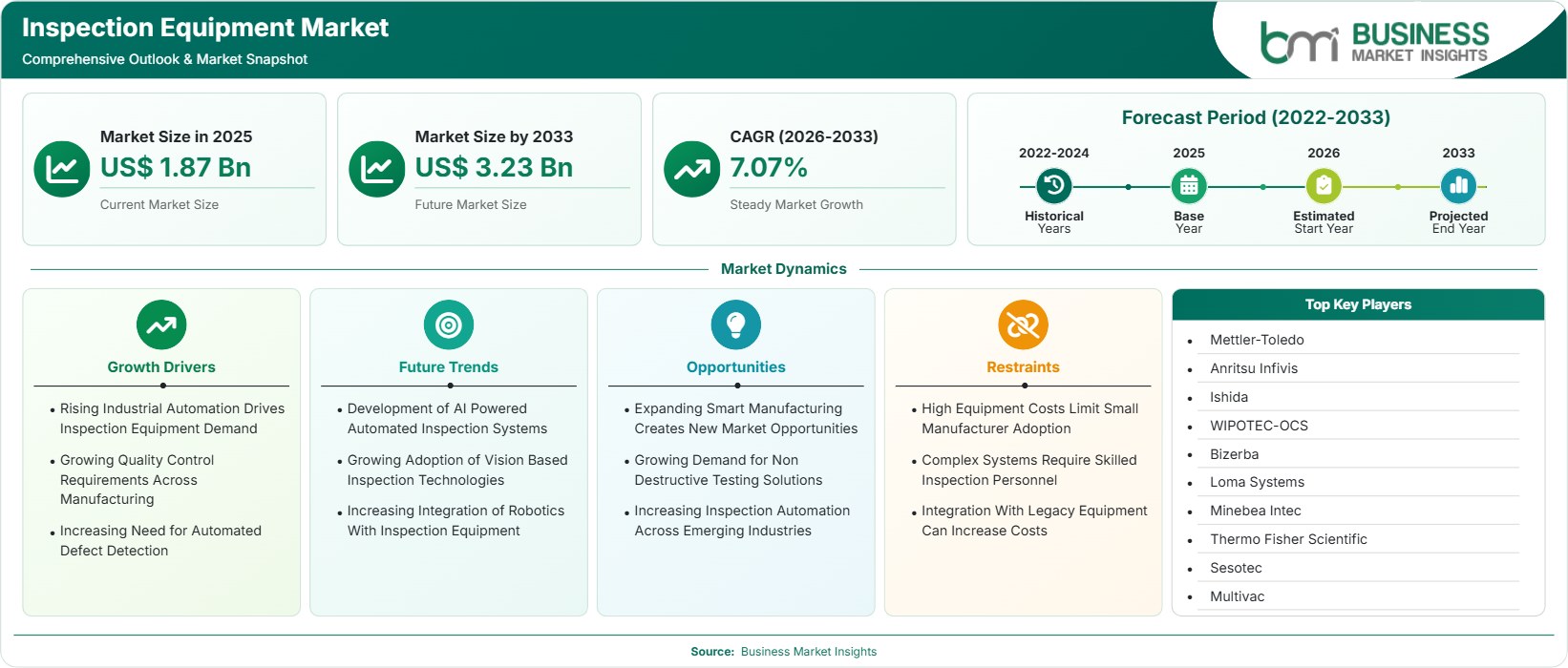
The Inspection Equipment Market size was valued at US$ 1.87 billion in 2025 and is projected to reach US$ 3.23 billion by 2033, growing at a CAGR of 7.07% during 2026–2033, supported by automation, quality assurance, defect detection, smart manufacturing, and demand for reliable production control.

Report Coverage
  • Type: Fully Automatic Machine, Semi-automatic Machine, Manual Machine
  • Product: Vision Inspection System, Leak Detection System, X-ray Inspection System, Checkweighers, Metal Detector, Software, Others
  • End User: Food & Beverages, Pharmaceuticals, Others
US$ 1.87 Bn Market size in 2025
US$ 3.23 Bn Market Size by 2033
7.07% CAGR, 2026 - 2033
2026-2033 Forecast Period

01 AI Overview

Inspection Equipment Market Summary

  • North America Region: North America holds a 28%–31% share in 2025 and is projected to grow at a 6.8%–7.4% CAGR through 2033, supported by manufacturing automation, stringent quality requirements, food safety controls, pharmaceutical production, and investments in connected inspection systems.
  • Fastest Growing Region: Asia Pacific holds a 34%–37% share in 2025 and is projected to grow at a 7.8%–8.5% CAGR, supported by expanding manufacturing capacity, automation investment, food processing, pharmaceutical production, export-oriented industries, and increasing quality-control requirements.
  • Leading Segment: Fully Automatic Machine holds a 52%–56% share in 2025 and is projected to grow at a 7.4%–8.0% CAGR, supported by continuous production, labor optimization, integrated quality control, high throughput, and automated rejection capabilities.
  • High Growth Segment: Vision Inspection System holds a 28%–31% share in 2025 and is projected to grow at a 8.5%–9.2% CAGR, supported by machine vision, artificial intelligence, defect recognition, traceability, and automated quality decisions.
  • Key Market Opportunity: Smart inspection platforms combining machine vision, software analytics, connectivity, automated rejection, and predictive quality capabilities can create scalable opportunities across food, pharmaceutical, and emerging manufacturing applications.
  • Major Market Players: Mettler-Toledo, Anritsu Infivis, Ishida, WIPOTEC-OCS, Bizerba, Loma Systems, Minebea Intec, Thermo Fisher Scientific, Sesotec, and Multivac.
02 Strategic Insights

Inspection Equipment Market: Strategic Insights

Inspection Equipment Market Strategic Framework
FREE PDF
Request your free sample
Request free sample
03 Stakeholder View

Key Takeaways

  • Inspection is becoming an integrated production function rather than a standalone quality-control activity, increasing the importance of communication between inspection platforms, manufacturing equipment, enterprise software, and plant-level analytics.
  • Vision-based inspection offers strong upside because software-driven recognition can address dimensional defects, packaging errors, surface abnormalities, labeling inconsistencies, and other quality deviations across high-speed production environments.
  • Product development is moving toward intelligent inspection architectures that combine cameras, sensors, algorithms, automated rejection, connectivity, and centralized data interpretation instead of relying on isolated inspection devices.
  • Asia Pacific provides a compelling investment case because manufacturing diversification, automation adoption, food processing expansion, pharmaceutical production, and export-quality requirements are increasing demand for dependable inspection infrastructure.
  • Suppliers can strengthen market positioning through modular systems that allow manufacturers to begin with basic inspection capabilities and later add software, sensors, analytics, and connected quality-management functionality.
  • Long-term competitive differentiation will depend increasingly on total cost of ownership, ease of integration, inspection accuracy, service responsiveness, operator usability, and the ability to adapt equipment to changing production requirements.
04 Geographic Outlook

Inspection Equipment Market Regional Highlights

North America Inspection Equipment Market

North America held a 28%–31% share in 2025 and is projected to grow at a 6.8%–7.4% CAGR through 2033. The region benefits from advanced manufacturing, food safety requirements, pharmaceutical quality control, established automation infrastructure, and strong demand for integrated inspection systems. The U.S. represents the principal market, while Canada contributes through food processing, industrial production, and automated manufacturing investments.

  • Food manufacturers increasingly require automated detection systems capable of identifying foreign materials, packaging defects, fill-level inconsistencies, and process deviations without slowing production.
  • Pharmaceutical manufacturers prioritize validated inspection workflows that support product quality, batch consistency, traceability, and compliance with increasingly structured quality-management requirements.
  • Manufacturers are integrating inspection systems with production equipment and plant software to improve data visibility, automate corrective actions, and reduce dependence on manual quality checks.
  • Demand for service, calibration, software updates, and equipment integration is creating recurring revenue opportunities alongside initial equipment sales.

US Inspection Equipment Market

The U.S. represented an estimated 23%–26% global share in 2025 and is projected to grow at a 6.7%–7.3% CAGR through 2033. Its manufacturing base, food safety controls, pharmaceutical production, and automation adoption create sustained demand for inspection technologies across high-volume production environments and specialized quality-control applications.

  • Food and beverage producers continue adopting automated inspection to improve consistency, detect contamination risks, and maintain quality across increasingly automated processing and packaging operations.
  • Pharmaceutical production requires inspection capabilities that support controlled processes, documentation, product integrity, and reliable identification of deviations during manufacturing and packaging.
  • Industrial manufacturers increasingly connect inspection equipment with production systems to generate actionable quality data rather than relying only on end-of-line manual verification.

Europe Inspection Equipment Market

Europe held an estimated 25%–28% share in 2025 and is projected to grow at a 6.5%–7.1% CAGR. Germany, France, Italy, and the U.K. represent leading markets, supported by sophisticated manufacturing and quality systems. Germany is projected at 6.8%–7.4% CAGR, while Italy and France provide attractive automation-driven opportunities.

  • Germany benefits from advanced manufacturing, engineering expertise, industrial automation, and strong adoption of inspection systems across machinery, food, automotive, and pharmaceutical production.
  • France and Italy provide opportunities through food processing, packaging, pharmaceuticals, and modernization of manufacturing lines requiring consistent automated quality control.
  • The U.K. continues to offer opportunities in food production, pharmaceuticals, logistics-related manufacturing, and industrial automation where inspection data can support operational efficiency.
  • European manufacturers increasingly value energy efficiency, software integration, modularity, and lifecycle service when selecting automated inspection systems.

Asia Pacific Inspection Equipment Market

Asia Pacific held an estimated 34%–37% Inspection Equipment Market share in 2025 and is projected to grow at a 7.8%–8.5% CAGR, making it the fastest-growing region. China, Japan, South Korea, and India are major demand centers, while Southeast Asia offers expanding opportunities through manufacturing relocation and industrial automation.

  • China benefits from extensive manufacturing capacity, increasing automation, food processing, electronics production, and demand for consistent quality across high-volume production environments.
  • Japan and South Korea provide mature opportunities through advanced manufacturing, electronics, automotive production, pharmaceuticals, and sophisticated factory automation ecosystems.
  • India is expanding inspection adoption as manufacturing investment, food processing, pharmaceutical production, and automation increasingly become priorities for industrial modernization.
  • Southeast Asian economies offer opportunities as new manufacturing facilities require modern quality-control systems designed for export-oriented production and international customer requirements.

Rest of World Inspection Equipment Market

Rest of World represented an estimated 11%–14% share in 2025 and is projected to grow at a 6.4%–7.1% CAGR. South and Central America benefit from food processing and industrial modernization, while the Middle East and Africa offer opportunities through pharmaceutical, food, and diversified manufacturing development.

Brazil is projected at a 6.8%–7.5% CAGR, while selected Middle Eastern markets are estimated at 7.0%–7.8%. Industrial diversification supports longer-term inspection adoption.

  • Brazil offers opportunities through food processing, beverage production, pharmaceuticals, and industrial facilities seeking automated quality control and foreign-material detection.
  • Mexico provides demand through export-oriented manufacturing, food production, packaging, and industrial facilities requiring inspection systems compatible with international customer standards.
  • Gulf economies are developing manufacturing and pharmaceutical capabilities, creating opportunities for advanced inspection systems that support quality assurance and automated production.
  • African markets offer longer-term potential as food processing, pharmaceuticals, and industrial manufacturing expand, although equipment affordability and technical service remain important purchasing considerations.
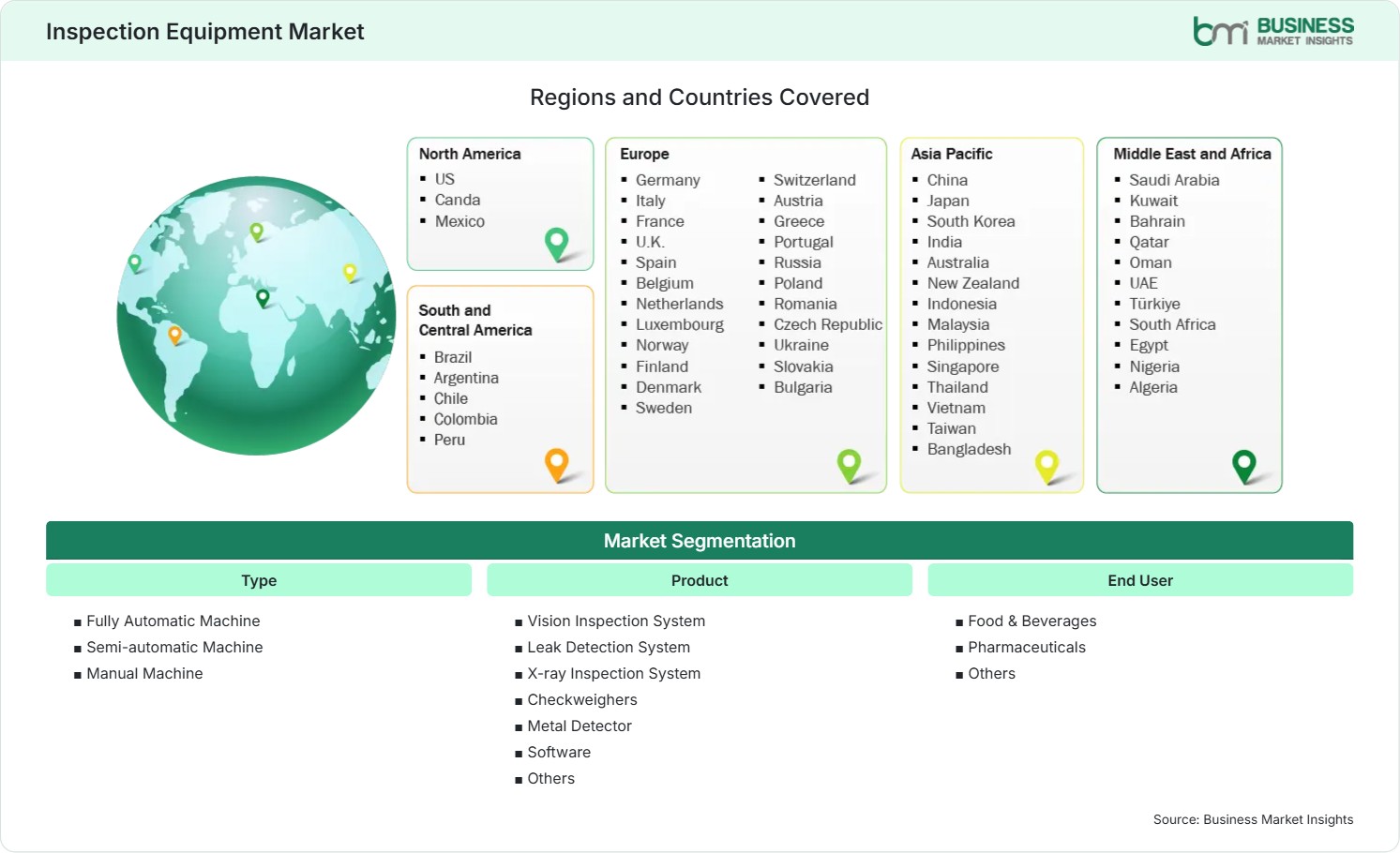
Global Market Geography
FREE PDF
Request your free sample
Request free sample
05 Segment Analysis

Inspection Equipment Market Segmentation

Type

Fully Automatic Machine holds a 52%–56% share in 2025 and is projected to grow at a 7.4%–8.0% CAGR through 2033. Automated operation supports continuous production, high throughput, consistent inspection decisions, reduced labor dependence, and integration with modern manufacturing lines.

  • Fully Automatic Machine: Fully automated systems support continuous production and rapid quality decisions, making them attractive where throughput, repeatability, automated rejection, and reduced manual intervention are priorities.
  • Semi-automatic Machine: Semi-automatic systems balance operator involvement with automated inspection functions, supporting manufacturers seeking improved consistency without fully replacing existing manual production workflows.
  • Manual Machine: Manual systems remain relevant for smaller operations, specialized products, low-volume production, and applications where investment constraints make complete automation economically difficult.

Product

Vision Inspection System leads product demand, holding a 28%–31% share in 2025 and growing at a 8.5%–9.2% CAGR through 2033. Inspection Equipment Market trend development increasingly favors software-enabled visual analysis, connected inspection, automated defect recognition, and adaptable production-line integration.

  • Vision Inspection System: Camera-based inspection identifies visual and dimensional defects rapidly, supporting packaging, labeling, assembly, surface-quality, and product-integrity applications across automated production lines.
  • Leak Detection System: Leak detection protects product integrity by identifying packaging failures, seal defects, and pressure-related inconsistencies, supporting food, beverage, pharmaceutical, and industrial applications.
  • X-ray Inspection System: X-ray inspection enables non-destructive internal examination, helping identify foreign materials, voids, density variations, and structural abnormalities without opening or damaging products.
  • Checkweighers: Checkweighers verify product weight at production speed, supporting compliance, portion control, process consistency, waste reduction, and automated rejection of non-conforming units.
  • Metal Detector: Metal detectors identify metallic contaminants within products or packaging, supporting food safety programs and continuous quality assurance where foreign-material prevention is essential.
  • Software: Inspection software centralizes data, configuration, analytics, reporting, and quality decisions, enabling manufacturers to connect inspection activities with broader production and quality-management workflows.

End User

Food & Beverages represents the leading end-user base, while pharmaceuticals provide strong technology-driven demand. Inspection Equipment Market scope continues expanding as manufacturers pursue automated quality assurance, traceability, production consistency, and regulatory compliance across increasingly complex processing environments.

  • Food & Beverages: Food and beverage manufacturers use inspection equipment for foreign-material detection, package integrity, weight verification, labeling accuracy, and consistent product quality.
  • Pharmaceuticals: Pharmaceutical manufacturers require inspection systems for packaging integrity, product verification, contamination control, quality documentation, and reliable identification of production deviations.
06 Market Forces

Inspection Equipment Market Dynamics

Key Market Drivers

Rising Industrial Automation Drives Inspection Equipment Demand

Automation of industry is creating an increasing demand for inspection systems, which can be deployed on a constant basis along with automated production systems. As factories minimize human intervention, it becomes imperative to have inspection systems in place to ensure quality control without hampering the production process. Machines, vision systems, automated rejection devices, sensors, and decision-making systems based on software are becoming integrated into production control systems. Hence, the Inspection Equipment Market growth is indicative of a larger trend towards digital management of manufacturing processes. Inspection systems that can adapt to product differences without having to undergo much reconfiguration are sought after by manufacturers.

Growing Quality Control Requirements Across Manufacturing

Manufacturers are expected to be more responsible for providing their products to regulated markets, multinational buyers, and clients that become increasingly specification-savvy. Automatic inspection provides an opportunity to make repetitive inspections and helps in reducing variation in manual inspections. Inspection equipment is required by the food industry to avoid contaminants and packaging issues, whereas the pharmaceutical industry functions in a quality-controlled environment. Manufacturers need inspection equipment to avoid failures in their further process. This is prompting manufacturers to invest in inspection equipment that can provide information about inspection results and traceability. The integration of inspection equipment with manufacturing and quality management software brings even more value.

Increasing Need for Automated Defect Detection

Defect detection by automated means is becoming significant as manufacturers aim to find quality deviations quickly without compromising on their speed of production. Vision technology will detect any surface or packaging defects, but X-ray detection, metal detection, and leak detection will be used to detect any defects that cannot be detected by standard visual techniques. The Inspection Equipment Market forecast will largely depend on manufacturers’ adoption of complementary inspection technologies instead of using only one inspection technique. Classification can be improved through software intelligence, which will differentiate between acceptable variations and real defects. This minimizes rejections and enables better quality decisions.

Key Market Opportunities

Expanding Smart Manufacturing Creates New Market Opportunities

Smart manufacturing presents opportunities for inspection solutions to interface with production machines, enterprise systems, and quality solutions. Inspection that connects can take quality inspections from disconnected activities to continuous information flows that enable process optimization and decision-making based on predictions. Manufacturers can make use of inspection data to identify persistent issues, link quality issues to production conditions, and decide on the actions needed. Modular platforms can also help in lowering barriers to adoption by enabling buyers to build up their inspection platform with sensors, cameras, analytics, or other functionalities over time. Vendors who have good integration capabilities can thus gain more than the sale of their hardware. The opportunity is even more compelling for manufacturers that are upgrading legacy production lines.

Growing Demand for Non Destructive Testing Solutions

Non-destructive testing offers an appealing growth opportunity due to the rising needs of manufacturers to test their products without harming the inventory. With x-ray testing, vision systems, leakage testing, and other similar technologies, manufacturers can detect any irregularities within or outside the product and allow compliant products to move through the production process. It helps in industries such as food, pharma, packaging, and even some specialized industrial manufacturers. Manufacturers can exploit this opportunity further by increasing sensitivity and making operations easier. Manufacturers can use small-sized equipment if required. Another opportunity is offered by software-based analysis to improve the accuracy of defects and the testing process.

Increasing Inspection Automation Across Emerging Industries

Opportunities in new manufacturing industries arise due to the fact that the installation of inspection technology will be done during the design of the factory itself, as opposed to integrating it into the system later on. Manufacturing plants in food processing, pharmaceuticals, consumer goods, electronics, and specialized manufacturing are developing an increasing number of automated production environments in which inspection technology can be implemented from the start. This would be a way for the suppliers to capitalize on their demand by providing scalable systems that are designed to take future expansion in production into account. Technical support, training, financing possibilities, and easier maintenance can be other ways of improving the adoption of such systems in cost-sensitive regions.

Market Restraints and Challenges

High Equipment Costs Limit Small Manufacturer Adoption

Factor: the purchase of advanced inspection equipment will need to be accompanied by investments in hardware, software, integration, calibration, installation, and maintenance. Impact: Small to medium-sized companies can delay implementation if there are no immediate improvements to productivity or quality, which will offset the initial investment made. This factor is especially significant for cases where the volume of production is low or the needs of inspection are fairly uncomplicated. Manufacturers can make this factor less significant by offering modularity in their equipment, financing options, standardized interfaces, and equipment that is easily upgradable as production grows. Inexpensive equipment will also allow the gradual move towards automation in inspection processes.

Complex Systems Require Skilled Inspection Personnel

Factor: inspection equipment integrates sensors, imaging equipment, software, human-machine interfaces, calibration, and quality management features that demand technical knowledge. Impact: Companies with inadequate engineering staff may encounter problems during installation, validation, troubleshooting, and maintenance that may result in delayed deployment or reduced use of the technology. Support services, hence, emerge as significant aspects in the choice of equipment. The supplier can tackle this problem using intuitive user interfaces, automatic calibration, remote troubleshooting, procedural automation, and thorough operator training. Simpler systems will help increase the use of the technology by relying less on specialist personnel for ordinary operations. Complex systems that incorporate different inspection techniques, however, will still need technically competent people.

07 Company Analysis

Competitive Landscape

The competitive environment includes inspection specialists, weighing technology providers, automation companies, analytical instrument manufacturers, and suppliers serving regulated production industries. Inspection Equipment Market analysis indicates that differentiation increasingly depends on detection accuracy, throughput, software capability, integration, service networks, customization, and lifecycle economics.

Company Name

Overview

Products and Services relevant to this market

Mettler-Toledo

Global measurement and inspection technology provider serving food, pharmaceutical, and industrial customers.

Checkweighers, metal detection, X-ray inspection, vision inspection, software, and integrated quality-control systems.

Anritsu Infivis

Inspection technology provider focused on automated quality and contamination detection for production environments.

X-ray inspection, metal detection, checkweighing, and inspection solutions for food and pharmaceutical applications.

Ishida

Established weighing, packaging, and inspection technology supplier serving high-throughput production operations.

Checkweighers, X-ray inspection, vision systems, metal detection, weighing, and packaging solutions.

WIPOTEC-OCS

Specialist provider of precision inspection and weighing technologies for automated production lines.

Checkweighers, vision inspection, track-and-trace systems, serialization, and quality-control technologies.

Bizerba

Weighing and inspection technology company serving food processing, retail, and industrial applications.

Checkweighers, inspection systems, weighing technology, labeling solutions, and process-control equipment.

Loma Systems

Inspection specialist focused on contamination detection and product quality for manufacturing environments.

Metal detectors, X-ray inspection, checkweighers, combination systems, and quality inspection technologies.

Minebea Intec

Industrial weighing and inspection technology provider serving process and discrete manufacturing industries.

Checkweighers, metal detection, X-ray inspection, industrial weighing, and process inspection systems.

Thermo Fisher Scientific

Diversified scientific technology company with inspection and analytical capabilities across industrial applications.

X-ray inspection, material analysis, quality-control technologies, and production inspection solutions.

Sesotec

Inspection technology specialist focused on contamination detection and automated material sorting.

Metal detectors, X-ray systems, sorting technology, separation systems, and inspection solutions.

Multivac

Packaging and processing technology provider incorporating inspection into integrated production solutions.

Vision inspection, checkweighing, metal detection, X-ray inspection, packaging, and integrated line solutions.

10 Trust & Transparency

Research Methodology

The market analysis combines proprietary research with secondary data from government agencies, company disclosures, regulatory filings, industry databases and expert interviews. Market estimates are validated through data triangulation, cross-market benchmarking and analyst review.

View Full Research Methodology

11 Questions Answered

Frequently Asked Questions

What does the Inspection Equipment Market report indicate about future competition?

The report indicates that competition will increasingly focus on detection accuracy, automation, software intelligence, system integration, ease of use, service capabilities, and lifecycle economics. Suppliers capable of combining multiple inspection technologies into flexible production solutions can strengthen customer retention and expand their role within automated manufacturing environments.

Why are non-destructive inspection technologies creating new opportunities?

Non-destructive technologies allow manufacturers to examine products without damaging them. X-ray inspection, vision systems, and leak detection can identify internal or external defects while preserving acceptable products. This supports quality assurance, reduces unnecessary waste, and enables continuous inspection within high-throughput production processes.

How are machine vision technologies influencing inspection equipment adoption?

Machine vision enables automated analysis of product appearance, dimensions, labels, packaging, and surface characteristics. Improvements in cameras, lighting, image processing, artificial intelligence, and software interfaces are expanding the range of defects that can be identified automatically, making vision inspection increasingly useful across diverse production environments.

Which applications present the strongest opportunity in the market?

Food and beverage production, pharmaceuticals, packaging, electronics, and automated industrial manufacturing offer strong opportunities. These applications require reliable quality verification, contamination detection, product integrity checks, and high-speed inspection while maintaining production throughput and reducing dependence on manual quality-control procedures.

What factors are improving Inspection Equipment Market return on investment?

Automation, reduced manual inspection, lower defect leakage, improved production consistency, faster quality decisions, and better traceability are improving return on investment. Inspection systems can also reduce waste and support compliance by identifying non-conforming products before distribution, while connected software can provide actionable production-quality information.

Access the Full Inspection Equipment Market Report

Get segment-level forecasts, regional estimates, competitive benchmarking, company profiles and downloadable Excel datasets.

Access the full Inspection Equipment Market Report
350 pages PDF & Excel | 2026-08-24