
Virtualized Evolved Packet Core Market Outlook: Size, Share, Trends, Growth Analysis, Competitive Landscape & Forecast, 2026-2033

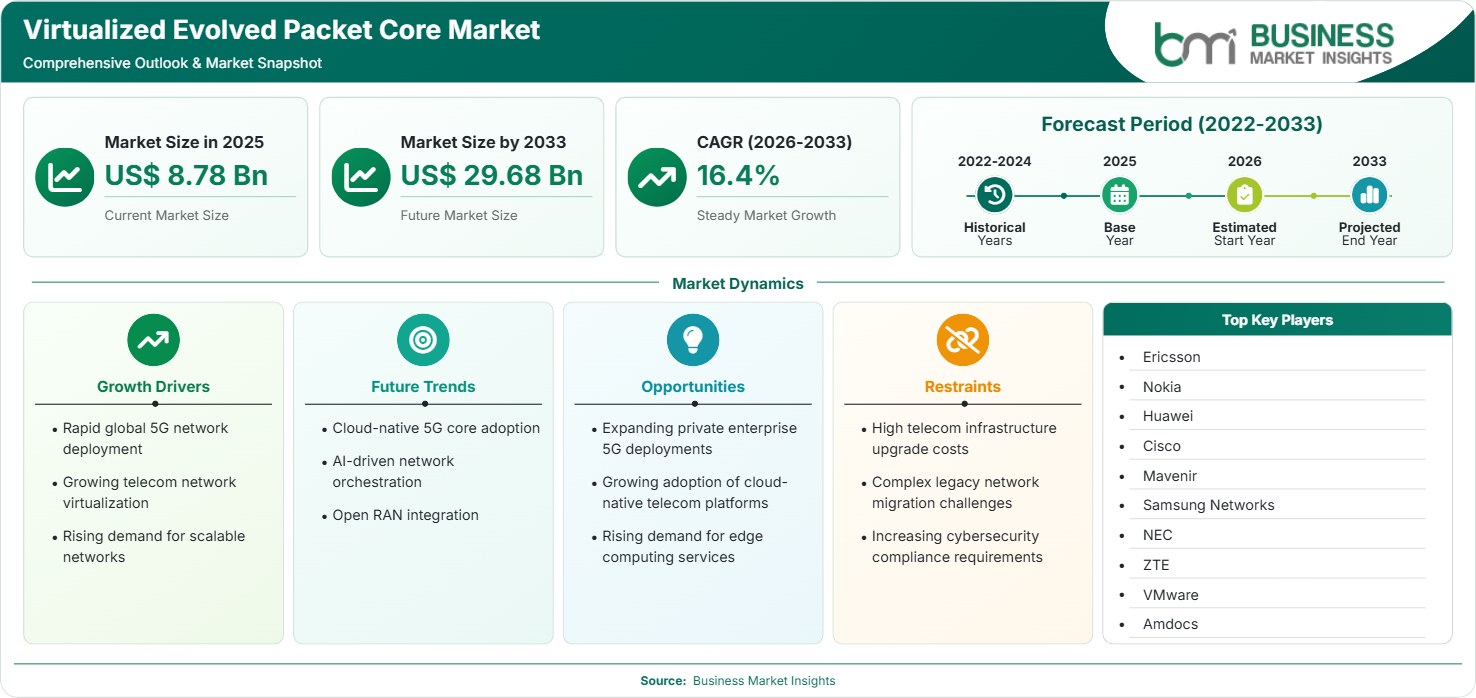
The Virtualized Evolved Packet Core Market size was valued at US$ 8.78 Billion in 2025 and is projected to reach US$ 29.68 Billion by 2033, growing at a CAGR of 16.4% from 2026 to 2033, driven by rapid 5G deployment, telecom virtualization, scalable network requirements, cloud-native transformation, and increasing demand for edge-enabled connectivity.

Report Coverage
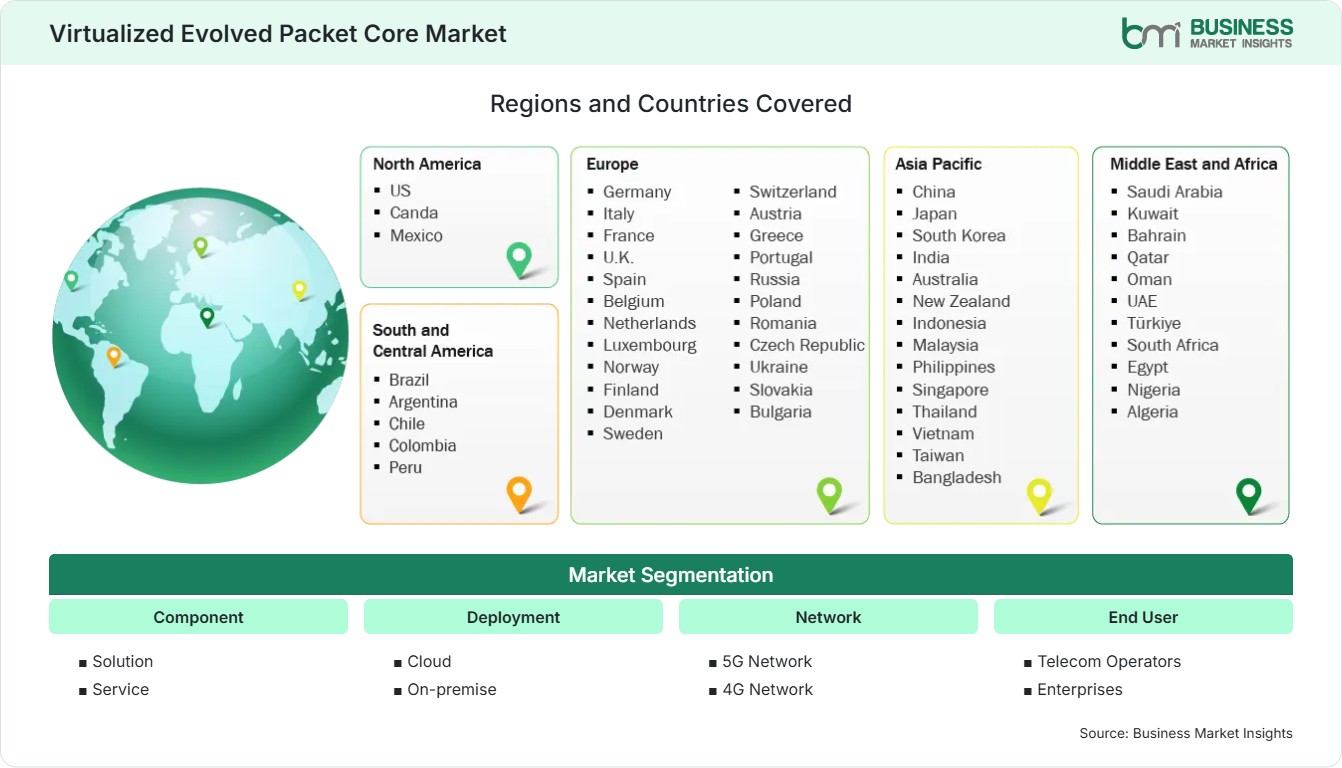
  • Component: Solution, Service
  • Deployment: Cloud, On-premise
  • Network: 5G Network, 4G Network
  • End User: Telecom Operators, Enterprises
US$ 8.78 Bn Market size in 2025
US$ 29.68 Bn Market Size by 2033
16.4% CAGR, 2026 - 2033
2026-2033 Forecast Period

01 AI Overview

Virtualized Evolved Packet Core Market Summary

  • North America Region: North America holds a market share of 33%–36% in 2025, growing with a CAGR of 14%–16%, influenced by advanced telecom infrastructure, enterprise 5G adoption, cloud transformation, and network modernization initiatives. The US market expands with a CAGR of 14%–16% during 2026–2033, supported by operator investments in virtualized network architectures and private connectivity solutions.
  • Fastest Growing Region: Asia Pacific represents a share range of 32%–35% in 2025, expanding with a CAGR of 18%–20% driven by large-scale 5G deployments, telecom infrastructure investments, digital transformation programs, and increasing demand for cloud-native network solutions.
  • Leading Segment: Solution segment accounts for a share range of 62%–65% in 2025, growing at a CAGR of 15%–17% due to increasing adoption of virtualized core platforms, network automation, and software-defined infrastructure among telecom operators.
  • High Growth Segment: Cloud deployment demonstrates a share range of 55%–58% in 2025, expanding at a CAGR of 18%–20% due to operator migration toward flexible architectures, reduced infrastructure costs, and improved network scalability.
  • Key Market Opportunity: Opportunities are concentrated in private 5G networks, cloud-native telecom platforms, edge computing integration, and next-generation connectivity solutions supporting enterprise digital transformation.
  • Major Market Players: Ericsson, Nokia, Huawei, Cisco, Mavenir, Samsung Networks, NEC, ZTE, VMware, Amdocs.
02 Strategic Insights

Virtualized Evolved Packet Core Market: Strategic Insights

Virtualized Evolved Packet Core Market Strategic Framework
FREE PDF
Request your free sample
Request free sample
03 Stakeholder View

Key Takeaways

  • Telecom ecosystems are transitioning toward software-centric architectures where network operators, cloud providers, and technology vendors collaborate to deliver flexible connectivity platforms.
  • Growth opportunities are concentrated in 5G networks, private enterprise deployments, edge computing environments, and cloud-based telecom infrastructure modernization.
  • Innovation is focused on cloud-native network functions, automation platforms, artificial intelligence-driven optimization, and enhanced interoperability across multi-vendor environments.
  • Asia Pacific provides significant investment potential due to rapid 5G expansion, large telecom subscriber bases, and government-backed digital infrastructure programs.
  • Strategic partnerships, platform integration, and technology consolidation are shaping competition as vendors strengthen capabilities across virtualized networking and telecom cloud ecosystems.
04 Geographic Outlook

Virtualized Evolved Packet Core Market Regional Highlights

North America Virtualized Evolved Packet Core Market

North America accounted for a share range of 33%–36% in 2025 and is projected to grow at a CAGR of 14%–16% during 2026–2033. The region benefits from advanced telecom infrastructure, strong cloud adoption, and early implementation of 5G technologies. The Virtualized Evolved Packet Core Market share in North America is supported by investments from telecom operators seeking flexible, scalable, and automated network architectures.

  • The United States remains a major contributor due to large telecom investments, enterprise private network adoption, and advanced 5G infrastructure deployment.
  • Telecom operators are modernizing network cores to support increasing data traffic and emerging low-latency applications.
  • Enterprises are adopting private connectivity solutions requiring flexible and programmable network architectures.
  • Cloud partnerships between telecom providers and technology companies are accelerating virtualization initiatives.

US Virtualized Evolved Packet Core Market

The US represented a share range of 28%–31% in 2025 and is expected to expand at a CAGR of 14%–16% between 2026 and 2033. The country remains a leading market due to strong 5G deployment activity, enterprise digital transformation, and investments in advanced networking infrastructure. Demand is supported by telecom operators seeking efficient solutions for managing complex connectivity requirements.

  • Major operators are investing in virtualized core platforms to improve network flexibility and operational efficiency.
  • Private 5G adoption among enterprises is increasing demand for customized connectivity solutions and localized network management.
  • Cloud-native networking approaches are gaining acceptance due to scalability and automation benefits.
  • Technology providers are developing integrated solutions combining virtualization, analytics, and network orchestration capabilities.

Europe Virtualized Evolved Packet Core Market

Europe held a share range of 24%–27% in 2025, growing at a CAGR of 15%–17% during 2026–2033. The region benefits from telecom modernization programs, industrial connectivity demand, and increasing adoption of software-based network infrastructure. Germany, the United Kingdom, and France represent leading markets, while Nordic countries demonstrate strong adoption due to advanced digital ecosystems.

  • Germany is expanding virtualized networking adoption through industrial automation and private 5G applications.
  • The United Kingdom is investing in telecom infrastructure modernization and cloud-based network transformation initiatives.
  • France is developing advanced connectivity solutions supporting enterprise digitalization and smart infrastructure projects.
  • European telecom operators are focusing on energy efficiency and automation through software-defined network technologies.

Asia Pacific Virtualized Evolved Packet Core Market

Asia Pacific accounted for a share range of 32%–35% in 2025 and is expanding at a CAGR of 18%–20% during 2026–2033. The region represents the fastest-growing market due to extensive 5G infrastructure deployment, increasing mobile data consumption, and government-led digital connectivity initiatives. China, Japan, South Korea, and India are driving regional expansion through telecom modernization and cloud-based network transformation.

  • China remains a major market due to large-scale 5G rollout programs, extensive telecom infrastructure investments, and increasing adoption of virtualized network solutions.
  • India is accelerating core network modernization through expanding 5G services, digital connectivity initiatives, and rising demand for scalable telecom infrastructure.
  • Japan and South Korea continue advancing cloud-native telecom platforms through technology innovation and early adoption of next-generation network architectures.
  • Southeast Asian markets are investing in telecom infrastructure upgrades to support digital services, smart cities, and enterprise connectivity applications.

Rest of World Virtualized Evolved Packet Core Market

The rest of the world represented a share range of 7%–10% in 2025, growing at a CAGR of 16%–18% during 2026–2033. Latin America, the Middle East, and Africa are adopting virtualized core solutions through telecom expansion, cloud migration, and digital inclusion initiatives. Brazil, Mexico, Saudi Arabia, and the UAE are emerging markets supported by 5G investments and enterprise connectivity requirements.

  • Brazil is expanding telecom virtualization adoption through network modernization programs and increasing demand for high-speed digital connectivity.
  • Mexico is improving telecom infrastructure through investments in advanced networks supporting enterprise applications and consumer connectivity growth.
  • Saudi Arabia and the UAE are deploying next-generation networks as part of digital transformation and smart infrastructure initiatives.
  • African markets are gradually adopting cloud-based telecom platforms to improve connectivity, scalability, and operational efficiency.
Global Market Geography
FREE PDF
Request your free sample
Request free sample
05 Segment Analysis

Virtualized Evolved Packet Core Market Segmentation

Component

The component segment reflects increasing demand for software-driven telecom infrastructure and managed network capabilities. Solution components represented the leading category with a share range of 62%–65% in 2025 and a CAGR of 15%–17% between 2026 and 2034. The Virtualized Evolved Packet Core Market scope is expanding through telecom virtualization, network automation, and the growing deployment of flexible core network architectures.

  • Solution: Solutions provide virtualized network functions, orchestration capabilities, and software-based core infrastructure supporting scalable telecom operations and advanced connectivity requirements.
  • Service: Services support implementation, integration, maintenance, consulting, and optimization activities required for the successful deployment of virtualized telecom core platforms.

Deployment

The deployment segment demonstrates increasing migration toward flexible infrastructure models as telecom operators optimize operational efficiency and scalability. Cloud deployment represents the leading adoption category due to improved resource utilization, faster service deployment, and reduced dependency on physical infrastructure. The Virtualized Evolved Packet Core Market trends indicate continued movement toward cloud-native architectures supporting automation and network agility.

  • Cloud: Cloud deployment enables flexible network scaling, automated resource management, operational efficiency improvements, and integration with modern telecom cloud platforms.
  • On-premise: On-premise deployment remains relevant for operators requiring direct infrastructure control, customized configurations, and enhanced management of sensitive network operations.

Network

The network segment is influenced by the ongoing transition from traditional connectivity systems toward advanced 5G architectures. 5G networks represent the fastest-growing application area due to increased bandwidth requirements, low-latency services, and enterprise connectivity demand. 4G networks continue supporting existing subscribers while operators gradually integrate virtualization technologies into legacy infrastructure.

  • 5G Network: 5G networks drive adoption through enhanced performance capabilities, support for private networks, edge applications, and advanced industrial connectivity requirements.
  • 4G Network: 4G networks continue utilizing virtualized core solutions to improve operational efficiency, manage existing traffic volumes, and support gradual network evolution.

End User

The end-user segment reflects increasing adoption among telecom operators and enterprises seeking scalable connectivity solutions. Telecom operators represent the dominant user group due to large-scale network modernization requirements. Enterprises are increasingly adopting private 5G networks and virtualized infrastructure to support industrial automation, smart facilities, and digital transformation initiatives.

  • Telecom Operators: Telecom operators deploy virtualized evolved packet core platforms to improve network flexibility, reduce operational costs, and support growing connectivity demands.
  • Enterprises: Enterprises adopt virtualized network solutions for private connectivity, industrial automation, edge computing applications, and customized communication environments.
06 Market Forces

Virtualized Evolved Packet Core Market Dynamics

Key Market Drivers

Rapid Global 5G Network Deployment

Rapid expansion of 5G networks is a primary driver supporting demand for virtualized evolved packet core solutions. The Virtualized Evolved Packet Core Market growth is influenced by telecom operators requiring flexible infrastructure capable of managing higher data volumes, connected devices, and low-latency applications. Investment in global 5G is driving change from the use of hardware-defined networks to software-defined networks. The International Telecommunications Union claims that expanding broadband connectivity continues to be a major priority globally and thus drives investment in communications infrastructure. This virtualization of the core allows operators to increase scalability and manage automation for new services such as private networks and edge applications.

Growing Telecom Network Virtualization

Telecom network virtualization is increasing as operators seek greater flexibility, operational efficiency, and faster service deployment capabilities. The Virtualized Evolved Packet Core Market trends reflect growing adoption of network function virtualization and software-defined networking technologies across global telecom ecosystems. The virtual architecture will allow the operator to decouple the network functions from the underlying hardware to achieve efficient resource management and easier management processes. The service providers are implementing cloud-native systems to meet their evolving connectivity demands and minimize infrastructure complexity. Automation and programmable network technologies are making virtualization strategies more robust. These trends are driving the technology vendors to improve their interoperability and provide telecom virtualization solutions.

Rising Demand for Scalable Networks

The rising need for scalability in the networks is forcing telecom operators to deploy flexible core network infrastructure that can cope with the increased demands for connectivity. The increased consumption of mobile data, devices, and enterprise digital applications is putting the existing network infrastructures under pressure. The virtualization of the evolved packet core provides telecom operators with a means to efficiently allocate their resources and provide efficient service delivery. The increased use of cloud computing and Internet of Things (IoT) applications requires more adaptability from the networks.

Key Market Opportunities

Expanding Private Enterprise 5G Deployments

Private enterprises’ 5G deployment initiatives open up many possibilities for organizations that need tailored connectivity for their industrial automation, manufacturing, logistics, and mission-critical operations. The virtual core allows them to create tailored networks. There has been an increased interest among manufacturing companies, energy firms, and transportation companies in utilizing private networks to facilitate connectivity of devices and processing of data in real time. Telecom players stand to benefit from this opportunity through the provision of flexible and scalable networks that meet the needs of enterprises.

Growing Adoption of Cloud-Native Telecom Platforms

Cloud-native telecom platforms represent an expanding opportunity as operators modernize infrastructure through containerized architectures, automation, and software-driven network functions. These platforms enable faster service deployment, improved scalability, and efficient resource utilization. The Virtualized Evolved Packet Core Market Forecasts indicate increasing opportunities from telecom operators transitioning toward cloud-based environments. Technology providers are developing solutions that integrate orchestration, analytics, and automation capabilities to support next-generation connectivity services. Cloud-native approaches allow operators to respond quickly to changing customer requirements while improving operational efficiency. Continued investment in telecom cloud transformation is expected to support the adoption of virtualized core technologies.

Rising Demand for Edge Computing Services

Edge computing adoption is creating opportunities for virtualized core providers as enterprises require lower latency, faster processing, and localized data management. Integration between virtualized packet core platforms and edge infrastructure enables advanced applications, including autonomous systems, industrial automation, and real-time analytics. Telecom operators are developing distributed architectures to support emerging digital services closer to users and devices. Companies investing in edge-enabled networking solutions can benefit from growing demand across industrial and enterprise markets. The combination of 5G, cloud computing, and edge technologies is creating new opportunities for scalable and intelligent connectivity ecosystems.

Market Restraints and Challenges

High Initial Automation Investment Costs

Factor: Significant upfront investment requirements for software platforms, cloud infrastructure, automation tools, and skilled technical resources create financial barriers for telecom operators.

Impact: Smaller operators and enterprises may delay adoption of virtualized evolved packet core solutions due to budget limitations and extended return-on-investment periods. Migration from traditional hardware-based systems requires infrastructure upgrades, workforce training, and operational restructuring. Although virtualization can reduce long-term costs, the initial implementation complexity remains a challenge for organizations with limited capital. Vendors are addressing this constraint through flexible deployment models, managed services, and phased migration approaches that reduce financial pressure during network transformation projects.

Complex Warehouse System Integration Challenges

Factor: Complex integration requirements between virtualized core platforms, existing telecom infrastructure, legacy systems, and multi-vendor network environments create operational challenges.

Impact: Deployment timelines may increase due to interoperability issues, customization requirements, and technical complexity during migration activities. Telecom operators must ensure seamless communication between new software-based network functions and existing systems while maintaining service continuity. Integration challenges require specialized expertise in orchestration, automation, and network management. Vendors are focusing on open standards, improved compatibility, and comprehensive support services to simplify implementation. Effective integration strategies remain essential for the successful adoption of virtualized evolved packet core technologies across diverse network environments.

07 Company Analysis

Competitive Landscape

The Virtualized Evolved Packet Core Market analysis highlights a competitive environment shaped by telecom innovation, cloud transformation capabilities, network virtualization expertise, and 5G infrastructure development. Leading companies are focusing on software-defined solutions, automation platforms, private network capabilities, and strategic partnerships to strengthen their position in next-generation connectivity ecosystems.

Company Name

Overview

Products and Services relevant to this market

Ericsson

Global telecommunications company providing advanced network infrastructure solutions.

Virtualized packet core, 5G core solutions, cloud-native networking platforms.

Nokia

Telecommunications technology provider supporting global network modernization.

Virtualized core solutions, 5G network platforms, telecom software services.

Huawei

Information and communication technology company offering telecom infrastructure solutions.

Virtualized evolved packet core, cloud core networks, 5G solutions.

Cisco

Networking technology company delivering communication and cloud infrastructure products.

Network virtualization, cloud networking, telecom software platforms.

Mavenir

Cloud-native network software provider focused on telecom transformation.

Open RAN solutions, virtualized core platforms, cloud-native network functions.

Samsung Networks

Telecommunications provider developing advanced mobile network technologies.

5G core solutions, virtualized network platforms, and private network solutions.

NEC

Technology company providing communication and digital infrastructure solutions.

Network virtualization, 5G infrastructure, telecom integration services.

ZTE

Telecommunications equipment provider serving global network operators.

Virtualized core networks, 5G infrastructure, telecom software solutions.

VMware

Cloud computing company providing virtualization and software infrastructure technologies.

Cloud platforms, network virtualization, telecom cloud solutions.

Amdocs

Software and services provider supporting communications companies globally.

Telecom software platforms, network automation, service management solutions.

08 Industry Activity

Recent Developments

February 2025

Nokia announced that Telefonica selected Nokia Packet Core solutions to enhance its 4G and 5G enterprise network capabilities in Spain. The deployment includes Nokia cloud-native software solutions and packet core appliances to improve network scalability, capacity, performance, and support low-latency enterprise applications.

January 2025

Nokia announced that 1GLOBAL selected Nokia’s Evolved Packet Core (EPC), IMS Voice Core, and security solutions to modernize its network operations across multiple markets, including deployments in countries such as Australia, the UK, and the US.

December 2024

Ericsson launched Ericsson Compact Packet Core, a cloud-native packet core solution designed to help communication service providers modernize existing packet core networks for 4G and 5G services and simplify migration toward cloud-based architectures.

August 2024

Nokia announced that Bite Group selected Nokia Packet Core solutions to modernize its network architecture across Latvia and Lithuania, supporting 2G, 3G, 4G, and 5G services while improving capacity, agility, and service delivery.

10 Trust & Transparency

Research Methodology

The market analysis combines proprietary research with secondary data from government agencies, company disclosures, regulatory filings, industry databases and expert interviews. Market estimates are validated through data triangulation, cross-market benchmarking and analyst review.

View Full Research Methodology

11 Questions Answered

Frequently Asked Questions

How does the Virtualized Evolved Packet Core Market Report support decision-making?

The market report provides insights into competitive strategies, regional opportunities, technology trends, market segments, and investment areas.

What opportunities exist for enterprises adopting these technologies?

Enterprises can leverage virtualized core solutions for private 5G networks, industrial automation, edge computing applications, and customized connectivity environments.

How does 5G influence virtualized evolved packet core demand?

5G networks require scalable and flexible core infrastructure capable of supporting high bandwidth, low latency, connected devices, and enterprise applications.

Why are telecom operators moving toward virtualized core networks?

Telecom operators are adopting virtualized core networks to improve flexibility, reduce infrastructure complexity, automate operations, and support emerging connectivity services.

What factors are driving the adoption of the virtualized evolved packet core market?

Rapid 5G deployment, telecom virtualization initiatives, increasing data traffic, demand for scalable networks, and adoption of cloud-native architectures are major factors supporting market expansion.

Access the Full Virtualized Evolved Packet Core Market Report

Get segment-level forecasts, regional estimates, competitive benchmarking, company profiles and downloadable Excel datasets.

Access the full Virtualized Evolved Packet Core Market Report
350 pages PDF & Excel | 2026-07-31