Market Summary
Executive Summary and Global Market Analysis
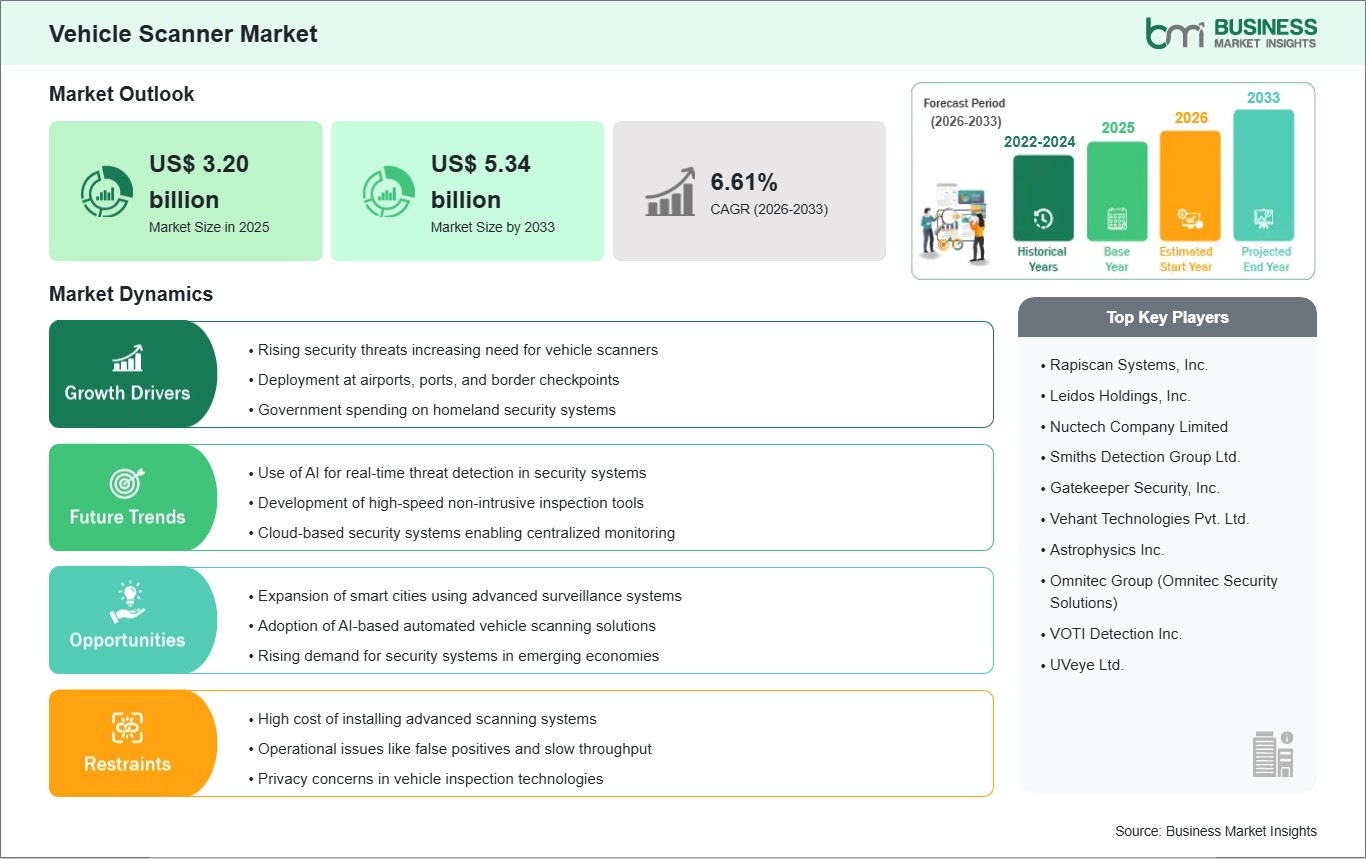
Vehicle scanners are specialized security and diagnostic systems engineered to provide non-intrusive inspection of a vehicle's undercarriage, interior, and cargo. These systems utilize a combination of X-ray imaging, computer vision, and high-resolution optical sensors to detect concealed threats such as explosives, narcotics, weapons, and unauthorized contraband without requiring physical disassembly. Primarily deployed at high-security installations, border crossings, and critical infrastructure, vehicle scanners have evolved from basic mirror-based inspections to sophisticated automated platforms capable of high-throughput screening in real-time. The modern market is characterized by a shift toward intelligent, AI-driven architectures that offer automated threat recognition and seamless integration with broader security ecosystems, ensuring that screening processes do not become bottlenecks in logistics and transport hubs.
However, the market faces notable challenges, including the high capital expenditure required for advanced X-ray and 3D imaging installations, which often limit adoption to high-budget government or tier-one commercial projects. There are also significant technical restraints regarding radiation safety standards and the high data processing power needed to run real-time AI analytics on ultra-high-resolution imagery. Furthermore, the market must navigate the complexities of global trade tensions and fluctuating tariffs on semiconductor and sensor components, which can disrupt supply chains and increase the total cost of ownership.
Despite these hurdles, lucrative opportunities remain in the rapid expansion of smart city initiatives and the growing demand for autonomous, robot-assisted inspection units. The integration of 5G connectivity and edge computing into scanning hardware is expected to unlock new potential for remote monitoring and decentralized security management, driving a resilient long-term growth trajectory.
Segment Analysis
Vehicle Scanner Market Segmentation
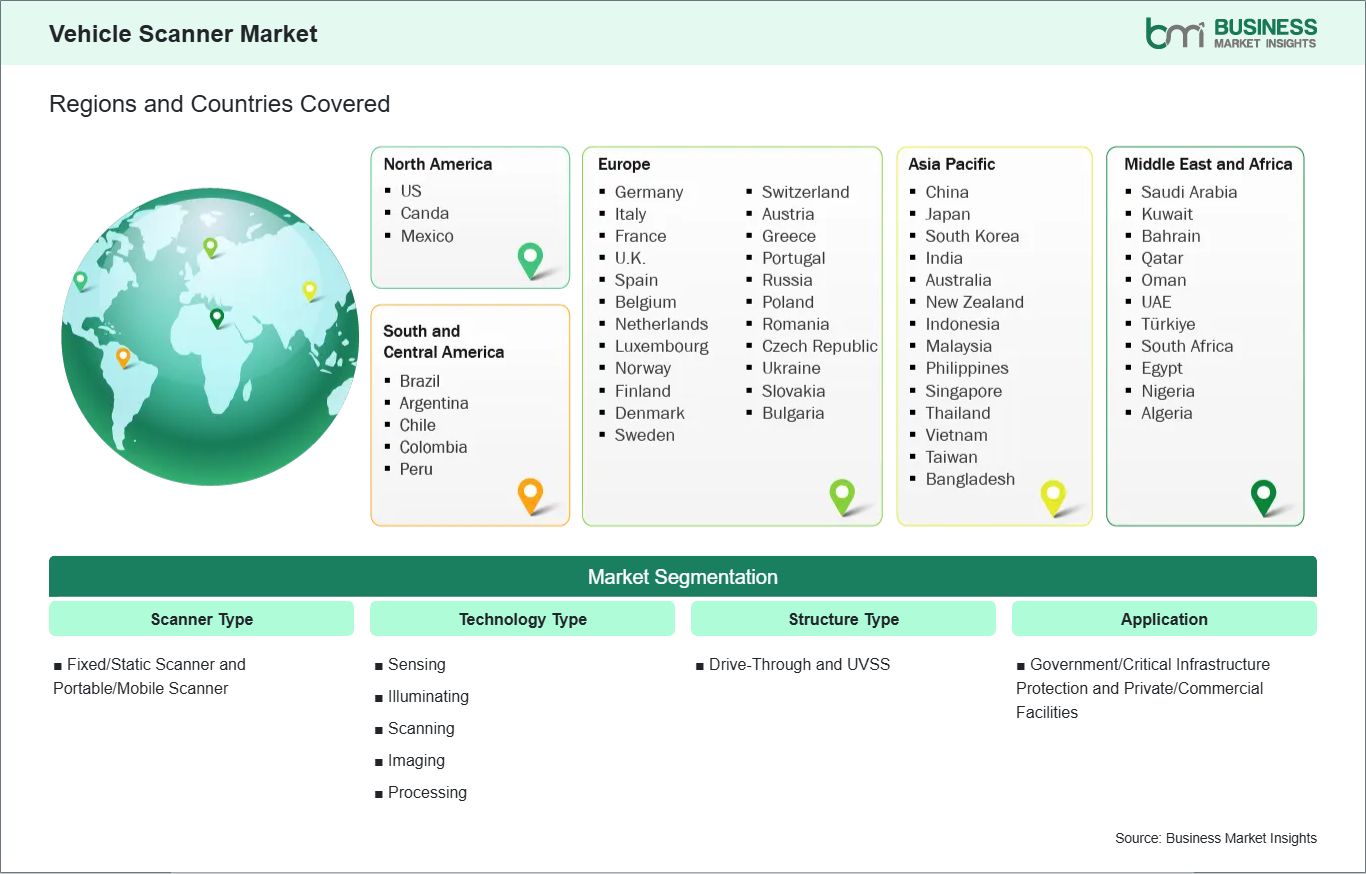
Key segments that contributed to the derivation of the Vehicle Scanner market analysis are scanner type, technology type, structure type, application, and component.
- By Scanner Type, the market is segmented into Fixed/Static Scanner and Portable/Mobile Scanner.
- By Technology Type, the market is divided into Sensing, Illuminating, Scanning, Imaging, and Processing.
- By Structure Type, the market is categorized into Drive-Through and UVSS (Under Vehicle Surveillance System).
- By Application, the market is bifurcated into Government/Critical Infrastructure Protection and Private/Commercial Facilities.
- By Component, the market includes Camera, Lighting Unit, Barrier, and Vehicle Scanning Software.
Market Forces
Vehicle Scanner Market Drivers and Opportunities
Heightened Global Security Mandates and Counter-Terrorism Efforts
The primary driver for the vehicle scanner market is the increasing stringency of global security protocols necessitated by a rise in cross-border smuggling, organized crime, and geopolitical instability. National governments and international security agencies are mandating the installation of advanced non-intrusive inspection (NII) systems at land borders, seaports, and critical entry points to mitigate the risk of illicit trafficking. High-energy X-ray scanners and drive-through portals are becoming the gold standard for these environments, as they allow for the rapid inspection of high-volume freight and passenger vehicles without disrupting the flow of commerce. This demand is further amplified by the shift toward "5G-Advanced" and "Smart Border" architectures, which require scanners to operate with near-zero latency and high spectral efficiency.
As international trade routes expand and the complexity of concealed threats increases, the reliance on high-speed, automated scanning solutions continues to grow. Security-conscious regions are increasing their capital investments in sophisticated signal chains and imaging sensors to protect national assets, directly propelling the demand for integrated, high-performance data conversion and scanning hardware. This regulatory-driven momentum ensures a steady pipeline of procurement for manufacturers who can deliver high-reliability systems capable of operating in extreme environments.
Integration of Artificial Intelligence (AI) and Machine Learning for Automated Threat Detection
A significant growth opportunity for the vehicle scanner market lies in the transition from manual, operator-led image analysis to AI-driven automated threat detection. Modern scanning systems are increasingly incorporating deep learning algorithms and computer vision to identify anomalies, such as hidden compartments or prohibited materials, by comparing real-time scans against vast databases of "clean" vehicle signatures. This opportunity is particularly lucrative in the development of "sensing-to-inference" pipelines, where high-speed processors within the scanner handle data locally to provide instantaneous results. By automating the recognition process, security operators can achieve higher throughput rates and reduce the human error associated with fatigue or oversight during long shifts.
Furthermore, the emergence of AI-powered edge computing allows these scanners to be integrated into broader Internet of Things (IoT) frameworks, enabling them to share threat data across a network of security nodes in real-time. For manufacturers, this shift opens avenues for recurring revenue through software-as-a-service (SaaS) models, where customers subscribe to cloud-based diagnostic updates and predictive maintenance alerts. As AI-powered inspection becomes the industry standard by 2033, the market will favor vendors who offer modular, software-defined scanning platforms that emphasize energy efficiency and high-fidelity digital signal processing tailored for intelligent mobility.
Size and Share Analysis
Vehicle Scanner Market Size and Share Analysis
The Vehicle Scanner market demonstrates steady growth, with size and share analysis revealing evolving trends and competitive positioning among key players. The report further examines subsegments categorized within scanner type, technology type, structure type, application, and component, offering insights into their contribution to overall market performance.
Based on scanner type, Fixed/Static Scanners sub-segment commands a significant portion of the market share, serving as the essential infrastructure for high-traffic checkpoints such as international borders and seaports.
In terms of technology type, the Scanning sub-segment remains widely preferred due to its ability to provide high-fidelity X-ray and 3D imaging necessary for rigorous security standards.
Regarding structure type, the Drive-Through sub-segment is seeing an increased share as it enables seamless vehicle transit without requiring the driver to exit, optimizing operational efficiency.
Within applications, the Government/Critical Infrastructure sub-segment remains a primary contributor, driven by national security mandates for protecting embassies and military installations.
Finally, for components, the Vehicle Scanning Software sub-segment is the fastest-growing as AI-driven analytics become central to the modern "sensing-to-inference" security pipeline.
Report Coverage
Vehicle Scanner Market Report Coverage and Deliverables
The "Vehicle Scanner Market Size and Forecast (2022 - 2033)" report provides a detailed analysis of the market covering below areas:
- Vehicle Scanner market size and forecast at global, regional, and country levels for all the key market segments covered under the scope
- Vehicle Scanner market trends, as well as market dynamics such as drivers, restraints, and key opportunities
- Vehicle Scanner market analysis covering key market trends, global and regional framework, major players, regulations, and recent market developments
- Industry landscape and competition analysis covering market concentration, heat map analysis, prominent players, and recent developments for the Vehicle Scanner market
- Detailed company profiles, including SWOT analysis
Geographic Insights
Vehicle Scanner Market Geographic Insights
The geographical scope of the Vehicle Scanner market report is divided into five regions: North America, Asia Pacific, Europe, the Middle East and Africa, and South and Central America.
In North America, the market is sustained by extensive investments in advanced border protection and the integration of high-resolution imaging at major transportation hubs to combat illicit trafficking.
Europe maintains a strong emphasis on regulatory compliance and the deployment of non-intrusive inspection technologies to secure critical public infrastructure and commercial facilities.
The Asia-Pacific region is characterized by rapid urbanization and the large-scale adoption of smart city frameworks, where automated scanning systems are increasingly utilized for urban traffic management and public safety.
In the Middle East and Africa, market growth is propelled by the modernization of logistics gateways and high-security mandates for protecting energy sector assets and government installations.
Meanwhile, South and Central America are witnessing a steady transition toward digitalized customs operations, with an increasing focus on enhancing the security of regional trade corridors through automated surveillance solutions. This global distribution ensures a balanced market expansion as both emerging and developed economies prioritize the technological fortification of their entry points and critical assets.
Industry Activity
Recent Developments
The Vehicle Scanner market is evaluated by gathering qualitative and quantitative data post primary and secondary research, which includes important corporate publications, association data, and databases. A few of the key developments in the Vehicle Scanner market are:
- In January 2025, OSI Systems, Inc. announced that its Security division had received an order valued at approximately $27 million to provide a comprehensive suite of security solutions to an international customer. This large-scale deployment featured a range of checkpoint and baggage screening technologies, which were integrated alongside the customer's existing Vehicle Scanner infrastructure to create a unified security perimeter. Among the systems delivered were the RTT® 110 (Real Time Tomography) explosive detection system for hold baggage and the Orion® 920CT (Computed Tomography) checkpoint screening system. The order also included the Orion 928DX for air cargo inspection and the Itemiser® 5X for trace detection, ensuring a multi-layered defense strategy that complemented the facility's high-throughput scanning operations.
- In June 2025, Rapiscan Systems announced the launch of its Eagle M60 ZBx mobile vehicle scanning system, designed for rapid deployment in border security, military, and critical infrastructure protection applications. The system combines high-energy X-ray imaging with Z Backscatter® technology to deliver detailed inspection of vehicles and cargo for threat detection. Featuring a mobile platform, advanced imaging analytics, and high-throughput capability, the solution enhances operational flexibility while ensuring effective detection of contraband, explosives, and other security threats in dynamic environments.
Trust & Transparency
Research Methodology
The market analysis combines proprietary research with secondary data from government agencies, company disclosures, regulatory filings, industry databases and expert interviews. Market estimates are validated through data triangulation, cross-market benchmarking and analyst
review.
View Full Research Methodology
Key Sources Referred:
World Bank - Global Trade Indicators World Trade Organization (WTO) International Monetary Fund (IMF) International Trade Administration (ITA) Company website Company annual reports Company investor presentations