Market Summary
Executive Summary and Global Market Analysis
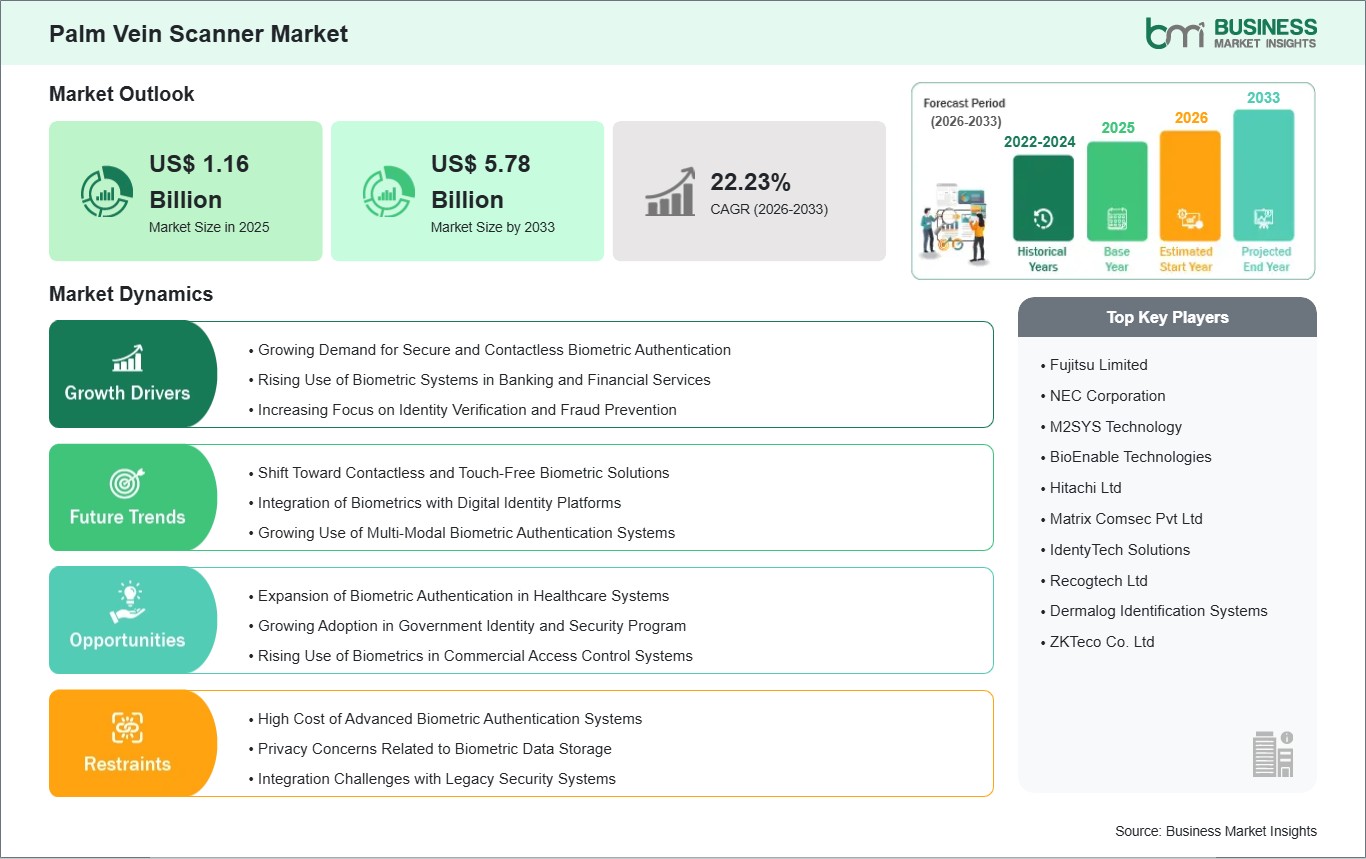
The market for palm vein scanners is increasing as organizations are seeking for secure and reliable biometric identification solutions. Palm vein recognition involves the use of near-infrared imaging to capture the vein patterns inside the human hand, which is a highly accurate and difficult-to-replicate form of identification. Palm vein recognition technology is widely used in banking, healthcare, government services, and business organizations where secure identification is of prime importance. Palm vein scanners are more secure, convenient, and contactless compared to other forms of identification such as passwords, cards, and fingerprints.
Increasing concerns about identity fraud and data security are encouraging organizations to adopt stronger authentication systems. Palm vein scanners help reduce risks related to unauthorized access while improving user convenience. The technology is also being integrated with digital identity systems, access control platforms, and financial transaction services. As businesses and institutions continue to prioritize secure and efficient identity verification, the demand for palm vein scanning solutions is expected to grow across multiple industries.
Segment Analysis
Palm Vein Scanner Market Segmentation
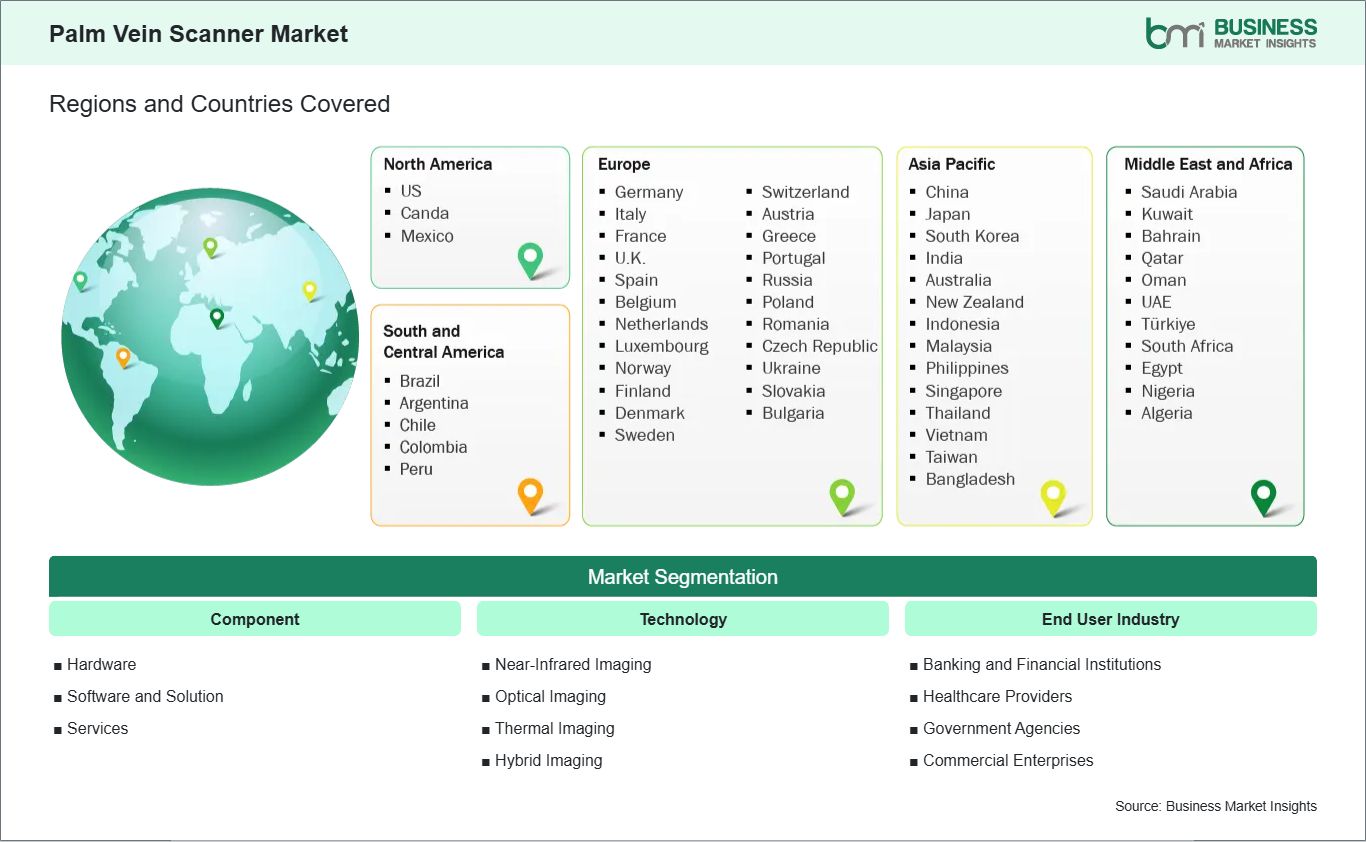
Key segments that contributed to the derivation of the palm vein scanner market analysis are component, technology, end user industry.
- By component, the palm vein scanner market is segmented into hardware, software and solution, and services. The hardware segment dominated the market in 2025.
- By technology, the market is classified into near-infrared imaging, optical imaging, thermal imaging, and hybrid imaging. The near-infrared imaging segment dominated the market in 2025.
- By end user industry, the market is segmented into banking and financial institutions, healthcare providers, government agencies, and commercial enterprises. The banking and financial institutions segment dominated the market in 2025.
Market Forces
Palm Vein Scanner Market Drivers and Opportunities
Growing Demand for Secure and Contactless Biometric Authentication
The growing demand for secure and contactless biometric authentication is a major driver for the palm vein scanner market. Organizations are increasingly adopting biometric technologies to improve security and reduce the risks associated with passwords, cards, or physical identification methods. Palm vein scanners provide a unique and reliable way to verify identity by analyzing vein patterns inside the human hand, which are difficult to copy or replicate. This high level of security makes palm vein recognition suitable for environments that require accurate and dependable authentication.
Many industries are adopting contactless authentication solutions to improve convenience and hygiene. Banking institutions use palm vein scanners for customer identification at automated teller machines and secure service counters. Healthcare providers are also using this technology to verify patient identities and prevent medical record errors. Government agencies and commercial organizations are implementing palm vein scanners to strengthen access control in offices, research facilities, and other sensitive locations.
In addition, the shift toward digital identity systems and stronger cybersecurity practices is encouraging the use of biometric authentication technologies. Palm vein scanners offer fast and reliable verification while reducing dependency on traditional identification methods. As organizations continue to prioritize secure and touch-free authentication, the demand for palm vein scanning technology is expected to increase across multiple sectors.
Expansion of Biometric Authentication in Healthcare Systems
The expansion of biometric authentication in healthcare systems presents a strong opportunity for the palm vein scanner market. Healthcare providers require reliable methods to verify patient identities, manage medical records, and ensure secure access to sensitive information. Palm vein recognition offers a highly accurate way to identify patients and healthcare staff while reducing the risk of identification errors. Because vein patterns are unique to each individual, this technology supports accurate record management and improves operational efficiency in hospitals and clinics.
Healthcare facilities are increasingly adopting digital systems for patient management, electronic medical records, and secure access to restricted areas. Palm vein scanners can be integrated with these systems to provide fast and reliable authentication for patients, doctors, and administrative staff. The contactless nature of the technology also supports hygiene standards, which is important in healthcare environments where infection control is a priority.
Furthermore, healthcare organizations are focusing on improving patient safety and reducing administrative errors. Biometric identification technologies help ensure that medical services, treatments, and prescriptions are linked to the correct patient. As healthcare systems continue to modernize and adopt secure identification technologies, palm vein scanners are expected to play an important role in improving identity verification and system efficiency.
Size and Share Analysis
Palm Vein Scanner Market Size and Share Analysis
The global palm vein scanner market is experiencing steady growth, with market size and share analysis reflecting evolving treatment preferences and competitive dynamics among key players. The report evaluates important subsegments categorized within component, technology, end user industry, highlighting their respective contributions to overall market performance.
By component, the hardware subsegment dominated the market in 2025, due to the essential role of scanners and sensors that capture vein patterns accurately for authentication across banking, healthcare, and government security systems.
By technology, the near-infrared imaging subsegment dominated the market in 2025, because it provides accurate detection of vein patterns beneath the skin, enabling secure, contactless, and highly reliable biometric identification.
By end user industry, the banking and financial institutions subsegment dominated the market in 2025, due to the growing need for secure customer authentication, fraud prevention, and reliable identity verification in financial transactions and banking services.
Report Coverage
Palm Vein Scanner Market Report Coverage and Deliverables
The "Palm Vein Scanner Market Size and Forecast (2022 - 2033)" report provides a detailed analysis of the market covering below areas:
- Palm Vein Scanner market size and forecast at the regional and country levels for segments covered under the scope
- Palm Vein Scanner market trends, as well as drivers, restraints, and opportunities
- Palm Vein Scanner market analysis covering key trends, regional framework, major players, regulations, and recent developments
- Industry landscape and competition analysis covering market concentration, heat map analysis, prominent players, and recent developments for the Palm Vein Scanner market
- Detailed company profiles, including SWOT analysis
Geographic Insights
Palm Vein Scanner Market Geographic Insights
The geographical scope of the palm vein scanner market report is divided into: North America, Asia Pacific, Europe, Middle East & Africa, and South & Central America. North America held the largest share in 2025.
North America dominates the palm vein scanner market due to strong adoption of advanced biometric technologies across multiple industries. Banking institutions, healthcare providers, government agencies, and commercial organizations in the region are increasingly adopting biometric authentication systems to improve security and prevent identity fraud. The region has a strong technology ecosystem with leading biometric technology developers and solution providers that support innovation and deployment of advanced authentication systems. Organizations in North America are focusing on strengthening identity verification systems for financial services, healthcare operations, and secure facility access. Palm vein scanners are used for customer authentication, patient identification, and employee access control in sensitive environments. The growing focus on digital identity management and cybersecurity is also encouraging the adoption of biometric technologies. In addition, continuous investments in research, technology development, and secure digital infrastructure support the expansion of palm vein scanning solutions across the region.
Report Guidance
Palm Vein Scanner Market Report Guidance
The report includes qualitative and quantitative data in the Palm Vein Scanner market across component, technology, end user industry, and geography.The report starts with the key takeaways (chapter 2), highlighting the key trends and outlook of the Palm Vein Scanner market.Chapter 3 focuses on the research methodology of the study.Chapter 4 includes ecosystem analysis.Chapter 5 highlights the major industry dynamics in the Palm Vein Scanner market, including factors that are driving the market, prevailing deterrents, potential opportunities, as well as future trends. Impact analysis of these drivers and restraints is also covered in this section.Chapter 6 discusses the Palm Vein Scanner market scenario, in terms of historical market revenues, and forecast till the year 2033.Chapters 7 to 10 cover the Palm Vein Scanner market segments by component, technology, end user industry, and geography across North America, Europe, Asia Pacific, the Middle East and Africa, and South and Central America. They cover the market revenue, forecast, and factors driving the market.Chapter 11 describes the competitive analysis along with the heat map analysis for the key players operating in the market.Chapter 12 describes the industry landscape analysis. It provides detailed descriptions of business activities such as market initiatives, new developments, mergers, and joint ventures globally, along with a competitive landscape.Chapter 13 provides detailed profiles of the major companies operating in the Palm Vein Scanner market. Companies have been profiled on the basis of their key facts, business descriptions, products, financial overview, SWOT analysis, and key developments.Chapter 14, i.e., the appendix, is inclusive of a brief overview of the company, list of abbreviations, and disclaimer.
Industry Activity
Recent Developments
The palm vein scanner market is evaluated by gathering qualitative and quantitative data post primary and secondary research, which includes important corporate publications, association data, and databases. A few of the key developments in the Palm Vein Scanner market are:
- In April 2024, Uniken announced that it integrated palm vein authentication into its REL-ID identity security platform to provide stronger biometric authentication for banking and enterprise digital security applications.
- In December 2023, Fujitsu Frontech Limited announced that it launched the “PalmSecure Authentication Library Millions Edition,” enabling large-scale palm vein authentication for up to 10 million registered users using only palm vein biometric data, expanding the technology’s applications to large events, payments, and transportation systems.
- In February 2023, Ingenico and Fujitsu Frontech North America announced that they introduced a palm-vein biometric payment solution that allows customers to enroll and make secure in-store payments using near-infrared palm scans integrated with the Fujitsu PalmSecure-F Pro sensor.
Trust & Transparency
Research Methodology
The market analysis combines proprietary research with secondary data from government agencies, company disclosures, regulatory filings, industry databases and expert interviews. Market estimates are validated through data triangulation, cross-market benchmarking and analyst
review.
View Full Research Methodology
Key Sources Referred:
International Electrotechnical CommissionInstitute of Electrical and Electronics EngineersInternational Organization for StandardizationBureau of Indian StandardsCentral Electricity AuthorityMinistry of PowerIndian Electrical and Electronics Manufacturers' AssociationEuropean Committee for Electrotechnical StandardizationVDE Association for Electrical Electronic & Information TechnologiesCompany WebsitesCompany Annual ReportsCompany Investor Presentations