
Unmanned Surface Vehicle Market Outlook (2022-2033)

Historic Data: 2022-2024   |   Base Year: 2025   |   Forecast Period: 2026-2033
Report Content: Market Scope, Market Segmentation, Market Dynamics, and Competitive Analysis

Report Coverage:
  • Type (Autonomous Surface Vehicles (ASVs), Semi-Autonomous/Remote Operated)
  • System (Payload, Navigation, Control, Power, Other Systems)
  • Application (Defense, Commercial)
  • Endurance (≤500 hours, 500-1000 hours, >1000 hours)

No. of Pages: 401
Report Code: BMIPUB00034579
Category: Electronics and Semiconductor
Unmanned Surface Vehicle Market

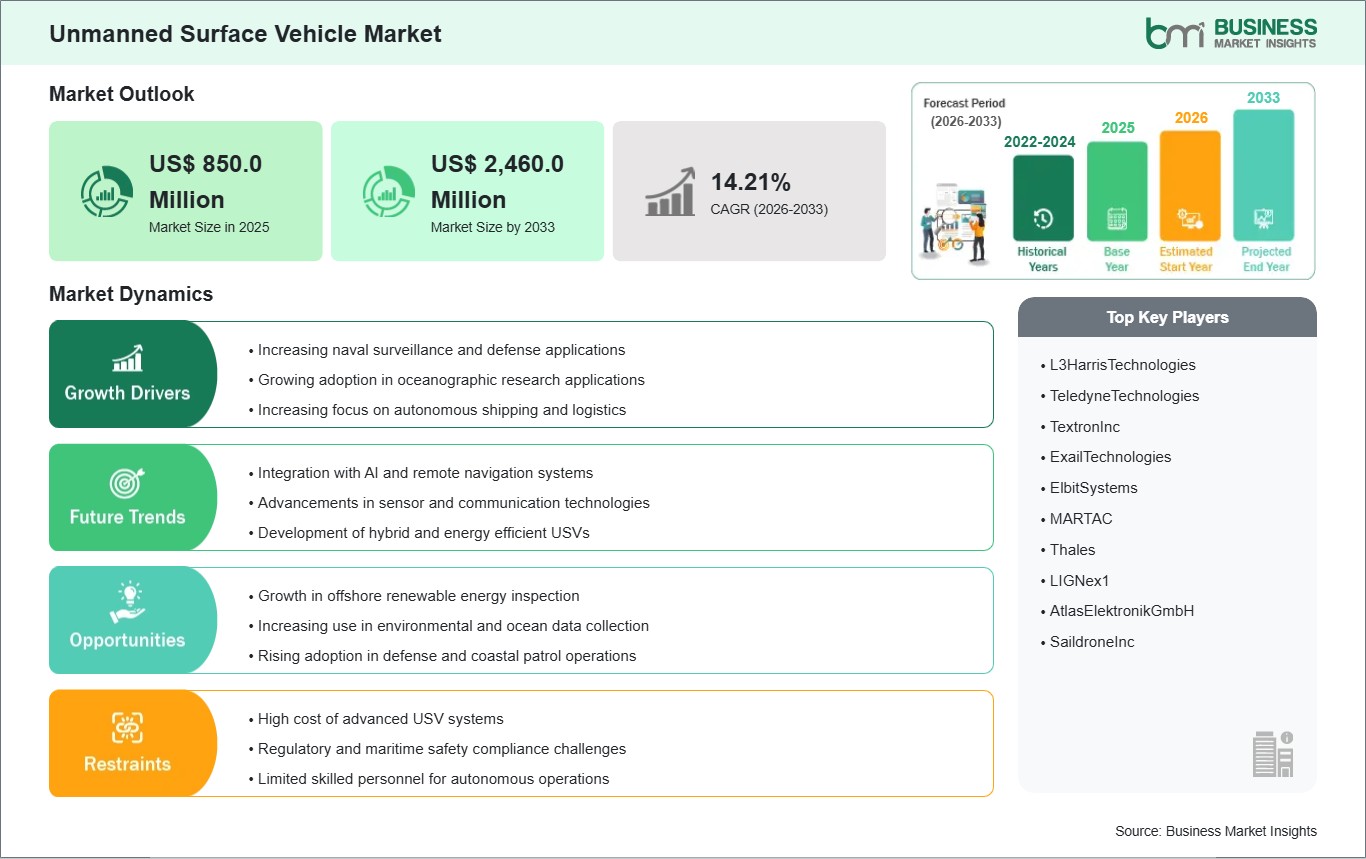
The Unmanned Surface Vehicle Market size is expected to reach US$ 2,460. million by 2033 from US$ 850. million in 2025. The market is estimated to record a CAGR of 14.21% from 2026 to 2033.

Executive Summary and Global Market Analysis:

The unmanned surface vehicles market is experiencing tremendous growth, with the market transforming rapidly due to technological developments in unmanned navigation, sensors, and artificial intelligence-based maritime analytics. The current unmanned surface vehicles are increasingly developed with the capability of performing multiple tasks, ranging from defense operations, environmental monitoring, exploration of the sea, and commercial maritime operations. The demand is driven by the need to operate in the sea in a safe, efficient, and cost-effective manner, especially in hazardous environments, as operations using manned vehicles are risky.

The inclusion of communication systems, sonar, and remote monitoring technologies has significantly contributed to the improvement of data collection and decision-making capabilities. The market is experiencing tremendous growth, with key market players adopting strategic moves, including R&D and partnerships, aimed at developing their products, hence expanding their reach across the globe. The market is driven by defense operations, with the vehicles increasingly used in coastal surveillance, mine countermeasure operations, and reconnaissance, while commercial operations are increasingly adopting unmanned surface vehicles, especially in the management of ports, wind farms, and maritime operations.

Unmanned Surface Vehicle Market - Strategic Insights:

global-market-strategic-framework
Get more information on this report

Unmanned Surface Vehicle Market Segmentation Analysis:

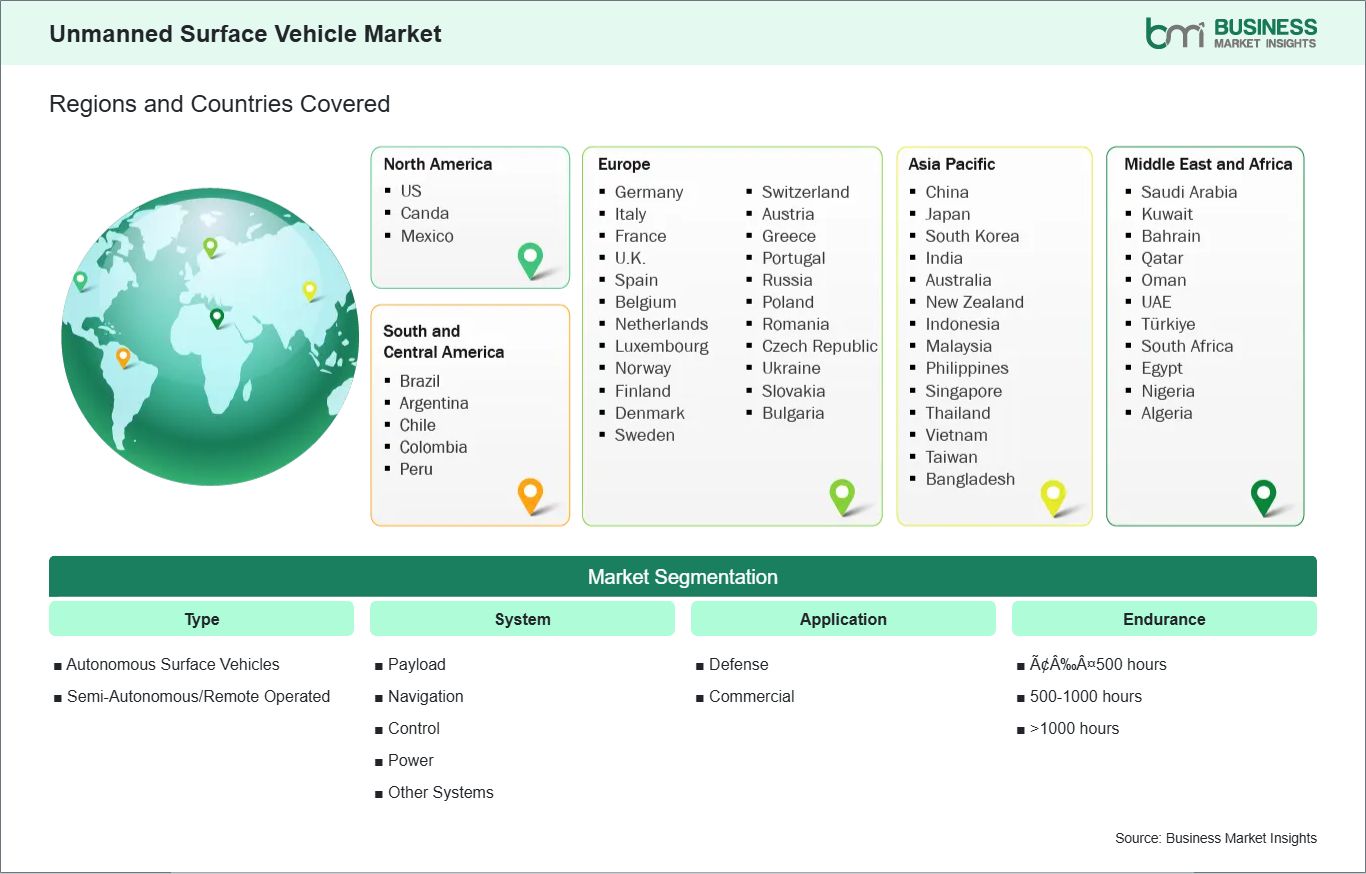
Key segments that contributed to the derivation of the unmanned surface vehicles market analysis are type, system, application, endurance, size, cruising speed, and hull type.

  • Type, the unmanned surface vehicles market is segmented into autonomous surface vehicles (ASVs) and semi-autonomous/remote operated vehicles. The ASV segment dominated the market in 2025.
  • System, the unmanned surface vehicles market is categorized into payload, navigation, control, power, and others. The payload segment dominated the market in 2025.
  • Application, the unmanned surface vehicles market is classified into defense and commercial. The defense segment dominated the market in 2025.
  • Endurance, the unmanned surface vehicles market is segmented into <500 hours, 500 - 1000 hours, and >1000 hours. The 500 - 1000 hours segment dominated the market in 2025.
  • Size, the unmanned surface vehicles market is categorized into small, medium, large, and extra-large. The large segment dominated the market in 2025.
  • Cruising Speed, the unmanned surface vehicles market is segmented into <10 knots, 10 - 30 knots, and >30 knots. The >30 knots segment dominated the market in 2025.
  • Hull Type, the unmanned surface vehicles market is segmented into single-hull, multi-hull, and other hull types. The single-hull segment dominated the market in 2025.
Unmanned Surface Vehicle Market Drivers and Opportunities:

Increasing naval surveillance and defense applications

Maritime forces across the world are increasingly employing unmanned surface vehicles for enhancing maritime security and minimizing risks. The unmanned surface vehicle has applications for coastal surveillance, reconnaissance, anti-submarine warfare, and port defense. The unmanned feature of USVs enables maritime forces to maintain surveillance for an extended period without risking personnel. This allows for the monitoring of potentially unsafe waters. The USV is also equipped with advanced sensors, radars, and communication devices. This allows USVs to acquire and transmit intelligence information.

The USV has modular applications, including tracking and search and rescue. This allows for flexibility, which cannot be attained by employing crewed vessels. The USV also offers cost-effectiveness by reducing the number of crewed vessels. The adoption of USVs is also driving innovations in autonomous navigation, obstacle avoidance, and mission planning software. Integration with existing naval fleets enhances operational efficiency, allowing manned vessels to focus on complex missions while unmanned systems handle repetitive or high-risk tasks. The growing reliance on these platforms highlights their strategic importance in modern maritime defense.

Growth in offshore renewable energy inspection

USVs are increasingly becoming an essential part of inspection and maintenance activities for offshore energy structures. This is particularly important for structures such as wind turbines, oil rigs, and subsea cabling. The USV plays an important role in monitoring these structures remotely, eliminating the need for crewed vessels that must navigate harsh sea conditions. The USV has cameras and other environmental sensors that enable it to collect information regarding the structural integrity of these facilities and the environmental conditions. This enables proper planning and scheduling of activities without risking downtime.

The autonomous nature of these vessels also removes the need for human labor and increases safety, as there is no human exposure in dangerous offshore environments. Besides the monitoring activities, USVs are also important in logistics and planning of operations in offshore environments. They are used in surveying and assessing the environment, and their use in the installation of energy infrastructure is also possible. The diversity of USVs in carrying out inspection, monitoring, and survey operations makes them important in the sustainability of offshore energy operations.

Unmanned Surface Vehicle Market Size and Share Analysis:

The unmanned surface vehicles market demonstrates steady growth, with size and share analysis highlighting evolving trends and competitive dynamics among key players. The report examines subsegments categorized within type, system, application, endurance, size, cruising speed, and hull type, offering insights into their contribution to overall market performance.

By Type, the autonomous surface vehicles (ASV) subsegment dominated the market in 2025, driven by increasing deployment in naval defense, maritime surveillance, and research missions.

Based on System, the payload subsegment dominated the market in 2025, owing to the integration of advanced sensors, cameras, and mission-specific equipment enhancing operational capabilities.

On the basis of Application, the defense subsegment dominated the market in 2025, supported by rising military investments in maritime unmanned technologies.

By Endurance, the 500 - 1000 hours subsegment dominated the market in 2025, as it offers a balance of operational range and cost-efficiency for extended missions.

By Size, the large subsegment dominated the market in 2025, due to higher payload capacity and suitability for complex maritime tasks.

By Cruising Speed, the >30 knots subsegment dominated the market in 2025, driven by the need for rapid deployment in naval and security operations.

By Hull Type, the single-hull subsegment dominated the market in 2025, owing to its simplicity, stability, and wide adoption in USV platforms.

Unmanned Surface Vehicle Market Report Highlights:

Report Attribute Details
Market size in 2025 US$ 850.0 Million
Market Size by 2033 US$ 2,460.0 Million
Global CAGR (2026 - 2033)14.21%
Historical Data 2022-2024
Forecast period 2026-2033
Segments Covered By Type
  • Autonomous Surface Vehicles
  • Semi-Autonomous/Remote Operated
By System
  • Payload
  • Navigation
  • Control
  • Power
  • Other Systems
By Application
  • Defense
  • Commercial
By Endurance
  • ≤500 hours
  • 500-1000 hours
  • >1000 hours
Regions and Countries Covered
North America US, Canada, Mexico
Europe Belgium, Austria, Finland, Denmark, Greece, Poland, Romania, Russia, Ukraine, Czech Republic, Slovakia, Bulgaria, Italy, Luxembourg, Germany, Switzerland, France, Netherlands, Norway, Portugal, Spain, Sweden, United Kingdom
Asia-Pacific Australia, China, India, Japan, South Korea, Indonesia, Malaysia, Philippines, Singapore, Thailand, Vietnam, Bangladesh, New Zealand, Taiwan
South and Central America Brazil, Argentina, Peru, Chile, Colombia
Middle East and Africa Bahrain, Kuwait, Oman, Qatar, Saudi Arabia, United Arab Emirates, Turkiye, South Africa, Egypt, Algeria, Nigeria
Market leaders and key company profiles
  • L3HarrisTechnologies
  • TeledyneTechnologies
  • TextronInc
  • ExailTechnologies
  • ElbitSystems
  • MARTAC
  • Thales
  • LIGNex1
  • AtlasElektronikGmbH
  • SaildroneInc
Get more information on this report

Unmanned Surface Vehicle Market Report Coverage and Deliverables:

The "Unmanned Surface Vehicle Market Size and Forecast (2022 - 2033)" report provides a detailed analysis of the market covering below areas:

  • Unmanned Surface Vehicle Market size and forecast at global, regional, and country levels for all the key market segments covered under the scope
  • Unmanned Surface Vehicle Market trends, as well as drivers, restraints, and opportunities
  • Unmanned Surface Vehicle Market analysis covering key trends, global and regional framework, major players, regulations, and recent developments
  • Industry landscape and competition analysis covering market concentration, heat map analysis, prominent players, and recent developments for the Unmanned Surface Vehicle Market
  • Detailed company profiles, including SWOT analysis

Unmanned Surface Vehicle Market Geographic Insights:

The geographical scope of the Unmanned Surface Vehicle Market report is divided into North America, Asia Pacific, Europe, Middle East & Africa, and South & Central America. North America held the largest share in 2025.

Regional adoption of USVs varies significantly, shaped by maritime priorities, technological infrastructure, and defense investments. North America remains a leading region due to advanced naval programs, strong defense budgets, and a mature autonomous vehicle ecosystem.

Europe’s growth is supported by collaborative maritime security initiatives, stringent environmental monitoring regulations, and increasing interest in offshore renewable energy projects.

The Asia-Pacific market is expanding rapidly, propelled by rising naval modernization, commercial port development, and offshore resource exploration, with countries investing in indigenous USV technologies.

In the Middle East, strategic emphasis on maritime security and border surveillance is driving selective USV deployment. Latin America is gradually exploring applications in fisheries, port management, and environmental monitoring, though adoption is constrained by budgetary and infrastructure limitations.

Across regions, localized production strategies, public-private partnerships, and technology transfer agreements are shaping market trajectories, resulting in a diverse and competitive landscape for USV manufacturers and solution providers.

global-market-geography
Get more information on this report

Unmanned Surface Vehicle Market Research Report Guidance:

  • The report includes qualitative and quantitative data in the unmanned surface vehicle market across type, system, application, endurance, size, cruising speed, hull type and geography.
  • The report starts with the key takeaways (chapter 2), highlighting key trends and outlook of the Unmanned Surface Vehicle Market.
  • Chapter 3 focuses on the research methodology of the study.
  • Chapter 4 includes ecosystem analysis.
  • Chapter 5 highlights the major industry dynamics in the unmanned surface vehicle market, including factors that are driving the market, prevailing deterrents, potential opportunities, as well as future trends. Impact analysis of these drivers and restraints is also covered in this section.
  • Chapter 6 discusses the unmanned surface vehicle market scenario, in terms of historical market revenues, and forecast till the year 2033.
  • Chapters 7 to 14 cover unmanned surface vehicle market segments across type, system, application, endurance, size, cruising speed, hull type and geography across North America, Asia Pacific, Europe, the Middle East & Africa, and South & Central America. They cover the market revenue forecast and factors driving the market.
  • Chapter 15 describes the competitive analysis along with the heat map analysis for the key players operating in the market.
  • Chapter 16 describes the industry landscape analysis. It provides detailed descriptions of business activities such as market initiatives, new developments, mergers, and joint ventures globally, along with a competitive landscape.
  • Chapter 17 provides detailed profiles of the major companies operating in the Unmanned Surface Vehicle Market. Companies have been profiled on the basis of their key facts, business descriptions, products, financial overview, SWOT analysis, and key developments.
  • Chapter 18, i.e., the appendix, is inclusive of a brief overview of the company, a list of abbreviations, and a disclaimer.

Unmanned Surface Vehicle Market News and Key Development:

The Unmanned Surface Vehicle Market is evaluated by gathering qualitative and quantitative data post primary and secondary research, which includes important corporate publications, association data, and databases. A few of the key developments in the spatial light Modulator market are:

  • In March 2026, RS Aqua announced that it had entered into a strategic partnership with US‑based Seasats to bring autonomous surface vehicle (USV) platforms to the defense markets in the United Kingdom and Ireland, including representation and support of Seasats’ Lightfish USV portfolio.
  • In February 2026, Lockheed Martin announced a significant strategic collaboration and a US$ 50 million investment in Saildrone to jointly develop and integrate advanced defense‑capable unmanned surface vehicles (USVs) for enhanced capabilities including sensors and weapon systems targeted at naval missions.

Key Sources Referred:

  • International Electrotechnical Commission
  • Institute of Electrical and Electronics Engineers
  • International Organization for Standardization
  • Bureau of Indian Standards
  • Central Electricity Authority
  • Ministry of Power
  • Indian Electrical and Electronics Manufacturers' Association
  • European Committee for Electrotechnical Standardization
  • VDE Association for Electrical Electronic & Information Technologies
  • Company Websites
  • Company Annual Reports
  • Company Investor Presentation
The List of Companies - Unmanned Surface Vehicle Market
  • L3HarrisTechnologies
  • TeledyneTechnologies
  • TextronInc
  • ExailTechnologies
  • ElbitSystems
  • MARTAC
  • Thales
  • LIGNex1
  • AtlasElektronikGmbH
  • SaildroneInc
Frequently Asked Questions
How big is the Unmanned Surface Vehicle Market?

The Unmanned Surface Vehicle Market is valued at US$ 850.0 Million in 2025, it is projected to reach US$ 2,460.0 Million by 2033.

What is the CAGR for Unmanned Surface Vehicle Market by (2026 - 2033)?

As per our report Unmanned Surface Vehicle Market, the market size is valued at US$ 850.0 Million in 2025, projecting it to reach US$ 2,460.0 Million by 2033. This translates to a CAGR of approximately 14.21% during the forecast period.

What segments are covered in this report?

The Unmanned Surface Vehicle Market report typically cover these key segments-

  • Type (Autonomous Surface Vehicles (ASVs), Semi-Autonomous/Remote Operated)
  • System (Payload, Navigation, Control, Power, Other Systems)
  • Application (Defense, Commercial)
  • Endurance (≤500 hours, 500-1000 hours, >1000 hours)

What is the historic period, base year, and forecast period taken for Unmanned Surface Vehicle Market?

The historic period, base year, and forecast period can vary slightly depending on the specific market research report. However, for the Unmanned Surface Vehicle Market report:

  • Historic Period : 2022-2024
  • Base Year : 2025
  • Forecast Period : 2026-2033
  • Who are the major players in Unmanned Surface Vehicle Market?

    The Unmanned Surface Vehicle Market is populated by several key players, each contributing to its growth and innovation. Some of the major players include:

  • L3HarrisTechnologies
  • TeledyneTechnologies
  • TextronInc
  • ExailTechnologies
  • ElbitSystems
  • MARTAC
  • Thales
  • LIGNex1
  • AtlasElektronikGmbH
  • SaildroneInc
  • Who should buy this report?

    The Unmanned Surface Vehicle Market report is valuable for diverse stakeholders, including:

    • Investors: Provides insights for investment decisions pertaining to market growth, companies, or industry insights. Helps assess market attractiveness and potential returns.
    • Industry Players: Offers competitive intelligence, market sizing, and trend analysis to inform strategic planning, product development, and sales strategies.
    • Suppliers and Manufacturers: Helps understand market demand for components, materials, and services related to concerned industry.
    • Researchers and Consultants: Provides data and analysis for academic research, consulting projects, and market studies.
    • Financial Institutions: Helps assess risks and opportunities associated with financing or investing in the concerned market.

    Essentially, anyone involved in or considering involvement in the Unmanned Surface Vehicle Market value chain can benefit from the information contained in a comprehensive market report.

    Available Report Formats

    pdf-format excel-format pptx-format
    Buy Now
    Sales Assistance
    +1 646 791 7070 (US & UK)
    Customization Form

    Please tell us your area of interest
    (Market Segments/ Regions and Countries/ Companies)