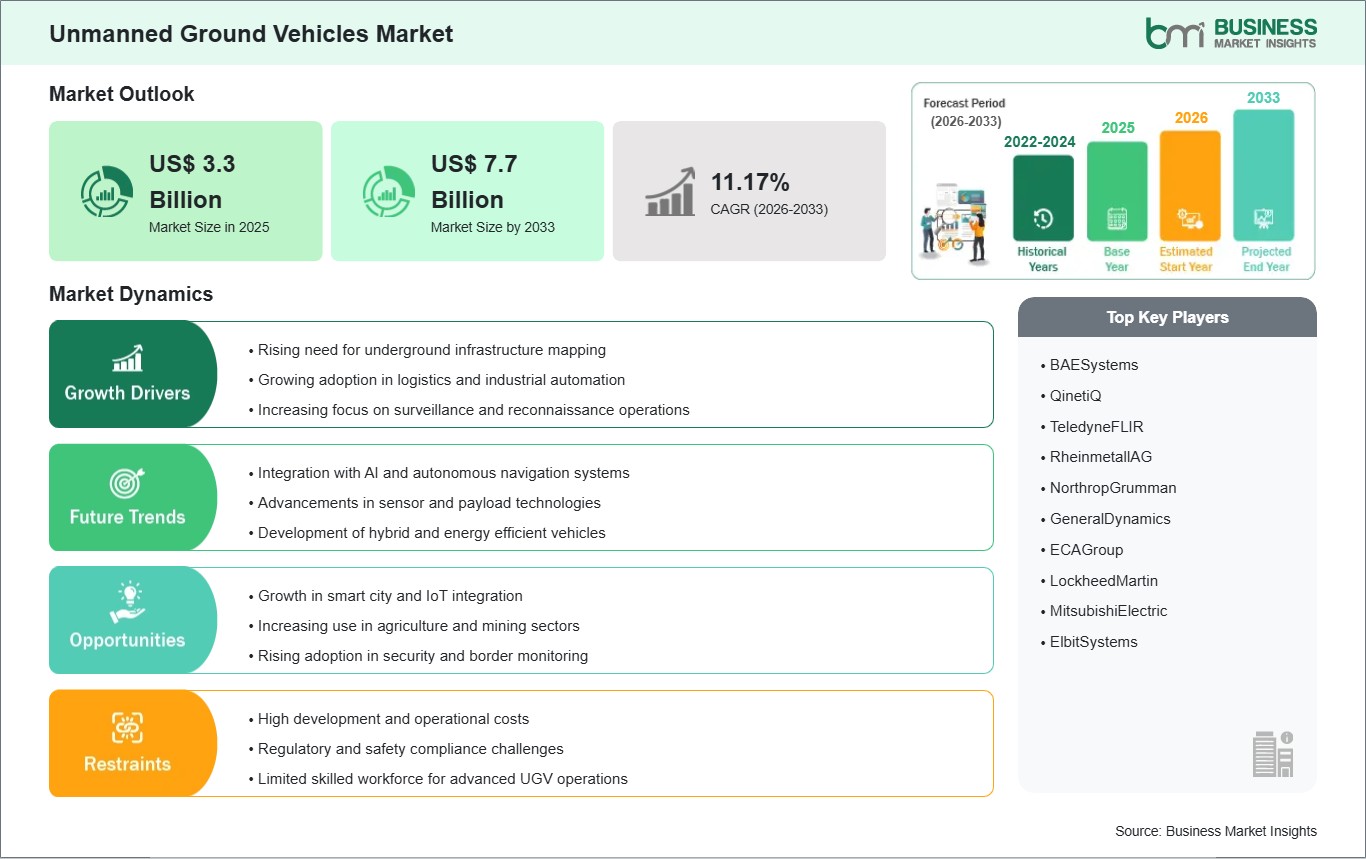
The Unmanned Ground Vehicles Market size is expected to reach US$ 7.7 billion by 2033 from US$ 3.3 billion in 2025. The market is estimated to record a CAGR of 11.17% from 2026 to 2033.
The global unmanned ground vehicles (UGVs) market is witnessing considerable change with the continuous advancement in autonomous technology, machine learning, and sensor fusion. Currently, companies in the unmanned ground vehicle industry are focusing on the creation of adaptable and expandable platforms that can be utilized in a variety of applications in different environments. The increased need to reduce human exposure in high-risk operations has led to an increased demand for unmanned ground vehicle operations. Improved connectivity and data processing are providing real-time situational awareness, thereby increasing the accuracy and efficiency of operations. Currently, unmanned ground vehicle companies are engaging in strategic partnerships and innovation-driven initiatives with the aim of strengthening their competitive positions. Although the unmanned ground vehicle industry is heavily focused on the military, other industries such as logistics, agriculture, and resource exploration are increasingly using unmanned ground vehicle technology to improve operations and reduce costs.
However, there are several challenges that are hindering the growth and adoption of unmanned ground vehicle technology. These include complexity in integration, security risks, and capital costs. The unmanned ground vehicle competitive environment is characterized by continuous innovation, increased investment in research and development, and the use of advanced autonomous technology.

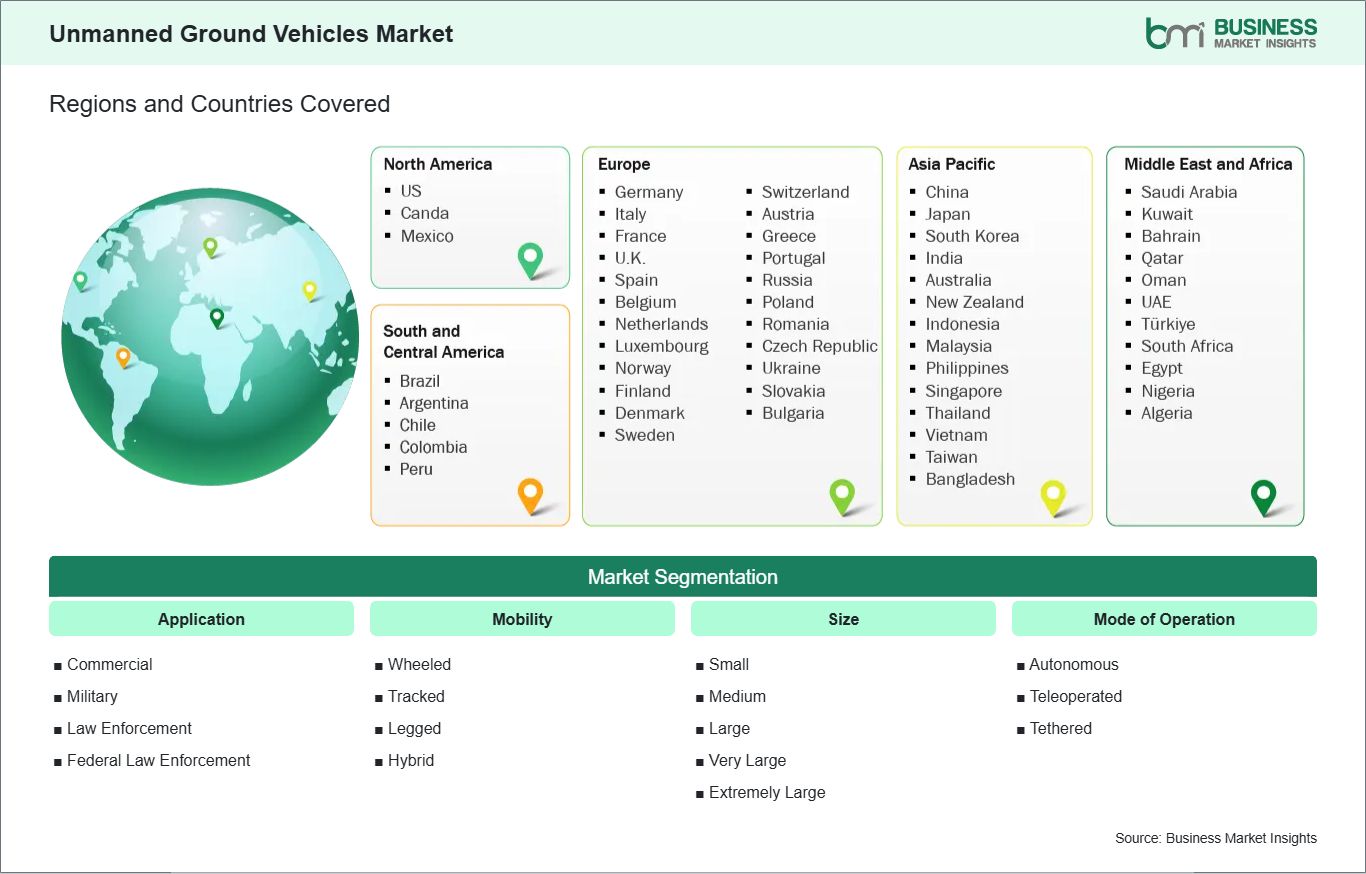
Key segments that contributed to the derivation of the unmanned ground vehicles market analysis are application, mobility, size, mode of operation, and system.
The world over, countries are increasingly using UGVs in their armed forces to ensure safety and efficiency in their operations. The United States, Germany, and China are using UGVs in their logistical support to transport supplies, ammunition, and equipment through hostile terrain without risking human lives. These robots are being used in war zones, border control, and relief operations after disasters, demonstrating the importance of using robots in warfare. The use of UGVs in military logistical support eliminates the need to rely on human carriers, as they are prone to attacks or accidents.
The US Army has tested autonomous cargo vehicles in the desert to transport supplies to forward operating bases, while Germany is considering using robots to support NATO war games. These vehicles can carry hundreds of kilograms of equipment and operate under continuous monitoring or semi-autonomously, which increases the speed and reliability of supply chains in combat zones. Investment in autonomous technologies is also driving innovation in vehicle durability, navigation, and communications. Saudi Arabia, for instance, has shown interest in large UGV platforms capable of patrolling borders and transporting supplies across deserts. This global push for autonomous military logistics ensures that UGVs will remain a crucial element of defense modernization strategies worldwide.
Agricultural applications are emerging as a major growth area for UGVs globally. Autonomous tractors, robotic harvesters, and soil-monitoring vehicles are being used in large-scale farms across North America, Europe, and Asia. These UGVs help reduce labor dependency, increase efficiency, and optimize the use of water and fertilizers through precision farming techniques. Precision agriculture relies on sensor-equipped UGVs to analyze soil conditions, monitor crop health, and apply nutrients selectively. In the United States and Brazil, for example, autonomous crop sprayers are being used on thousands of hectares of farmland to minimize waste and improve yield.
Meanwhile, in Europe, small robotic platforms are performing automated weeding in vineyards and orchards, reducing pesticide usage and improving sustainability. Emerging economies are also adopting UGVs for farming at a smaller scale. In India and Southeast Asia, low-cost autonomous vehicles are used to manage rice paddies and vegetable farms. Local governments are supporting these innovations through subsidies or pilot programs, enabling wider adoption. By extending beyond defense into agriculture, UGVs are diversifying their global market and opening up new opportunities for automation across industries.

The unmanned ground vehicles market demonstrates steady growth, with size and share analysis highlighting evolving trends and competitive dynamics among key players. The report examines subsegments categorized within application, mobility, size, mode of operation, and system, offering insights into their contribution to overall market performance.
By Application, the military subsegment dominated the market in 2025, driven by increasing defense investments and demand for unmanned systems in surveillance, reconnaissance, and combat support operations.
Based on Mobility, the tracked subsegment dominated the market in 2025, owing to its superior performance in rough terrains and military environments.
On the basis of Size, the small subsegment dominated the market in 2025, due to its portability, cost-effectiveness, and growing adoption in both defense and commercial applications.
By Mode of Operation, the teleoperated subsegment dominated the market in 2025, supported by its reliability and human-in-the-loop control in critical missions.
By System, the payloads subsegment dominated the market in 2025, driven by the increasing integration of sensors, cameras, and weapon systems enhancing vehicle capabilities.
| Report Attribute | Details |
|---|---|
| Market size in 2025 | US$ 3.3 Billion |
| Market Size by 2033 | US$ 7.7 Billion |
| Global CAGR (2026 - 2033) | 11.17% |
| Historical Data | 2022-2024 |
| Forecast period | 2026-2033 |
| Segments Covered | By Application
|
|
Regions and Countries Covered
| |
| North America | US, Canada, Mexico |
| Europe | Belgium, Austria, Finland, Denmark, Greece, Poland, Romania, Russia, Ukraine, Czech Republic, Slovakia, Bulgaria, Italy, Luxembourg, Germany, Switzerland, France, Netherlands, Norway, Portugal, Spain, Sweden, United Kingdom |
| Asia-Pacific | Australia, China, India, Japan, South Korea, Indonesia, Malaysia, Philippines, Singapore, Thailand, Vietnam, Bangladesh, New Zealand, Taiwan |
| South and Central America | Brazil, Argentina, Peru, Chile, Colombia |
| Middle East and Africa | Bahrain, Kuwait, Oman, Qatar, Saudi Arabia, United Arab Emirates, Turkiye, South Africa, Egypt, Algeria, Nigeria |
| Market leaders and key company profiles |
|
The "Unmanned Ground Vehicles Market Size and Forecast (2022 - 2033)" report provides a detailed analysis of the market covering below areas:
The geographical scope of the Unmanned Ground Vehicles Market report is divided into North America, Asia Pacific, Europe, Middle East & Africa, and South & Central America. North America held the largest share in 2025.
The adoption and development of unmanned ground vehicles vary considerably across regions, reflecting differences in economic priorities, technological capabilities, and regulatory environments. North America continues to lead in terms of innovation and implementation, supported by robust investment in defense technologies and a well-established robotics ecosystem.
In Europe, growth is driven by collaborative defense initiatives and regulatory frameworks that emphasize safety, standardization, and interoperability.
The Asia-Pacific region is emerging as a high-growth market, propelled by expanding industrial sectors, rising defense budgets, and government initiatives aimed at strengthening domestic manufacturing capabilities.
In the Middle East, increasing focus on security and surveillance has accelerated the uptake of UGV technologies, particularly for critical infrastructure protection and border management. Latin America is gradually embracing these systems, with applications primarily concentrated in sectors such as mining and agriculture, although progress is moderated by financial and infrastructural limitations.
Across all regions, market participants are adapting their strategies to align with local requirements, fostering partnerships, and enhancing supply chain resilience to support sustained growth and market penetration.

The Unmanned Ground Vehicles Market is evaluated by gathering qualitative and quantitative data post primary and secondary research, which includes important corporate publications, association data, and databases. A few of the key developments in the spatial light Modulator market are:
The Unmanned Ground Vehicles Market is valued at US$ 3.3 Billion in 2025, it is projected to reach US$ 7.7 Billion by 2033.
As per our report Unmanned Ground Vehicles Market, the market size is valued at US$ 3.3 Billion in 2025, projecting it to reach US$ 7.7 Billion by 2033. This translates to a CAGR of approximately 11.17% during the forecast period.
The Unmanned Ground Vehicles Market report typically cover these key segments-
The historic period, base year, and forecast period can vary slightly depending on the specific market research report. However, for the Unmanned Ground Vehicles Market report:
The Unmanned Ground Vehicles Market is populated by several key players, each contributing to its growth and innovation. Some of the major players include:
The Unmanned Ground Vehicles Market report is valuable for diverse stakeholders, including:
Essentially, anyone involved in or considering involvement in the Unmanned Ground Vehicles Market value chain can benefit from the information contained in a comprehensive market report.
Please tell us your area of interest
(Market Segments/ Regions and Countries/ Companies)