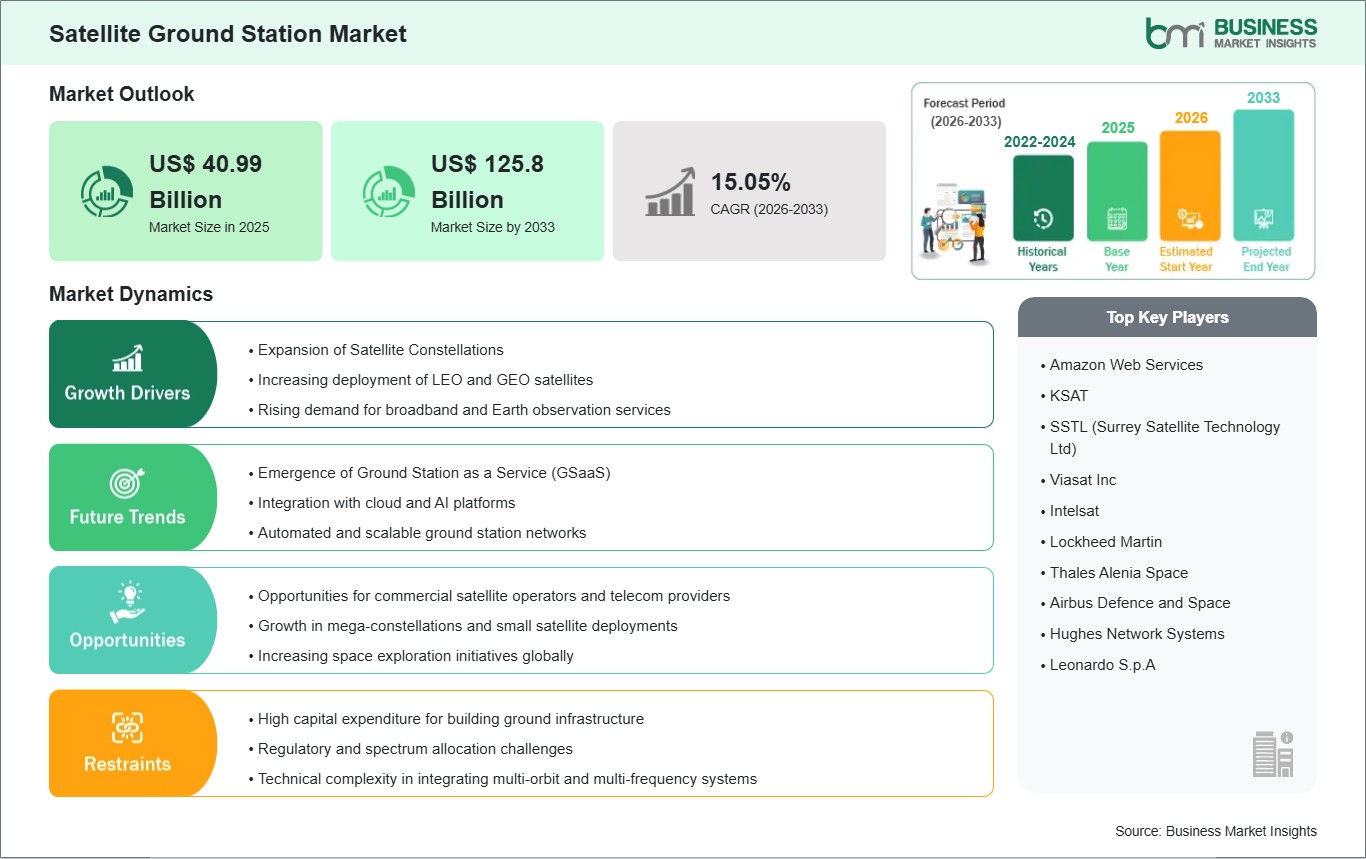
The Satellite Ground Station Market size is expected to reach US$ 125.8 billion by 2033 from US$ 40.99 billion in 2025. The market is estimated to record a CAGR of 15.05% from 2026 to 2033.
The global satellite ground station market is witnessing significant expansion as satellite-based services become increasingly vital for global communications, navigation, Earth observation, and scientific research. Ground stations form the critical link between satellites in orbit and terrestrial networks, enabling data transmission, command operations, and telemetry monitoring. As satellite constellations continue to grow—particularly in low Earth orbit—the demand for advanced and scalable ground station infrastructure is rising rapidly.
The proliferation of small satellites and mega-constellations designed for broadband connectivity, remote sensing, and IoT services is transforming the satellite ecosystem. These developments are creating a need for high-capacity ground infrastructure capable of supporting frequent satellite passes, high data volumes, and reliable communication links. Modern ground stations incorporate advanced antenna systems, high-frequency communication technologies, and software-defined networking capabilities to support these requirements.
Additionally, the emergence of Ground Station as a Service (GSaaS) models is reshaping how satellite operators access infrastructure. Instead of investing in expensive physical ground stations, satellite companies can utilize shared infrastructure through cloud-based platforms, reducing capital expenditure and improving operational efficiency. As the global space economy expands and satellite deployments increase, satellite ground stations will remain a foundational component of the space communication ecosystem.

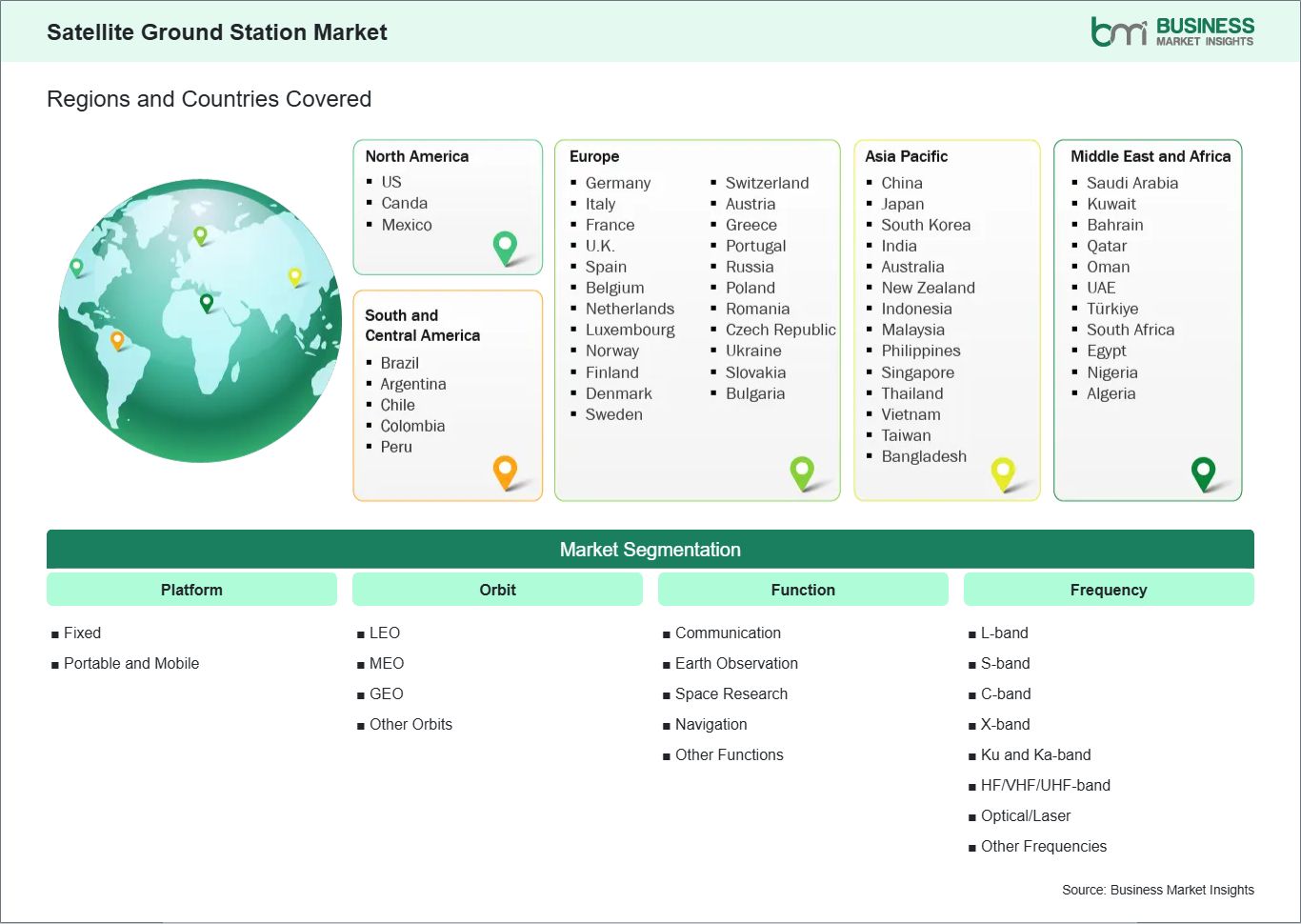
Key segments that contributed to the derivation of the satellite ground station market analysis are platform, orbit, function, frequency, solution, end user, and application.
The rapid growth of satellite constellations, particularly in low Earth orbit, is increasing the demand for scalable and automated ground station networks capable of managing frequent satellite passes and high data volumes.
GSaaS solutions allow satellite operators to access shared ground station infrastructure through cloud-based platforms, reducing capital expenditure and enhancing operational flexibility.
Modern ground stations incorporate advanced antenna systems, high-frequency communication technologies, and software-defined networking capabilities to support broadband connectivity, Earth observation, and scientific missions.
The Satellite Ground Station Market demonstrates steady growth, with size and share analysis highlighting evolving trends and competitive dynamics among key players. The report examines subsegments categorized within platform, orbit, function, frequency, solution, end user, and application, offering insights into their contribution to overall market performance.
By platform, the fixed segment accounted for the largest share in 2025, as permanent ground stations provide stable and high-capacity communication capabilities.
Based on orbit, the LEO segment held the largest market share in 2025, driven by the increasing deployment of small satellite constellations.
In terms of function, the communication segment dominated the market in 2025, supported by the growing reliance on satellite-based broadband and data services.
By frequency, the Ku and Ka‑band segment held the largest market share in 2025, driven by the growing adoption of high‑throughput satellites and the rising demand for broadband connectivity across aviation, maritime, and enterprise networks.
By solution, the hardware segment accounted for the largest share in 2025, reflecting the ongoing demand for antenna systems and communication equipment used in ground stations.
By end user, the commercial segment held the largest market share in 2025, driven by the expansion of satellite broadband services, the rise of Ground Station as a Service (GSaaS), and increasing demand from telecom operators, cloud providers, and mobility applications.
| Report Attribute | Details |
|---|---|
| Market size in 2025 | US$ 40.99 Billion |
| Market Size by 2033 | US$ 125.8 Billion |
| Global CAGR (2026 - 2033) | 15.05% |
| Historical Data | 2022-2024 |
| Forecast period | 2026-2033 |
| Segments Covered | By Platform
|
|
Regions and Countries Covered
| |
| North America | US, Canada, Mexico |
| Europe | Belgium, Austria, Finland, Denmark, Greece, Poland, Romania, Russia, Ukraine, Czech Republic, Slovakia, Bulgaria, Italy, Luxembourg, Germany, Switzerland, France, Netherlands, Norway, Portugal, Spain, Sweden, United Kingdom |
| Asia-Pacific | Australia, China, India, Japan, South Korea, Indonesia, Malaysia, Philippines, Singapore, Thailand, Vietnam, Bangladesh, New Zealand, Taiwan |
| South and Central America | Brazil, Argentina, Peru, Chile, Colombia |
| Middle East and Africa | Bahrain, Kuwait, Oman, Qatar, Saudi Arabia, United Arab Emirates, Turkiye, South Africa, Egypt, Algeria, Nigeria |
| Market leaders and key company profiles |
|
The "Satellite Ground Station Market Size and Forecast (2022 - 2033)" report provides a detailed analysis of the market covering below areas:
The geographical scope of the Remote Power Panel Market report is divided into North America, Asia Pacific, Europe, Middle East & Africa, and South & Central America. North America held the largest share in 2025.
North America remains the largest market for remote power panels. This dominance is driven by extensive data center infrastructure growth, high adoption of advanced power management technologies, and robust regulatory environments focused on safety and energy efficiency. The U.S. and Canada host a large number of hyperscale and enterprise facilities that continually upgrade power distribution technologies to accommodate evolving IT workloads. In Europe, the market is expanding steadily, supported by modernization of existing data centers, stringent energy performance regulations, and increased investment in telecom and cloud services. European operators prioritize solutions that enhance energy efficiency and reduce operating costs, aligning with EU sustainability targets. Asia Pacific is the fastest growing region. Rapid digital transformation, rising broadband penetration, and increasing investments in cloud services and edge computing infrastructure are boosting demand for RPP solutions. Countries such as China, India, and Japan are witnessing significant data center expansion a trend that is expected to continue. Government initiatives in smart cities and industrial automation further accelerate growth. In Latin America, growth is moderate but promising, driven by increasing digital adoption and expansion of IT infrastructure in commercial and government sectors. Meanwhile, the Middle East & Africa region leans heavily on renewable integration and new data center developments, particularly around major hubs like UAE and South Africa. Overall, developed markets lead in absolute revenue while emerging regions offer higher growth rates driven by digital adoption and infrastructure scaling.

The Satellite Ground Station Market is evaluated by gathering qualitative and quantitative data post primary and secondary research, which includes important corporate publications, association data, and databases. A few of the key developments in the satellite ground station market are:
The Satellite Ground Station Market is valued at US$ 40.99 Billion in 2025, it is projected to reach US$ 125.8 Billion by 2033.
As per our report Satellite Ground Station Market, the market size is valued at US$ 40.99 Billion in 2025, projecting it to reach US$ 125.8 Billion by 2033. This translates to a CAGR of approximately 15.05% during the forecast period.
The Satellite Ground Station Market report typically cover these key segments-
The historic period, base year, and forecast period can vary slightly depending on the specific market research report. However, for the Satellite Ground Station Market report:
The Satellite Ground Station Market is populated by several key players, each contributing to its growth and innovation. Some of the major players include:
The Satellite Ground Station Market report is valuable for diverse stakeholders, including:
Essentially, anyone involved in or considering involvement in the Satellite Ground Station Market value chain can benefit from the information contained in a comprehensive market report.
Please tell us your area of interest
(Market Segments/ Regions and Countries/ Companies)