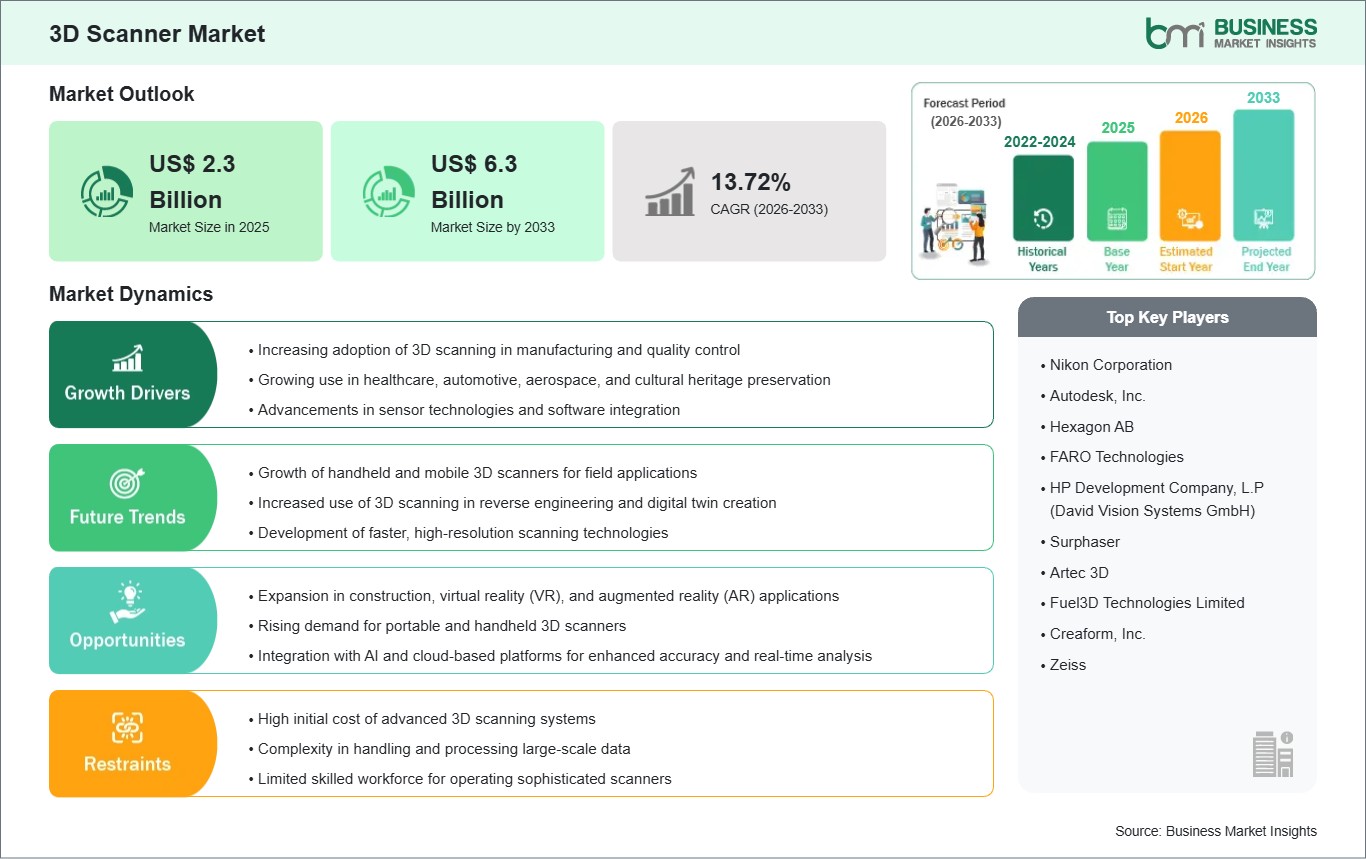
The 3D Scanner market size is expected to reach US$6.3 billion by 2033 from US$1.98 billion in 2024. The market is estimated to record a CAGR of 13.7% from 2025 to 2033.
The 3D scanner market mainly revolves around the development of technologies that help to record the three-dimensional shape and geometry of a physical object by collecting spatial data and converting it into digital models. Such scanners generate high-resolution point clouds or mesh models through laser beams, structured light patterns, or optical imaging techniques.
3D scanners find application not only in quality inspection, dimensional analysis, and reverse engineering but also in product design, virtual simulation, and medical imaging. Automotive and aerospace are two industries that heavily depend on 3D scanning to guarantee dimensional accuracy, minimize production errors, and shorten product development cycles. 3D scanners are essential in the healthcare sector for prosthetics, orthopedics, dental applications, and surgical planning.
The worldwide growth of automation, smart factories, and digital transformation initiatives is additionally 3D scanning technology is becoming one of the essential tools of modern engineering and manufacturing processes.

Key segments that contributed to the derivation of the 3D Scanner market analysis are technology, propulsion type, and vehicle type.
The biggest factor that is driving the 3D scanners market is the increased use of Industry 4.0 and smart manufacturing technologies. Producers are getting more dependent on 3D scanners for quality control, reverse engineering, and precision inspection to lessen production errors, save on waste, and speed up the product development cycle. The growing requirements of the automotive, aerospace, and healthcare industries for non-contact measurement solutions also help to raise the level of adoption. Besides that, the move to digital twin creation and virtual simulation calls for highly accurate spatial data, thus making 3D scanners indispensable tools. Industrial digitization and modernization through the support of government subsidy programs are also among the driving forces for the global market, with North America, Europe, and the Asia Pacific leading the way.
Major openings are there for portable, software-enabled, and AI, AI-integrated 3D scanners, resulting in a wider range of SMEs, construction, healthcare, and research applications. Advanced technologies like multi-mode scanning, real-time data processing, and cloud-based solutions enable even greater accuracy and seamless integration of workflows. Besides, the urban growth, inspection of infrastructure, and virtual/augmented reality uses are the factors that extend the market potential. A deep dive into the 3D scanner market in developing countries like India, Southeast Asia, and Latin America shows that the market has still not been penetrated to a great extent and thus provides plenty of room for growth. Cooperation with local partners, setting up regional distribution channels, and entering into joint ventures with the industry for sharing knowledge and experience help a company to move forward in its existing business model while also reaching out to the new customers who are looking for non, non-industrial solutions only. All these factors combined have opened up a highly profitable scenario for both innovation and expansion.
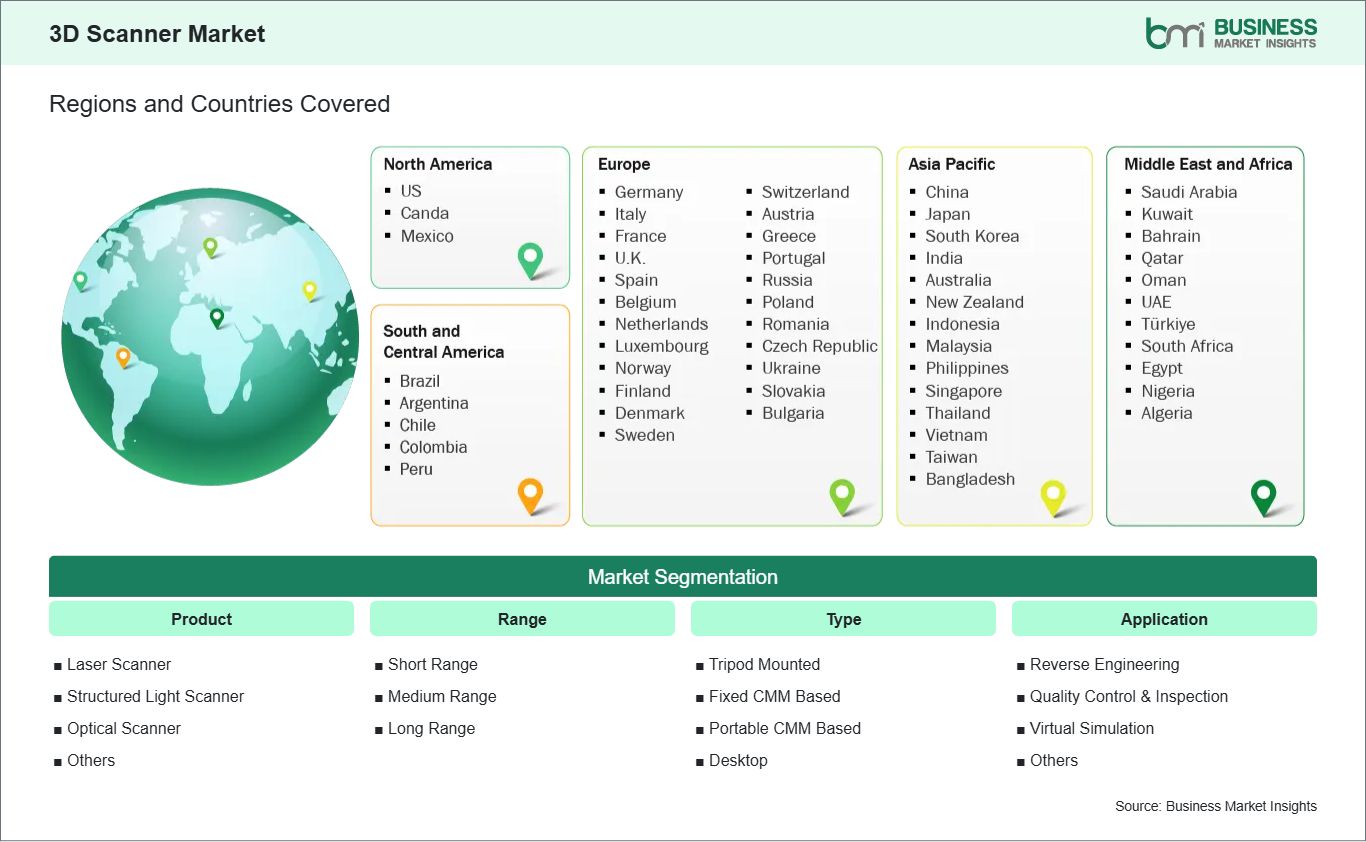
By product, the 3D Scanner market is segmented into Laser Scanners, Structured Light Scanners, Optical Scanners, and Others. The laser scanners segment accounted for the largest share in 2024 due to their high precision, long-range capability, and versatility across industrial, automotive, and construction applications. Laser scanners generate detailed 3D point clouds by measuring laser reflections, making them ideal for large objects and complex geometries. Structured light scanners are preferred for short-range, high-resolution tasks such as quality inspection, reverse engineering, and healthcare applications. Optical scanners and other technologies are gaining traction in portable and desktop solutions for educational, research, and small-scale manufacturing environments.
By range, the 3D Scanner market is segmented into Short Range, Medium Range, and Long Range scanners. Short-range scanners dominated the market in 2024, driven by high demand in precision applications like medical imaging, dental prosthetics, and small part inspection. Medium-range scanners are widely used in automotive, aerospace, and industrial prototyping for capturing moderately sized objects. Long-range scanners are increasingly adopted in architecture, civil engineering, large-scale industrial inspection, and infrastructure monitoring. The range-based segmentation reflects how scanning accuracy, resolution, and distance capabilities directly influence adoption across various applications.
By type, the 3D Scanner market is segmented into tripod-mounted, fixed CMM-based, Portable CMM-based, and Desktop scanners. Portable CMM-based scanners accounted for the largest market share in 2024 due to their flexibility, ease of use on the production floor, and ability to perform on-site measurements. Tripod-mounted scanners are widely used in industrial and construction environments requiring stability for large-scale scanning. Fixed CMM-based scanners are preferred in high-precision manufacturing and quality inspection labs. Desktop scanners dominate educational, research, and small-scale prototyping segments, offering affordable and compact scanning solutions.
By application, the market is segmented into Reverse Engineering, Quality Control & Inspection, Virtual Simulation, and Others. Quality control & inspection took up the biggest chunk of the pie in 2024, as more and more manufacturers used 3D scanners for non-contact dimensional verification, defect detection, and process optimization. Reproducing the parts that are no longer available in the market is one of the main reasons to keep reverse engineering growing at a rapid pace. In the automotive, aerospace, and architecture industries, virtual simulation usage is going up for creating digital twins, doing stress analysis, and checking the designs before manufacturing. Besides, 3D scanning technology is used for heritage preservation, cultural modeling, and medical imaging, which demonstrates its multi-functional functionality.
By end-user, the market is segmented into Automotive, Aerospace & Defence, Healthcare, Architecture & Construction, and Others. The automotive industry dominated the market share in 2024 because of the wide application of 3D scanners in prototyping, inspection, and tooling. Aerospace & defence still entails a substantial segment for precision measurement, structural inspection, and reverse engineering. Healthcare is experiencing accelerated adoption because of medical modelling, prosthetics, orthopaedics, and dental applications. Architecture & construction use 3D scanners for building design, renovation, and infrastructure inspection. Besides that, other sectors like consumer electronics, heritage preservation, and research laboratories are increasing the range of their adoption as the 3D scanning technology is becoming more accessible and affordable.

| Report Attribute | Details |
|---|---|
| Market size in 2025 | US$ 2.3 Billion |
| Market Size by 2033 | US$ 6.3 Billion |
| Global CAGR (2026 - 2033) | 13.72% |
| Historical Data | 2022-2024 |
| Forecast period | 2026-2033 |
| Segments Covered | By Product
|
|
Regions and Countries Covered
| |
| North America | US, Canada, Mexico |
| Europe | Belgium, Austria, Finland, Denmark, Greece, Poland, Romania, Russia, Ukraine, Czech Republic, Slovakia, Bulgaria, Italy, Luxembourg, Germany, Switzerland, France, Netherlands, Norway, Portugal, Spain, Sweden, United Kingdom |
| Asia-Pacific | Australia, China, India, Japan, South Korea, Indonesia, Malaysia, Philippines, Singapore, Thailand, Vietnam, Bangladesh, New Zealand, Taiwan |
| South and Central America | Brazil, Argentina, Peru, Chile, Colombia |
| Middle East and Africa | Bahrain, Kuwait, Oman, Qatar, Saudi Arabia, United Arab Emirates, Turkiye, South Africa, Egypt, Algeria, Nigeria |
| Market leaders and key company profiles |
|
The "3D Scanner Market Size and Forecast (2022–2033)" report provides a detailed analysis of the market covering below areas:
The geographical scope of the 3D Scanner market report is divided into five regions: North America, Asia Pacific, Europe, the Middle East & Africa, and South & Central America. The 3D Scanner market in the Asia Pacific is expected to grow significantly during the forecast period.
The current 3D scanner market demonstrates significant differences in adoption and growth potential between regions that are largely conditioned by industrial digitization, manufacturing modernization, and technological innovation. North America is at the forefront, backed by a well-established industrial base, the presence of automotive and aerospace sectors, and the early integration of advanced metrology and quality inspection technologies. The US and Canada are major contributors to the demand for these two countries. They benefit from high investment in R&D and the extensive use of 3D scanning for smart factory deployments, reverse engineering, and quality assurance workflows. Europe ranks second and enjoys solid support from the engineering sectors, tight quality standards, and broad adoption of the technology in automotive, aerospace, construction, and heritage documentation, among others. The digital infrastructure improvement initiatives in the region and industrial innovation contribute to market growth in Europe. On the other hand, the Asia Pacific region undergoes the strongest growth rate due to industrialization of the newly settled areas, the manufacturing, expansion hubs, and the increased digital transformation of the major economies of China, Japan, South Korea, and India, among others. Also, the rising infrastructure and construction in Southeast Asia aim to improve the living standard, thus they are in high demand for low-cost, cost 3D scanning solutions.

The 3D Scanner market is evaluated by gathering qualitative and quantitative data post-primary and secondary research, which includes important corporate publications, association data, and databases. A few of the key developments in the 3D Scanner market are:
The 3D Scanner Market is valued at US$ 2.3 Billion in 2025, it is projected to reach US$ 6.3 Billion by 2033.
As per our report 3D Scanner Market, the market size is valued at US$ 2.3 Billion in 2025, projecting it to reach US$ 6.3 Billion by 2033. This translates to a CAGR of approximately 13.72% during the forecast period.
The 3D Scanner Market report typically cover these key segments-
The historic period, base year, and forecast period can vary slightly depending on the specific market research report. However, for the 3D Scanner Market report:
The 3D Scanner Market is populated by several key players, each contributing to its growth and innovation. Some of the major players include:
The 3D Scanner Market report is valuable for diverse stakeholders, including:
Essentially, anyone involved in or considering involvement in the 3D Scanner Market value chain can benefit from the information contained in a comprehensive market report.
Please tell us your area of interest
(Market Segments/ Regions and Countries/ Companies)