Market Summary
Executive Summary and Global Market Analysis
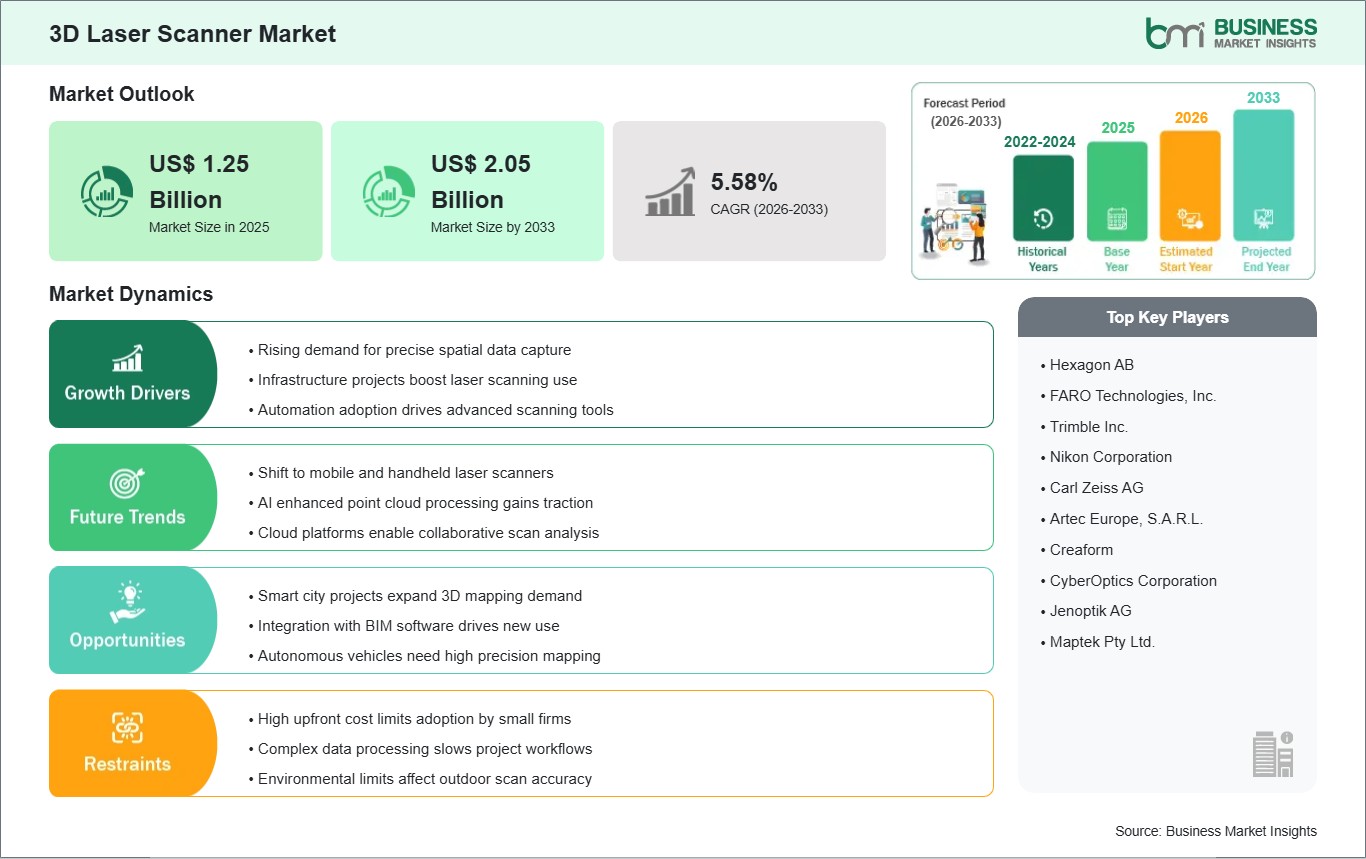
The 3D laser scanner is a cornerstone of the modern industrial metrology and geospatial sectors, providing high-precision, non-contact measurement solutions that convert physical objects and environments into accurate digital twin models. These scanners operate by emitting laser beams to capture millions of data points, known as point clouds, which are essential for quality control, reverse engineering, and Building Information Modeling (BIM). By enabling rapid data acquisition and sub-millimeter accuracy, 3D laser scanners have become indispensable across high-stakes industries such as aerospace, automotive manufacturing, and large-scale infrastructure development.
Despite its robust technological foundation, the market faces significant hurdles. High initial capital expenditure for premium hardware and specialized software remains a primary deterrent for small and medium-sized enterprises. Technical complexities, including the steep learning curve for data processing and the substantial computational power required to manage massive point cloud files, often lead to operational bottlenecks. Furthermore, environmental factors such as ambient light interference and surface reflectivity can compromise data integrity, necessitating expensive recalibrations or specialized scanning conditions.
However, the industry is overcoming these restraints through the integration of artificial intelligence and cloud-based processing. The transition toward portable, handheld devices is democratizing access, while the rise of the "Digital Twin" philosophy in Industry 4.0 is creating a constant demand for real-time spatial data. Lucrative opportunities are especially prevalent in the AEC (Architecture, Engineering, and Construction) sector and heritage preservation, where 3D scanning is evolving from a luxury tool into a regulatory and operational necessity, ensuring long-term market vitality and sustained innovation.
Segment Analysis
3D Laser Scanner Market Segmentation
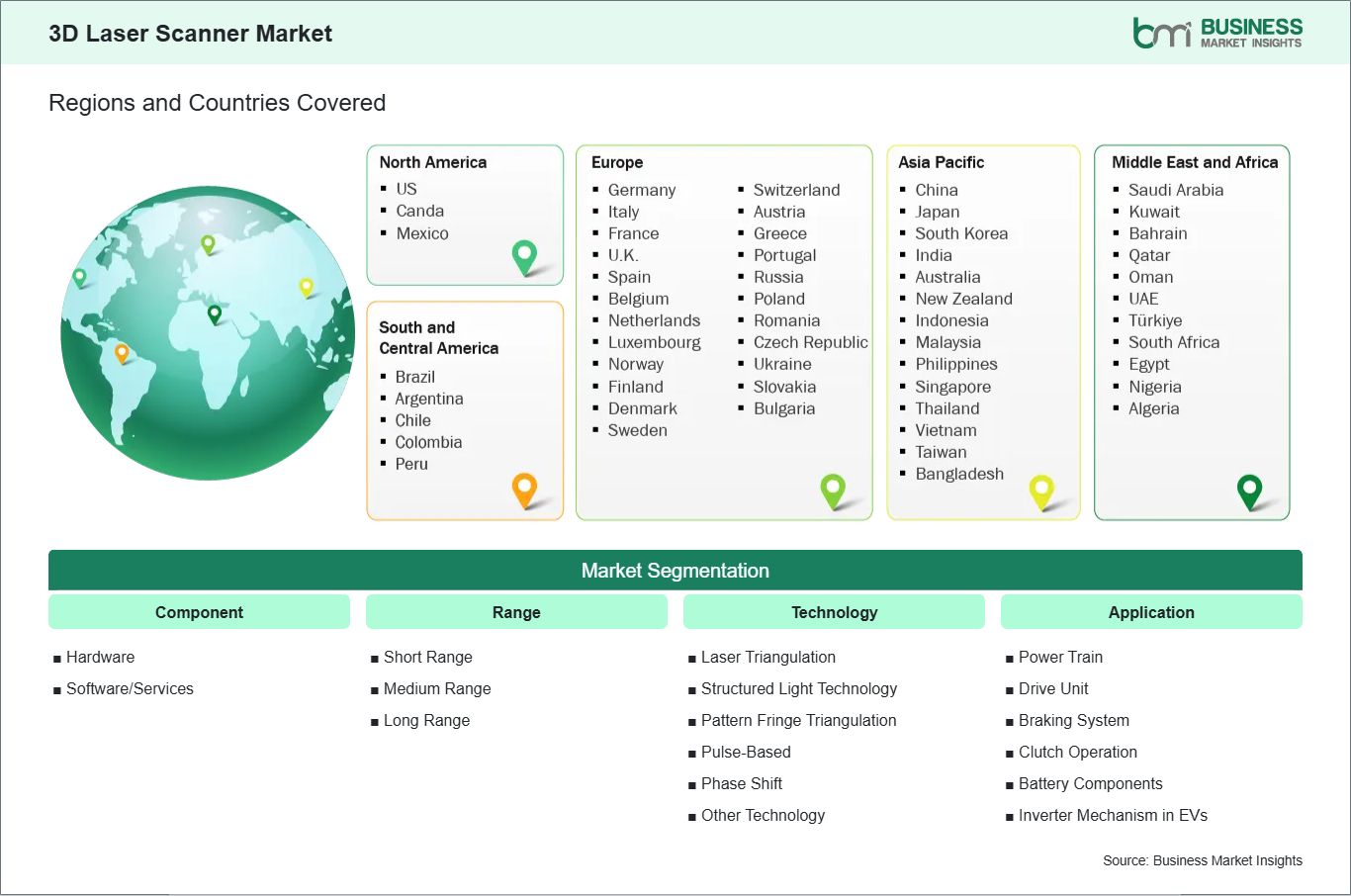
Key segments that contributed to the derivation of the 3D Laser Scanner market analysis are component, range, technology, and industry vertical.
- By Component , the market is segmented into Hardware and Software/Services.
- By Range , the market is divided into Short Range, Medium Range, and Long Range.
- By Technology , the market is categorized into Laser Triangulation, Structured Light Technology, Pattern Fringe Triangulation, Pulse-Based, Phase Shift, and Others.
- By Industry Vertical , the market is segmented into Aerospace and Defense, Automotive, Construction and Infrastructure, Electronics and Semiconductors, Artifact and Heritage Preservation, and Others.
Market Forces
3D Laser Scanner Market Drivers and Opportunities
Digital Transformation and Industry 4.0 Integration
The primary driver for the 3D laser scanner market is the global shift toward smart manufacturing and the "Digital Twin" framework. As industries move toward autonomous operations, the need for high-fidelity 3D replicas of physical assets has surged. 3D laser scanners provide the foundational data required to synchronize physical production lines with digital simulation environments. This allows manufacturers to conduct predictive maintenance, optimize floor layouts, and perform virtual stress tests before physical changes are implemented. In the aerospace and automotive sectors, this integration significantly reduces time-to-market and minimizes the margin of error in complex assemblies. As IoT-connected factories become the standard, the 3D laser scanner acts as the essential bridge between the physical and digital realms, driving continuous demand for high-speed, high-accuracy scanning solutions.
AI-Driven Data Processing and Automation
A transformative opportunity lies in the integration of Artificial Intelligence (AI) and Machine Learning (ML) into 3D scanning software. Historically, the "bottleneck" of scanning was the manual labor required to clean, register, and convert raw point clouds into usable CAD models. Emerging AI-powered algorithms are now capable of automating feature recognition, noise reduction, and semantic segmentation, allowing the scanner to automatically identify pipes, walls, or mechanical defects in real-time. This reduces the need for specialized metrology experts and slashes processing times from days to hours. For industries like construction and infrastructure, AI-enhanced scanners enable "real-time vs. plan" analysis on-site, providing immediate feedback on structural deviations. This shift toward intelligent, self-processing hardware creates a massive opportunity for vendors to offer high-margin, subscription-based software ecosystems alongside their hardware.
Size and Share Analysis
3D Laser Scanner Market Size and Share Analysis
The 3D Laser Scanner market demonstrates steady growth, with size and share analysis revealing evolving trends and competitive positioning among key players. The report further examines subsegments categorized within component, range, technology, and industry vertical, offering insights into their contribution to overall market performance.
For instance, within the Component segment, the Hardware subsegment currently maintains the largest revenue share due to the high cost of premium sensors and optics. Regarding Range, medium-range scanners are the most utilized, providing the necessary versatility for industrial plant layouts and automotive design. In Technology, Laser Triangulation remains a dominant force for high-precision metrology applications. Finally, the Construction and Infrastructure vertical is the leading contributor to market growth, as the global push for Building Information Modeling (BIM) mandates the use of laser scanning for accurate as-built documentation.
Report Coverage
3D Laser Scanner Market Report Coverage and Deliverables
The "3D Laser Scanner Market Size and Forecast (2022 - 2033)" report provides a detailed analysis of the market covering below areas:
- 3D Laser Scanner market size and forecast at global, regional, and country levels for all the key market segments covered under the scope
- 3D Laser Scanner market trends, as well as market dynamics such as drivers, restraints, and key opportunities
- 3D Laser Scanner market analysis covering key market trends, global and regional framework, major players, regulations, and recent market developments
- Industry landscape and competition analysis covering market concentration, heat map analysis, prominent players, and recent developments for the 3D Laser Scanner market
- Detailed company profiles, including SWOT analysis
Geographic Insights
3D Laser Scanner Market Geographic Insights
The geographical scope of the 3D Laser Scanner market report is divided into five regions: North America, Asia Pacific, Europe, the Middle East &Africa, and South &Central America.
North America represents a leading innovation hub characterized by the early adoption of 3D scanning in the aerospace and defense sectors to ensure stringent quality standards. Europe exhibits steady growth driven by a strong focus on preserving architectural heritage and the rapid digitalization of its vast automotive manufacturing base. The Asia Pacific region is the most dynamic, with countries like China and India investing heavily in infrastructure projects and electronics manufacturing that require rapid, large-scale scanning solutions. Latin America is seeing a gradual rise in adoption, primarily within the mining and energy sectors, for site monitoring and safety inspections. Meanwhile, the Middle East and Africa are witnessing increased demand for long-range scanning technology to support massive urban development projects and smart city initiatives across the region.
Industry Activity
Recent Developments
The 3D Laser Scanner market is evaluated by gathering qualitative and quantitative data post primary and secondary research, which includes important corporate publications, association data, and databases. A few of the key developments in the 3D Laser Scanner market are:
- In October 2025, Hexagon's Manufacturing Intelligence division introduced the ATLASCAN Pro, a new handheld 3D Laser Scanner designed to bring professional-grade laser scanning capabilities to entry-level users across industries. Using multiple laser lines and a unique processing algorithm, the ATLASCAN Pro delivered fast scanning performance and high-quality data capture in an affordable, easy-to-use format that new users could quickly learn. This advancement positioned the device as a significant step forward in making 3D Laser Scanner technology more accessible, enabling precise, reliable scanning for applications such as reverse engineering, quality inspection, and product development.
- In January 2025, FARO® Technologies, Inc. entered a new category of handheld scanning with the launch of the FARO Leap ST®. This new handheld 3D Laser Scanner expanded the company's product portfolio, positioning FARO as one of the few providers to offer a complete range of portable 3D metrology devices. The introduction of this 3D Laser Scanner strengthened FARO's presence across the manufacturing sector, where speed, accuracy, and throughput remained critical operational requirements. To ensure a seamless user experience, FARO paired this hardware launch with a significant update to its FARO CAM2® Software, providing a simple and effective way to scan complex parts.
Trust & Transparency
Research Methodology
The market analysis combines proprietary research with secondary data from government agencies, company disclosures, regulatory filings, industry databases and expert interviews. Market estimates are validated through data triangulation, cross-market benchmarking and analyst
review.
View Full Research Methodology
Key Sources Referred:
World Bank - Global Trade IndicatorsWorld Trade Organization (WTO)International Monetary Fund (IMF)International Trade Administration (ITA)Company websiteCompany annual reportsCompany investor presentations