Market Summary
Executive Summary and Global Market Analysis
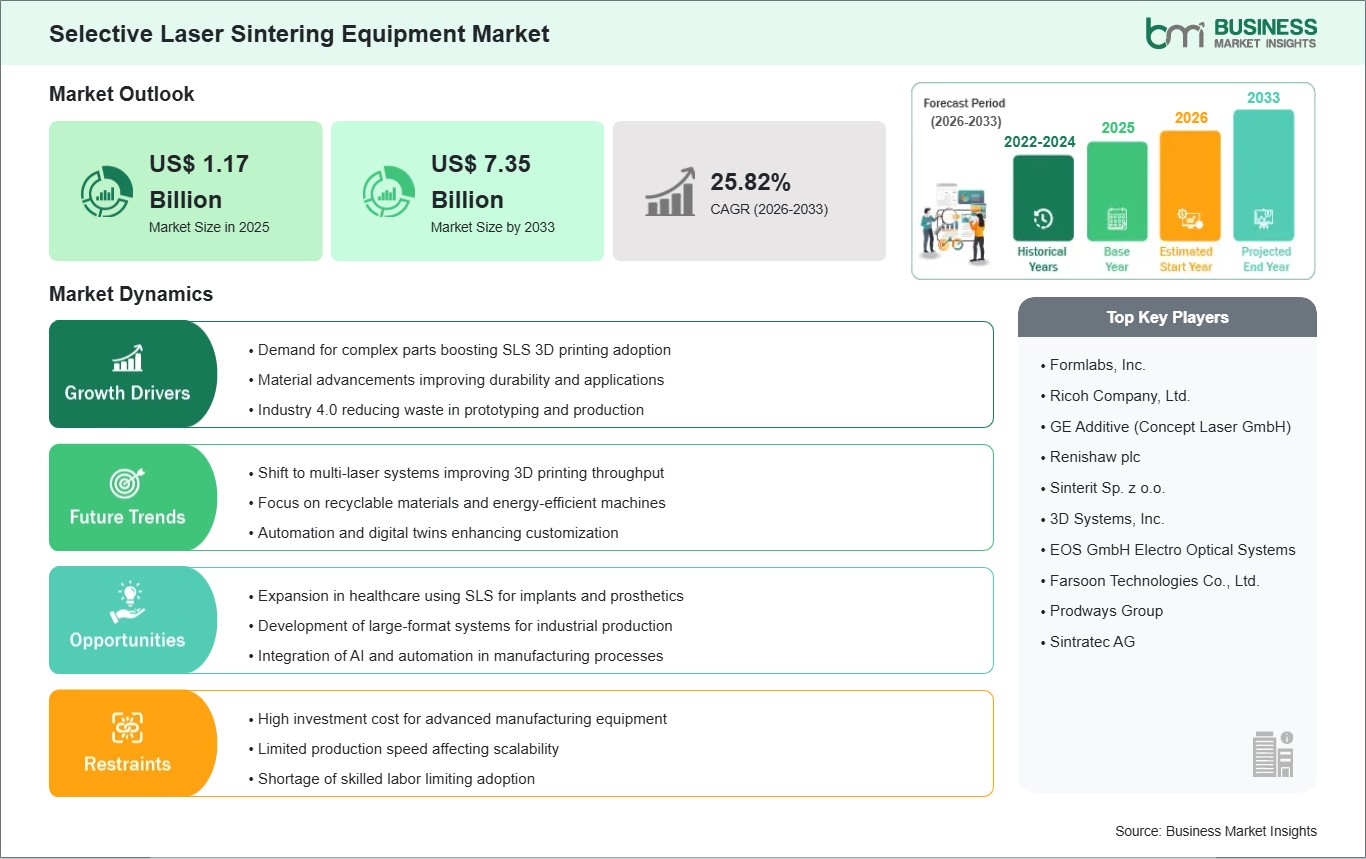
Selective Laser Sintering (SLS) equipment is a cornerstone of industrial additive manufacturing, utilizing high-power lasers to fuse powdered materials, primarily nylon and metals, into solid 3D structures. Unlike other 3D printing methods, SLS does not require support structures, as the unsintered powder acts as a natural build platform, allowing for unparalleled design freedom and high-density part nesting. This technology is critical for producing functional, durable components across industries such as automotive, aerospace, and medical devices. The global market is being propelled by the shift from rapid prototyping to end-use part production, facilitated by improvements in laser precision and material science.
While the market offers immense potential, it faces challenges including significant initial capital requirements, a limited palette of certified industrial powders, and the need for controlled environmental conditions during the printing process. However, the rise of "Service-as-a-Software" (SaaS) integration for fleet management and the entry of lower-cost desktop SLS systems are democratizing access to the technology. As industries increasingly prioritize localized, on-demand supply chains, SLS equipment stands out as a vital tool for reducing lead times and minimizing material waste. Strategic investments in multi-laser systems and sustainable powder recycling are expected to be the key growth catalysts through 2033.
Segment Analysis
Selective Laser Sintering Equipment Market Segmentation
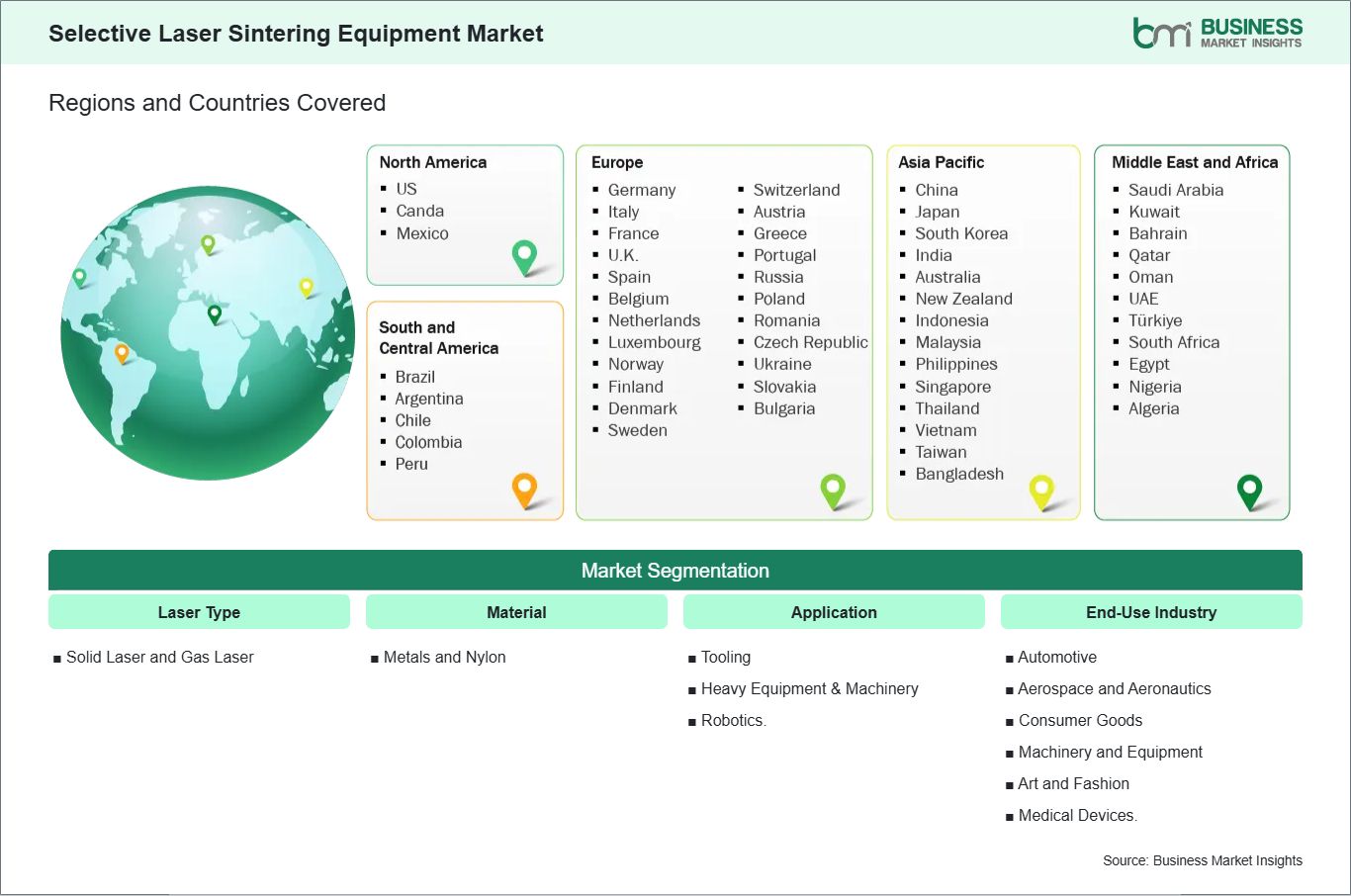
Key segments that contributed to the derivation of the Selective Laser Sintering Equipment market analysis are laser type, material, application, and industry.
- By Laser Type, the market is segmented into Solid Laser and Gas Laser.
- By Material, the market is divided into Metal and Nylon.
- By Application, the market is categorized into Tooling, Heavy Equipment and Machinery, and Robotics.
- By Industry, the market is segmented into Automotive, Aerospace and Aeronautics, Consumer Goods, Machinery and Equipment, Art and Fashion, and Medical Devices.
Market Forces
Selective Laser Sintering Equipment Market Drivers and Opportunities
Acceleration of Functional Prototyping and Complex Part Production
The demand for accelerated product development cycles has positioned selective laser sintering as a vital driver for modern industrial manufacturing. Traditionally, creating complex functional prototypes required weeks of machining or expensive molding; however, SLS equipment reduces this timeframe to a matter of days. This driver is particularly prominent in the automotive and aerospace sectors, where the ability to produce lightweight, lattice-structured components directly influences fuel efficiency and performance. SLS technology allows for the consolidation of multiple parts into a single complex geometry, which reduces assembly time and eliminates potential failure points.
Furthermore, the robustness of SLS-printed nylon and metal parts allows them to undergo rigorous mechanical testing, bridging the gap between design and production. Over 50% of manufacturers have integrated SLS to improve design flexibility. As global competition intensifies, the pressure to bring innovative products to market faster is forcing companies to move away from subtractive methods. The capability of SLS to handle high-resolution, intricate internal features without the need for support removal makes it the preferred choice for engineers seeking to push the boundaries of functional design and serial production.
Integration of Artificial Intelligence and Sustainable Manufacturing
A major opportunity in the SLS equipment market lies in the convergence of additive manufacturing with Artificial Intelligence (AI) and the global shift toward sustainable production. AI-driven software is now being integrated into SLS systems to provide real-time thermal monitoring and defect detection. By analyzing the heat signature of each layer as it is sintered, AI can adjust laser parameters on the fly to ensure consistent material density and mechanical properties. This significantly reduces the failure rate of large-scale builds, which has historically been a barrier to cost-effective mass production.
On the sustainability front, SLS equipment offers a distinct advantage through material reusability. Unlike traditional manufacturing, which generates significant scrap, unsintered powder in an SLS build can often be recycled for future prints. Market leaders are increasingly focusing on the development of bio-based powders and "zero-waste" workflows that align with international environmental regulations. The opportunity to localize production through digital files, rather than shipping physical parts across oceans, further reduces the carbon footprint of global supply chains. As companies seek to meet ESG (Environmental, Social, and Governance) targets, the adoption of smart, material-efficient SLS systems is expected to see a substantial surge in investment.
Size and Share Analysis
Selective Laser Sintering Equipment Market Size and Share Analysis
The Selective Laser Sintering Equipment market demonstrates steady growth, with size and share analysis revealing evolving trends and competitive positioning among key players. The report further examines subsegments categorized within laser type, material, application, and industry, offering insights into their contribution to overall market performance.
Based on laser type, the gas lasers currently hold a significant revenue share due to their established reliability in processing high-performance polymers.
In the material segment, the Metal segment is driven by the aerospace industry`s demand for titanium and superalloy components.
From an industry perspective, the Automotive sector leads in adoption, while Medical Devices are emerging as a high-growth niche for personalized orthopedic implants and surgical guides.
Report Coverage
Selective Laser Sintering Equipment Market Report Coverage and Deliverables
The "Selective Laser Sintering Equipment Market Size and Forecast (2022 - 2033)" report provides a detailed analysis of the market covering the below areas:
- Selective Laser Sintering Equipment market size and forecast at global, regional, and country levels for all the key market segments covered under the scope
- Selective Laser Sintering Equipment market trends, as well as market dynamics such as drivers, restraints, and key opportunities
- Selective Laser Sintering Equipment market analysis covering key market trends, global and regional framework, major players, regulations, and recent market developments
- Industry landscape and competition analysis covering market concentration, heat map analysis, prominent players, and recent developments for the Selective Laser Sintering Equipment market
- Detailed company profiles, including SWOT analysis
Geographic Insights
Selective Laser Sintering Equipment Market Geographic Insights
The geographical scope of the Selective Laser Sintering Equipment market is divided into five regions: North America, Asia Pacific, Europe, Middle East and Africa, and South and Central America.
North America region, the United States is a primary hub for SLS innovation, supported by the heavy presence of aerospace giants and medical technology firms that utilize 3D printing for mission-critical components. Europe follows closely, with Germany leading the way in industrial-grade printer manufacturing and precision engineering. The region's focus on "Industry 4.0" and digitalization has led to widespread adoption in the automotive and machinery sectors.
The Asia-Pacific region, the growth is spearheaded by China, Japan, and India, where massive investments in manufacturing automation and government-backed 3D printing initiatives are driving demand. Middle East and Africa and South and Central America represent emerging territories, where the technology is increasingly used in the energy and healthcare sectors to overcome traditional supply chain constraints and localize spare part production.
Industry Activity
Recent Developments
The Selective Laser Sintering Equipment market is evaluated by gathering qualitative and quantitative data post primary and secondary research, which includes important corporate publications, association data, and databases. A few of the key developments in the selective laser sintering equipment market are:
- In November 2025, Farsoon unveiled the HT601P-2, a serial production-ready, large-format polymer laser sintering system engineered for ultimate quality and efficiency. Building on the success of the Flight® HT601P-4 platform, the HT601P-2 continued to offer continuous production capability, advanced process control, increased level of automation to address the evolving needs of industrial manufacturing while being able to take advantage of the wide range of existing powdered materials available on the market for CO2-based SLS systems.
- In October 2025, EOS (a leading supplier of responsible manufacturing solutions for industrial 3D printing) announced the addition of four new metal additive manufacturing (AM) materials to its portfolio: EOS FeNi36, EOS NickelAlloy C22, EOS Steel 42CrMo4, and EOS StainlessSteel 316L-4404, each optimized for EOS Laser Powder Bed Fusion (LPBF) systems. These new materials further expand the company`s ability to address specialized AM requirements across the aerospace, energy, chemical, automotive, and marine industries, among others.
Trust & Transparency
Research Methodology
The market analysis combines proprietary research with secondary data from government agencies, company disclosures, regulatory filings, industry databases and expert interviews. Market estimates are validated through data triangulation, cross-market benchmarking and analyst
review.
View Full Research Methodology
Key Sources Referred:
World Bank - Global Trade IndicatorsWorld Trade Organization (WTO)International Monetary Fund (IMF)International Trade Administration (ITA)Company WebsitesCompany Annual ReportsCompany Investor Presentations\