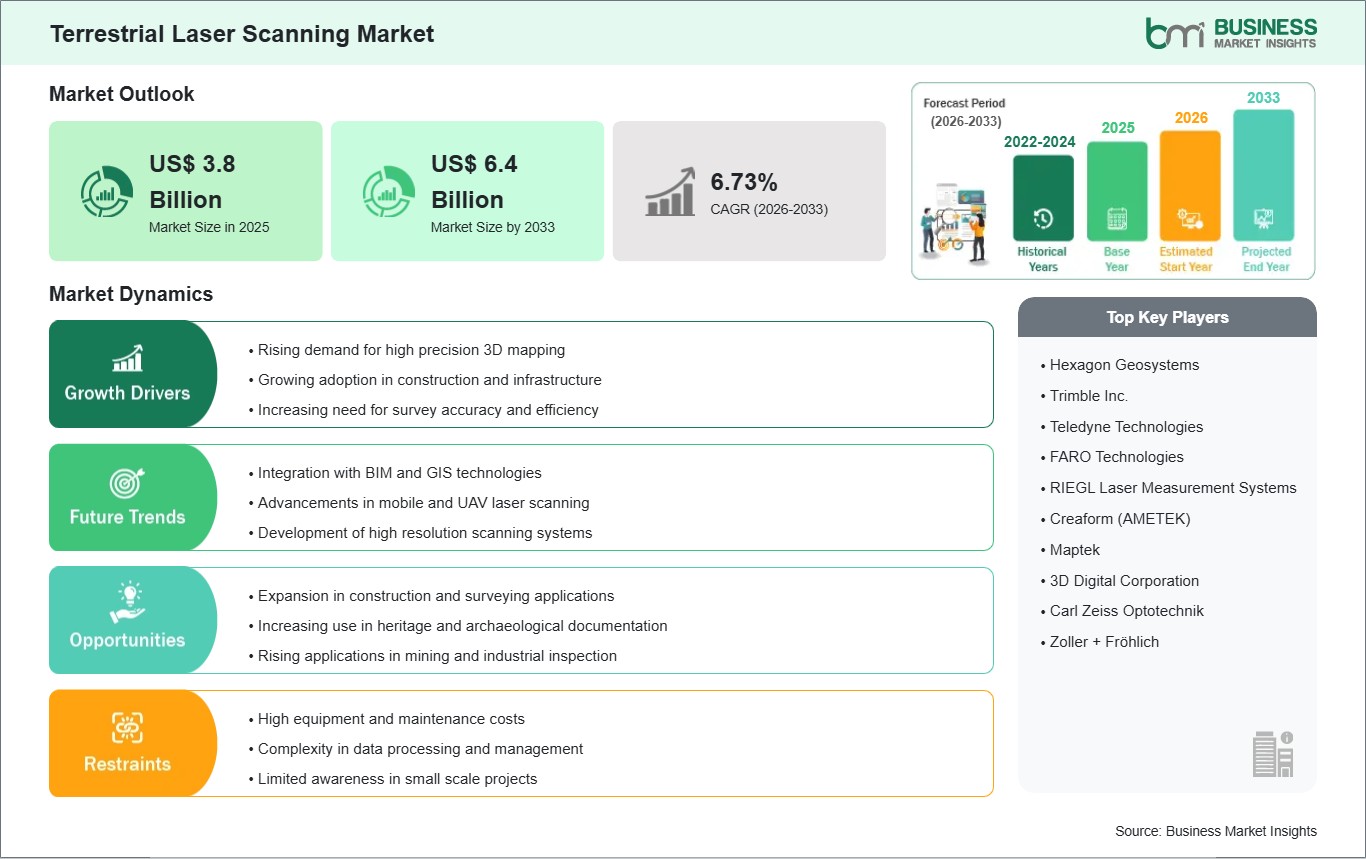
The Terrestrial Laser Scanning Market size is expected to reach US$ 6.4 billion by 2033 from US$ 3.8 billion in 2025. The market is estimated to record a CAGR of 6.73% from 2026 to 2033.
The worldwide terrestrial laser scanning (TLS) industry is growing quickly because many sectors want more accurate, detailed 3D mapping/measurement methods for surveying, construction, coal mining, and inspecting structures. With TLS systems’ accurate point clouds, customers can conduct in-depth spatial analyses, model buildings/structures digitally, and virtually rebuild the physical world around us.
Changes in technology, such as mobile scanners, faster scanning speeds and better data processing algorithms, are helping improve productivity within both field operations and post-processing workflows. TLS is also being used in combination with other technologies (e.g., Building Information Modeling (BIM), Geographic Information System (GIS) software, and aerial photography via drones) so customers can better manage their buildings/projects from overall planning to ongoing management and monitoring activities. In addition to longer and heavier scanners, smaller and lighter scanners have made it possible for organizations working in remote locations (like underground mines), historical sites, or dense urban areas to perform TLS scans that were previously impossible due to size/weight limitations of the equipment.
Furthermore, the addition of automated registering as well as AI-assisted data interpretation has decreased the amount of manual work required to register and analyze large collections of point cloud data, thus increasing efficiency and productivity while decreasing the number of compilation errors. Even though the TLS was driven largely by the desire for increased accuracy in survey construction and reducing risk, the market also experiences significant challenges due to the high upfront cost of purchasing equipment, storage constraints (due to big data), and the ongoing requirement to have qualified personnel capable of operating it and interpreting complex data sets produced from point clouds.
To summarize, the TLS is an industry that consists primarily of innovations in growth, across many industries, and where a growing reliance will be on high-fidelity spatial data to derive operational planning.

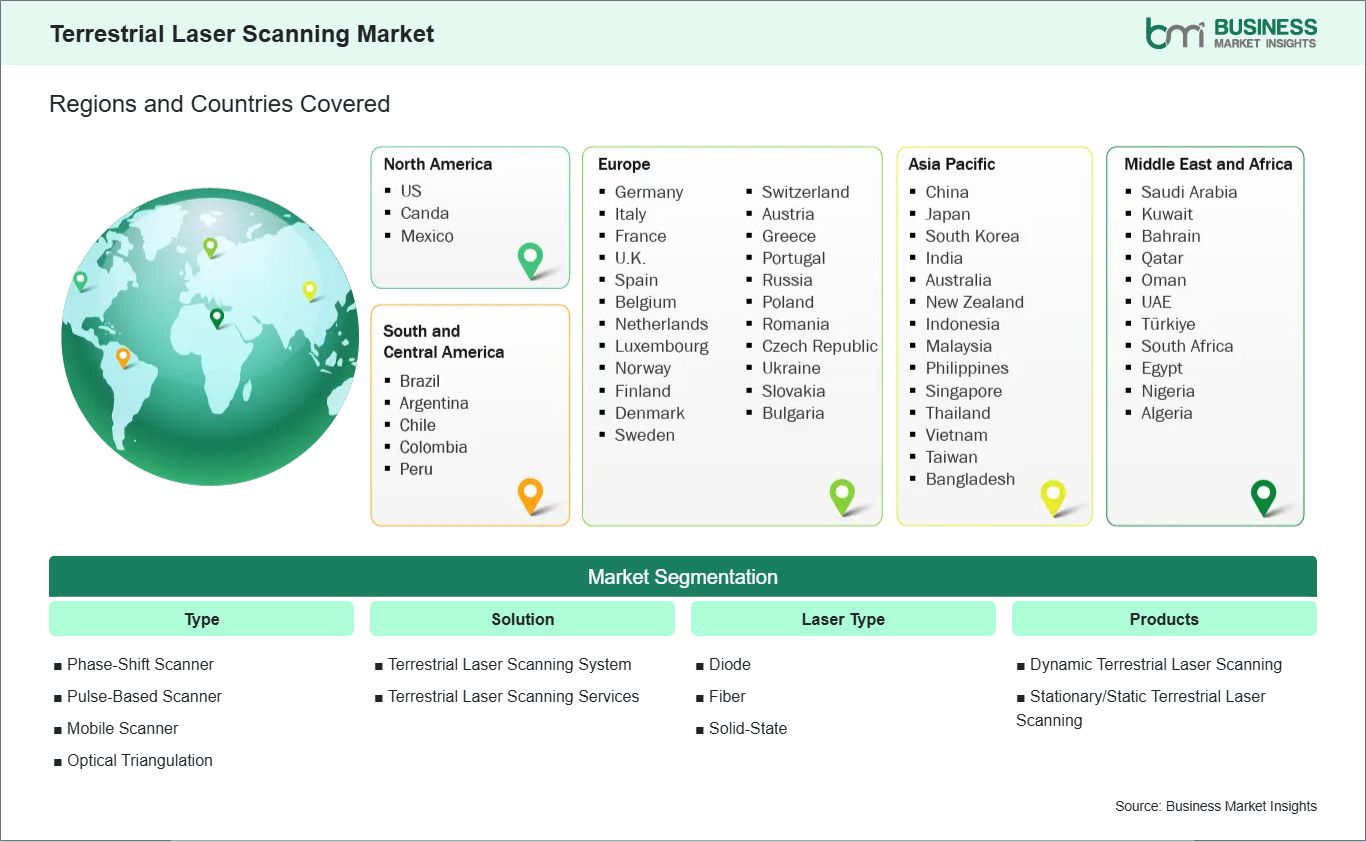
Key segments that contributed to the derivation of the terrestrial laser scanning market analysis are type, solution, laser type, products, principles, mappings, application, and end use.
The global terrestrial laser scanning (TLS) market is being driven by the rising demand for high‑precision 3D mapping across multiple industries. TLS provides rapid, accurate, and detailed measurements of physical environments, enabling precise modeling of buildings, terrain, and infrastructure. Organizations are increasingly using this technology to reduce errors, improve planning, and enhance decision-making in engineering, construction, and geospatial projects. Advancements in laser scanning systems, including higher resolution, longer range, and faster data acquisition, have expanded their applicability.
Professionals can capture millions of points within minutes, producing dense point clouds that integrate seamlessly with 3D modeling and BIM (Building Information Modeling) software. This has significantly improved project visualization, design verification, and risk assessment. The growing need for accurate and comprehensive mapping in applications such as digital twins, heritage preservation, and industrial modeling is fueling TLS adoption. As industries continue to emphasize efficiency, precision, and safety, high‑performance laser scanning systems are becoming essential tools for global operations.
The construction and surveying sectors are major contributors to the global growth of the TLS market. TLS systems are widely used for as-built verification, progress monitoring, and clash detection on complex construction projects. Accurate 3D scans reduce rework, improve collaboration between stakeholders, and support faster, data-driven decision-making throughout project lifecycles. In surveying, TLS enables detailed topographic mapping, volume calculations, and infrastructure assessment with minimal field time. The technology improves operational efficiency, enhances safety by reducing the need for manual measurements in hazardous environments, and delivers high-resolution data for analysis and reporting.
Additionally, the expansion of industrial projects, infrastructure development, and urban planning has increased reliance on TLS for accurate site characterization and monitoring. By enabling faster, more precise, and safer data capture, terrestrial laser scanning has become a critical tool across global construction and surveying workflows, driving widespread adoption across multiple sectors.
The Terrestrial Laser Scanning Market demonstrates steady growth, with size and share analysis highlighting evolving trends and competitive dynamics among key players. The report examines subsegments categorized within type, solution, laser type, products, principles, mappings, application, and end use, offering insights into their contribution to overall market performance.
By Type, the phase‑shift scanner subsegment dominated the market in 2025, driven by its high accuracy and efficiency for large-scale surveying and modeling applications.
Based on Solution, the terrestrial laser scanning System subsegment dominated the market in 2025, owing to its wide adoption for industrial, construction, and infrastructure projects.
On the Basis of Laser Type, the diode subsegment dominated the market in 2025, propelled by its precision, lower power consumption, and cost-effectiveness.
In terms of Products, the stationary/static terrestrial laser Scanning subsegment dominated the market in 2025, driven by its stability and suitability for detailed structural scanning.
By Principles, the galvanometer scanner subsegment dominated the market in 2025, owing to its fast-scanning capabilities and reliability.
Based on Mappings, the panorama scanner subsegment dominated the market in 2025, due to its ability to capture comprehensive 3D imaging efficiently.
On the Basis of Application, the BIM (Building Information Modeling) subsegment dominated the market in 2025, driven by the growing adoption of 3D modeling in construction, architecture, and infrastructure planning.
In terms of End Use, the industrial subsegment dominated the market in 2025, propelled by the adoption of laser scanning in manufacturing, plant maintenance, and industrial monitoring applications.
| Report Attribute | Details |
|---|---|
| Market size in 2025 | US$ 3.8 Billion |
| Market Size by 2033 | US$ 6.4 Billion |
| Global CAGR (2026 - 2033) | 6.73% |
| Historical Data | 2022-2024 |
| Forecast period | 2026-2033 |
| Segments Covered | By Type
|
|
Regions and Countries Covered
| |
| North America | US, Canada, Mexico |
| Europe | Belgium, Austria, Finland, Denmark, Greece, Poland, Romania, Russia, Ukraine, Czech Republic, Slovakia, Bulgaria, Italy, Luxembourg, Germany, Switzerland, France, Netherlands, Norway, Portugal, Spain, Sweden, United Kingdom |
| Asia-Pacific | Australia, China, India, Japan, South Korea, Indonesia, Malaysia, Philippines, Singapore, Thailand, Vietnam, Bangladesh, New Zealand, Taiwan |
| South and Central America | Brazil, Argentina, Peru, Chile, Colombia |
| Middle East and Africa | Bahrain, Kuwait, Oman, Qatar, Saudi Arabia, United Arab Emirates, Turkiye, South Africa, Egypt, Algeria, Nigeria |
| Market leaders and key company profiles |
|
The "Terrestrial Laser Scanning Market Size and Forecast (2022 - 2033)" report provides a detailed analysis of the market covering below areas:
The geographical scope of the Terrestrial Laser Scanning Market report is divided into North America, Asia Pacific, Europe, Middle East & Africa, and South & Central America. North America held the largest share in 2025.
Regional trends in terrestrial laser scanning adoption reflect differences in industrial infrastructure, technological readiness, and sector-specific demands.
North America leads in TLS adoption due to advanced construction, mining, and infrastructure monitoring applications, with emphasis on integration with BIM workflows and smart city planning.
Europe demonstrates strong usage in heritage preservation, industrial automation, and urban planning, leveraging high-resolution TLS for structural assessment and compliance with strict regulatory standards.
Asia Pacific is witnessing rapid growth, driven by large-scale infrastructure projects, mining expansion, and industrial modernization; mobile and cloud-enabled TLS solutions are increasingly deployed to optimize project timelines and reduce operational risks.
Middle East & Africa is gradually adopting TLS for oil and gas facility monitoring, mining operations, and large-scale construction, where harsh environmental conditions require durable and portable scanning systems. South & Central America is expanding usage in civil engineering, transportation projects, and resource exploration, often focusing on cost-effective TLS solutions adaptable to varying terrain and infrastructure conditions. Across all regions, the market is shaped by factors such as project complexity, investment in digital infrastructure, availability of skilled operators, and the need for precise spatial data, highlighting TLS as a strategic technology for enhancing accuracy, efficiency, and risk management in engineering and surveying operations globally.

The Terrestrial Laser Scanning Market is evaluated by gathering qualitative and quantitative data post primary and secondary research, which includes important corporate publications, association data, and databases. A few of the key developments in the spatial light Modulator market are:
The Terrestrial Laser Scanning Market is valued at US$ 3.8 Billion in 2025, it is projected to reach US$ 6.4 Billion by 2033.
As per our report Terrestrial Laser Scanning Market, the market size is valued at US$ 3.8 Billion in 2025, projecting it to reach US$ 6.4 Billion by 2033. This translates to a CAGR of approximately 6.73% during the forecast period.
The Terrestrial Laser Scanning Market report typically cover these key segments-
The historic period, base year, and forecast period can vary slightly depending on the specific market research report. However, for the Terrestrial Laser Scanning Market report:
The Terrestrial Laser Scanning Market is populated by several key players, each contributing to its growth and innovation. Some of the major players include:
The Terrestrial Laser Scanning Market report is valuable for diverse stakeholders, including:
Essentially, anyone involved in or considering involvement in the Terrestrial Laser Scanning Market value chain can benefit from the information contained in a comprehensive market report.
Please tell us your area of interest
(Market Segments/ Regions and Countries/ Companies)