Market Summary
Executive Summary and Global Market Analysis
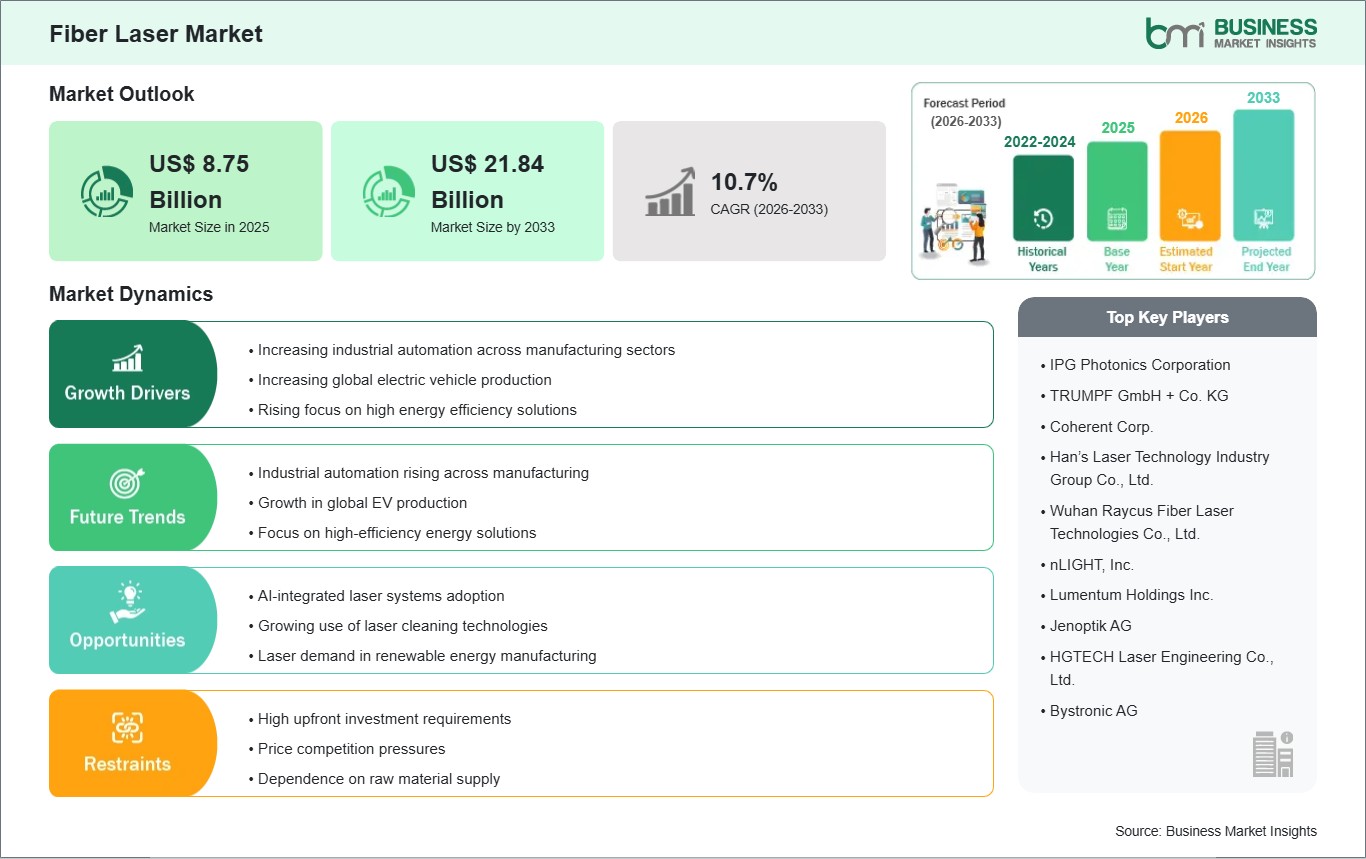
The global fiber laser market has emerged as a transformative force in advanced manufacturing and precision processing, leveraging optical fibers doped with rare-earth elements as the gain medium to generate high-quality laser beams with exceptional efficiency and reliability. Unlike traditional gas or solid-state lasers, fiber lasers offer superior beam quality, lower maintenance requirements, and higher wall-plug efficiency, making them indispensable across a widening spectrum of industrial, medical, and scientific applications. The market is experiencing robust growth propelled by the accelerating adoption of fiber lasers in automotive manufacturing, particularly for electric vehicle (EV) battery welding and lightweight material processing, the expansion of aerospace and defense applications demanding precision micromachining, and the proliferation of renewable energy technologies such as solar panel fabrication. The unique ability of fiber lasers to deliver high power with minimal thermal distortion is revolutionizing materials processing, enabling faster cutting speeds, deeper weld penetration, and finer feature resolution than conventional technologies.
However, the market faces significant challenges, including the high initial capital investment required for advanced fiber laser systems, which can be prohibitive for small and medium-sized enterprises. The complexity of system integration and the need for specialized technical expertise for operation and maintenance also pose hurdles, particularly in emerging markets with limited skilled labor pools. Despite these constraints, compelling opportunities are emerging from the integration of fiber lasers with artificial intelligence (AI) and robotic automation for smart manufacturing, the development of ultrafast femtosecond and picosecond lasers for medical device fabrication and semiconductor processing, and the increasing demand for green and ultraviolet wavelength lasers for electronics and photovoltaic applications. The convergence of fiber laser technology with Industry 4.0 paradigms is positioning these systems as intelligent, adaptive tools capable of real-time process optimization and predictive maintenance.
Segment Analysis
Fiber Laser Market Segmentation
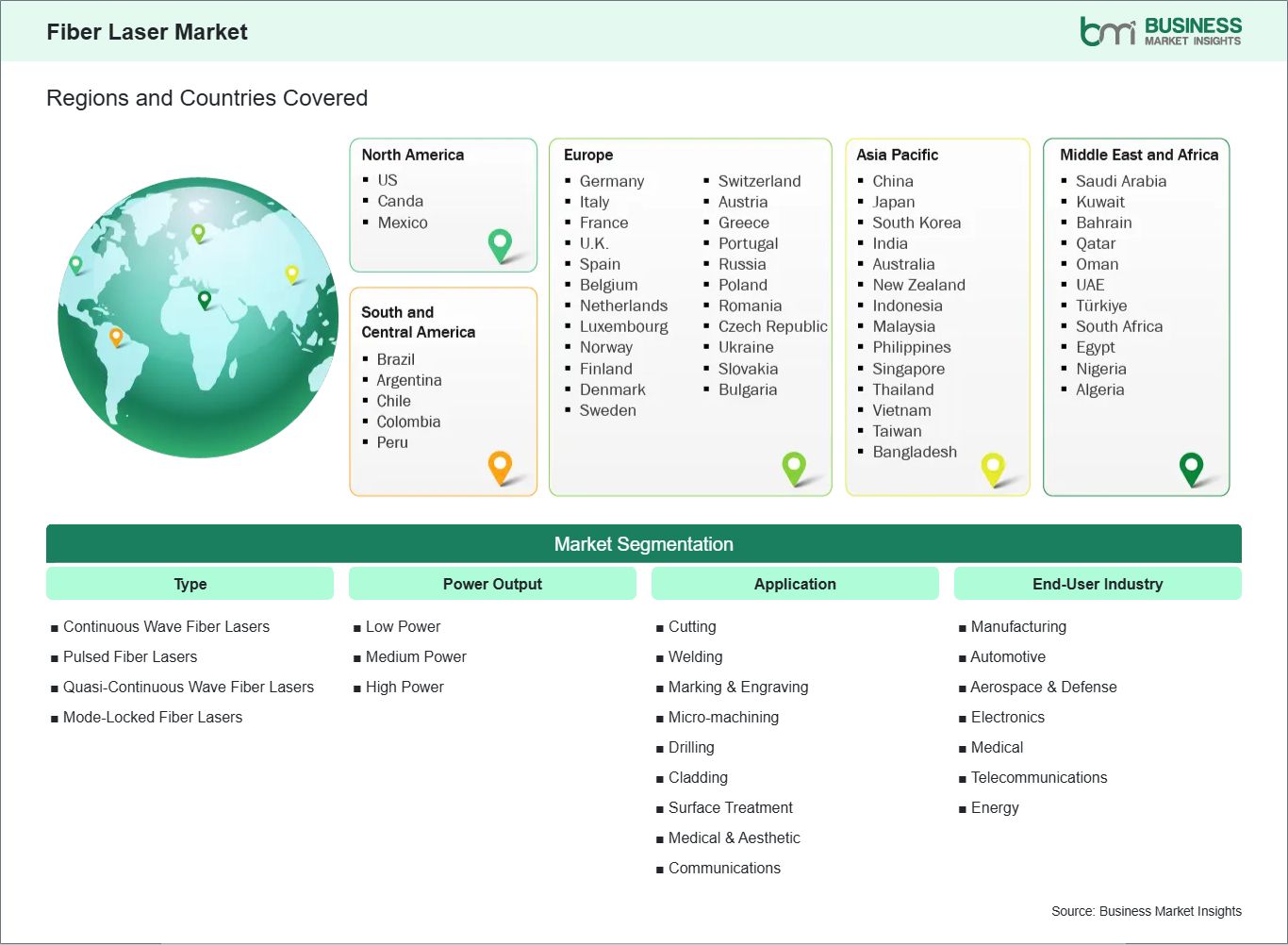
Key segments that contributed to the derivation of the fiber laser market analysis are type, power output, application, and end-user industry.
- By type, the market is segmented into continuous wave (CW) fiber lasers, pulsed fiber lasers, quasi-continuous wave fiber lasers, and mode-locked fiber lasers. The continuous wave (CW) fiber laser segment dominated the market in 2025.
- By power output, the market is categorized into low power (up to 100W), medium power (100W - 2kW), and high power (above 2kW). The high power segment holds the largest market share in 2025.
- By application, the market is segmented into cutting, welding, marking & engraving, micro-machining, drilling, cladding, surface treatment, medical & aesthetic, and communications. The cutting and welding applications collectively account for the dominant share in 2025.
- By end-user industry, the market is segmented into manufacturing, automotive, aerospace & defense, electronics, medical, telecommunications, and energy. The automotive and manufacturing sectors are the largest consumers, leveraging fiber lasers for body-in-white welding, powertrain component processing, and general fabrication in 2025.
Market Forces
Fiber Laser Market Drivers and Opportunities
Electrification of Transportation and Lightweight Materials Processing
A primary driver for the fiber laser market is the accelerating global transition toward electric vehicles (EVs) and the concomitant demand for lightweight materials processing. As automakers worldwide ramp up EV production, the need for precise, reliable laser welding of battery components—including busbars, tab connections, and cell casings—has intensified dramatically. Fiber lasers offer the power density, beam quality, and process stability required for defect-free welds in copper, aluminum, and dissimilar material combinations critical to battery pack integrity. Concurrently, the automotive industry's shift toward lightweight materials such as advanced high-strength steels, aluminum alloys, and carbon-fiber-reinforced polymers for vehicle lightweighting drives demand for fiber laser cutting and joining solutions capable of handling these challenging materials with minimal thermal distortion. This dual focus on EV battery production and vehicle lightweighting creates sustained, high-volume demand for both high-power and precision fiber laser systems.
Integration with AI and Additive Manufacturing Technologies
A transformative opportunity lies in the convergence of fiber lasers with artificial intelligence and additive manufacturing processes. The integration of AI-enabled monitoring and control systems into fiber laser platforms enables real-time process optimization, defect detection, and predictive maintenance, significantly enhancing manufacturing efficiency and reducing scrap rates. Major players are developing self-regulating laser systems for Industry 4.0 applications, incorporating machine learning algorithms that adapt welding parameters instantaneously based on sensor feedback. Furthermore, fiber lasers are becoming integral to metal additive manufacturing techniques such as selective laser melting and selective laser sintering, where their precise energy delivery enables layer-by-layer fabrication of complex, customized components for aerospace, medical, and industrial applications. This capability to produce lightweight, topology-optimized parts with minimal material waste positions fiber lasers at the heart of next-generation digital manufacturing paradigms.
Size and Share Analysis
Fiber Laser Market Size and Share Analysis
By type, continuous wave (CW) fiber lasers maintain revenue leadership due to their dominant position in high-throughput industrial cutting and welding applications requiring sustained power delivery. Pulsed fiber lasers, including nanosecond, picosecond, and femtosecond variants, are capturing an increasing share of precision micromachining and medical device manufacturing applications, commanding premium pricing due to their technological sophistication.
By power output, high-power lasers (above 2kW) generate the largest revenue stream, serving heavy fabrication, shipbuilding, and automotive body-in-white welding lines where processing speed directly impacts productivity. Medium-power lasers (100W - 2kW) represent the fastest-growing segment, addressing the sweet spot of general fabrication, medical device manufacturing, and precision component welding across diverse industries.
By application, cutting dominates due to fiber lasers' superior speed and edge quality in metal sheet processing, displacing traditional technologies such as CO2 lasers and plasma cutting. Welding applications are growing rapidly, particularly in EV battery production and automotive assembly. Marking and engraving represent high-volume, lower-power applications with steady demand across consumer goods, electronics, and medical device traceability.
By end-user industry, automotive and general manufacturing collectively account for the majority of fiber laser consumption, with aerospace and defense representing high-value, precision-critical applications. The electronics sector is a growing adopter of ultrafast lasers for semiconductor dicing and PCB micro-drilling. The medical sector, while smaller in volume, commands premium pricing for specialized laser systems used in device fabrication and surgical procedures.
Report Coverage
Fiber Laser Market Report Coverage and Deliverables
The "Fiber Laser Market Size and Forecast (2022 - 2033)" report provides a detailed analysis of the market covering below areas:
- Fiber Laser Market size and forecast at global, regional, and country levels for all the key market segments covered under the scope
- Fiber Laser Market trends, as well as market dynamics such as drivers, restraints, and key opportunities
- Fiber Laser Market analysis covering key market trends, global and regional framework, major players, regulations, and recent market developments
- Industry landscape and competition analysis covering market concentration, heat map analysis, prominent players, and recent developments for the fiber laser market
- Detailed company profiles, including SWOT analysis
Geographic Insights
Fiber Laser Market Geographic Insights
The geographical scope of the fiber laser market report is divided into five regions: North America, Asia Pacific, Europe, Middle East & Africa, and South & Central America. Asia Pacific is both the largest market and the fastest-growing region.
Asia Pacific, led by China, Japan, South Korea, and India, dominates global fiber laser consumption and production. China's position as the world's manufacturing powerhouse, combined with massive government investments in industrial automation under initiatives such as "Made in China 2025," drives unprecedented demand for fiber laser cutting, welding, and marking systems. The region's booming electronics industry, particularly in semiconductor fabrication and consumer device assembly, fuels adoption of ultrafast and UV fiber lasers for precision micromachining. Japan and South Korea contribute through their advanced automotive and electronics manufacturing sectors, while India emerges as a high-growth market supported by government initiatives to improve manufacturing capabilities and infrastructure.
North America, led by the United States, is a technologically advanced market characterized by strong investments in defense and aerospace applications, including laser-based directed energy weapons, LIDAR systems, and precision component manufacturing. The region's robust industrial automation sector, coupled with early adoption of additive manufacturing technologies, drives demand for high-power and ultrafast fiber lasers. The presence of leading manufacturers alongside significant R&D investments sustains North America's position as an innovation hub.
Industry Activity
Recent Developments
The fiber laser market is evaluated by gathering qualitative and quantitative data post primary and secondary research, which includes important corporate publications, association data, and databases. A few of the key developments in the fiber laser market are:
- In November 2025, Exail, a European leader in specialty optical fibers, launches a new erbium/ytterbium (Er:Yb) co-doped fiber, setting new performance standards for single-mode fiber lasers operating at 1.5 µm. This innovation expands the potential of ultrafast laser communication between ground stations and space, while driving advancements in LiDAR and quantum technologies.
- In October 2025, Coherent Corp. (NYSE: COHR), a global leader in photonics, today announces the launch of its next generation polarization-maintaining optical fiber, engineered to deliver superior performance and reliability for the high-performance fiber laser market.
Trust & Transparency
Research Methodology
The market analysis combines proprietary research with secondary data from government agencies, company disclosures, regulatory filings, industry databases and expert interviews. Market estimates are validated through data triangulation, cross-market benchmarking and analyst
review.
View Full Research Methodology
Key Sources Referred:
World Bank - Global Trade IndicatorsWorld Trade Organization (WTO)International Monetary Fund (IMF)International Trade Administration (ITA)Company websiteCompany annual reportsCompany investor presentations