
Vegan Meat Market Outlook: Size, Share, Trends, Growth Analysis, Competitive Landscape & Forecast, 2026-2033

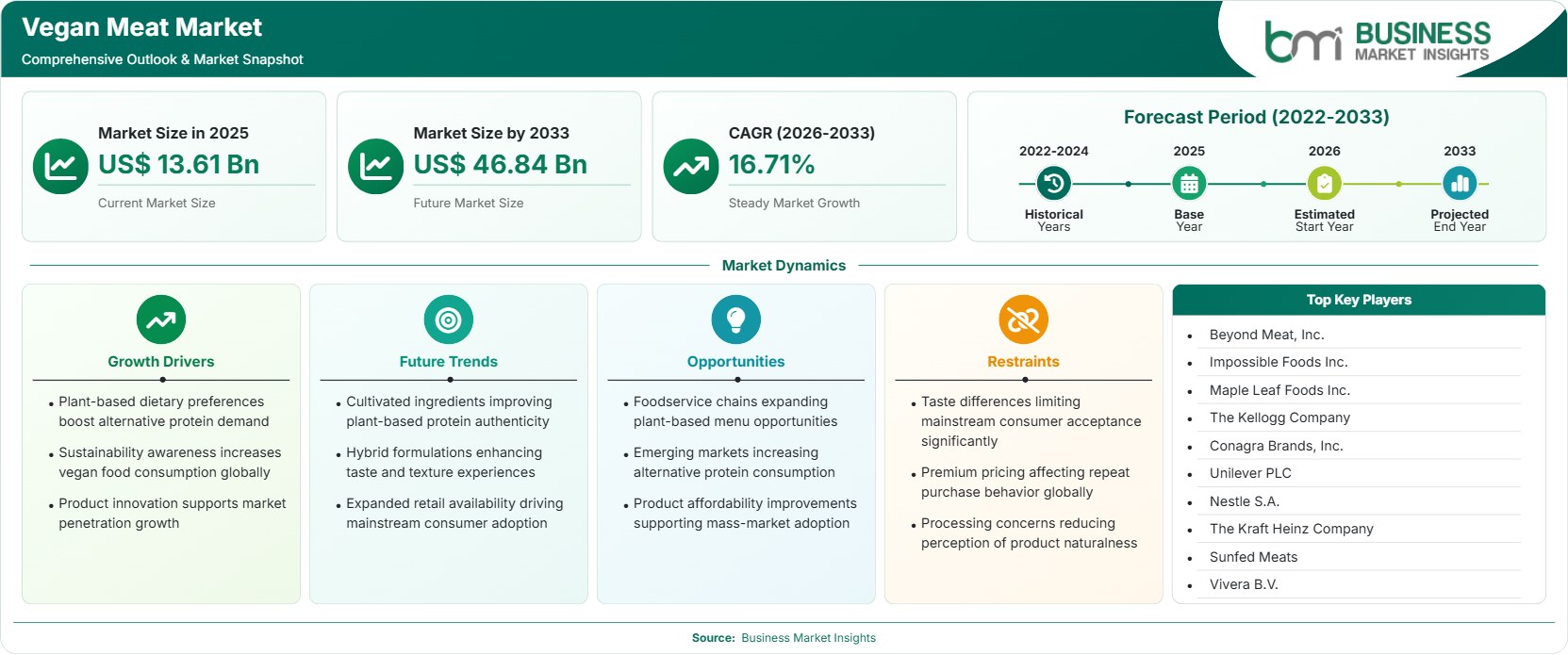
The Vegan Meat Market size was valued at US$ 13.61 Billion in 2025 and is projected to reach US$ 46.84 Billion by 2033, growing at a CAGR of 16.71% during 2026–2033. Product innovation, flexitarian diets, foodservice partnerships, alternative proteins, and scalable manufacturing create opportunities across retail, hospitality, and emerging consumer markets.

Report Coverage
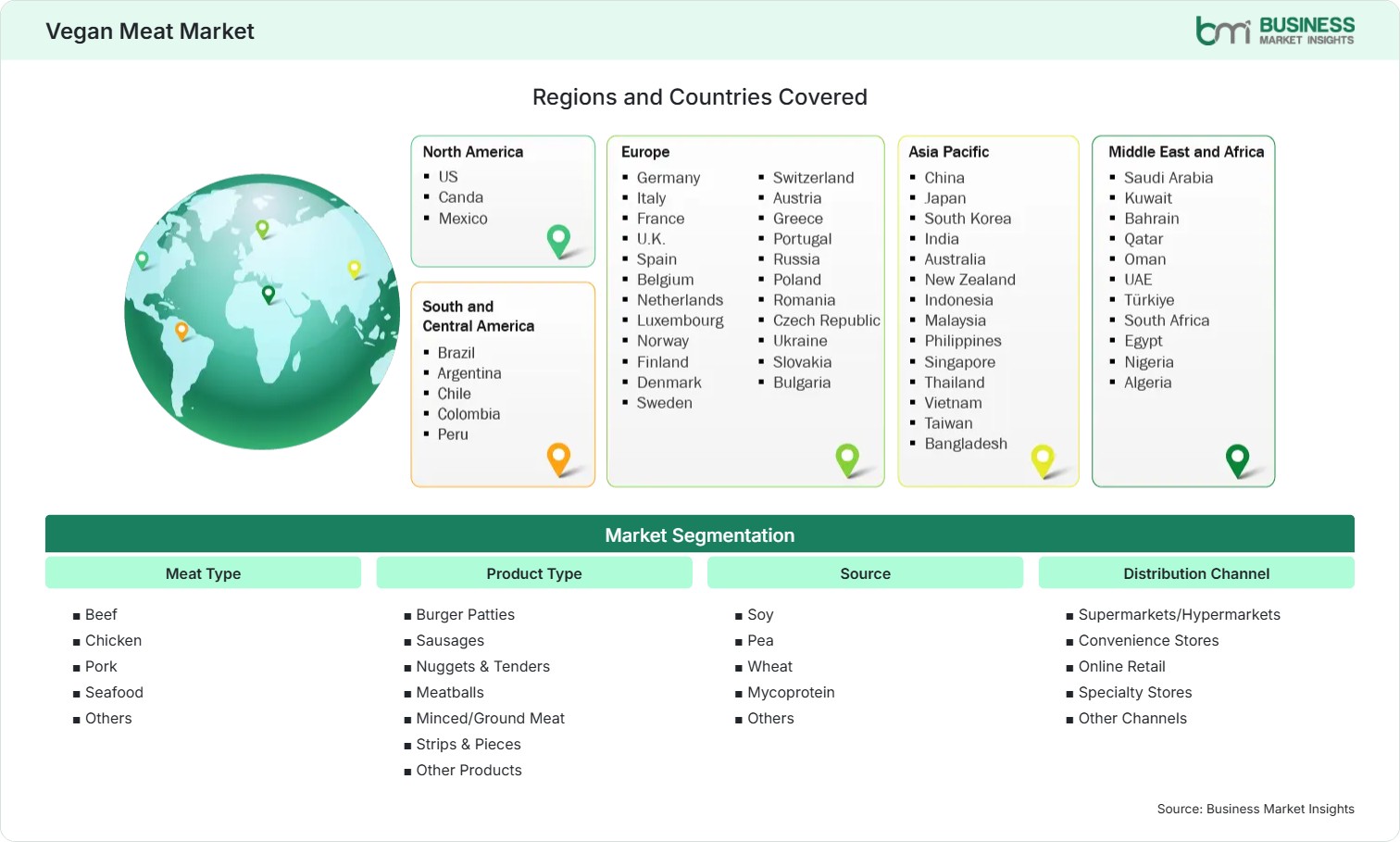
  • Meat Type: Beef, Chicken, Pork, Seafood, Others
  • Product Type: Burger Patties, Sausages, Nuggets & Tenders, Meatballs, Minced/Ground Meat, Strips & Pieces, Other Products
  • Source: Soy, Pea, Wheat, Mycoprotein, Others
  • Distribution Channel: Supermarkets/Hypermarkets, Convenience Stores, Online Retail, Specialty Stores, Other Channels
  • End User: Retail/Household, Foodservice
US$ 13.61 Bn Market size in 2025
US$ 46.84 Bn Market Size by 2033
16.71% CAGR, 2026 - 2033
2026-2033 Forecast Period

AI Overview

Vegan Meat Market Summary

  • North America Region: North America accounted for an estimated 35%–38% share in 2025, with a modeled CAGR of 14%–16% during 2026–2033. Established brands, retail networks, and product innovation support penetration, while improved taste and manufacturing efficiency create opportunities. The US benefits from broad availability and established distribution, supporting a modeled CAGR of 14%–16%.
  • Fastest Growing Region: Asia Pacific held an estimated 22%–25% share in 2025, with a modeled CAGR of 19%–22% during 2026–2033. Urbanization, modern retail, protein diversification, localized flavors, and online grocery penetration create opportunities for manufacturers targeting price-sensitive consumers.
  • Leading Segment: Burger patties represented an estimated 24%–28% of the Vegan Meat Market share in 2025, with a modeled CAGR of 14%–17% during 2026–2033. Familiar meal formats, restaurant adoption, convenient preparation, and established product development support household and foodservice demand.
  • High Growth Segment: Seafood alternatives accounted for an estimated 5%–8% share in 2025, with a modeled CAGR of 20%–24% during 2026–2033. Culinary innovation, protein diversification, and convenient seafood-style products create opportunities in premium retail and restaurant menus.
  • Key Market Opportunity: Local sourcing, regional flavors, contract manufacturing, and foodservice partnerships can improve affordability, strengthen repeat purchasing, and expand distribution beyond established alternative-protein markets.
  • Major Market Players: Beyond Meat, Inc.; Impossible Foods Inc.; Maple Leaf Foods Inc.; The Kellogg Company; Conagra Brands, Inc.; Unilever PLC; Nestlé S.A.; The Kraft Heinz Company; Sunfed Meats; Vivera B.V.
Strategic Insights

Vegan Meat Market: Strategic Insights

Vegan Meat Market Strategic Framework
FREE PDF
Request your free sample
Request free sample
Stakeholder View

Key Takeaways

  • Arrange the sourcing of proteins, make use of the available processing capacity, manage the cold-chain logistics, and ensure that retail replenishment takes place. Just as important as spending on the brand should be attention to supplier concentration and the specifications of the ingredients.
  • Food suitable for serving in restaurants, minced products, and ready-meal formats cater to common situations. Partnerships with foodservice operators can prove the products' performance before carrying out an expensive expansion into the retail sector.
  • The research should focus on fibrous texture, reduced beany flavors, balanced protein profiles, and better performance during freezing, reheating, and commercial cooking.
  • There are opportunities in the Asian markets for products based on well-known soy and wheat proteins, since local flavors and cheap packaging can increase accessibility.
  • Acquisitions, licensing, and shared manufacturing can offer quicker access to the market than relying on individual facilities. Investors should look at the level of utilization, the tendency for customers to buy again, and the strength of margins.
  • Measure repurchase rates, household penetration, and price sensitivity rather than relying on initial trial or brand awareness.
Geographic Outlook

Vegan Meat Market Regional Highlights

North America Vegan Meat Market

North America represented an estimated 35%–38% share in 2025, with a modeled CAGR of 14%–16% for 2026–2033. Established brands, grocery distribution, and product development capabilities underpin its position. The Vegan Meat Market share benefits from familiarity with burgers and chicken substitutes, although pricing and perceptions of processing affect repeat purchases.

  • Established brands benefit from refrigerated and frozen distribution and national retail accounts. Formulation consistency can improve repeat purchasing and strengthen category productivity.
  • By means of restaurant partnerships, products are introduced via well-known menus, and the cooking performance, serving consistency, ingredient handling, and customer reaction are tested.
  • The text deals with concerns about ingredients and nutritional expectations, and it is possible to distinguish products by means of clear labeling and by having claims regarding protein that are supported by evidence, without having to depend entirely on environmental messaging.
  • Retailers may enhance performance in a product category by providing better shelf navigation, offering targeted promotions, and introducing private-label products which allow consumers to compare prices and ingredients.

US Vegan Meat Market

The United States Vegan Meat Market accounted for an estimated 28%–31% of global revenue in 2025, with a modeled CAGR of 14%–16% through 2033. Grocery chains, specialist brands, and foodservice distribution support commercial reach. Competition centers on taste, price, nutrition, and ingredient transparency.

  • National retailers offer wide availability, but the allocation of shelf space is based on sales velocity and the effectiveness of promotions. Brands have to show that they can maintain a steady supply and have consistent demand.
  • The introduction of foodservice provides trial opportunities by means of well-known menus. When restaurant operators want to expand their range of offerings, they first look at the preparation time, the consistency of the portions, and the total cost of the plate.
  • The way in which the product is presented deals with the examination of sodium, saturated fat, and the list of ingredients. Effective communication about nutrition can enhance its market position without affecting its taste or cooking performance.

Europe Vegan Meat Market

Europe held an estimated 25%–28% Vegan Meat Market share in 2025, with a modeled CAGR of 14%–17% during 2026–2033. Established meat-free manufacturers, supermarket networks, and familiarity with vegetarian meals support demand. The United Kingdom and Germany remain important markets, while the Netherlands offers a specialized innovation ecosystem.

  • The United Kingdom has readily available chilled food ranges and good access to supermarkets; affordable meal options together with clearer nutritional comparisons can increase the number of households using such products.
  • Germany has the ability to produce processed foods and at the same time shows a demand for vegetarian products, allowing manufacturers to focus on sausages, mince and regional recipes.
  • The Netherlands has specialized producers and a manufacturing sector that is oriented towards exports. Partnerships with retailers can help to speed up the process of developing formulations and facilitate distribution across borders.
  • The importance of sustainability leads food businesses to evaluate their emissions and resource usage. Rather than assuming that different products have the same environmental benefits, companies should provide evidence to support their environmental claims.

Asia Pacific Vegan Meat Market

Asia Pacific Vegan Meat Market accounted for an estimated 22%–25% share in 2025, with a modeled CAGR of 19%–22% through 2033. Urbanization, soy-based food traditions, modern retail, and consumer diversification create opportunities. China and Japan offer developed product ecosystems, while India and Southeast Asia provide growth potential through localized formulations.

  • China provides opportunities for soy-based mince, dumpling fillings, and ready-to-use meat substitutes; although domestic ingredients allow for local production, traditional foods still act as strong competitors.
  • India's vegetarian eating traditions are combined with a demand for easy-to-access protein sources, and well-known spice flavors together with low-cost formats can help increase acceptance.
  • Japan provides opportunities for alternatives in the form of seafood and ready-to-eat meals. It is still important to consider texture, portion size, and culinary compatibility.
  • The Southeast Asian markets have potential in the fields of e-commerce, modern retail, and foodservice, and this can be enhanced by forming local seasoning and regional distribution partnerships.

Rest of World Vegan Meat Market

Latin America Vegan Meat Market represented an estimated 7%–10% share in 2025, with a modeled CAGR of 16%–20% through 2033. Brazil and Mexico offer opportunities through urban populations, food processing, and modern retail. Familiar recipes and affordable formulations can improve adoption, provided manufacturers compete effectively on taste and value.

  • Brazil has the advantage of its agricultural resources and its food processing capabilities, and the fact that it produces locally as well as offers flavors inspired by barbecue can help to increase its competitiveness.
  • Mexico provides opportunities through its well-established mince and easy-to-use fillings, as well as well-known recipes and reasonable prices, which can lead people to give them a try.
  • The United Arab Emirates offers access to top retailers and hospitality companies, and by entering into distributor partnerships, companies can gain exposure prior to their wider expansion.
  • South Africa has the chance to take advantage of urban supermarkets, and by sourcing locally and using suitable pack sizes, it is possible to help with consumer affordability.
Global Market Geography
FREE PDF
Request your free sample
Request free sample
Segment Analysis

Vegan Meat Market Segmentation

Meat Type

Meat type determines sensory expectations, recipe compatibility, and development priorities. Beef-style alternatives benefit from burger and mince applications, while chicken-style products address everyday meals. The Vegan Meat Market scope reflects demand for familiar culinary experiences, with adoption influenced by price, texture, protein composition, and availability.

  • Beef: Beef-style products serve burgers, mince-based dishes, and prepared meals. Success depends on browning, juiciness, savory flavor, and competitive pricing across retail and restaurants.
  • Chicken: Chicken-style alternatives address nuggets, tenders, strips, and meal components. Familiar preparation supports household, quick-service, and institutional applications.
  • Pork: Pork-style substitutes target sausages, breakfast products, and seasoned mince. Formulations must reproduce characteristic seasoning and texture.
  • Seafood: Seafood alternatives address fish-style fillets and patties. Innovation focuses on flaky textures, marine-style flavor, and convenient preparation.

Product Type

Product type influences purchase occasions, manufacturing requirements, and retail positioning. Burgers provide a familiar entry point, while nuggets, sausages, and mince extend everyday use. The segment mix reflects convenience, cooking performance, and foodservice suitability. Vegan Meat Market Growth opportunities favor products that simplify preparation or fit established recipes, supported by reliable distribution and consistent performance.

  • Burger Patties: Patties suit grilling, sandwiches, and restaurant menus. Familiar portioning supports trial, while sensory consistency and price influence repeat purchases.
  • Sausages: Sausages serve breakfast, grilling, and prepared meals. Seasoning flexibility and convenient cooking support household and catering applications.
  • Nuggets & Tenders: Breaded products offer familiar textures and easy preparation. They suit family meals, quick-service menus, and frozen-food aisles.
  • Meatballs: Meatballs work in pasta dishes, sauces, and prepared meals. Their format supports portion control and established recipes.
  • Minced/Ground Meat: Minced alternatives suit tacos, sauces, fillings, and mixed dishes. Versatility encourages repeat use, while browning and moisture retention remain priorities.
  • Strips & Pieces: Strips and pieces suit stir-fries, wraps, salads, and bowls. Adaptability supports convenient meals and commercial kitchens.

Source

Source selection affects ingredient cost, texture, nutritional composition, and scalability. Soy and wheat offer established processing pathways, while pea protein supports diversification. Mycoprotein provides a distinct production platform. Manufacturers must assess functionality, supply reliability, allergen disclosure, and regional preferences when developing commercially viable formulations.

  • Soy: Soy provides established functionality and versatile processing characteristics. Its familiarity supports mince, patties, and nuggets, although allergen management remains important.
  • Pea: Pea protein supports ingredient diversification and selected allergen-positioning strategies. Cost and functional consistency influence formulation decisions.
  • Wheat: Wheat protein contributes fibrous texture and chew. Its characteristics support structured products, although gluten restricts suitability for some consumers.
  • Mycoprotein: Mycoprotein offers a distinct texture profile and established meat-free applications. Expansion depends on production efficiency and consistent quality.

Distribution Channel

Distribution determines product discovery, availability, merchandising, and replenishment economics. Supermarkets provide scale, convenience stores support immediate consumption, and online retail offers assortment breadth. Specialty stores serve consumers seeking dedicated plant-based ranges. Effective distribution combines mainstream placement with targeted marketing and dependable fulfillment.

  • Supermarkets/Hypermarkets: Large retailers provide broad reach and chilled or frozen shelf space. Listing success depends on sales velocity, pricing, and reliable supply.
  • Convenience Stores: Smaller outlets support quick meals and immediate consumption. Compact packs and easy preparation suit limited shelf space.
  • Online Retail: Digital platforms expand assortment access and enable targeted marketing. Manufacturers must manage delivery costs, temperature control, and repeat orders.
  • Specialty Stores: Dedicated retailers serve consumers seeking plant-based selections and product guidance. Specialist placement supports discovery, although store coverage may be limited.

End User

End users shape portion sizes, product specifications, packaging, and purchasing economics. Retail households prioritize price, taste, nutrition, and convenience, while foodservice operators evaluate consistency, labor requirements, yield, and ingredient costs. Manufacturers can use retail feedback to refine recipes and foodservice contracts to build predictable demand.

  • Retail/Household: Households purchase products for familiar meals, convenience, and dietary preferences. Repeat demand depends on taste, affordable pricing, transparency, and availability.
  • Foodservice: Restaurants, caterers, and institutional kitchens require consistent portions, preparation performance, and predictable supply. Successful products integrate with existing equipment and recipes.
Market Forces

Vegan Meat Market Dynamics

Key Market Drivers

Flexitarian Consumption and Familiar Meal Formats

Flexitarianism satisfies consumer demand for reducing meat consumption without giving up traditional dishes. Burgers, sausages, nuggets, and minced meat provide an easy transition due to their compatibility with traditional food habits. Intention to purchase transforms into demand when taste, texture, cost, and preparation match consumer expectations. The Vegan Meat Market opportunity depends on repeat purchasing, retailer availability, and appeal beyond committed vegans.

Processing Innovation and Product Quality

Extrusion, protein blending, flavor systems, and structured plant proteins help manufacturers improve bite, moisture retention, and cooking performance. These vegan meat market trends and capabilities support differentiation across beef, poultry, pork, and seafood-style applications. Ingredient selection also affects cost, allergens, nutrition, and supply reliability. Formulators who link their product formulation to a particular consumer moment can simplify the process of product design. The money put into sensory evaluation, shelf-life testing, and production consistency can pay off.

Retail Expansion and Foodservice Integration

Supermarkets, online commerce, chain restaurants, and institutional food providers present different paths for adoption. Retail allows for domestic consumption, whereas foodservice provides exposure through menus and professional cooking. Distribution via multiple channels increases reach but demands different considerations for packaging, portioning, storage, and supply replenishment. Vegan Meat Market manufacturers benefit when retail and restaurant products share compatible ingredient systems without compromising channel-specific performance.

Key Market Opportunities

Localised Formulations and Regional Ingredient Sourcing

Regional formulation creates opportunities to align familiar flavors with locally available soy, wheat, pea, and other proteins. Asian Vegan Meat Market manufacturers can adapt products for stir-fries, dumplings, and seasoned fillings, while Latin American businesses can explore grilling-oriented formats. If there is assured quality of the ingredients locally, local procurement will limit exposure to freight and enhance response capabilities. In the case of investment, priority must be given to small-scale plant trials, sensory testing, and commercial proof before building big plants.

Foodservice Contracts and Private-Label Development

Foodservice contracts offer a steady volume of sales, as well as feedback on product performance and access to consumers who might not otherwise buy competing products. Another way of doing this is by entering into private-label partnerships, using the retailers' purchasing power and their established store brands. In both cases, it is necessary to have reliable specifications, full ingredient documentation, and a manufacturing capacity capable of dealing with fluctuations. Suppliers should focus on minced products, breaded items, and sausages since standardized preparation helps to ensure consistency. When making investment decisions, it is important to take into account the length of the contract, the degree of concentration of customers, the margin structure, and the capital expenditure.

Nutrition-Led Innovation and Seafood Alternatives

Good nutritional positioning provides an opportunity for products that have good protein levels, with controlled sodium, saturated fat, and other ingredients. The seafood-type alternatives provide yet another approach in the form of fillets, patties, and meal components. Innovation needs to focus more on texture, flavor, and nutrition, rather than novelty. The Vegan Meat Market Forecasts opportunity is strongest where products satisfy defined needs and demonstrate repeatable manufacturing. Investors can support ingredient research, sensory evaluation, and manufacturer partnerships.

Market Restraints and Challenges

Price Premiums and Manufacturing Economics

The fact that an ingredient's function, the complexity of its processing, the need for specialized equipment, and the small volume of production compared to conventional meat can lead to higher manufacturing costs has the effect of possibly causing shelf prices to rise, which in turn may deter price-conscious consumers and reduce the likelihood of them buying it again, this being especially true when such alternatives are only purchased from time to time. Manufacturers can deal with this by improving their production processes, offering simpler product ranges, entering into procurement agreements, and better utilizing their facilities.

Consumer Trust, Nutrition Perceptions, and Product Consistency

The fact that concerns regarding processing, the ingredient lists, sodium content, allergens, and the differences between various formulations make it difficult for consumers to assess the products has a negative impact in that it can lead to fewer people trying them or failing to repurchase them even if the products offer an acceptable taste and level of convenience. It is necessary for manufacturers to clearly communicate nutritional information, back up any comparative claims, and enhance the consistency of their batches. Also, labels have to correctly show the ingredients and allergens.

Company Analysis

Competitive Landscape

The Vegan Meat Market analysis highlights competition between multinational food manufacturers, alternative-protein businesses, and established meat-free brands. Differentiation rests on formulation capabilities, portfolios, retail access, manufacturing economics, and repeat demand.

Company Name

Overview

Products and Services relevant to this market

Beyond Meat, Inc.

US alternative-protein company focused on products designed to reproduce conventional meat characteristics.

Burgers, beef-style mince, sausages, chicken-style pieces, and steak-style alternatives.

Impossible Foods Inc.

US food technology company emphasizing flavor, texture, and culinary performance.

Plant-based beef-style products, burger patties, sausages, and chicken-style alternatives.

Maple Leaf Foods Inc.

Canadian food manufacturer with protein expertise and plant-based operations.

Plant-based burgers, sausages, grounds, and meat-free products.

The Kellogg Company

Legacy food company historically associated with MorningStar Farms meat-free products.

Meat-free burgers, breakfast sausages, nuggets, and prepared alternatives historically marketed through MorningStar Farms.

Conagra Brands, Inc.

US packaged-food manufacturer with frozen and prepared-food capabilities.

Frozen meat-free foods, convenient meal products, and selected meat-alternative offerings.

Unilever PLC

Multinational consumer-goods company with plant-based food development experience.

Meat-free products historically associated with The Vegetarian Butcher, including burgers, mince, and chicken-style alternatives.

Nestlé S.A.

Global food manufacturer with plant-based product development capabilities.

Plant-based burger, mince, and meat-alternative products in selected regions.

The Kraft Heinz Company

Global packaged-food company with prepared-food and foodservice capabilities.

Plant-based initiatives and complementary sauces and meal components supporting meat-free occasions.

Sunfed Meats

New Zealand-origin alternative-protein specialist developing plant-based meat substitutes.

Chicken-style products and other alternatives designed for familiar cooking applications.

Vivera B.V.

European plant-based food producer serving retail markets.

Plant-based burgers, schnitzels, mince, chicken-style products, and prepared foods.

Trust & Transparency

Research Methodology

The market analysis combines proprietary research with secondary data from government agencies, company disclosures, regulatory filings, industry databases and expert interviews. Market estimates are validated through data triangulation, cross-market benchmarking and analyst review.

View Full Research Methodology

Questions Answered

Frequently Asked Questions

How should companies evaluate entry into a new region?

Companies should assess food preferences, ingredient availability, price sensitivity, distribution infrastructure, labeling requirements, and competitors. Pilot launches and local partnerships can validate demand before major investment.

Which indicators best measure category performance?

Repeat purchases, household penetration, sales per retail listing, promotional dependence, gross margins, and manufacturing utilization provide a fuller assessment than initial sales alone. Foodservice retention also indicates commercial durability.

Why are seafood-style alternatives attracting development interest?

Seafood-style products extend offerings beyond burgers and nuggets. Fillets, patties, and prepared components create opportunities in convenient meals, although texture, flavor, and production economics remain important.

How can manufacturers reduce ingredient supply risks?

According to the Vegan Meat Market Report, manufacturers can qualify multiple suppliers, diversify protein inputs, establish ingredient specifications, and maintain contingency inventory. Alternative formulations require validation for taste, allergens, nutrition, and processing compatibility.

What determines repeat purchasing?

Taste, texture, price, nutrition, preparation convenience, and availability influence repeat purchasing. Curiosity may prompt initial trial, but regular adoption requires satisfactory performance in familiar meals.

Access the Full Vegan Meat Market Report

Get segment-level forecasts, regional estimates, competitive benchmarking, company profiles and downloadable Excel datasets.

Access the full Vegan Meat Market Report
350 pages PDF & Excel | 2026-11-03
Similar Research

Related Market Reports