
Feed Amino Acids Market Outlook: Size, Share, Trends, Growth Analysis, Competitive Landscape & Forecast, 2026-2033

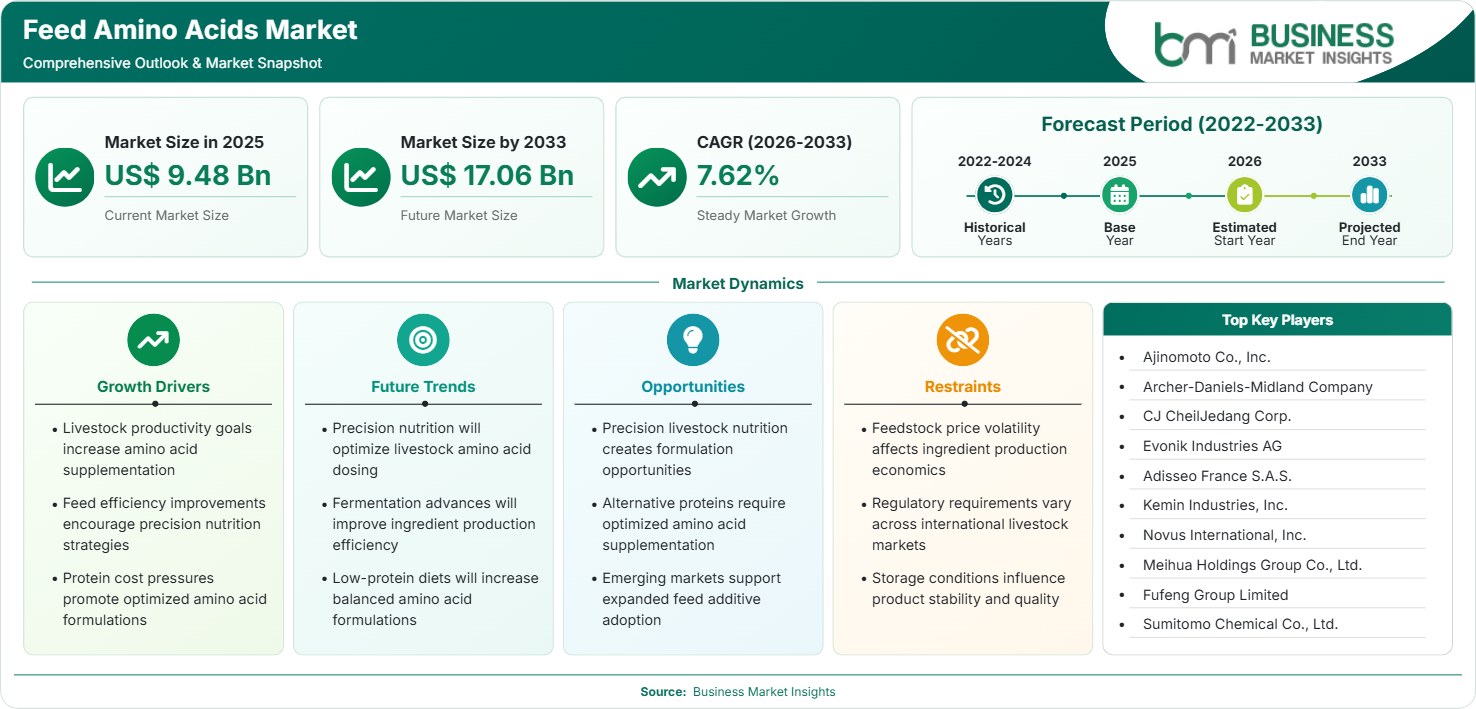
The Feed Amino Acids Market size was valued at US$ 9.48 Billion in 2025 and is projected to reach US$ 17.06 Billion by 2033, growing at a CAGR of 7.62% during 2026–2033, driven by precision nutrition, protein efficiency, aquaculture expansion, sustainable formulations, and fermentation investments.

Report Coverage
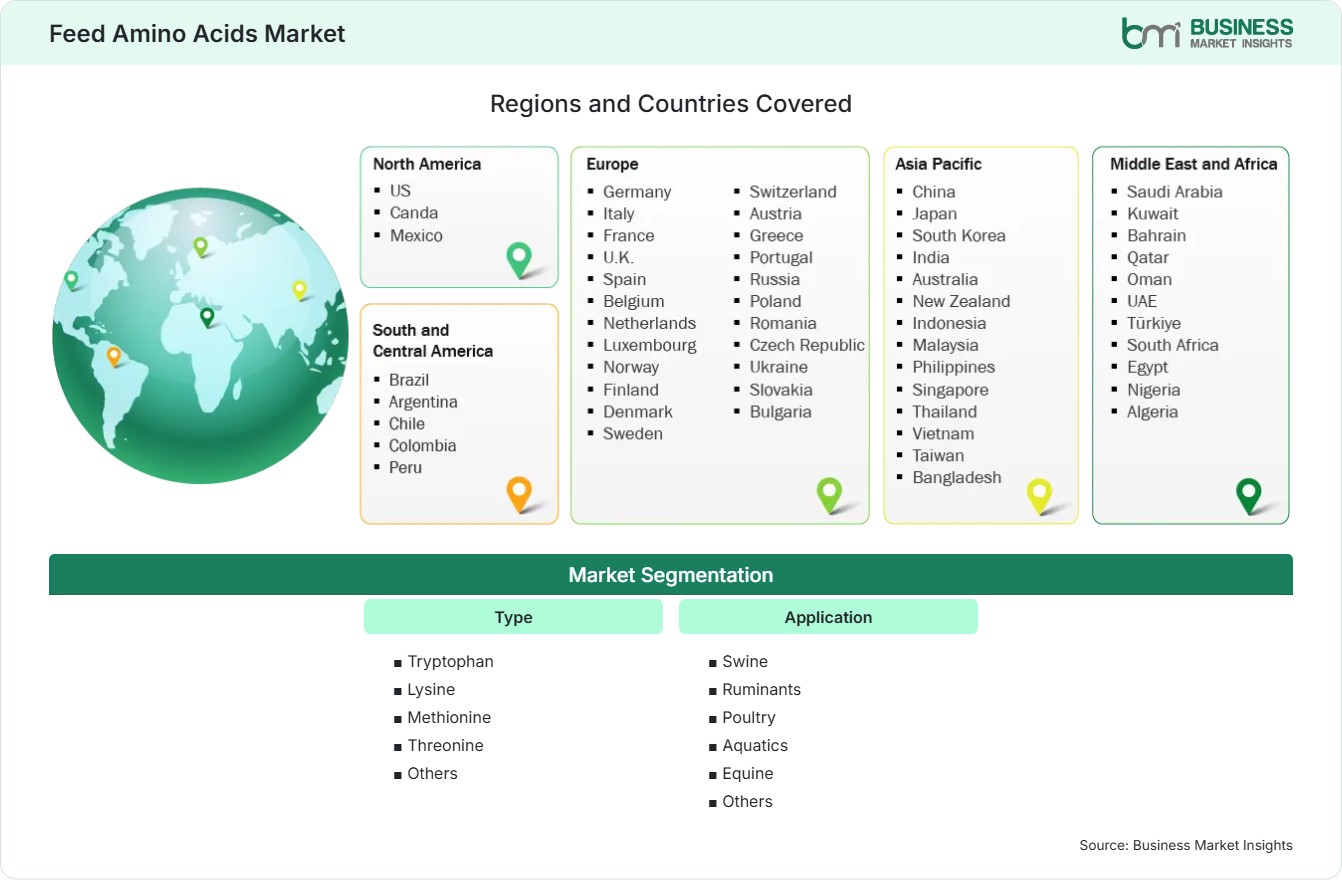
  • Type: Tryptophan, Lysine, Methionine, Threonine, Others
  • Application: Swine, Ruminants, Poultry, Aquatics, Equine, Others
US$ 9.48 Bn Market size in 2025
US$ 17.06 Bn Market Size by 2033
7.62% CAGR, 2026 - 2033
2026-2033 Forecast Period

AI Overview

Feed Amino Acids Market Summary

  • North America Region: North America holds a Feed Amino Acids Market share of 23%–27% in 2025, growing at a CAGR of 6.4%–7.0% during 2026–2033, supported by precision feeding, poultry production, dairy efficiency, and lower-nitrogen diets. The U.S. market grows at 6.2%–6.8% CAGR, supported by integrated feed manufacturing and specialized ruminant nutrition.
  • Fastest Growing Region: Asia Pacific holds market share of 40%–44% in 2025, growing at a CAGR of 8.2%–8.8% during 2026–2033, supported by poultry, aquaculture, swine production, fermentation capacity, urbanization, and rising demand for affordable animal protein.
  • Leading Segment: Methionine holds market share of 32%–36% in 2025, growing at a CAGR of 7.0%–7.6% during 2026–2033, supported by poultry diets, protein-cost optimization, nitrogen efficiency, established formulations, and extensive manufacturing infrastructure.
  • High Growth Segment: Aquatics holds market share of 10%–14% in 2025, growing at a CAGR of 8.8%–9.4% during 2026–2033, driven by aquaculture expansion, fishmeal substitution, feed conversion optimization, alternative proteins, and species-specific nutrition.
  • Key Market Opportunity: Application-specific nutrition creates opportunities in protected amino acids, low-protein formulations, aquaculture feeds, digital formulation, lower-carbon fermentation, regional production, and technical nutrition services.
  • Major Market Players: Ajinomoto Co., Inc.; Archer-Daniels-Midland Company; CJ CheilJedang Corp.; Evonik Industries AG; Adisseo France S.A.S.; Kemin Industries, Inc.; Novus International, Inc.; Meihua Holdings Group Co., Ltd.; Fufeng Group Limited; Sumitomo Chemical Co., Ltd.
Strategic Insights

Feed Amino Acids Market: Strategic Insights

Feed Amino Acids Market Strategic Framework
FREE PDF
Request your free sample
Request free sample
Stakeholder View

Key Takeaways

  • The value chain is increasingly integrated across fermentation feedstocks, amino acid production, purification, formulation, distribution, and technical services. Scale and vertical integration remain important defenses against commodity price cycles.
  • Aquatics, poultry, low-protein diets, and protected ruminant nutrition offer strong upside because these applications monetize improved nutrient utilization rather than commodity volume alone.
  • Innovation is moving toward precision nutrition, microbial strain engineering, protected delivery, lower-carbon production, and digital formulation supported by measurable feed-conversion outcomes.
  • Asia Pacific provides the strongest investment case, with China offering scale and India, Indonesia, and Vietnam providing high-growth opportunities across poultry, livestock, and aquaculture.
  • Investment increasingly targets geographic diversification, supply-chain resilience, intermediate integration, and specialty nutrition capabilities rather than undifferentiated production capacity.
  • Buyers increasingly evaluate delivered active cost, qualification history, technical support, sustainability credentials, logistics reliability, and formulation performance alongside headline price.
Geographic Outlook

Feed Amino Acids Market Regional Highlights

North America Feed Amino Acids Market

North America accounts for 23%–27% share in 2025 and records a CAGR of 6.4%–7.0% through 2033. The region benefits from sophisticated feed manufacturing, intensive poultry and swine production, dairy specialization, and established supplementation practices. The U.S. Feed Amino Acids Market is the primary demand center, while Canada supports dairy, poultry, and swine applications. Producers increasingly prioritize formulation efficiency, nitrogen utilization, supply continuity, and automated dosing, creating opportunities for suppliers combining commodity products with technical nutrition services and application expertise.

  • Poultry and swine integrators increasingly balance amino acids to reduce unnecessary crude protein while protecting growth, carcass quality, and feed conversion.
  • Dairy nutrition supports protected amino acid technologies where rumen bypass delivery targets intestinal availability, milk protein production, and ration efficiency.
  • Domestic distribution infrastructure reduces exposure to international supply disruptions, although freight costs and intermediate availability can still influence delivered prices.
  • Sustainability objectives are increasing demand for measurable nitrogen-efficiency outcomes, strengthening differentiation for suppliers offering documented nutritional performance.

US Feed Amino Acids Market

The U.S. represents 72%–78% of North American demand in 2025, with a CAGR of 6.2%–6.8% during 2026–2033. Large poultry, swine, and dairy operations support recurring consumption, while sophisticated feed mills increasingly use automated dosing and formulation optimization. Methionine and lysine remain central to monogastric diets, whereas protected products serve specialized ruminant applications. Procurement increasingly considers freight exposure, domestic inventories, supplier qualification, and delivery reliability, encouraging diversified sourcing and stronger technical relationships between manufacturers and integrated feed producers.

  • Poultry remains a major demand anchor because amino acid balancing improves protein efficiency while supporting performance in cost-sensitive commercial formulations.
  • Dairy provides a premium niche through protected amino acids targeting milk protein, lactation efficiency, nutrient utilization, and reproductive performance.
  • Domestic supply resilience is increasingly important because international freight disruption and trade-policy changes can alter landed amino acid economics quickly.

Europe Feed Amino Acids Market

Europe holds 21%–25% Feed Amino Acids Market share in 2025 and grows at 6.7%–7.3% CAGR through 2033. Germany and France remain leading markets, while Spain and Poland provide high-volume poultry and swine opportunities. Spain records 7.0%–7.6% CAGR, Poland 7.2%–7.8%, and France 6.6%–7.2%. Sustainability requirements, feed traceability, nitrogen management, and regulatory discipline favor technically supported products. Buyers remain sensitive to imports, currency movements, supply interruptions, and delivered costs, reinforcing demand for reliable suppliers with regional technical and regulatory capabilities.

  • Germany combines advanced feed manufacturing with strict sustainability requirements, favoring consistent specifications and documented nutritional performance.
  • France benefits from established poultry and dairy production, creating opportunities for differentiated amino acid solutions and application support.
  • Spain provides high-growth potential because intensive poultry and swine production supports recurring lysine, methionine, and threonine demand.
  • Poland offers expanding commercial feed production and competitive livestock systems, supporting demand for efficient premixes and direct mill supply.

Asia Pacific Feed Amino Acids Market

Asia Pacific commands a 40%–44% share in 2025 and records the fastest regional CAGR of 8.2%–8.8% through 2033. China leads regional volume, while India, Indonesia, and Vietnam offer strong growth opportunities. China records 8.0%–8.6% CAGR, India 9.0%–9.6%, and Indonesia 8.8%–9.4%. Extensive fermentation infrastructure, expanding feed mills, poultry integration, aquaculture concentration, and rising animal protein consumption underpin demand. Competitive pricing remains intense, making production efficiency, feedstock access, logistics, and technical service key differentiators.

  • China combines large livestock and aquaculture demand with extensive fermentation infrastructure, supporting both domestic consumption and export-oriented manufacturing.
  • India offers strong potential across poultry, dairy, aquaculture, and commercial feed as formulation practices become more sophisticated.
  • Indonesia and Vietnam benefit from expanding poultry and aquaculture production, increasing demand for balanced nutrition and efficient feed conversion.
  • Regional producers are diversifying production footprints to improve supply resilience and access rapidly expanding feed markets.

Rest of World Feed Amino Acids Market

South and Central America are led by Brazil, Mexico, Argentina, and Colombia. Brazil Feed Amino Acids Market benefits from large poultry, swine, and aquaculture industries, while Mexico combines poultry scale with growing feed modernization. The subregion records 7.6%–8.2% CAGR through 2033, supported by protein exports, feed efficiency initiatives, and greater use of balanced low-protein diets.

The Middle East and Africa provide smaller but strategic opportunities. Saudi Arabia, Türkiye, South Africa, and Egypt anchor demand, while selected African markets offer longer-term potential. The regional CAGR is 6.8%–7.6%, constrained by logistics, purchasing power, and uneven feed infrastructure.

  • Brazil provides attractive opportunities for lysine, methionine, and threonine suppliers because of its large poultry and swine production base.
  • Mexico is expanding commercial livestock systems, increasing demand for standardized premixes and consistent amino acid supply.
  • Saudi Arabia and Egypt offer opportunities linked to poultry self-sufficiency programs, although imported inputs remain exposed to freight and currency movements.
  • South Africa provides a developed feed ecosystem and potential distribution platform for selected suppliers targeting wider African markets.
Global Market Geography
FREE PDF
Request your free sample
Request free sample
Segment Analysis

Feed Amino Acids Market Segmentation

Type

The type segment reflects different nutritional roles, production technologies, and formulation economics. Methionine leads with 32%–36% share in 2025 and a CAGR of 7.0%–7.6% through 2033. Lysine remains important across monogastrics, while threonine and tryptophan benefit from precision feeding. Feed Amino Acids Market scope increasingly includes specialty formulations, protected delivery, and lower-protein diets that enhance product value.

  • Tryptophan: Precision poultry and swine diets use tryptophan to balance amino acid profiles, support feed intake management, and optimize reduced-protein formulations.
  • Lysine: Broad poultry and swine adoption makes lysine a core formulation input, supported by fermentation scale, competitive economics, and widespread feed-mill qualification.
  • Methionine: Methionine leads because poultry diets depend heavily on supplementation, while nitrogen-efficiency objectives reinforce its importance in protein-optimized formulations.

·         Threonine: Threonine benefits from reduced-protein diets and intestinal functionality priorities, especially in poultry and swine formulations seeking efficient nutrient utilization.

Application

Application demand is driven by the intensive production of monogastric animals. Aquatic feeds offer the quickest growth opportunity. The swine, poultry, and ruminant sectors will continue to be major consumption segments for the feed industry, while the aquatic sector will grow due to increased production and the need to replace fishmeal. There is an increasing shift in the Feed Amino Acids Market towards species-specific formulations and precise inclusion rates.

  • Swine: Amino acid balancing supports growth, lean tissue development, protein efficiency, and lower-protein formulations in cost-sensitive commercial pig production.
  • Ruminants: Protected lysine and methionine technologies improve targeted intestinal delivery for dairy productivity, milk protein synthesis, reproductive performance, and nitrogen utilization.
  • Poultry: High-volume poultry production sustains amino acid demand as producers optimize growth, feed conversion, carcass yield, and dietary protein efficiency.
  • Aquatics: Aquaculture requires balanced amino acid profiles as producers optimize feed conversion and reduce reliance on marine protein ingredients.
  • Equine: Specialized nutrition supports muscle maintenance, performance, recovery, and balanced diets where forage composition varies substantially.
Market Forces

Feed Amino Acids Market Dynamics

Key Market Drivers

Precision Protein Nutrition and Feed Efficiency

The focus of protein formulation has shifted from crude protein to amino acids, enabling feed mills to reduce excess nitrogen while maintaining animal performance. Growth in the Feed Amino Acids Market is driven by the ability of lysine, methionine, threonine, and tryptophan to help compensate for deficiencies in cereals and oilseeds used in the formulation process. Global livestock output is estimated to grow by 16% over the next 10 years, underscoring the need for productive feed. Incorporating amino acids into the feed will lead to more efficient protein utilization. There is increasing use of least-cost formulation systems that compare the inclusion of amino acids with soybean meal and other protein feeds.

Fermentation Technology and Manufacturing Scale

The process of fermentation still plays an essential role in the industrial-scale synthesis of amino acids. Thus, the efficiency of strains, substrate utilization, purification process, energy consumption, and plant utilization become important competitive factors in this area. Genetic engineering may be used to increase efficiency and reduce waste, whereas integrated production can help reduce conversion costs and ensure supply security. Feed Amino Acids Market trends are now characterized by a growing trend towards geographic diversification of production, as the concentration of production facilities exposes producers to threats such as transportation disruptions, raw material availability, and trade policy.

Expansion of Animal Protein Production

Increased protein intake from animal sources broadens the target market for poultry, swine, dairy, and aquaculture. Agricultural and fisheries production worldwide is expected to rise by 14% by 2034, boosting demand for inputs such as feed that optimize performance and nutrient efficiency. The Feed Amino Acids Market growth is due to the poultry industry, driven by the shorter life cycles of these animals, which increase the monetary benefit of improving feed efficiency. The aquaculture industry creates another area of demand growth due to increased production and the substitution of marine ingredients with other proteins.

Key Market Opportunities

Low-Protein and Nitrogen-Efficient Feed Formulations

Accurate protein nutrition offers opportunities for those suppliers who can measure nitrogen utilization, performance, and formula savings. Feed mills are increasingly interested in reducing crude protein levels while still meeting the essential amino acid needs of animals, primarily poultry and pigs. It is easy for suppliers to add value by combining amino acids with formulation software and performance results. Premium products are further enhanced when customers can relate supplementation to reduced meal protein use, increased feed efficiency, or nitrogen savings. European concerns about sustainability help create this opportunity, along with North American and Asian producers who are analyzing feed efficiency to manage margins. Product development should emphasize documented efficacy, compatibility with automated dosing, and species-specific recommendations.

Aquaculture Nutrition and Alternative Protein Systems

Aquaculture offers a differentiated expansion opportunity as producers seek improved growth, feed conversion, and reduced dependence on fishmeal and fish oil. By 2034, global aquaculture production will rise to 118 million tonnes, driving demand for nutrients to address protein shifts and amino acid requirements across species. This market can be tapped by tailoring formulations, leveraging digestibility data, and targeting dosing for shrimp, salmonids, tilapia, carp, and marine fish. This is made even more attractive as feed producers incorporate plant-, microbial-, and insect-based proteins, as well as other novel proteins, which affect amino acid availability.

Regionalized Production and Supply-Chain Resilience

Regional manufacturing investments have the potential to mitigate risks from transport disruptions, geopolitical tensions, tariffs, and delivery delays. Feed Amino Acids Market forecasts see an increasing preference for suppliers located closer to raw material sources, power sources, shipping hubs, and major feed markets. Backward integration and manufacturing capacity development abroad have highlighted the importance of managing dependency on intermediates and logistics. Such a strategy can be taken to the next level by having regional warehouses, dual supply chains, regional technical services, and inventory management contracts. A new area of growth would be M&A in the amino acids niche sectors, which have very high barriers to organic market entry.

Market Restraints and Challenges

Commodity Price Volatility and Oversupply

Factor: The high volume of fermentation, cyclicality in demand for livestock, transport of raw materials, and fierce competition among suppliers can result in oversupply and fast price erosion. Impact: Reduced prices result in lower margins, longer payback periods for production capacity, and motivate buyers to reduce inventory levels. Commodity-quality lysine, threonine, and tryptophan are especially vulnerable due to low product differentiation and cost being the key factor in purchasing decisions. Companies that have direct access to feedstock, efficient plants, diverse portfolios, and healthy financials can better withstand price fluctuations.

Regulatory, Logistics, and Qualification Complexity

Factor: There are safety, labeling, approval, quality, documentation, and import issues related to feed additives at the jurisdictional level, whereas the international logistics system is prone to disruptions and trade restrictions. Impact: Market entry takes longer; qualifications are costly; and higher inventory needs increase the demand for working capital. The large suppliers already possess knowledge of regulations and customers' approvals, and thus, small players find it hard to compete with them. Large manufacturing concentration centers could limit the ability to substitute supply in the event of a power failure or logistical disruption.

Company Analysis

Competitive Landscape

The Feed Amino Acids Market analysis indicates a competitive structure combining global fermentation manufacturers, methionine specialists, integrated agricultural businesses, and application-focused nutrition companies. Differentiation increasingly depends on manufacturing scale, consistency, geographic coverage, technical service, sustainability credentials, and species-specific formulation expertise.

Company Name

Overview

Products and Services relevant to this market

Ajinomoto Co., Inc.

Global amino acid specialist with extensive fermentation expertise and established animal nutrition operations.

Lysine, threonine, tryptophan, specialty amino acids, protected lysine, formulation, and technical nutrition support.

Archer-Daniels-Midland Company

Integrated agricultural processor combining feed ingredients, nutrition services, commodity sourcing, and global distribution.

Feed amino acids, feed ingredients, animal nutrition formulations, premix support, and technical services.

CJ CheilJedang Corp.

Major biotechnology producer with broad amino acid manufacturing and diversified fermentation infrastructure.

Lysine, methionine, threonine, tryptophan, valine, specialty amino acids, and formulation solutions.

Evonik Industries AG

Specialty chemicals producer with a major animal nutrition business focused on essential amino acids.

MetAMINO DL-methionine, formulation tools, nutrition services, sustainability support, and technical expertise.

Adisseo France S.A.S.

International animal nutrition specialist with major methionine manufacturing and global technical capabilities.

Rhodimet methionine, liquid methionine, specialty additives, feed integrity products, and technical support.

Kemin Industries, Inc.

Global nutrition company focused on specialty feed technologies, protected amino acids, and feed efficiency.

Protected methionine and lysine, feed additives, digestibility solutions, nutrition technologies, and technical services.

Novus International, Inc.

Animal nutrition specialist focused on methionine technologies, trace minerals, and performance applications.

MFP, ALIMET, MINTREX technologies, methionine nutrition, trace minerals, and dairy solutions.

Meihua Holdings Group Co., Ltd.

Large biotechnology manufacturer using fermentation infrastructure across feed, food, and specialty markets.

Lysine, threonine, tryptophan, fermentation products, animal nutrition ingredients, and integrated manufacturing.

Fufeng Group Limited

Large fermentation producer with extensive corn-processing integration and international expansion.

Lysine, threonine, tryptophan, feed additives, fermentation ingredients, and corn-derived products.

Sumitomo Chemical Co., Ltd.

Diversified chemical company with an established animal nutrition business focused on methionine.

DL-methionine, SUMIMET-P, feed additives, technical support, distribution, and supply-chain services.

Trust & Transparency

Research Methodology

The market analysis combines proprietary research with secondary data from government agencies, company disclosures, regulatory filings, industry databases and expert interviews. Market estimates are validated through data triangulation, cross-market benchmarking and analyst review.

View Full Research Methodology

Questions Answered

Frequently Asked Questions

What should investors monitor before entering the sector?

Investors should assess manufacturing scale, feedstock access, utilization rates, customer qualification, regulatory requirements, logistics exposure, pricing cycles, and product differentiation. Protected amino acids and technical nutrition services can offer greater defensibility than commodity production.

How does aquaculture influence demand?

Aquaculture increases demand for precisely balanced feeds because alternative protein ingredients can change amino acid availability. Targeted supplementation helps maintain nutritional adequacy, growth performance, and feed efficiency across species-specific formulations.

Which technology is changing amino acid production?

Microbial fermentation remains central, while strain engineering, substrate conversion, purification, process integration, energy efficiency, and wastewater management increasingly influence production economics and environmental performance.

What determines amino acid supplier selection?

Buyers typically evaluate assay, delivered active cost, consistency, technical support, regulatory documentation, logistics reliability, qualification history, and supply continuity. Large integrators may also consider sustainability data and formulation assistance.

Why are amino acids important in modern animal feed?

As per the Feed Amino Acids Market report, they help nutritionists meet essential amino acid requirements without relying exclusively on high crude-protein inclusion. Targeted supplementation can improve nutrient utilization, support animal performance, and reduce unnecessary nitrogen in properly balanced diets.

Access the Full Feed Amino Acids Market Report

Get segment-level forecasts, regional estimates, competitive benchmarking, company profiles and downloadable Excel datasets.

Access the full Feed Amino Acids Market Report
350 pages PDF & Excel | 2026-10-05
Similar Research

Related Market Reports